A former Speech and Language Pathologist for nearly 20 years, I began educating our 3 children full-time in 2015 and have cherished every gifted moment (even the challenges). But what is interwoven into all aspects of daily life (as a wife, via motherhood, teaching, friendship, fitness, etc.) is Christian Apologetics (1 Peter 3:15)… which is why this blog exists.
The problem of evil is something every worldview needs to answer.
Buddhism blames desire for our suffering and says to work harder (karma is coming).
Islam teaches to endure every hardship by working harder, knowing there’s no promise of salvation (judgement is coming).
Christianity acknowledges that self-righteousness work cannot save us, but the righteous work of the Judge can (love was exhibited on the cross).
“In this the love of God was made manifest among us, that God sent his only Son into the world, so that we might live through him. 10 In this is love, not that we have loved God but that he loved us and sent his Son to be the propitiation for our sins.” 1 John 4:9-10
God is Love because His being is Triune in nature (one Being/Essence, 3 coequal and coetetnal Persons — Father, Son, and Holy Spirit). God is sufficient and perfect, for He has no lack of anything, especially Love. The Father, Son, and Holy Spirit have been loving one smother since eternity past. Therefore, when God created the universe and everything in it, He did so out of love (to share love), not to get love.
Since we are designed in this image (Genesis 1; Romans 1), we are made out of love, to love. With this in view, we need to remember that in order for us to love, we need the choice to love… This is the gift of free will. And because we have the choice to love, we can choose not to love. Which we did (and still do, today)… Hence the brokenness passed down from our human parents, as well as the brokenness seen around us in the world. Again, this was our choice. We created this mess. To blame our choices upon God only reinforces the fact that we are broken. Sisters, we created the grave, but God came down to overcome it (1 Corinthians 15). Love came down and overcame both spiritual and physical death!
With Jesus, forgiveness is a free gift and adoption (as a son or daughter) is a reality. There’s no greater love than what God has done for us (1 John 4). The answer to the problem of evil is love.
Every worldview has to account for the problem of evil. We just need to research their claims and examine them thoughtfully.
On December 16, 2023, Christian author Reagan Rose wiped every one of his social media accounts. In an age where digital presence is practically required, the move looked bold—maybe even reckless—for someone leading an online ministry such as Redeeming Productivity. Publishers routinely ask for an author’s social media metrics, and those platforms are typically considered essential tools for promotion.
So why did Reagan quit social media?
After attempting to “leverage the good parts” of social media through moderation, Reagan eventually realized that these platforms were actually hindering his ability to be a “faithful steward” of the responsibilities God had given him. In his assessment, the costs created by those hindrances far outweighed any potential benefits of staying online. The following five points unpack the key reasons behind his decision to step away from Facebook, Instagram, and other platforms.
1. A Hindrance to Focus.
“For we are his workmanship, created in Christ Jesus for good works, which God prepared beforehand, that we should walk in them.” Ephesians 2:10
Reagan explains, “I want to live a life of faithfulness. I want to walk in the good works that the Lord has prepared for me in advance to walk in. I want to be an effective steward of my short life, and this requires focus; it requires me not to get distracted. Paul writes to Timothy, ‘you know a soldier doesn’t get involved in civilian affairs’ (2 Timothy 2:4). You have to have a single-minded focus, and social media is an enemy of focus. And it’s by design. The goal of social media of the companies is to keep you on their platform for as long as possible. We all know this, and the algorithms are getting better and better by the day. And for whatever potential benefit social media might offer you with one hand, I feel like it takes it away with the other in focus; your attention is spread out.”
2. A Hindrance to Joy.
“Life is obviously full of ups and downs. [Which is why] you fight to have joy in the midst of all the trials and tribulations you face. You’re fighting to keep your eyes fixed on Jesus Christ in the midst of [difficult] circumstances and discouragements. But I found that there was one thing that really doesn’t help me fight for joy, and that is when my social media feed is backing up like a dump truck and just unloading seven metric tons of discouragement on my timeline every day.”
3. A Hindrance to Worship.
“Addiction problems really are worship problems.”
“A lot has been written about addiction in social media. They’ve designed it as this casino where the currency is your attention, and it’s designed to keep you pulling that lever right. It’s designed to addict you. Think back 5 years, even if you’re like, ‘I didn’t use social media that much,’ and now you’re like, ‘Why am I constantly scrolling?’ Like, ‘What even is this?’ It’s gotten better at hooking you (as I argued back when I wrote my book on video games). Addiction problems really are worship problems. It’s an issue of the heart. And Christians, we joke sometimes about being addicted to our phones or social media, but it’s not really a laughing matter, is it? You know the God who called us to love him with all of our heart, soul, strength, and might meant that, and when you have an inordinate amount of time being spent on whatever it is you might call an addiction, there’s a heart problem there.
“Hear, O Israel: The Lord our God, the Lord is one. 5 You shall love the Lord your God with all your heart and with all your soul and with all your might. 6 And these words that I command you today shall be on your heart. 7 You shall teach them diligently to your children, and shall talk of them when you sit in your house, and when you walk by the way, and when you lie down, and when you rise. 8 You shall bind them as a sign on your hand, and they shall be as frontlets between your eyes. 9 You shall write them on the doorposts of your house and on your gates.” Deuteronomy 6:4-8
Your affections are misaligned, and a part of you is satisfying itself in that thing, with something that you ought to get from God. For example, you might be looking to social media for affirmation, right, which you ought to get from your identity in Christ. You’re hunting for something. You need it. Something has gone wrong in the heart when that happens.”
“And the other aspect of this is the problem with what we call addiction is that we are submitting ourselves to another master who is not the Lord Jesus Christ. Paul wrote in 1 Corinthians 6:12, ‘”All things are lawful for me,” but not all things are helpful. “All things are lawful for me,” but I will not be dominated by anything.’ And so you might say that social media is lawful for you, and that it’s okay if you use it right. And that it’s not sin to use it if it’s helpful for you. But I’m like, no. [While] social media is lawful for me, I am being dominated by it. It is taking over to such a degree that it’s actually a problem. I found that I wasn’t in control of how often I was using it, and this I recognized was ultimately a worship problem.”
4. A Hindrance to Holiness.
“Yes, you have to exercise self-control when when temptation comes upon you, but why are you willingly walking into it?”
“We’re called to be holy as He is Holy, right? We want to be sanctified, expelling sin from our lives — turning it all over to the Lord. And yet we put ourselves in the way of temptation through social media more often than we realize.”
Rose continues… “Lust is an obvious one. But there are also many other sins that social media tempt you to, that are no less serious. They’re still sin. For example, the temptation of discontentment. Or the love of money, right? If all you see are photos or stories of people who have what you want, it’s hard to keep an attitude of contentment. You know you’re thinking about, ‘I wish my house looked that way.’ ‘I wish I had that car.’ Or, it can manifest in full-on covetousness… which is like an unlawful desire for something that’s not yours. It’s actually one of the Ten Commandments!”
“Keep your way far from her, and do not go near the door of her house,” Proverbs 5:8
“I think that we all sort of feel the effects of this the temptation to sin when you’re on social media, but we don’t identify it for what it is. What I mean is: you scroll social media for a while and you come away feeling kind of like… yucky. You’re just like, ‘Ah, I’m not glad I did that.’ Maybe the reason you feel yucky after you spend 30 minutes scrolling is because you spent 30 minutes scrolling temptations to sin in your heart… whether it be lust, or covetousness, or discontentment, or lust, or whatever it is. What if that’s the problem and you’re just putting yourself in the path of those temptations?! We’re told to flee temptation… Yet, with every swipe we’re willingly subjecting ourselves to these things! People say that they just need to exercise self-control, but that’s not what Solomon said. I agree self-control is important, but he (Solomon) says, ‘Don’t go that way son! Don’t put yourself in the way of temptation!’ Yes, you have to exercise self-control when when temptation comes upon you, but why are you willingly walking into it? I think social media exposes us to a lot of heart.”
5. A Hindrance to Eternal-Mindedness.
“Set your minds on things that are above, not on things that are on earth.” Colossians 3:2
Finally, “social media has a way of magnifying the insignificant. The older I get, the more I’m interested in investing myself in things of eternal value — things that last. And social media favors the ephemeral over the Eternal. It trains you to dwell on trivial stuff instead of lasting stuff.
“I want to invest in relationships with real people, in real life, and not fall for the deception that the people that are following me on social media are the same as people that I have a relationship with in real life. I have limited time, limited focus. I want to focus my energies on what has eternal significance. When am I going to have the time to think the big thoughts about God? It’s not going to be when I’m on my phone. Less social media will help me be more eternally minded.
So, maybe you’re thinking, ‘I should quit social media.’ One thing I wish someone had told me… I’ll tell you: You are allowed to quit. You’re allowed to quit.
If you are hearing, ‘You know you’re Christian, so you have an obligation to be a positive influence on social media,’ [please know that] you don’t have to do every type of ministry; you’re not required to be on these platforms, especially if they’re a hindrance to your faithfulness. I’ll leave you with this: We have such limited time, and I for one want to produce work that lasts. I want to think on what matters; I want to live a faithful life. And in my experience, social media (for all its many benefits) stands opposed to those goals. So I will willingly forsake social media’s potential benefits in favor of a life of depth and focus and faithfulness, and I’m not going to apologize for that.”🔥
AMEN.
Personal note from Mer coming (Hold Fast Apologetics):
Deification of the soul = New Age and New Thought.
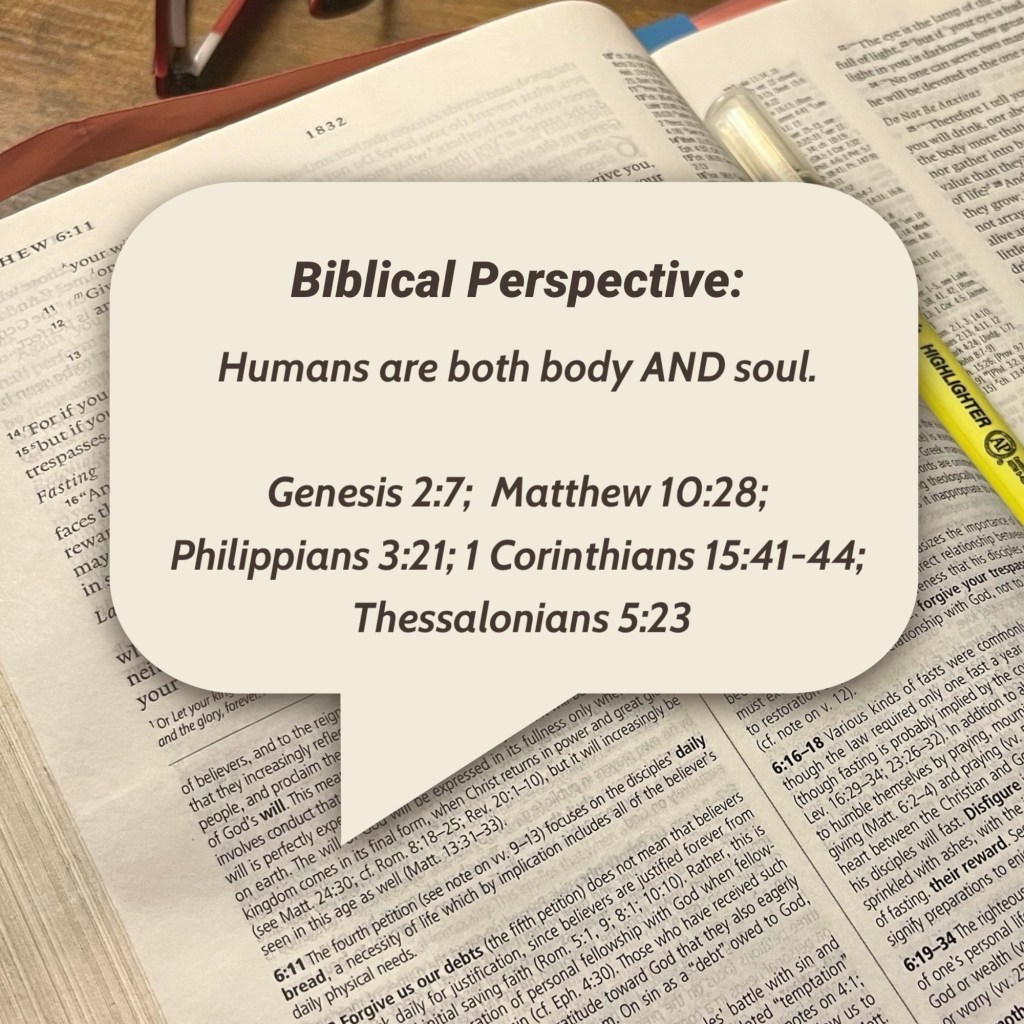
Both body and soul are essential components of our created design = Christianity.
Every major worldview provides a unique perspective of what it means to be human. The question we should all be asking is — “Is this perspective true?” And then examine it thoughtfully.
In her incredible book Love Thy Body, author and professor Nancy Pearcey writes, “The Bible proclaims the profound value and dignity of the material realm—including the human body—as the handiwork of a loving God” (p.34).
Pearcey continues… “We are made in God‘s image to reflect God‘s character, both in our minds and in our bodily actions. There is no division, no alienation. We are embodied beings” (p.35).
“then the LORD God formed the man of dust from the ground and breathed into his nostrils the breath of life, and the man became a living creature.” — Genesis 2:7
“(Jesus) who will transform our lowly body to be like his glorious body, by the power that enables him even to subject all things to himself.” — Philippians 3:21
Resources for further study:
ESV Study Bible
Love Thy Body: Answering Hard Questions about Life and Sexuality; Nancy Pearcey.
“In the beginning, God created the heavens and the earth.” Genesis 1:1📕
“Then God said, ‘Let us make human beings in our image, to be like us. They will reign over the fish in the sea, the birds in the sky, the livestock, all the wild animals on the earth, and the small animals that scurry along the ground.’” Genesis 1:26📕
“God is love.” 1 John 4:8📕
Excerpts from Francis Schaeffer’s Genesis in Space and Time
“The universe had a personal beginning — a personal beginning on the high order of the Trinity. That is, before ‘in the beginning’ the personal was already there. Love and thought and communication existed prior to the creation of the heavens and the earth. Modern man is deeply plagued by the question ‘Where do love and communication come from?’” (p.21)
“The historic Christian position concerning Genesis 1:1 is the only one which can be substantiated, the only one which is fair and adequate to the whole thrust of Scripture. ‘In the beginning’ is a technical term stating the fact that at this particular point of sequence there is a creation ex nihilo — a creation out of nothing. All that is, except for God himself who already has been, now comes into existence. Before this there was a personal existence — love and communication. Prior to the material universe (whether we think of it as mass or energy), prior to the creation of all else, there is love and communication. This means that love and communication are intrinsic. And hence, when modern man screams for love and communication (as he so frequently does), Christians have an answer: There is value to love and value to communication because it is rooted into what intrinsically always has been.“ (p.24)
“The Christian message does not begin with ‘accept Christ as your Savior;’ it begins with ‘in the beginning God created the heavens and the earth.’” — Nancy Pearcey [1]
“In the beginning, God created the heavens and the earth.” — Genesis 1:1 📕
“For since the creation of the world God’s invisible qualities—his eternal power and divine nature—have been clearly seen, being understood from what has been made, so that people are without excuse.” — Romans 1:20 📕
“The Lord is good to all, and his mercy is over all that he has made.” — Psalm 145:9 📕
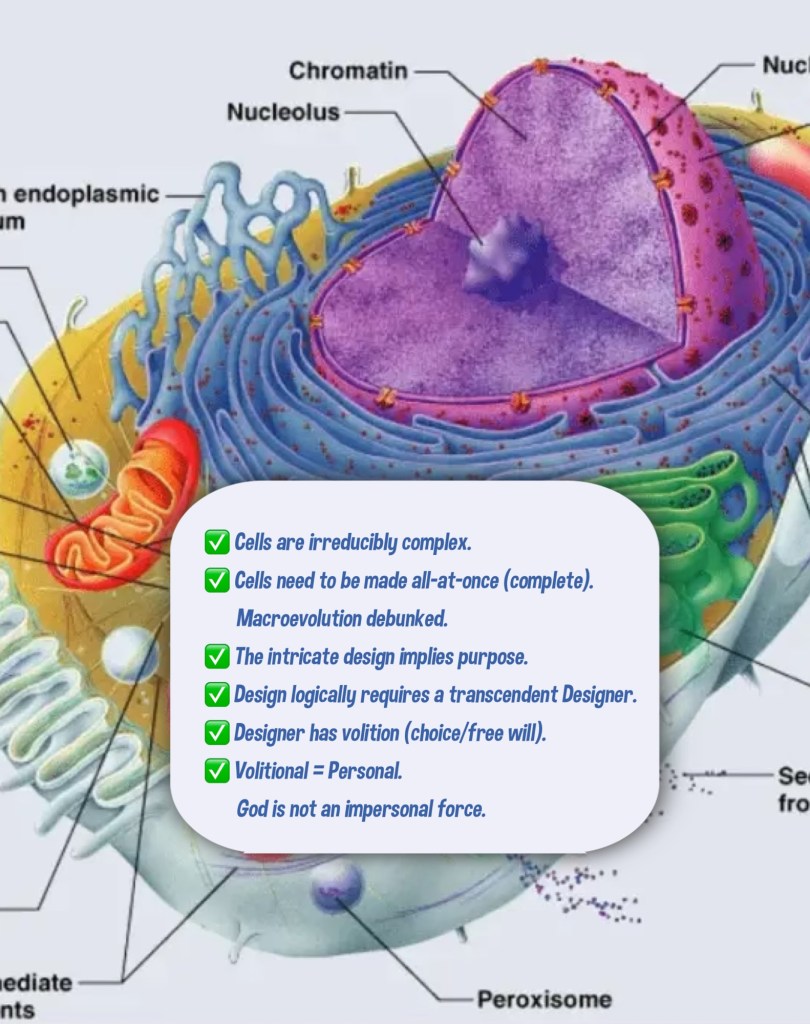
Yes, God designed the entirety of time, space, and matter out of nothing. God did this. And God also lovingly gave us the ability to choose him or to go our own way. We are moral creatures, designed with the recognition that a transcendent “right” exists outside of our opinions and preferences (Romans 2).
He also designed all of humanity with the linguistic capabilities to communicate with him (prayer) and one another, as well as the realization that communication is necessary and important. All of these examples only scratch the surface of how creation points to purpose, and how purpose points to God.
Yet, how are we all utilizing God’s good design (our bodies and minds, our families, our work, etc)? If we are excruciatingly transparent, we should all confess that we fall short daily. We are helplessly impatient, and become irritable or anxious when we perceive a lack of control. And all of this affects how we treat our bodies, minds, and relationships.
But God. Everyday we have the gift of looking to Him, not in. God is our present help and refuge in times of trouble (Ps 46), and only He can take what’s difficult and use it all for good (Romans 8). Friends, let’s not grow weary of doing good… let’s keep placing every worry and anxious thought into His good and faithful hands. The same God who designed the cells in your body is the same one who came down to save you (John 1; Philippians 1; Col 1)! He’s got this!
“but God shows his love for us in that while we were still sinners, Christ died for us.” — Romans 5:8 📕
“In this is love, not that we have loved God but that he loved us and sent his Son to be the propitiation for our sins.” — 1 John 4:10 📕
The Story of Reality: How the World Began, How It Ends, and Everything Important that Happens in Between; Introduction. https://a.co/d/0hAykHwG
“If God verified Jesus’ message by raising Him from the dead, then perhaps the chief issue concerns whether Jesus taught the inspiration of Scripture.”
“To him [Jesus], what Scripture says, God says.” John Wenhan; Christ and the Bible, p.14.
Old Testament/Hebrew Scriptures (39) New Testament Scriptures (27)
Jesus quoted the Old Testament approximately 78 times, as recorded in the 4 Gospel accounts. “It is written” occurs ~70 times in the New Testament, regarding Old Testament Scripture. Fulfilled occurs 34 times in the New Testament (Old Testament Prophecy).
“Do not think that I have come to abolish the Law or the Prophets; I have not come to abolish them but to fulfill them. 18 For truly, I say to you, until heaven and earth pass away, not an iota, not a dot, will pass from the Law until all is accomplished.” Matt 5:17-18
“But it is easier for heaven and earth to pass away than for one dot of the Law to become void.” Luke 16:17
His source for solving theological disputes:And as Jesus taught in the temple, he said, “How can the scribes say that the Christ is the son of David? David himself, in the Holy Spirit, declared,
‘The Lord said to my Lord,’ ‘Sit at my right hand, until I put your enemies under your feet.’David himself calls him Lord. So how is he his son?”
And the great throng heard him gladly.” Mark 12:35-37
“And as for the resurrection of the dead, have you not read what was said to you by God: ‘I am the God of Abraham, and the God of Isaac, and the God of Jacob’? He is not God of the dead, but of the living.’” Matt 22:31-32 Jesus used the Old Testament as a proof text that serves as God’s blueprint for correct theology and behavior. It disproved contrary positions. “But Jesus answered them, ‘You are wrong, because you know neither the Scriptures nor the power of God.’” Matt 22:19 “He answered, ‘Have you not read that he who created them from the beginning made them male and female, 5 and said, ‘Therefore a man shall leave his father and his mother and hold fast to his wife, and the two shall become one flesh’?” Matt 19:4-5Jesus appears to refer to the entire Old Testament as the “commandment of God” and “the word of God”“You leave the commandment of God and hold to the tradition of men.” Mk 7:8“And he said to them, ‘You have a fine way of rejecting the commandment of God in order to establish your tradition! 10 For Moses said, ‘Honor your father and your mother’; and, ‘Whoever reviles father or mother must surely die.’ 11 But you say, ‘If a man tells his father or his mother, “Whatever you would have gained from me is Corban”’ (that is, given to God)— 12 then you no longer permit him to do anything for his father or mother, 13 thus making void the word of God by your tradition that you have handed down. And many such things you do.” Mk 7:9-13“But how then should the Scriptures be fulfilled, that it must be so?” Matthew 26:54
“If you believed Moses, you would believe me, for he wrote about me. 47 But since you do not believe what he wrote, how are you going to believe what I say?” John 5:46 “Do not think that I have come to abolish the Law or the Prophets; I have not come to abolish them but to fulfill them.” Matt 5:17 Jesus indicated that each section was the Word of God: “Then he said to them, ‘These are my words that I spoke to you while I was still with you, that everything written about me in the Law of Moses and the Prophets and the Psalms must be fulfilled.’” Luke 24:44
Jesus taught His disciples. Then He designated witnesses and spokesmen:
“ You are witnesses of these things.” Luke 24:48
“But you will receive power when the Holy Spirit has come upon you, and you will be my witnesses in Jerusalem and in all Judea and Samaria, and to the end of the earth.” Acts 1:8
“And you also will bear witness, because you have been with me from the beginning.” John 15:27 “I do not ask for these only, but also for those who will believe in me through their word,” John 17:20 Jesus also promised His disciples the inspiration and guidance of the Holy Spirit: “I still have many things to say to you, but you cannot bear them now. 13 When the Spirit of truth comes, he will guide you into all the truth, for he will not speak on his own authority, but whatever he hears he will speak, and he will declare to you the things that are to come.” John 16:12-13 “But the Helper, the Holy Spirit, whom the Father will send in my name, he will teach you all things and bring to your remembrance all that I have said to you.” John 14:26As the New Testament writers penned their words, they recognizedthat they were inspired: “It was revealed to them that they were serving not themselves but you, in the things that have now been announced to you through those who preached the good news to you by the Holy Spirit sent from heaven, things into which angels long to look.” 1 Peter 1:12 “For no prophecy was ever produced by the will of man, but men spoke from God as they were carried along by the Holy Spirit.” 2 Pe 1:21 “How shall we escape if we neglect such a great salvation? It was declared at first by the Lord, and it was attested to us by those who heard, 4 while God also bore witness by signs and wonders and various miracles and by gifts of the Holy Spirit distributed according to his will.” Heb 2:3-4 “For Christ did not please himself, but as it is written, ‘The reproaches of those who reproached you fell on me.’ 4 For whatever was written in former days was written for our instruction, that through endurance and through the encouragement of the Scriptures we might have hope.” Romans 15:3-4 “And count the patience of our Lord as salvation, just as our beloved brother Paul also wrote to you according to the wisdom given him, as he does in all his letters when he speaks in them of these matters. There are some things in them that are hard to understand, which the ignorant and unstable twist to their own destruction, as they do the other Scriptures.” 2 Peter 3:15-16 “But as for you, continue in what you have learned and have firmly believed, knowing from whom you learned it 15 and how from childhood you have been acquainted with the sacred writings, which are able to make you wise for salvation through faith in Christ Jesus. 16 All Scripture is breathed out by God and profitable for teaching, for reproof, for correction, and for training in righteousness, 17 that the man of God may be complete, equipped for every good work.” 2 Tim 3:14-17
“All his disciples deserted him and ran away.” Mark 14:50
But 3 days later (according to the Jewish Calendar), they were beholding a bodily risen Jesus!
“You seek Jesus of Nazareth, who was crucified. He has risen; he is not here. See the place where they laid him. But go, tell his disciples and Peter that he is going before you to Galilee. There you will see him, just as he told you.” Mark 16:6-7
Friends, He is risen!
Just has he had promised!
“For I delivered to you as of first importance what I also received: that Christ died for our sins in accordance with the (Old Testament) Scriptures, that he was buried, that he was raised on the third day in accordance with the Scriptures, and that he appeared to Cephas (Peter), then to the twelve. Then he appeared to more than five hundred brothers at one time, most of whom are still alive, though some have fallen asleep. Then he appeared to James, then to all the apostles. Last of all, as to one untimely born, he appeared also to me (Paul).” 1 Corinthians 15:3-8
‘Unto us a child is born, unto us a Son is given.’ As Jesus Christ is a child in his human nature, he is born, begotten of the Holy Spirit, born of the Virgin Mary. He is as truly-born, as certainly a child, as any other man that ever lived upon the face of the earth. He is thus in his humanity a child born. But as Jesus Christ is God’s Son, he is not born; but given, begotten of his Father from before all worlds, begotten— not made, being of the same substance with the Father.
And while God had visited men numerous times before in redemptive history, the incarnation was ‘the most wonderful visit of all…when He came to tarry here…to work out our salvation.’”
-Charles Haddon Spurgeon December 25, 1859; Scripture: Isaiah 9:6
Man is not God.
Nor can men become God (Isaiah 44:6).
But God became a man (Philippians 2). Let that sink in!
It was God’s plan from eternity past (1 Peter 1:19-21).
“but with the precious blood of Christ, like that of a lamb without blemish or spot. 20 He was foreknown before the foundation of the world but was made manifest in the last times for the sake of you 21 who through him are believers in God, who raised him from the dead and gave him glory, so that your faith and hope are in God.” 1 Peter 1:19-21
Yes, God became a man. Jesus came down from Heaven in the most humble of ways — as a baby. And while he added upon himself a fully human nature (Is 9:6; Phlp 2), it’s important to remember that he never stopped being God.
It was Jesus’ mission to be the “second Adam” (1 Cor 15) — tempted as Adam was (and as we are) but without sin. Jesus lived a sinless life on behalf of all of humanity. Friends, Jesus didn’t come to abolish the Law, he came to “fulfill” it! (Matt 5). Something only God could do!
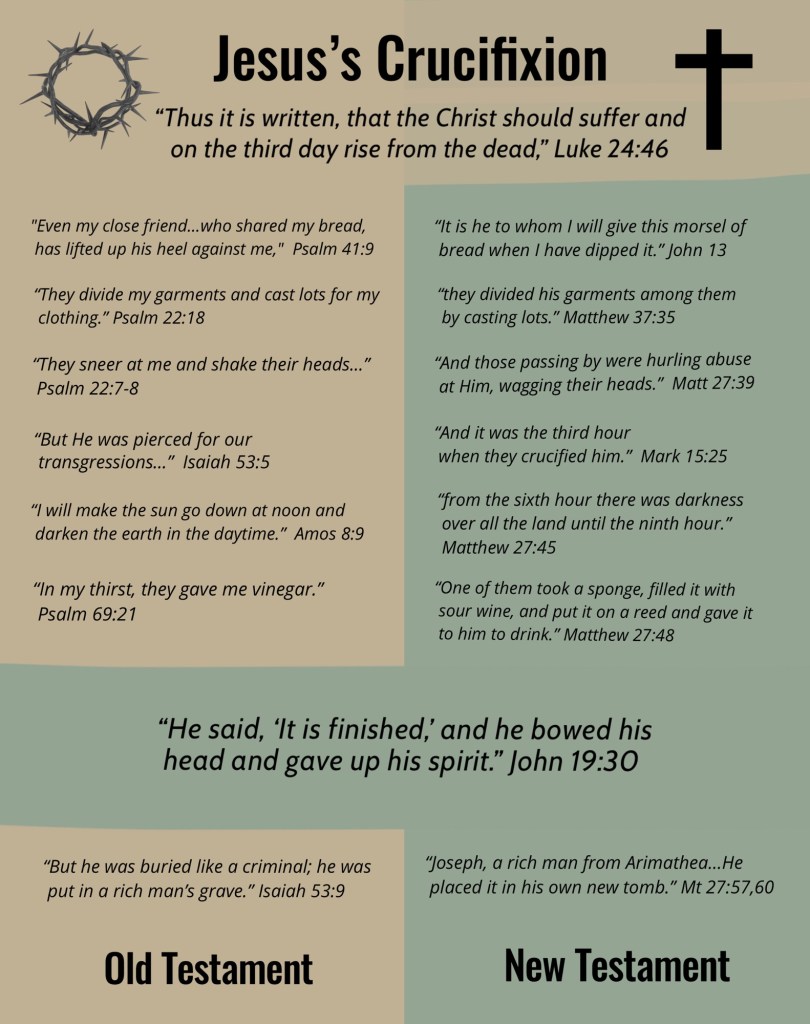
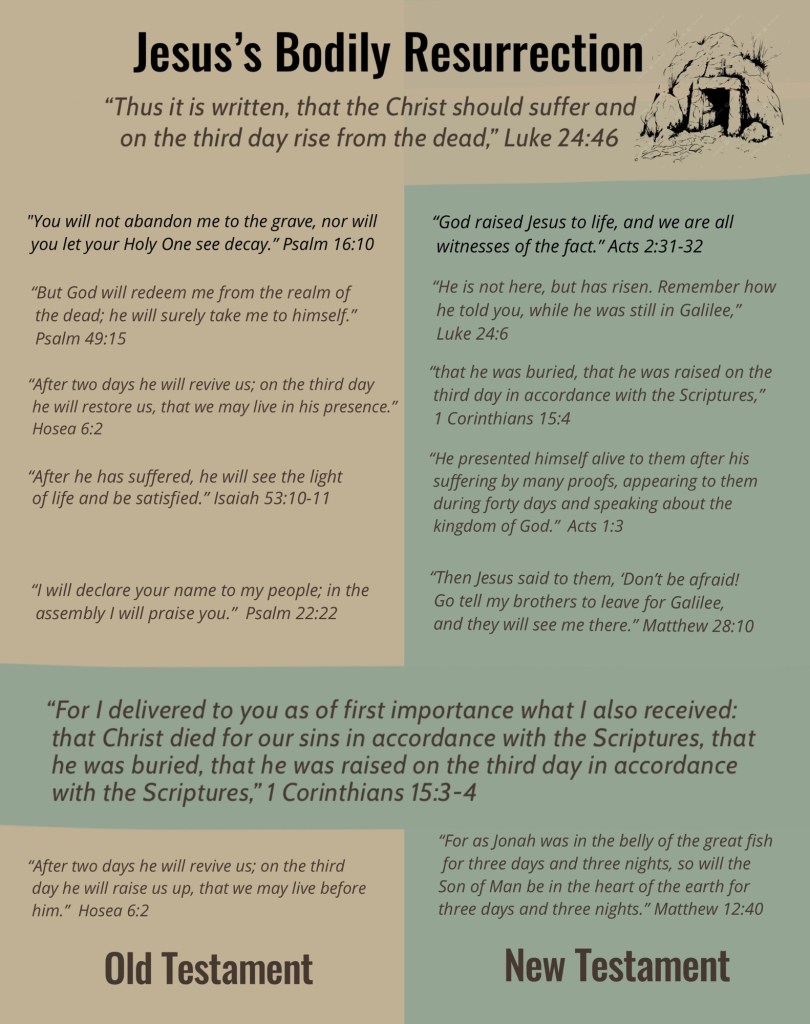
“Then he said to them, ‘These are my words that I spoke to you while I was still with you, that everything written about me in the Law of Moses and the Prophets and the Psalms must be fulfilled.’45 Then he opened their minds to understand the Scriptures, 46 and said to them, ‘Thus it is written, that the Christ should suffer and on the third day rise from the dead, 47 and that repentance for the forgiveness of sins should be proclaimed in his name to all nations, beginning from Jerusalem.48 You are witnesses of these things.’”
— Jesus (Luke 24:44-48)
The Judge of every soul was judged on our behalf (Isaiah 53:5-6; Jn 5). The good Shepherd willingly laid his life down for his sheep (Jn 10; Matt 26:24). His righteous work — as a substitute for our sin-stained works (2 Cor 5:21). All of this was planned! It was Jesus’ mission!
“The Son of Man goes as it is written of him, but woe to that man by whom the Son of Man is betrayed! It would have been better for that man if he had not been born.”
— Jesus (Matthew 26:24)
Created by Meridith Black
Friends, this good news God has given humanity is not a myth… It took place in real time and space (AD 33). It can be examined, historically. And it has tremendous purpose — our Salvation! What God has done for us is the greatest act of love humanity has ever witnessed! It was not deserved. Nor can it be earned. It is a free gift of God to us (Eph 2:1-9).
“He suffered as God because only God had the power to save; He suffered as Man because only man owed the debt.” – Michael Horton
When we interview for a new job or fill out paperwork for a new home, we need to do more than say, “Just trust me, Bro.” Instead, it’s very reasonable for others to require verification of our identity. We need to show that we are who we say we are.
During Jesus’s ministry, it was not unique for someone to claim Messianic status — for blasphemy was a criminal charge prior to the first century. Therefore, Jesus would need to do more than merely say, “I am the promised Messiah,” or “I am God, worship me.” He would need to boldly demonstrate his identity in ways only God could do.
Jesus did just this!
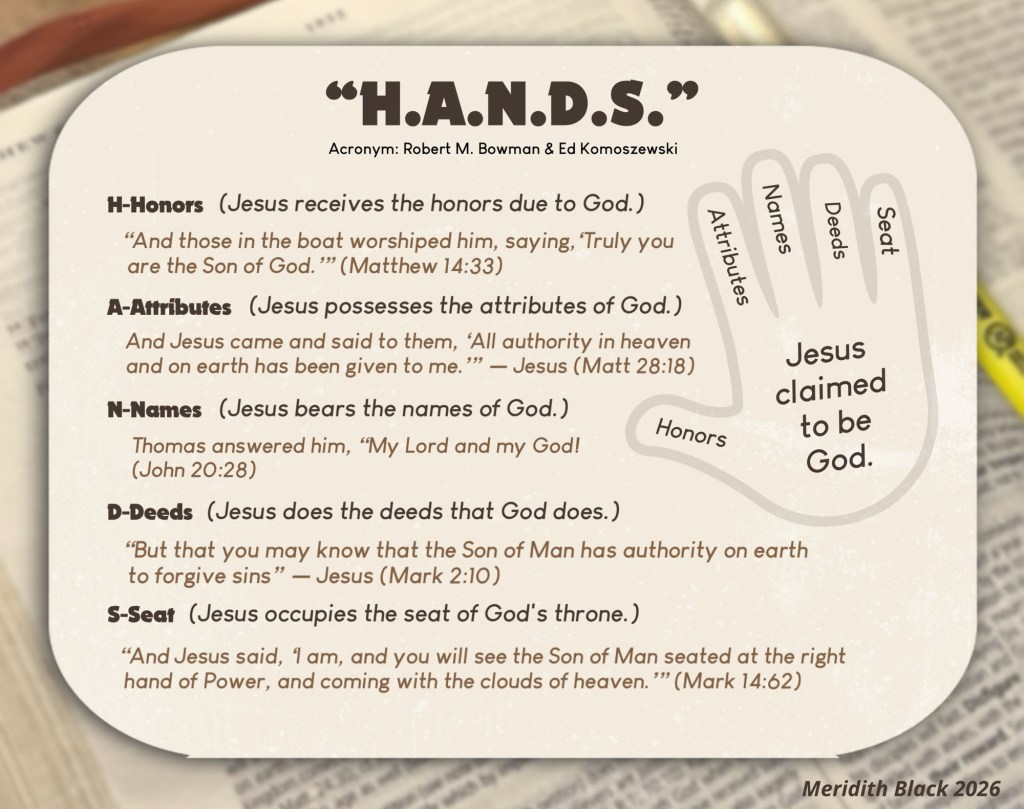
Again, as only God could do, Jesus exhibited who he was through the worship he accepted, the God-oriented attributes he displayed, the titles he applied to himself, the noteworthy deeds he carried-out, and the preexistent authority he claimed to possess. Scripture is filled with such evidence!
C.S. Lewis makes the case logically:
“I am trying here to prevent anyone saying the really foolish thing that people often say about Him: I’m ready to accept Jesus as a great moral teacher, but I don’t accept his claim to be God. That is the one thing we must not say. A man who was merely a man and said the sort of things Jesus said would not be a great moral teacher. He would either be a lunatic—on the level with the man who says he is a poached egg—or else he would be the Devil of Hell. You must make your choice. Either this man was, and is, the Son of God, or else a madman or something worse. You can shut him up for a fool, you can spit at him and kill him as a demon or you can fall at his feet and call him Lord and God, but let us not come with any patronising nonsense about his being a great human teacher. He has not left that open to us. He did not intend to. . . . Now it seems to me obvious that He was neither a lunatic nor a fiend: and consequently, however strange or terrifying or unlikely it may seem, I have to accept the view that He was and is God.” (Mere Christianity, 55-56)
We are basically left with…
If Jesus were not Lord, he would be a liar or a lunatic.
Jesus was neither a liar nor a lunatic.
Therefore, Jesus is Lord.
In their book “The Incarnate Christ and His Critics,” Authors Robert Bowman and Ed Komoszewski provide a “tested and proven device for enabling people of different backgrounds to remember and explain the biblical evidence for identifying Jesus as God (HANDS of GOD)” p.37.
“Relating to Jesus as to God is important for every aspect of the Christian life. We hope it is obvious that understanding Jesus’ identity as God is extremely relevant to how we relate to Jesus. Knowing that he is God incarnate is the only sound foundation for approaching Jesus, for coming to him in prayer, and for trusting in him for salvation. Relating to Jesus as God is also crucial to the message me take to the rest of the world. We must know whom we represent if we are to represent him faithfully. Our Christian walk, witness, and worship all must reflect a sound understanding of the identity of our Lord Jesus Christ.” — Bowman & Komoszewski; Putting Jesus in His Place, p22.
“Come to me (Jesus), all who labor and are heavy laden, and I will give you rest.” Matthew 11:28 📕
Wes Huff, 7 minutes
6 minutes
Nabeel Qureshi 3 minutes
Testify 4 minutes
58 minutes
70 minutes with Drs Sean McDowell and Robert Bowman
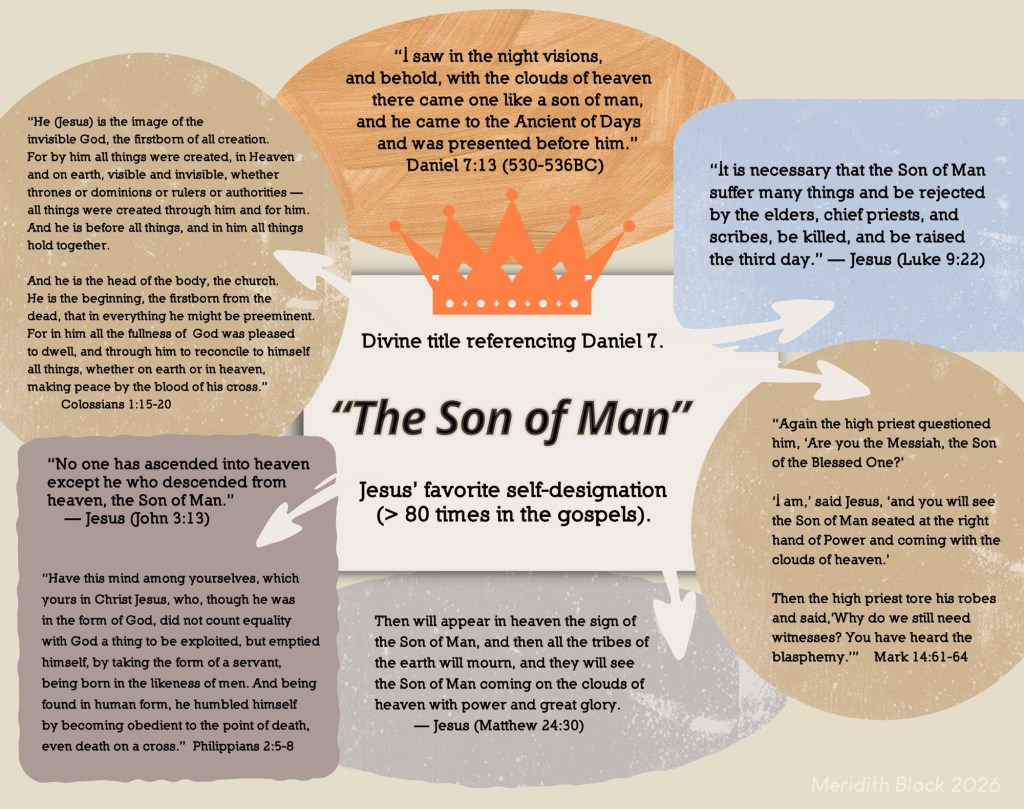
Written nearly 500 years before Jesus’ earthly ministry, Daniel described a vision he had of someone “like a son of man” sitting next to the Ancient of Days and coming on the clouds. It was this title, the Son of Man, which Jesus used most frequently for himself!
D.A. Carson unpacks Daniel 7:13-14 saying that “the messianic Son of Man…will exercise great power in judgment over rebellious nations along with provide salvation” to His sheep. [1]
Therefore, when Jesus stood before Caiaphas, a first-century Jewish High Priest, he knew Caiaphas would be keenly aware of his reference to Daniel’s vision.
“Again the high priest asked him, ‘Are you the Christ, the Son of the Blessed?’ And Jesus said, ‘I am, and you will see the Son of Man seated at the right hand of Power, and coming with the clouds of heaven.’ And the high priest tore his garments and said, ‘What further witnesses do we need?’” Mark 14:61-63 📕
It’s this Son of Man Stephen saw when he was martyred for preaching the Gospel:
“But Stephen, full of the Holy Spirit, looked intently into heaven and saw the glory of God and Jesus standing at the right hand of God. ‘Look,’ he said, ‘I see heaven open and the Son of Man standing at the right hand of God’” (Acts 7:55-56)
“While they were stoning him, Stephen appealed, ‘Lord Jesus, receive my spirit.’ Falling on his knees, he cried out in a loud voice, ‘Lord, do not hold this sin against them.’ And when he had said this, he fell asleep” (Acts 7:59-60).
Friends, God came down. The Creator of the universe put on humanity. The Judge of every soul was willing to be judged on our behalf. Jesus, the Son of Man, laid his life down for His sheep. He paid the debt that only humanity owed and rose again bodily — all for the sake of reconciling us back to Himself. Only God could do this for us. Think upon these things.
D.A. Carson and G.K. Beale; Commentary on the New Testament Use of the Old Testament: A Comprehensive Bible Commentary on Old Testament Quotations, Allusions & Echoes That Appear from Matthew through Revelation https://a.co/d/00yrSvv6
“It is necessary that the Son of Man suffer many things and be rejected by the elders, chief priests, and scribes, be killed, and be raised the third day.” – Jesus (Luke 9) 📕
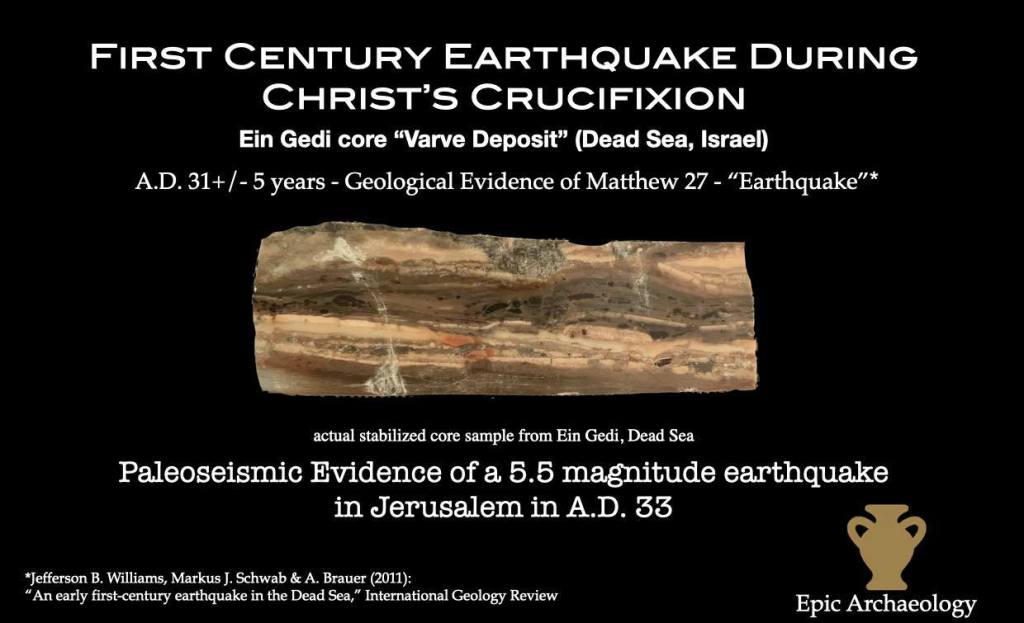
“And behold, the curtain of the temple was torn in two, from top to bottom. And the earth shook, and the rocks were split. The tombs also were opened. And many bodies of the saints who had fallen asleep were raised, and coming out of the tombs after his resurrection they went into the holy city and appeared to many.” Matthew 27:51-53 📕
“In this is love, not that we have loved God but that he loved us and sent his Son to be the propitiation for our sins.” 1 John 4:10 📕
But even if someone ignores the eyewitness accounts compiled within the New Testament, he or she would still have a “robust description of Jesus and his followers from ancient, non-Christian voices in the fallout…(ninety-two historical figures).” [1]
Possibly the earliest *non-Christian* reference to Jesus and his crucifixion comes from a Samaritan historian named Thallus around AD 50. And while Thallus’s writings are no longer with us, a portion of his work was quoted by historian Sextus Julius Africanus.
Here is a passage from Thallus’s original account:
“On the whole world there pressed a most fearful darkness; and the rocks were rent by an earthquake, and many places in Judea and other districts were thrown down. This darkness Thallus, in the third book of his History, calls, as appears to me without reason, an eclipse of the sun.” [2]
Jesus’s crucifixion upon a Roman cross in AD 30 or 33, combined with the empty tomb he left behind (April 5th), is not mythology. Nor is it just “true for me.” As J. Gresham Machen articulated so succinctly, “‘Christ died,’ that is history; ‘Christ died for my sins’, that is doctrine.“ [3]
Instead, these are real historical events that can be examined thoughtfully. These God-given events provide even more evidence of His good character, steadfast Justice, and faithful love. What God has done on our behalf is the greatest gift ever given (Ge 3:15; Isaiah 53; 1 Cor 15)!
The identity of Isaiah 53’s Suffering Servant has been fervently debated by various scholars and theologians for centuries!
Christians assert that proper exegesis of Isaiah 53 points to a person, Jesus of Nazareth, as the Suffering Servant who redeems Israel and the Gentile nations. Whereas others view Isaiah 53 as representing the (corporate) nation of Israel, claiming Jesus was merely a good teacher, crucified for the charge of blasphemy (identifying Himself as one with the Father). As we can see, both could be wrong, but neither could be correct simultaneously.
It’s my genuine prayer that this post will be a helpful resource for anyone having questions about this incredibly important topic!
Written nearly 700 years before Jesus’ crucifixion (AD 30 or 33):
“Yet he himself bore our sicknesses, and he carried our pains; but we in turn regarded him stricken, struck down by God, and afflicted. 5 But he was pierced because of our rebellion, crushed because of our iniquities; punishment for our peace was on him, and we are healed by his wounds. 6 We all went astray like sheep; we all have turned to our own way; and the Lord has punished him for the iniquity of us all.” (Isaiah 53:4-6)
Written approximately 30 years after Jesus’s crucifixion and bodily resurrection:
“He did not commit sin, and no deceit was found in his mouth; 23 when he was insulted, he did not insult in return; when he suffered, he did not threaten but entrusted himself to the one who judges justly. 24 He himself bore our sins in his body on the tree; so that, having died to sins, we might live for righteousness. By his wounds you have been healed. 25 For you were like sheep going astray, but you have now returned to the Shepherd and Overseer of your souls.” (1 Peter 2:22-25)
Who wrote Isaiah?
“The author of this book claims to be Isaiah, son of Amos. He was a great poet, orator, and statesman. Isaiah was highly educated, knowledgeable in international affairs, and on familiar terms with the royal court. He was no doubt the greatest of the writing prophets both in the extent and comprehensiveness of his message and in his ability to communicate.” (pgs 244-245)
When was Isaiah written?
The book of Luke was written between 740 and 690 BC (nearly 700 years before Jesus’s crucifixion in AD 30 or 33). During the reigns of Jotham, Ahaz, Hezekiah, and Manasseh. (p. 231) Isaiah wrote from Judah. Judah was “located in southern Palestine. Its capital was Jerusalem, where throughout the book, Isaiah centered his activity.” (p. 245)
General Details about the Book of Isaiah
“In many aspects, Isaiah is a miniature Bible. It has sixty-six chapters; the Bible has 66 books. The first thirty-nine chapters correspond to the thirty-nine books of the Old Testament, speaking largely about Israel before the coming Messiah. The last twenty-seven chapters parallel the New Testament, speaking largely about the Messiah and His messianic kingdom. Isaiah is one of the Old Testament books most quoted in the New Testament.” (p. 243)
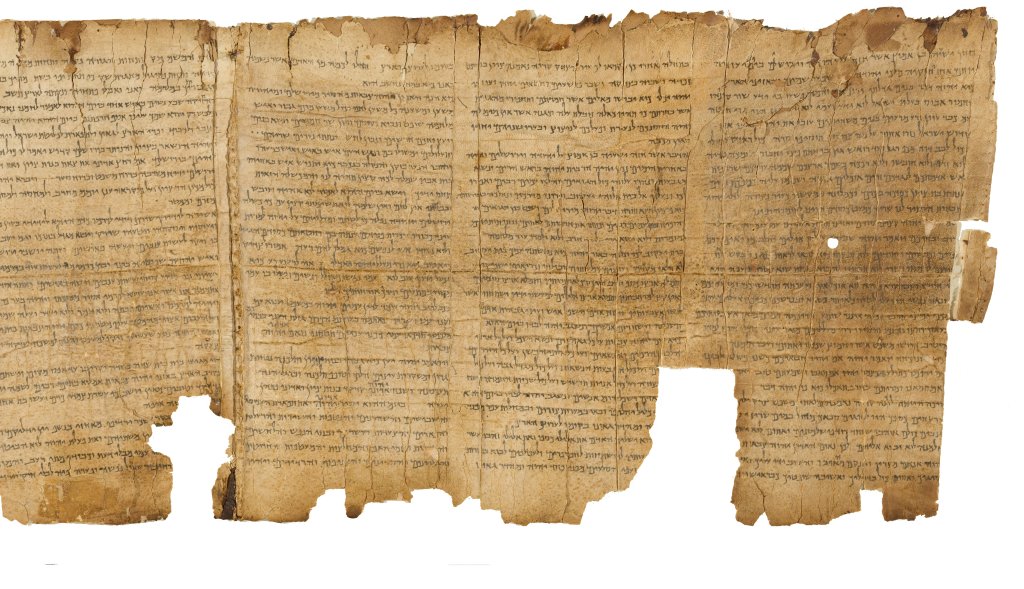
“The earliest manuscripts of Isaiah discovered among the Dead Sea Scrolls support the fact that Isaiah is one complete and whole book.”
“At the heart of the critic’s objection is their aversion to the fact that Isaiah contains supernatural predictive prophecy. For example, parts of Isaiah name Cyrus (who became king of Persia) more than one hundred fifty years before he lived (44:28; 45:1). But no one who believes in a God who created this world should have any problem believing that He can reveal the future in advance.” (p. 244)
To whom was Isaiah written?
“Isaiah as a prophet ministered primarily to the southern kingdom of Judah. His message was generally directed toward Judah’s sinful people (1:4) and particularly to is eveil leaders (1:23).” (p. 245)
Why was Isaiah written?
“The historical Purpose: “Isaiah was sent by God to warn Judah of the sins that lead ot Israel’s downfall, and ot warn of the evil that would lead to their own. His message to them was twofold: God will bring condemnation on Israel and Judah through thenations but He will also one day provide salvation through Israel and Judah to the nations.”
“I will put hostility between you and the woman,and between your offspring and her offspring.He will strike your head,and you will strike his heel.” (Genesis 3:15)
“I will bless those who bless you,I will curse anyone who treats you with contempt,and all the peoples on earthwill be blessed through you.” (Genesis 12:3)
“Now the promises were spoken to Abraham and to his seed. He does not say “and to seeds,” as though referring to many, but referring to one, and to your seed, who is Christ.” (Galatians 3:16)
“The doctrinal purpose: This book comprehends all the great truths of the Old Testament regarding the salvation from man’s sin (1) through Christi’s redemptive work (53) as well as the final glorious restoration of this earth (65).”
“The Christological purpose: Isaiah presents the most complete and comprehensive descriptions of Christ found in the Old Testament. For example, Christ is referred to as the “Lord…high and lifted up” (6); the son of the virgin (7:14); the “Wonderful Counselor, Mighty God, Everyloasting Father, Prince of Peace” 9:6); a Branch from Jesse and Anointed of the Lord (11:1, 2); the “Compfro” of His people (40); the “Rdeemer” and the “Holy Oneof Hsrael” and their Crator and King (43); the Deliverer of the camptives (61) and more.”
“The message of Isaiah is one of salvation both for Israel in particular and for all nations in general. The book has been called “The Gospel According ot Isaiah.” The book may be divided into three sections: the prophetic (1-35), the historic (36-39), and the messianic (40-66).” (pgs. 245-246)
Was Isaiah 53 referring to the nation of Israel or to the promised Messiah (Jesus)?
📌 Jesus’s Crucifixion occurred in AD 30 or 33.
“The national servant, Israel, is loved by God but guilty, blind, and deaf, suffering for its own sins. The individual Servant is righteous, suffering vicariously for the sins of others. This agrees with the Sinai theology of blessings for national obedience and curses for national disobedience (Lv 26; Dt 28). In light of this, righteous, nbational Isreael wouldbe established in the land, triumphing over her enemies; unrighteous Israel would be exiled ot the nations, vanquished by her enemies. In other words, Daniel, while in Babylonian captivity, uttered, “All Israel has transgressed your law and turned aside, rfulsing ot obey your voice. And the curse and oath that are written in the Law of Moses, the servant of God has been poured out upon us, because we have sinned against him” (Daniel 9:11). Under no circumstances, then, would the Lord exile Israel if they were righteous as a people. Thus, Isaiah 53 cannot apply to the nation of Israel, regardless of Longstanding Jewish tradition.
Could Isa 53 instead apply to the rightwoud remnant, as posited by some rabbinic commentators? The voice of that remnannt appear sot be heard in passages like Ps 44, where the author protests that terrible calamities have come upon his people “though we have not forgotten you, and we have not been false to your covenant” (Ps 44:17 ESV).
Certainly, there were righteous individuals like Daniel and Ezekiel who suffered in exile because of the guilt of the nation as a whole. Yet once again, this interpretation breaks down since: (1) The suffering of hte righteous remnant did not bring healing to the nations which, instead, were severely judged by the Lord for their excessive treament of Israel (Jer 50:17-18; Mic 5:5-6); (2) In contrast to Ibn Exra’s view, that ht e”healing” of the nations came through exiled Isrel’s prayers for their wellbeing (Jer 29:7), not only were those nations note healed, but it appears tha tht erighteous remnant interveded for judgement (rather than healing) to come upon their enemies. See, e.g., Lam 1:22 and 3:61-66, and note that this righteous remnant identitfied with the sin and gilt of the rest of hte nation of Isreal, thereby recognizing that their suffering was just; (3) Since the servant is clealy an individual elsewhere in teh Isa 40-55, adn since Isa 53 reads most naturally as personal rather than collective, there is no good reason to apply it to the righteous remnant, unless that remnant is reduced otone, namely, the Messiah, the ruly righteous One whose vicarious suffereing brings healing to the repentant Isreal and the nations.” [1]
“When Israel saw the great power that the Lord used against the Egyptians, the people feared the Lord and believed in him and in his servant Moses.” Exodus 14:31
“So Moses the servant of the Lord died there in the land of Moab, according to the Lord’s word.” Deuteronomy 34:5
“After the death of Moses the Lord’s servant, the Lord spoke to Joshua son of Nun, Moses’s assistant: ‘Moses my servant is dead.’” Joshua 1:1-2
“The Lord your God will raise up for you a prophet like me from among you, from your brothers—it is to him you shall listen— just as you desired of the Lord your God at Horeb on the day of the assembly, when you said, ‘Let me not hear again the voice of the Lord my God or see this great fire any more, lest I die.’ And the Lord said to me, ‘They are right in what they have spoken. I will raise up for them a prophet like you from among their brothers. And I will put my words in his mouth, and he shall speak to them all that I command him. And whoever will not listen to my words that he shall speak in my name, I myself will require it of him.” Deuteronomy 18:15:19
As we can see in the entire context of Isaiah 53, the Servant is a righteous person of Jewish descent, sent by God to save both Israel and the Gentile nations. For more information pertaining to Isaiah 53 and the Suffering Servant, this video resource by Nate Sala from Wise Disciple is an excellent resource!
34 minutes with Nate Sala
Isaiah 52:13 to Isaiah 53:12
OT & NT Connections to Isaiah 52 & 53
Isaiah 52:13 See, my servant will be successful; He will be raised and lifted up and greatly exalted.
Isaiah 42:1 CSB“This is my servant; I strengthen him, this is my chosen one; I delight in him. I have put my…
Isaiah 49:3-7He said to me, “You are my servant, Israel, in whom I will be glorified.” But I myself said: I…
Isaiah 50:10Who among you fears the Lord and listens to his servant? Who among you walks in darkness, and…
Isaiah 53:11After his anguish, he will see light and be satisfied. By his knowledge, my righteous servant…
Ezekiel 34:23-24 CSBI will establish over them one shepherd, my servant David, and he will shepherd them. He will…
Zechariah 3:8 CSB“Listen, High Priest Joshua, you and your colleagues sitting before you; indeed, these men are a…
Acts 3:13 CSB“The God of Abraham, Isaac, and Jacob, the God of our ancestors, has glorified his servant Jesus, whom you handed over and denied before Pilate, though he had decided to release him.”
Isaiah 52:14 “Just as many were appalled at you — His appearance was so disfigured that he did not look like a man, and his form did not resemble a human being—”
John 19:1 “Then Pilate had Jesus flogged with a lead-tipped whip.”
Matthew 27:29 “and twisting together a crown of thorns, they put it on his head and put a reed in his right hand. And kneeling before him, they mocked him, saying, “Hail, King of the Jews!”
Mark 15:19 “And they were striking his head with a reed and spitting on him and kneeling down in homage to him.”
Isaiah 52:15 “So he will sprinkle many nations. Kings will shut their mouths because of him, for they will see what had not been told them, and they will understand what they had not heard.”
Numbers 19:18-21“A person who is clean is to take hyssop, dip it in the water, and sprinkle the tent, all the…”
Ezekiel 36:25 “I will also sprinkle clean water on you, and you will be clean. I will cleanse you from all your…”
Isaiah 53:1 “Who has believed what we have heard? And to whom has the arm of the Lord been revealed?”
Exodus 6:6 “Therefore tell the Israelites: ‘I am the LORD, and I will bring you out from under the yoke of the Egyptians. I will free you from being slaves to them, and I will redeem you with an outstretched arm and with mighty acts of judgment.’”
John 12:37-38 “Although Jesus had performed so many signs in their presence, they still did not believe in Him. This was to fulfill the word of Isaiah the prophet: ‘Lord, who has believed our message? And to whom has the arm of the Lord been revealed?’”
Acts 13:17 “The God of this people Israel chose our ancestors, made the people prosper during their stay in the land of Egypt, and led them out of it with a mighty arm.”
Isaiah 53:2 “He grew up before him like a young plant and like a root out of dry ground. He didn’t have an impressive form or majesty that we should look at him, no appearance that we should desire him.”
Isaiah 11:1“Then a shoot will grow from the stump of Jesse, and a branch from his roots will bear fruit.”
Matthew 13:55 “Is not this the carpenter’s son? Is not his mother called Mary? And are not his brothers James and Joseph and Simon and Judas?”
Isaiah 53:3 “He was despised and rejected by men, a man of suffering who knew what sickness was. He was like someone people turned away from; he was despised, and we didn’t value him.”
Psalm 22:6“But I am a worm and not a man, scorned by mankind and despised by people.”
Isaiah 49:7“This is what the Lord, the Redeemer of Israel, his Holy One, says to one who is despised, to one…”
Luke 18:31-33“Then he took the Twelve aside and told them, ‘See, we are going up to Jerusalem. Everything that…’”
Mark 9:12“And he said to them, ‘Elijah does come first to restore all things. And how is it written of the Son of Man that he should suffer many things and be treated with contempt?’”
Mark 8:31 “Then He began to teach them that the Son of Man must suffer many things and be rejected by the elders, chief priests, and scribes, and that He must be killed and after three days rise again.”
Luke 9:22 “The Son of Man must suffer many things and be rejected.”
John 1:10-11 “He was in the world, and the world was created through him, and yet the world did not recognize…”
Hebrews 4:15 “For we do not have a high priest who is unable to sympathize with our weaknesses, but one who…”
Isaiah 53:4 “Yet he himself bore our sicknesses, and he carried our pains; but we in turn regarded him stricken, struck down by God, and afflicted.”
Matthew 8:17 “so that what was spoken through the prophet Isaiah might be fulfilled: He himself took our…”
1 Peter 2:21“For you were called to this, because Christ also suffered for you, leaving you an example, that…”
Isaiah 53:5 “But he was pierced because of our rebellion, crushed because of our iniquities; punishment for our peace was on him, and we are healed by his wounds.”
Romans 4:25 CSB“He was delivered up for our trespasses and raised for our justification.”
1 Corinthians 15:3 “For I passed on to you as most important what I also received: that Christ died for our sins…”
Hebrews 9:28 “so also Christ, having been offered once to bear the sins of many, will appear a second time,… Isaiah 1:4 “Oh sinful nation, people weighed down with iniquity, brood of evildoers, depraved children!” Jeremiah 2:30“I have struck down your children in vain; they would not accept discipline. Your own sword has…”
Zephaniah 3:2“She has not obeyed; she has not accepted discipline. She has not trusted in the Lord; she has…”
Hebrews 5:8 “Although he was the Son, he learned obedience from what he suffered.” 1 Peter 2:24 “He himself bore our sins in his body on the tree, that we might die to sin and live to righteousness. By his wounds you have been healed.”
Isaiah 53:6 “We all went astray like sheep; we all have turned to our own way; and the Lord has punished him for the iniquity of us all.”
1 Peter 2:25 “For you were straying like sheep, but have now returned to the Shepherd and Overseer of your souls.”
Matthew 18:12“What do you think? If someone has a hundred sheep, and one of them goes astray, won’t he leave…”
Isaiah 53:7“He was oppressed and afflicted, yet he did not open his mouth. Like a lamb led to the slaughter and like a sheep silent before her shearers, he did not open his mouth.”
Jeremiah 11:19“For I was like a docile lamb led to slaughter. I didn’t know that they had devised plots against…”
Matthew 26:63“But Jesus kept silent. The high priest said to him, ‘I charge you under oath by the living God:…’”
Matthew 27:12-14“While he was being accused by the chief priests and elders, he didn’t answer. Then Pilate said…”
Luke 23:9“So he kept asking him questions, but Jesus did not answer him.”
John 19:9“He went back into the headquarters and asked Jesus, “Where are you from?” But Jesus did not give…”
Acts 8:32-33 “Now the Scripture passage he was reading was this: He was led like a sheep to the slaughter, and…”
1 Peter 2:23 “When he was insulted, he did not insult in return; when he suffered, he did not threaten but…”
Isaiah 53:8 “He was taken away because of oppression and judgment, and who considered his fate? For he was cut off from the land of the living; he was struck because of my people’s rebellion.”
Acts 13:28 “And though they found in him no guilt worthy of death, they asked Pilate to have him executed.”
John 19:15“They cried out, ‘Away with him, away with him, crucify him!” Pilate said to them, ‘Shall I crucify your King?’ The chief priests answered, ‘We have no king but Caesar.’”
Isaiah 53:9 “He was assigned a grave with the wicked, but he was with a rich man at his death, because he had done no violence and had not spoken deceitfully.”
Matthew 27:57-60“When it was evening, a rich man from Arimathea named Joseph came, who himself had also become a…”
1 Peter 2:22 “He did not commit sin, and no deceit was found in his mouth;”
1 John 3:5“You know that he was revealed so that he might take away sins, and there is no sin in him.”
Isaiah 53:10 “Yet the Lord was pleased to crush him severely. When you make him a guilt offering, he will see his seed, he will prolong his days, and by his hand, the Lord’s pleasure will be accomplished.”
Isaiah 44:28 “who says to Cyrus, ‘My shepherd, he will fulfill all my pleasure’”
1 Timothy 2:5-6 “For there is one God and one mediator between God and mankind, the man Christ Jesus, 6 who gave himself as a ransom for all, a testimony at the proper time.”
Titus 2:14 “He gave himself for us to redeem us from all lawlessness and to cleanse for himself a people for his own possession, eager to do good works.”
Isaiah 53:11 “After his anguish, he will see light and be satisfied. By his knowledge, my righteous servant will justify many, and he will carry their iniquities.”
Acts 13:39 “Everyone who believes is justified through him from everything that you could not be justified…”
Romans 5:18-19“So then, as through one trespass there is condemnation for everyone, so also through one…”
2 Corinthians 5:21 “He made the one who did not know sin to be sin for us, so that in him we might become the righteousness of God.”
1 Peter 3:18“For Christ also suffered for sins once for all, the righteous for the unrighteous, that he might bring you to God. He was put to death in the flesh but made alive by the Spirit,”
Isaiah 53:12 “Therefore I will give him the many as a portion, and he will receive the mighty as spoil, because he willingly submitted to death, and was counted among the rebels; yet he bore the sin of many and interceded for the rebels.”
Matthew 26:42“Again, a second time, he went away and prayed, ‘My Father, if this cannot pass unless I drink…”
John 10:14-18“I am the good shepherd. I know my own, and my own know me, just as the Father knows me, and I…”
Philippians 2:6-8 “who, existing in the form of God, did not consider equality with God as something to be…”
Luke 22:37“For I tell you, what is written must be fulfilled in me: And he was counted among the lawless….”
Hebrews 9:28“so also Christ, having been offered once to bear the sins of many, will appear a second time,…” Luke 23:34“Then Jesus said, ‘Father, forgive them, because they do not know what they are doing.’ And they…”
Romans 8:34“Who is the one who condemns? Christ Jesus is the one who died, but even more, has been raised;…”
Hebrews 7:25“Therefore, he is able to save completely those who come to God through him, since he always…”
Colossians 2:15 “He disarmed the rulers and authorities and disgraced them publicly; he triumphed over them in him.”
“‘Christ died’ —that is history; ‘Christ died for my sins—that is doctrine.“ J. Gresham Machen; C & L, p. 23
Was Jesus Crucified?
“Even if you silenced the voices of the New Testament authors, you would still have a robust description of Jesus and his followers from ancient, hostile non-Christian voices in the fallout…There are more non-Christian voices in this extrabiblical collection (ninety-two historical figures) than Christian ones, and regardless of their social stature, ethnicity, motivation, or region, the common description of Jesus (at their core) remains the same.” [2]
The Chart below contains examples of both Christian and non-Christian attestations of Jesus’s existence, crucifixion, and worship. These quotes are from the first and second centuries, exhibited the compelling evidence of Jesus’s impact on the world and why his crucifixion/bodily resurrection matters (well before the Council of Nicaea).
Name
Quote
Topics Covered
Thallus (AD 52)
Samarian historian
Non-Christian
“Another historian, Sextus Julius Africanus, wrote a text entitled History of the World in AD 221 which quoted Thallus’s chronicled statement pertaining to the darkness that was observed at the time of Jesus’s death.” [1] “On the whole world there pressed a most fearful darkness; and the rocks were rent by the earthquake, and many places in the Judea and other districts were thrown down. This darkness Thallus, in the third book of his History, calls, as appears to me without reason, an eclipse of the sun.” [1] Julius Africanus’s historical writings
– Jesus existed.- Jesus died.- Notable weather conditions coincided with Jesus’s death.
Josephus (AD 37-101)
Jewish historian
Non-Christian
“Now there was about this time Jesus, a wise man. For he was a doer of startling deeds, a teacher of such men as receive the truth with pleasure. And he gained a following both among many Jews and many of Greek origin. And when Pilate, at the suggestion of the principal men amongst us, condemned him to the cross, those that loved him at the first did not forsake him. And the tribe of Christians, so named from him, are not extinct at this day.” [2] Josephus’s Antiquities of the Jews (18:3:3)
– Jesus existed.- Brother of James.- Referred to Jesus as a wise man.- Referred to Pontius Pilate.- Acknowledged that Jesus performed miracles.
Clement (AD 70-96)
First century church leader in Rome
Christian
Clement “wrote a letter to the church at Corinth (ca. AD 70-96). In it he speaks of the teachings of Jesus (13:1), his death (21:6), and his resurrection from the dead (24:1).” [5] The First Letter of Clement to Rome
– Jesus existed.- Affirms Jesus’s death and resurrection.
Ignatius (AD 50-117)
Disciple of John, Bishop in Antioch
Christian
“For our God, Jesus the Christ, was conceived by Mary according to God’s plan, both from the seed of David and of the Holy Spirit.” [3] Ignatius, Letter to the Ephesians, 18.2
– Jesus existed.- Jesus was the promised Messiah.- Jesus is God.
Tacitus (AD 56-120)
Ancient Roman historian
Non-Christian
“Consequently, to get rid of the report, Nero fastened the guilt and inflicted the most exquisite tortures on a class hated for their abominations, called Christians by the populace. Christus, from whom the name had its origin, suffered the extreme penalty during the reign of Tiberius at the hands of one of our procurators, Pontius Pilatus, and a most mischievous superstition, thus checked for the moment, again broke out not only in Judea, the first source of the evil, but even in Rome, where all things hideous and shameful from every part of the world find their centre and become popular.” [4] Annals 12
– Jesus (Christus) existed.- Jesus had followers.- Pontius Pilate existed.- Nero persecuted Christians.-Tacitus “hated” Christians because their allegiance was to Jesus not to the worshiped gods of the culture.
Polycarp (AD 69-155)
Disciple of John, Bishop at Smyrna
Christian
“Now may the God and Father of our Lord Jesus Christ, and the eternal high priest himself, the Son of God Jesus Christ, build you up in faith and truth…and to us with you, and to all those under heaven who will yet believe in our Lord and God Jesus Christ and in his Father who raised him from the dead.” [3]The Letter of Polycarp to the Philippians12.2
– Polycarp was martyred for being a Christian.- Preached Jesus was a real man. – Preached that Jesus was/is God.
Mara Bar-Serapion (AD 70 – Unknown)
Stoic (Syrian) philosopher
Non-Christian
“What benefit did the Athenians obtain by putting Socrates to death? Famine and plague came upon them as judgment for their crime. Or, the people of Samos for burning Pythagoras? In one moment their country was covered with sand. Or the Jews by murdering their wise king?…After that their kingdom was abolished. God rightly avenged these men…The wise king…Lived on in the teachings he enacted.” [4] A Letter of Mara, Son of Serapion
– Jesus existed.- Confirmed Jesus’s Jewish heritage.- Claimed Jesus was wise. – Affirmed Jesus’s death.
– Jesus existed.- Justin was martyred for following Jesus.- Jesus was/is God.- Jesus was the Messiah.
Pliny the Younger (AD 61-113)
Governor of Bithynia; Connected with Trajan
Non-Chrisitan
“Th never to falsify their wordey (the Christians) were in the habit of meeting on a certain fixed day before it was light, when they sang in alternate verses a hymn to Christ, as to a god, and bound themselves by a solemn oath, not to any wicked deeds, but never to commit any fraud, theft or adultery,, nor deny a trust when they should be called upon to deliver it up; after which it was their custom to separate, and then reassemble to partake of food—but food of an ordinary and innocent kind.” [4] Pliny, Letters 10.96-97 (Pliny to the Emperor Trajan)
– Followers of Jesus worshiped him as God. – Christ was a reference to Jesus.
– Jesus was referred to as Chrestus.- Jesus had followers
Phlegon of Tralles (AD 140)
Historian
Non-Christian
Origen refers to Phlegon’s book of history: “And with regard to the eclipse in the time of Tiberius Caesar, in whose reign Jesus appears to have been crucified, and the great earthquakes which then took place, Phlegon too, I think, has written in the thirteenth or fourteenth book of his Chronicles” [5] Origen, Against Celsus, 2.14. Online
– Jesus existed.- Jesus was crucified.- Notable weather phenomenon occurred around the time of Jesus’s death.
Lucian of Samosata (AD 166)
Greek Satirist
Non-Christian
“The Christians, you know, worship a man to this day,–the distinguished personage who introduced their novel rites, and was crucified on that account…. You see, these misguided creatures start with the general conviction that they are immortal for all time, which explains the contempt of death and voluntary self-devotion which are so common among them; and then it was impressed on them by their original lawgiver that they are all brothers, from the moment that they are converted, and deny the gods of Greece, and worship the crucified sage, and live after his laws.” [5] The Lucian of Samosata Project
– Jesus existed.- Jesus had followers.- Jesus was crucified.- Affirmed that Christians would not worship the gods of Greece.
“The narration of the facts is history; the narration of the facts with the meaning of the facts is doctrine. ‘Suffered under Pontius Pilate, was crucified, dead and buried’ that is history. ‘He loved me and gave Himself for me’ that was the Christianity of the primitive Church.”
– J. Gresham Machen; Christianity & Liberalism, p. 25
Citations
Rydelnik, Michael, and Edwin Blum, eds. 2019. The Moody Handbook of Messianic Prophecy: Studies and Expositions of the Messiah in the Old Testament. N.p.: Moody Publishers. p. 965-966.
J. Warner Wallace; Cold Case Christianity. Page 216.