A former Speech and Language Pathologist for nearly 20 years, I began educating our 3 children full-time in 2015 and have cherished every gifted moment (even the challenges). But what is interwoven into all aspects of daily life (as a wife, via motherhood, teaching, friendship, fitness, etc.) is Christian Apologetics (1 Peter 3:15)… which is why this blog exists.
On December 16, 2023, Christian author Reagan Rose wiped every one of his social media accounts. In an age where digital presence is practically required, the move looked bold—maybe even reckless—for someone leading an online ministry such as Redeeming Productivity. Publishers routinely ask for an author’s social media metrics, and those platforms are typically considered essential tools for promotion.
So why did Reagan quit social media?
After attempting to “leverage the good parts” of social media through moderation, Reagan eventually realized that these platforms were actually hindering his ability to be a “faithful steward” of the responsibilities God had given him. In his assessment, the costs created by those hindrances far outweighed any potential benefits of staying online. The following five points unpack the key reasons behind his decision to step away from Facebook, Instagram, and other platforms.
1. A Hindrance to Focus.
“For we are his workmanship, created in Christ Jesus for good works, which God prepared beforehand, that we should walk in them.” Ephesians 2:10
Reagan explains, “I want to live a life of faithfulness. I want to walk in the good works that the Lord has prepared for me in advance to walk in. I want to be an effective steward of my short life, and this requires focus; it requires me not to get distracted. Paul writes to Timothy, ‘you know a soldier doesn’t get involved in civilian affairs’ (2 Timothy 2:4). You have to have a single-minded focus, and social media is an enemy of focus. And it’s by design. The goal of social media of the companies is to keep you on their platform for as long as possible. We all know this, and the algorithms are getting better and better by the day. And for whatever potential benefit social media might offer you with one hand, I feel like it takes it away with the other in focus; your attention is spread out.”
2. A Hindrance to Joy.
“Life is obviously full of ups and downs. [Which is why] you fight to have joy in the midst of all the trials and tribulations you face. You’re fighting to keep your eyes fixed on Jesus Christ in the midst of [difficult] circumstances and discouragements. But I found that there was one thing that really doesn’t help me fight for joy, and that is when my social media feed is backing up like a dump truck and just unloading seven metric tons of discouragement on my timeline every day.”
3. A Hindrance to Worship.
“Addiction problems really are worship problems.”
“A lot has been written about addiction in social media. They’ve designed it as this casino where the currency is your attention, and it’s designed to keep you pulling that lever right. It’s designed to addict you. Think back 5 years, even if you’re like, ‘I didn’t use social media that much,’ and now you’re like, ‘Why am I constantly scrolling?’ Like, ‘What even is this?’ It’s gotten better at hooking you (as I argued back when I wrote my book on video games). Addiction problems really are worship problems. It’s an issue of the heart. And Christians, we joke sometimes about being addicted to our phones or social media, but it’s not really a laughing matter, is it? You know the God who called us to love him with all of our heart, soul, strength, and might meant that, and when you have an inordinate amount of time being spent on whatever it is you might call an addiction, there’s a heart problem there.
“Hear, O Israel: The Lord our God, the Lord is one. 5 You shall love the Lord your God with all your heart and with all your soul and with all your might. 6 And these words that I command you today shall be on your heart. 7 You shall teach them diligently to your children, and shall talk of them when you sit in your house, and when you walk by the way, and when you lie down, and when you rise. 8 You shall bind them as a sign on your hand, and they shall be as frontlets between your eyes. 9 You shall write them on the doorposts of your house and on your gates.” Deuteronomy 6:4-8
Your affections are misaligned, and a part of you is satisfying itself in that thing, with something that you ought to get from God. For example, you might be looking to social media for affirmation, right, which you ought to get from your identity in Christ. You’re hunting for something. You need it. Something has gone wrong in the heart when that happens.”
“And the other aspect of this is the problem with what we call addiction is that we are submitting ourselves to another master who is not the Lord Jesus Christ. Paul wrote in 1 Corinthians 6:12, ‘”All things are lawful for me,” but not all things are helpful. “All things are lawful for me,” but I will not be dominated by anything.’ And so you might say that social media is lawful for you, and that it’s okay if you use it right. And that it’s not sin to use it if it’s helpful for you. But I’m like, no. [While] social media is lawful for me, I am being dominated by it. It is taking over to such a degree that it’s actually a problem. I found that I wasn’t in control of how often I was using it, and this I recognized was ultimately a worship problem.”
4. A Hindrance to Holiness.
“Yes, you have to exercise self-control when when temptation comes upon you, but why are you willingly walking into it?”
“We’re called to be holy as He is Holy, right? We want to be sanctified, expelling sin from our lives — turning it all over to the Lord. And yet we put ourselves in the way of temptation through social media more often than we realize.”
Rose continues… “Lust is an obvious one. But there are also many other sins that social media tempt you to, that are no less serious. They’re still sin. For example, the temptation of discontentment. Or the love of money, right? If all you see are photos or stories of people who have what you want, it’s hard to keep an attitude of contentment. You know you’re thinking about, ‘I wish my house looked that way.’ ‘I wish I had that car.’ Or, it can manifest in full-on covetousness… which is like an unlawful desire for something that’s not yours. It’s actually one of the Ten Commandments!”
“Keep your way far from her, and do not go near the door of her house,” Proverbs 5:8
“I think that we all sort of feel the effects of this the temptation to sin when you’re on social media, but we don’t identify it for what it is. What I mean is: you scroll social media for a while and you come away feeling kind of like… yucky. You’re just like, ‘Ah, I’m not glad I did that.’ Maybe the reason you feel yucky after you spend 30 minutes scrolling is because you spent 30 minutes scrolling temptations to sin in your heart… whether it be lust, or covetousness, or discontentment, or lust, or whatever it is. What if that’s the problem and you’re just putting yourself in the path of those temptations?! We’re told to flee temptation… Yet, with every swipe we’re willingly subjecting ourselves to these things! People say that they just need to exercise self-control, but that’s not what Solomon said. I agree self-control is important, but he (Solomon) says, ‘Don’t go that way son! Don’t put yourself in the way of temptation!’ Yes, you have to exercise self-control when when temptation comes upon you, but why are you willingly walking into it? I think social media exposes us to a lot of heart.”
5. A Hindrance to Eternal-Mindedness.
“Set your minds on things that are above, not on things that are on earth.” Colossians 3:2
Finally, “social media has a way of magnifying the insignificant. The older I get, the more I’m interested in investing myself in things of eternal value — things that last. And social media favors the ephemeral over the Eternal. It trains you to dwell on trivial stuff instead of lasting stuff.
“I want to invest in relationships with real people, in real life, and not fall for the deception that the people that are following me on social media are the same as people that I have a relationship with in real life. I have limited time, limited focus. I want to focus my energies on what has eternal significance. When am I going to have the time to think the big thoughts about God? It’s not going to be when I’m on my phone. Less social media will help me be more eternally minded.
So, maybe you’re thinking, ‘I should quit social media.’ One thing I wish someone had told me… I’ll tell you: You are allowed to quit. You’re allowed to quit.
If you are hearing, ‘You know you’re Christian, so you have an obligation to be a positive influence on social media,’ [please know that] you don’t have to do every type of ministry; you’re not required to be on these platforms, especially if they’re a hindrance to your faithfulness. I’ll leave you with this: We have such limited time, and I for one want to produce work that lasts. I want to think on what matters; I want to live a faithful life. And in my experience, social media (for all its many benefits) stands opposed to those goals. So I will willingly forsake social media’s potential benefits in favor of a life of depth and focus and faithfulness, and I’m not going to apologize for that.”🔥
AMEN.
Personal note from Mer coming (Hold Fast Apologetics):
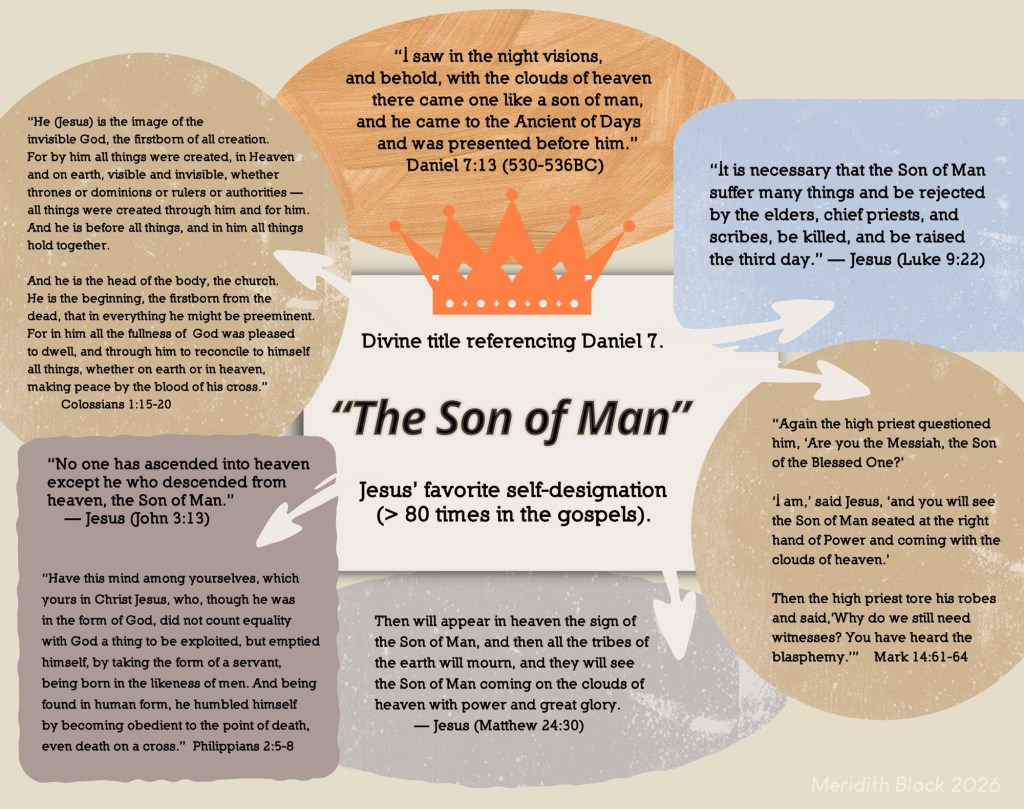
Written nearly 500 years before Jesus’ earthly ministry, Daniel described a vision he had of someone “like a son of man” sitting next to the Ancient of Days and coming on the clouds. It was this title, the Son of Man, which Jesus used most frequently for himself!
D.A. Carson unpacks Daniel 7:13-14 saying that “the messianic Son of Man…will exercise great power in judgment over rebellious nations along with provide salvation” to His sheep. [1]
Therefore, when Jesus stood before Caiaphas, a first-century Jewish High Priest, he knew Caiaphas would be keenly aware of his reference to Daniel’s vision.
“Again the high priest asked him, ‘Are you the Christ, the Son of the Blessed?’ And Jesus said, ‘I am, and you will see the Son of Man seated at the right hand of Power, and coming with the clouds of heaven.’ And the high priest tore his garments and said, ‘What further witnesses do we need?’” Mark 14:61-63 📕
It’s this Son of Man Stephen saw when he was martyred for preaching the Gospel:
“But Stephen, full of the Holy Spirit, looked intently into heaven and saw the glory of God and Jesus standing at the right hand of God. ‘Look,’ he said, ‘I see heaven open and the Son of Man standing at the right hand of God’” (Acts 7:55-56)
“While they were stoning him, Stephen appealed, ‘Lord Jesus, receive my spirit.’ Falling on his knees, he cried out in a loud voice, ‘Lord, do not hold this sin against them.’ And when he had said this, he fell asleep” (Acts 7:59-60).
Friends, God came down. The Creator of the universe put on humanity. The Judge of every soul was willing to be judged on our behalf. Jesus, the Son of Man, laid his life down for His sheep. He paid the debt that only humanity owed and rose again bodily — all for the sake of reconciling us back to Himself. Only God could do this for us. Think upon these things.
D.A. Carson and G.K. Beale; Commentary on the New Testament Use of the Old Testament: A Comprehensive Bible Commentary on Old Testament Quotations, Allusions & Echoes That Appear from Matthew through Revelation https://a.co/d/00yrSvv6
Made popular by Christian Apologist Dr. David Wood, the Islamic Dilemma is a logical argument revealing how the Quran openly “affirms the inspiration, preservation, and authority of the Jewish and Christian Scriptures (the Torah and the Gospel).” [1]
The Islamic Dilemma exposes Allah’s command, through the Quran, for Christians to judge the Quran by the Torah and the Gospel. In other words, the “previous Scriptures” are to be the straightedge.
Therefore, if the Christian Scriptures are to judge the Quran, then the Quran is false — because the Quran contradicts the Gospel on fundamental events and doctrine (eg. Jesus’s claims to be God as well as his crucifixion).
However, numerous Muslims claim that the Scriptures have been corrupted. But if the Torah and the Gospel have been corrupted, then the Quran is still false (because it promises the preservation of the Christian Scriptures). This dilemma implores both Muslims and Christians to study both books, investigating truth — which is what we should do (1 Thessalonians 5:21).
It should also be noted, as Islam claims, that the Quran was “revealed” to Muhammad between AD 610 and AD 632. If Allah is all-knowing and all-powerful, he would have known about any corruption that might have occurred with the biblical scriptures (Torah and the Gospels) and would not have made these commands.
The Muslim Scriptures (Quran) “affirm the inspiration, preservation, and authority of the Christian scriptures (including the Torah and the Gospel).” [4]
The Dilemma:
A. If the Torah and the Gospel are true (inspired and authoritative), then the Quran is false.
B. If the Torah and the Gospel are false (Allah did not preserve them), then the Quran is false.
“Recite what has been revealed to you from the Book of your Lord. None can change His Words, nor can you find any refuge besides Him.” Quran 18:27
The Quran promises the preservation of the Christian Scriptures, but if the Christian Scriptures have been corrupted, then Allah’s words can be changed, making the Quran false.
But if Allah did preserve the Bible, then the Quran is still false because it contradicts the Bible.
“Those who follow the Messenger, the unlettered prophet, whom they find written in what they have of the Torah and the Gospel, who enjoins upon them what is right and forbids them what is wrong and makes lawful for them the good things and prohibits for them the evil and relieves them of their burden and the shackles which were upon them. So they who have believed in him, honored him, supported him and followed the light which was sent down with him – it is those who will be the successful.” Quran 7:157
Allah commands that the “people of the Book” (Christians) should live by their book and judge the Quran by their Scriptures (Old and New Testaments).
The Christian Scriptures differ from the Quran on essential doctrines (per Dr. David Wood):
God is a Trinity (Matthew 28:18-20). The Son entered creation as Jesus of Nazareth (John 1:1-4). Jesus died on the cross for sins (Mark 10:32-34, 45). Jesus rose from the dead (Luke 24; 1 Cor 15).
“Say, ˹O Prophet,˺ ‘O People of the Book! You have nothing to stand on unless you observe the Torah, the Gospel, and what has been revealed to you from your Lord.’ And your Lord’s revelation to you ˹O Prophet˺ will only cause many of them to increase in wickedness and disbelief. So do not grieve for the people who disbelieve. (Al-Ma’idah 5:68)” Quran 5:68
“And when you come across those who ridicule Our revelations, do not sit with them unless they engage in a different topic. Should Satan make you forget, then once you remember, do not ˹continue to˺ sit with the wrongdoing people.” Quran 6:68
“He has revealed to you ˹O Prophet˺ the Book in truth, confirming what came before it, as He revealed the Torah and the Gospel previously, as a guide for people, and ˹also˺ revealed the Standard ˹to distinguish between right and wrong˺. Surely those who reject Allah’s revelations will suffer a severe torment. For Allah is Almighty, capable of punishment.” Quran 3:3-4
“If you ˹O Prophet˺ are in doubt about ˹these stories˺ that We have revealed to you, then ask those who read the Scripture before you. The truth has certainly come to you from your Lord, so do not be one of those who doubt,” Quran 10:94
“And let the people of the Gospel judge by what God sent down therein; and whoso judges not by what God has sent down: it is they who are the perfidious. So let the people of the Gospel judge by what Allah has revealed in it. And those who do not judge by what Allah has revealed are ˹truly˺ the rebellious. We have revealed to you ˹O Prophet˺ this Book with the truth, as a confirmation of previous Scriptures and a supreme authority on them. So judge between them by what Allah has revealed, and do not follow their desires over the truth that has come to you. To each of you We have ordained a code of law and a way of life. If Allah had willed, He would have made you one community, but His Will is to test you with what He has given ˹each of˺ you. So compete with one another in doing good. To Allah you will all return, then He will inform you ˹of the truth˺ regarding your differences.” Surah 5:47-49
Why is this important?
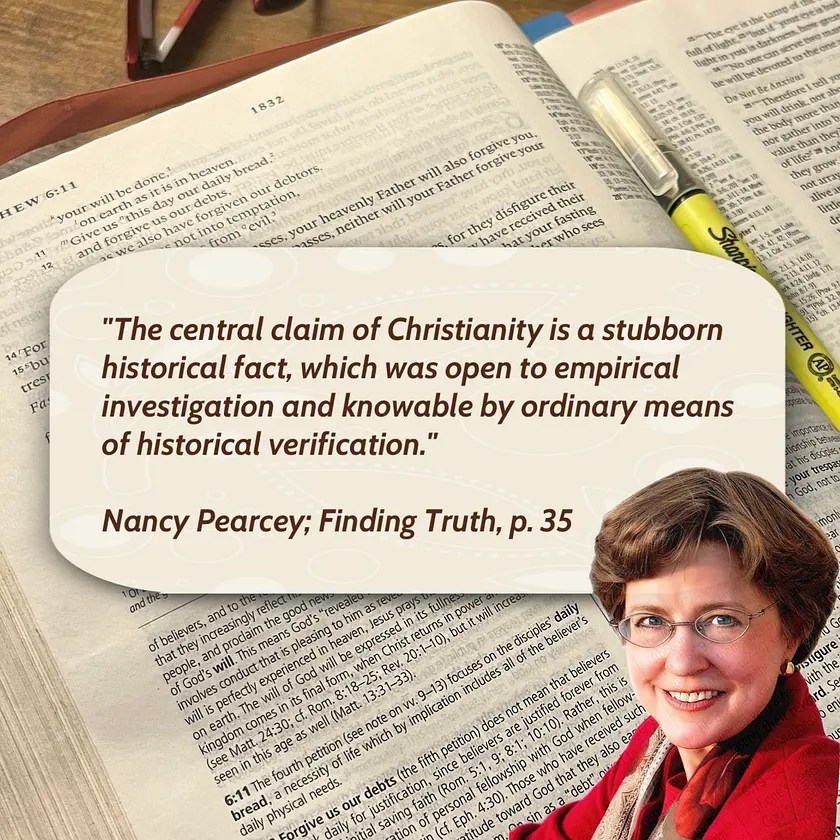
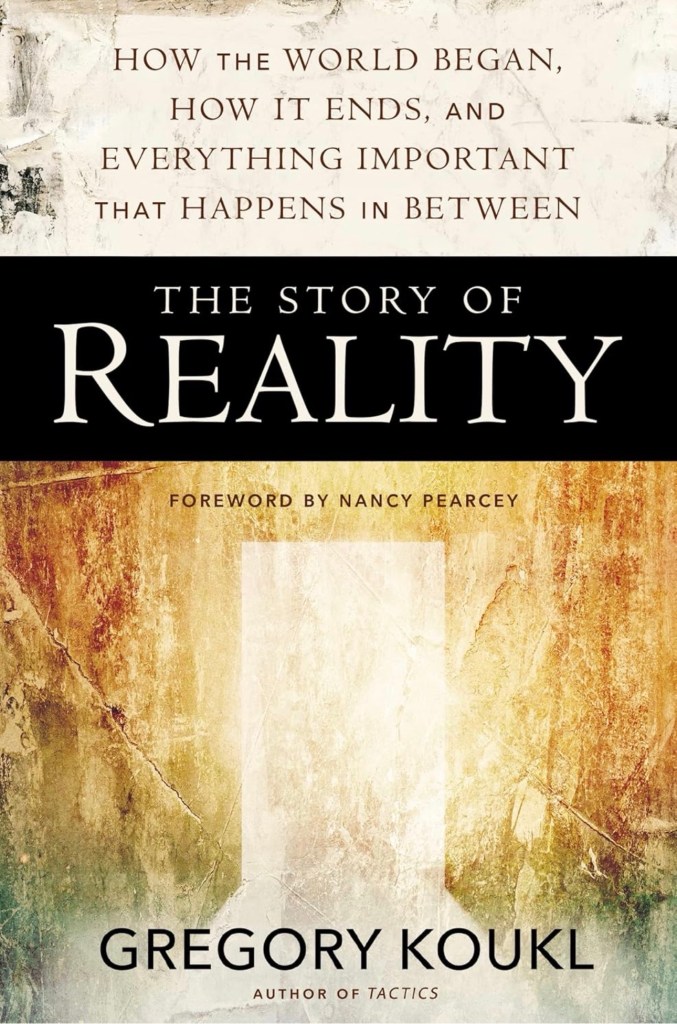
Every person has a view of the world (a worldview) that answers the major questions we all have: Who are we? How did we get here? What is our purpose? Why are we and this world so broken and yet so beautiful at the same time? From where did love come? How can the broken be made right? Nancy Pearcey, in her book Total Truth, explains that a worldview is like a “mental map that tells us how to navigate the world effectively (p.23). Pearcey contends that the biblical worldview (Christianity) best accounts for the truth of “total reality” and provides a “perspective for interpreting every subject matter” (p. 34).
“I am not a Christian because it works for me. I had a life prior to Christianity that seemed to be working just fine. And my life as a Christian hasn’t always been that easy.
I am a Christian because it’s true.
I’m a Christian because I want to live in a way that reflects the truth.
I’m a Christian because my high regard for truth gives me no alternative.”
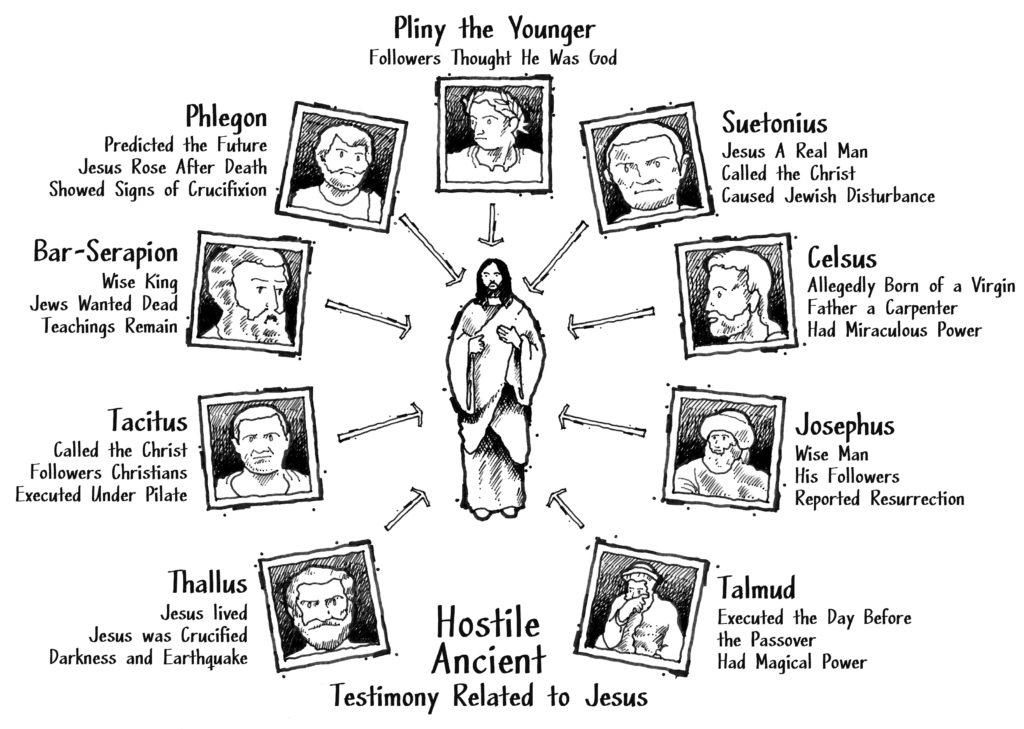
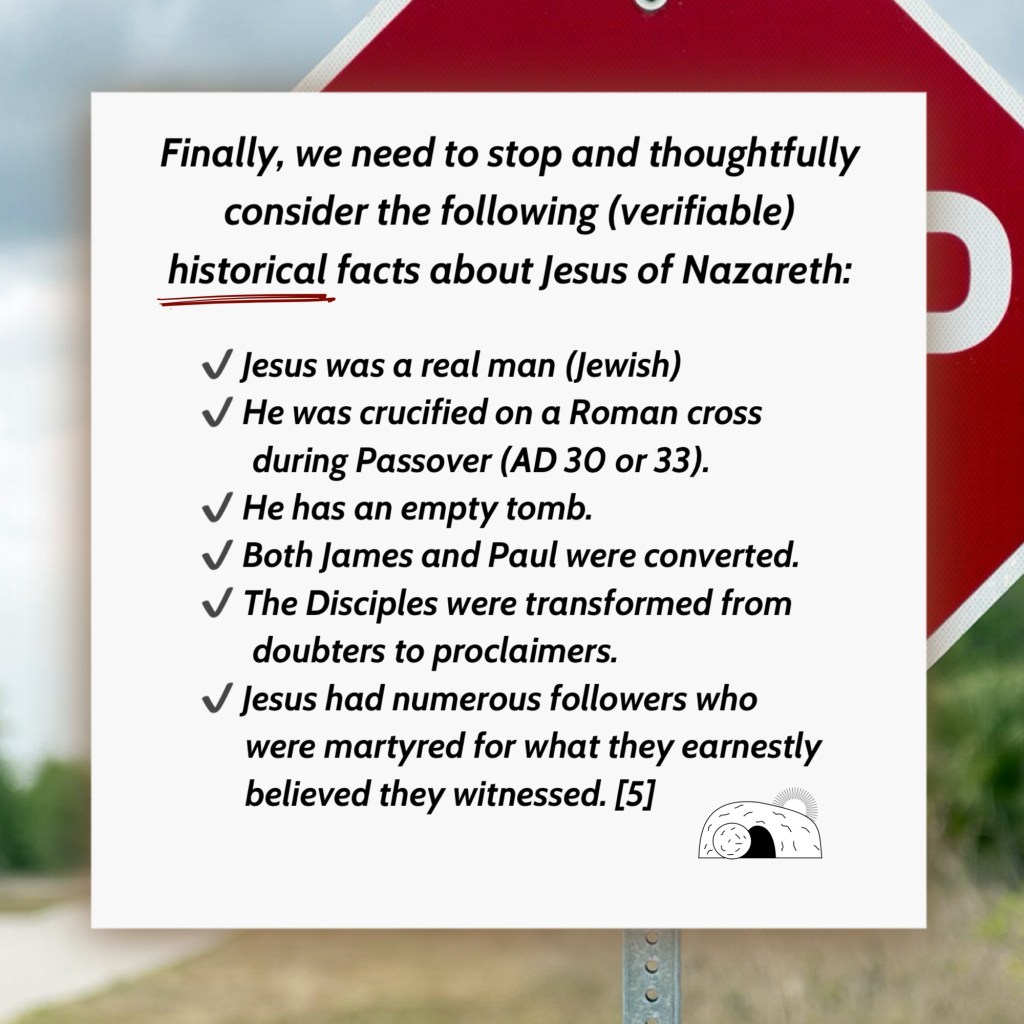
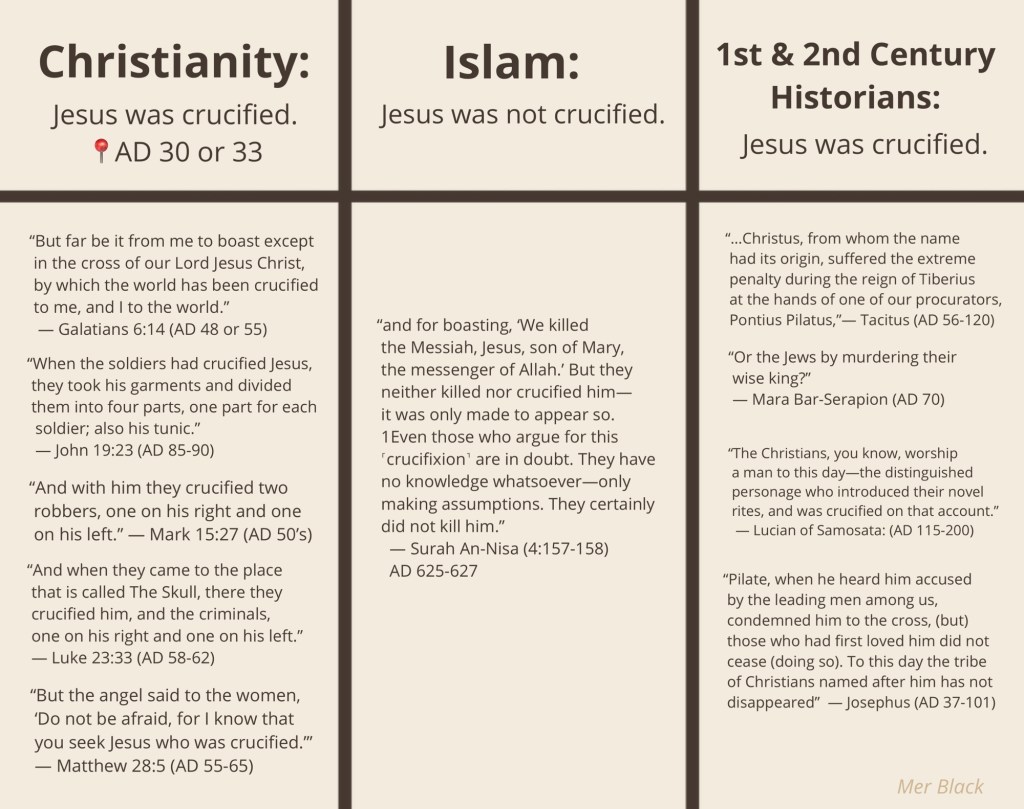
Nearly every major worldview (religion) today acknowledges that Jesus was a real man who performed wondrous deeds, was a good and wise teacher, and was crucified upon a Roman cross around AD 30 or 33. And while Islam denies that Jesus died on the Roman cross (Quran 4:157-158), the historical evidence says otherwise. The combined written testimonies of both Christian eyewitnesses (New Testament writers) and non-Christian historians (eg, Josephus, Pliny the Younger, Mara Bar Sarapion, Livy, and Tacitus) record this event as factual.
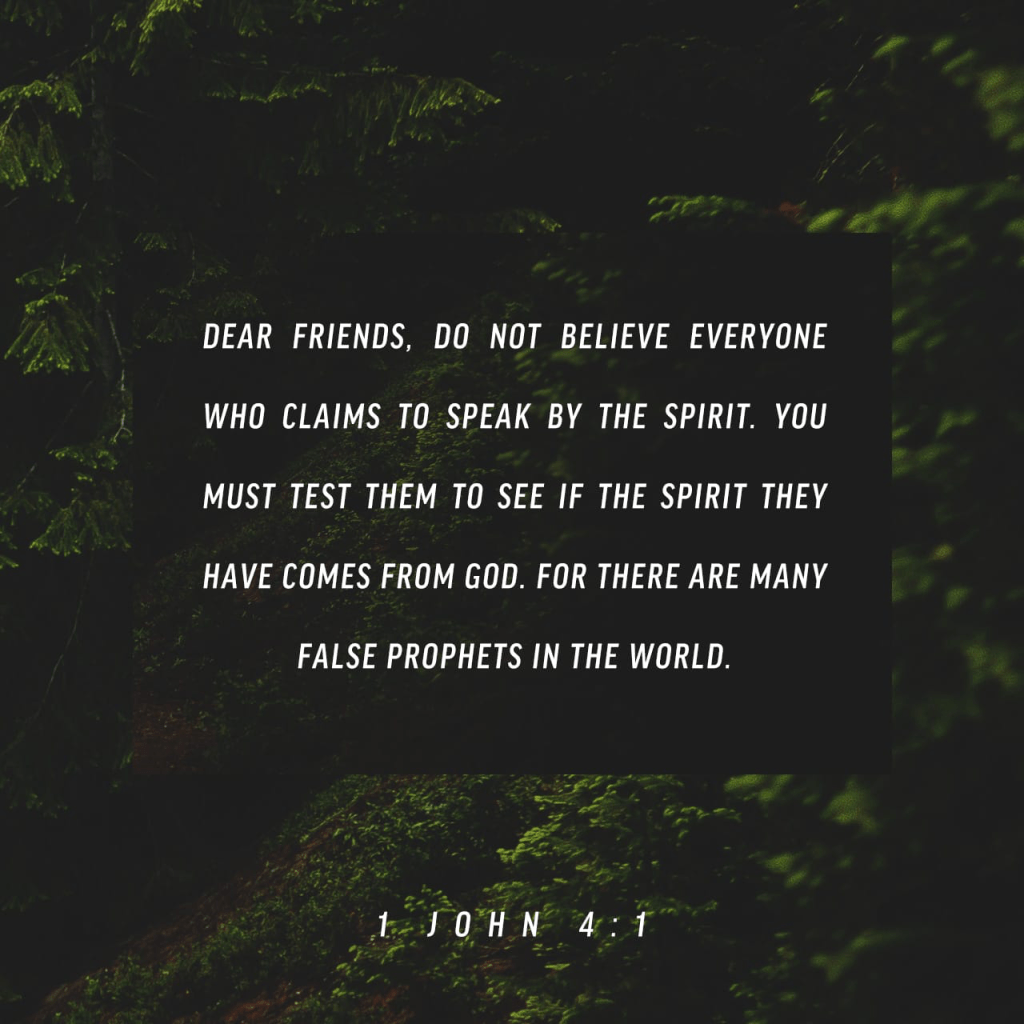
“Beloved, do not believe every spirit, but test the spirits to see whether they are from God, for many false prophets have gone out into the world. 2 By this you know the Spirit of God: every spirit that confesses that Jesus Christ has come in the flesh is from God, 3 and every spirit that does not confess Jesus is not from God. This is the spirit of the antichrist, which you heard was coming and now is in the world already.” (1 John 4: 1-3)
When someone tests the claims of Christianity, he or she has the option to trust those claims or not. However, upon examining those assertions, one thing is for certain: wishful thinking is no longer viable. The crucifixion either happened or it didn’t. And the bodily resurrection either occurred or it didn’t. Jesus either claimed to be God, or he didn’t. To not examine these assertions thoughtfully and responsibly is to build one’s home out of the wood of apathy, with its foundation on the shifting sands of relativism.
“but test everything; hold fast what is good.” (1 Thessalonians 5:21)
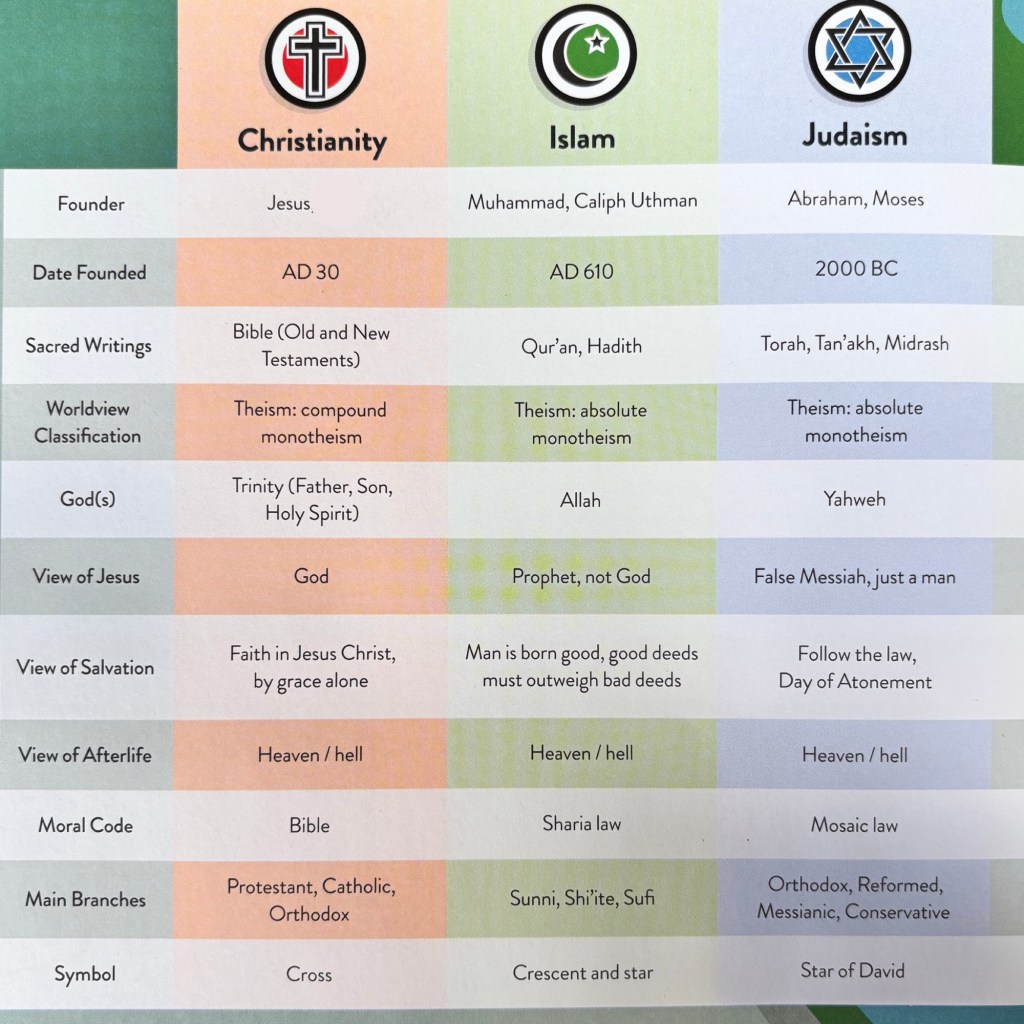
✔️The promised Messiah (fulfilling > 300 Old Testament prophecies); ✔️God (A); ✔️Died for the sins of humanity on a Roman cross in AD 30 or 33; ✔️Born of a virgin; ✔️Creator; ✔️Judge
✔️Prophet (A); ✔️Born of a virgin (B); ✔️Did not die on a cross (C); ✔️Judge (D); ✔️Just a man (E);
*It should be noted that “the Ebionites were not dominant followers of Jesus nor were they proto-Muslims.” (F)
✔️False Messiah (A); ✔️Just a man (B); ✔️Crucified by Pontius Pilate (C).
View of Salvation
Faith in Jesus (his work on our behalf); Grace alone.
Ephesians 2:1-10; Romans 10: 9-10
Man is born good; Good deeds must outweigh the bad deeds.
Christianity holds fast to a monotheistic worldview. This means that Christians view God as the one and only God: There is no other being like Him (Isaiah 45:5; Isaiah 46:9). Only God is the eternal, infinite, Holy, transcendent, uncreated Creator of everything (Genesis 1; Psalm 24; John 1:1-14; Colossians 1:15-20). This means that humanity is not God, nor can man ever become God. God alone is God for eternity. And humans stay humans, forever.
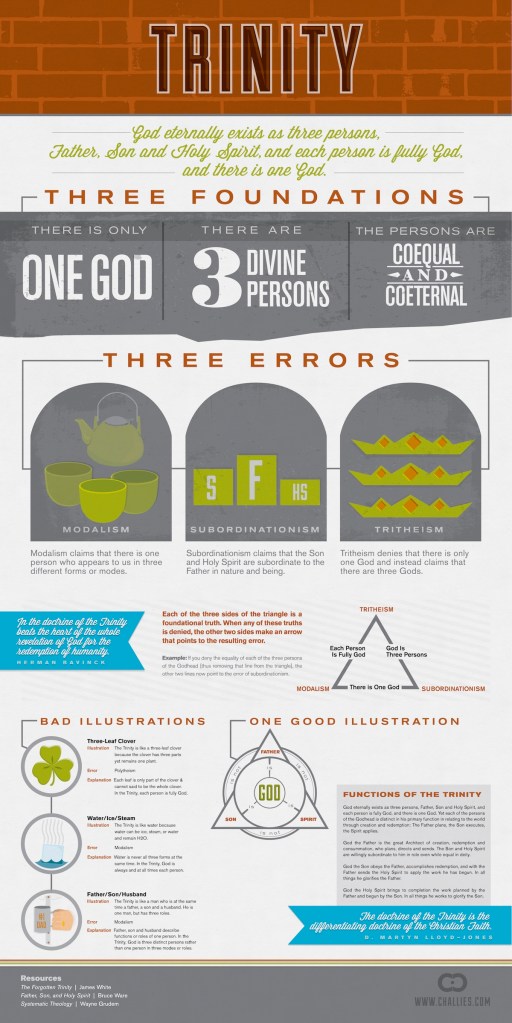
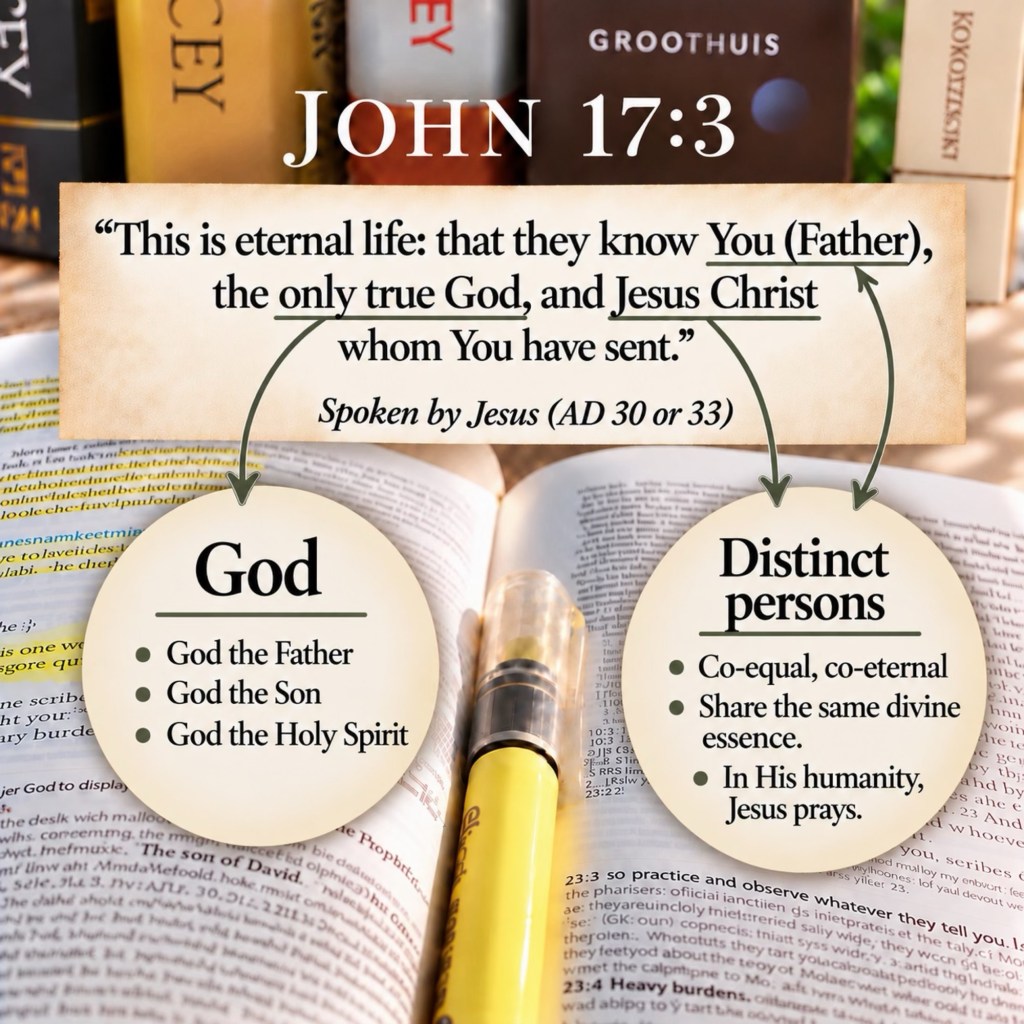
God is one essence or Being (what), and three coequal, coeternal Persons (who).
Christianity teaches the biblical view that God alone is self-sufficient. In other words, God is perfect, lacking nothing (Exodus 3:14; Isaiah 40:28; Isaiah 46:9; Romans 11:33. Therefore, if God were only the Father (one Person), he would need to create humanity to know love. This would demonstrate a lack within him. He would be imperfect. Wes Huff explains that “The Father has been loving the Son in the power of the Holy Spirit forever. God does not need to create to experience anything. [Instead,] creation is an outpouring of his love.” (source)
“In eternity past, the Father loved the Son and the Son loved the Father. Love is bound up in the very nature of God.” D.A. Carson (source)
This is why God, as a Trinity, best explains why God is Love (1 John 4). Even though the word Trinity is not found in the Bible, Scripture (both the Old and New Testaments) confirms the concept. God the Father, God the Son, and God the Holy Spirit have been loving one another from Eternity past. There is no lack of love (holiness, goodness, etc.) in the Godhead. There is no need to create anything to love because God is already Love. God’s love stands in stark contrast to our frail and self-focused affections. Instead, God’s love always has another’s best interest in mind. Viewing God as a Trinity, God is one essence (what) and three coequal, coeternal Persons (who), has been an essential teaching of Christianity from the very beginning.
“Go therefore and make disciples of all nations, baptizing them in the name of the Father and of the Son and of the Holy Spirit,” Jesus (Matthew 28:19)
“For to us a child is born, to us a son is given; and the government shall be upon his shoulder, and his name shall be called Wonderful Counselor, Mighty God, Everlasting Father, Prince of Peace.” (Isaiah 9:6)
“And when Jesus saw their faith, he said to the paralytic, ‘Son, your sins are forgiven.’ 6 Now some of the scribes were sitting there, questioning in their hearts, 7 ‘Why does this man speak like that? He is blaspheming! Who can forgive sins but God alone?’” (Mark 2:5-7)
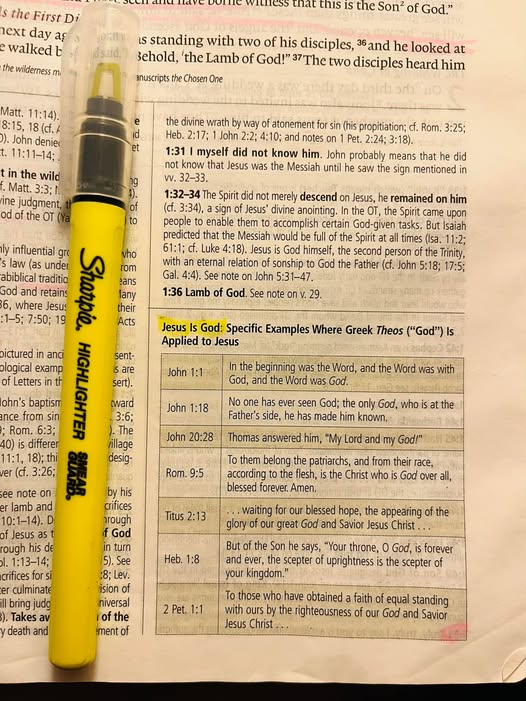
“In the beginning was the Word, and the Word was with God, and the Word was God. He was with God in the beginning. All things were created through him, and apart from him not one thing was created that has been created.He was in the world, and the world was created through him, and yet the world did not recognize him. He came to his own, and his own people did not receive him. But to all who did receive him, *he gave* them the right to be children of God, to those who believe in his name, who were born, not of natural descent, or of the will of the flesh, or of the will of man, but of God.The Word became flesh and dwelt among us. We observed his glory, the glory as the one and only Son from the Father, full of grace and truth.” (John 1:1-14)
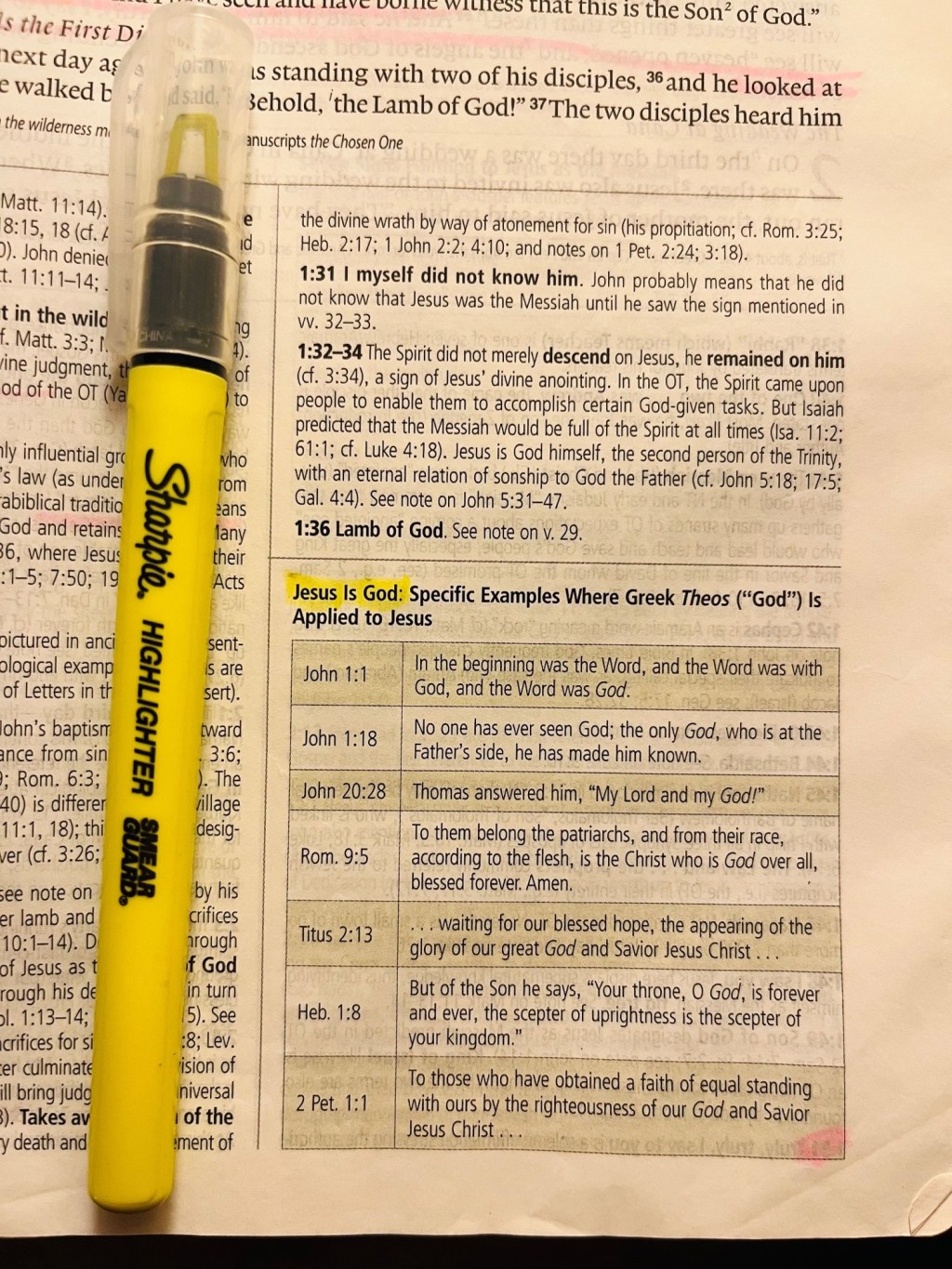
“No one has ever seen God; God the only Son,who is at the Father’s side, he has made him known” (John 1:18)
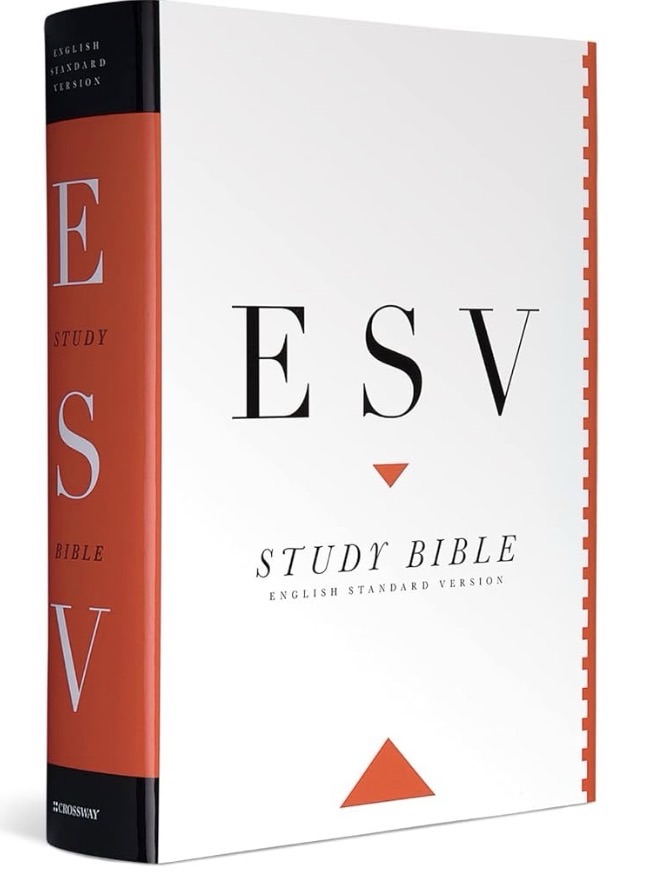
Page 2021 of the ESV Study Bible
And while God does not need anything (even us), he created us for his good and perfect purposes. Per GotQuestions.org, “Being created for God’s pleasure does not mean humanity was made to entertain God or provide Him with amusement. God is a creative Being, and it gives Him pleasure to create. God is a personal Being, and it gives Him pleasure to have other beings He can have a genuine relationship with.” (source)
“For by him all things were created, in heaven and on earth, visible and invisible, whether thrones or dominions or rulers or authorities — all things were created through him and for him.” (Colossians 1:16)
The Bible tells us that God created humanity in his image (Genesis 1:27), which does not imply that humanity is like God in our being (ontology). Instead, it refers to our God-given design for communication (with him), creativity (stewarding the resources given to us), relationship (resembling what God has as a Trinity), and the ability to love. God has given humanity the gift of Free Will so that love would be possible. Without the choice to love, love would not be an option.
Another important note to make is this: God is good, and therefore everything God creates is good. Genesis 1 attests to the goodness of God’s design! God made humanity with a body and a soul. Therefore, humanity is not just a soul, but both body and soul. And both have a good design because God made both (Genesis 1:26-27). This biblical perspective of God’s design of humanity differs drastically from the Docetic (Gnostic) perspective, drastically!
“Docestism is the viewpoint that our bodies are bad because the material world is bad or evil. “The word Docetism comes from the Greek dokein, which meant ‘to seem’; according to Docetism, Jesus Christ only seemed to have a human body like ours.” [14] This view finds it illogical for a infinte, holy God to wear a finite, sin-riddled humanity. Islam, Gnosticism, Perennial Wisdom, and the New Age Spirituality would agree with the Docetic interpretation of Jesus’s life, claiming that he could not have been God incarnate. Nor could a prophet from God die such a humiliating death (upon a Roman cross).
“For the word of the cross is folly to those who are perishing, but to us who are being saved it is the power of God. 19 For it is written,
‘I will destroy the wisdom of the wise, and the discernment of the discerning I will thwart.’”
Christian apologist GodLogic (Avery) dialogued with a Muslim via a livestream on YouTube about the essential doctrine of God’s incarnation (as Jesus of Nazareth). GodLogic helped this young man to understand that Christians recognize that humanity is a creation of God, and that no human can become God (as opposed to Mormonism and the New Age). Christians do not believe that we are divine. However, we do hold fast to the biblical teaching that God can become a man (see Isaiah 9:6 & Philippians 2). GL pointed to a teaching in the Quran, where Allah (believed by Muslims to be the infinite, uncreated Creator) chooses to protect creation by veiling himself in light (a creation). [15]
GodLogic, both respectfully and patiently, built a bridge with the Muslim caller, finding mutual agreement that God, being infinite and mighty, lovingly veiled himself with creation. For the Muslim, Allah chooses to withhold his glory (without losing his glory or might) with a created thing: light. For the Christian, we recognize Jesus as remaining the infinite, glorious God of the Universe, all the while adding upon himself a human nature. Jesus was fully God and fully human. To reiterate, Jesus did not become God nor was merely an enlightened man. Jesus was God incarnate. That is why Philippians 2:6-11 was an early creed of Christians (recorded in Paul’s letter to the Philippian church in AD 61-61).
“who (Jesus), existing in the form of God, did not consider equality with God as something to be exploited. 7 Instead he emptied himself by assuming the form of a servant, taking on the likeness of humanity. And when he had come as a man, 8 he humbled himself by becoming obedient to the point of death— even to death on a cross. 9 For this reason God highly exalted him and gave him the name that is above every name, 10 so that at the name of Jesus every knee will bow— in heaven and on earth and under the earth— 11 and every tongue will confess that Jesus Christ is Lord, to the glory of God the Father.” (Philippians 2:6-11)
What does it mean to be made in the Image of God, and how does this relate to the Gospel of God? Dr. David Wood unpacks what it means to be made in the image of God. This is an excellent resource!
20 minutes with Dr. David Wood.
“So God created man in his own image, in the image of God he created him; male and female he created them.” (Genesis 1:27)
We are created by a good God. All that God does is good. This means that our design is good (Genesis 1 and 2). Included in this design is our ability to choose. We are moral creatures. We have the God-given ability to choose either God’s way (his word/character) or our own way. In other words, can either follow God’s heart and do what is best for us, or follow our own hearts and do what seems right! Or as Frank Sinatra sang, “I’ll do it my way!”
Choosing our own way is straying from what is good and right. Therefore, forging our own path is choosing what is wrong and evil, for it goes against God’s guidance. When our first parents (Adam and Eve) chose to follow their own hearts instead of God’s heart, they essentially chose to pilot a good design with a less capable pilot. Because of this choice, we all have inherited a broken lens through which to operate what God has given us. Friends, we broke the world. We are the only ones to blame, not God.
“It’s your sins that have cut you off from God. Because of your sins, he has turned away and will not listen anymore.”(Isaiah 59:2)
“All we like sheep have gone astray; we have turned—every one—to his own way; and the Lord has laid on him the iniquity of us all.” (Isaiah 53:6)
What then? Are we Jews any better off? No, not at all. For we have already charged that all, both Jews and Greeks, are under sin, 10 as it is written:
(D)“None is righteous, no, not one; 11 no one understands; no one seeks for God. (Romans 3:9-11)
“for all have sinned and fall short of the glory of God,” (Romans 3:23)
“Therefore, just as sin came into the world through one man, and death through sin, and so death spread to all men because all sinned.” (Romans 5:12
But in his immense (charitable and steadfast) love for us, He did not leave us in this death-bound state. God had a plan. A plan set forth by the Father, the Son, and the Holy Spirit in eternity past. A boots-on-the-ground mission of God for humanity, carried out in real time and space. A plan that could not be thwarted.
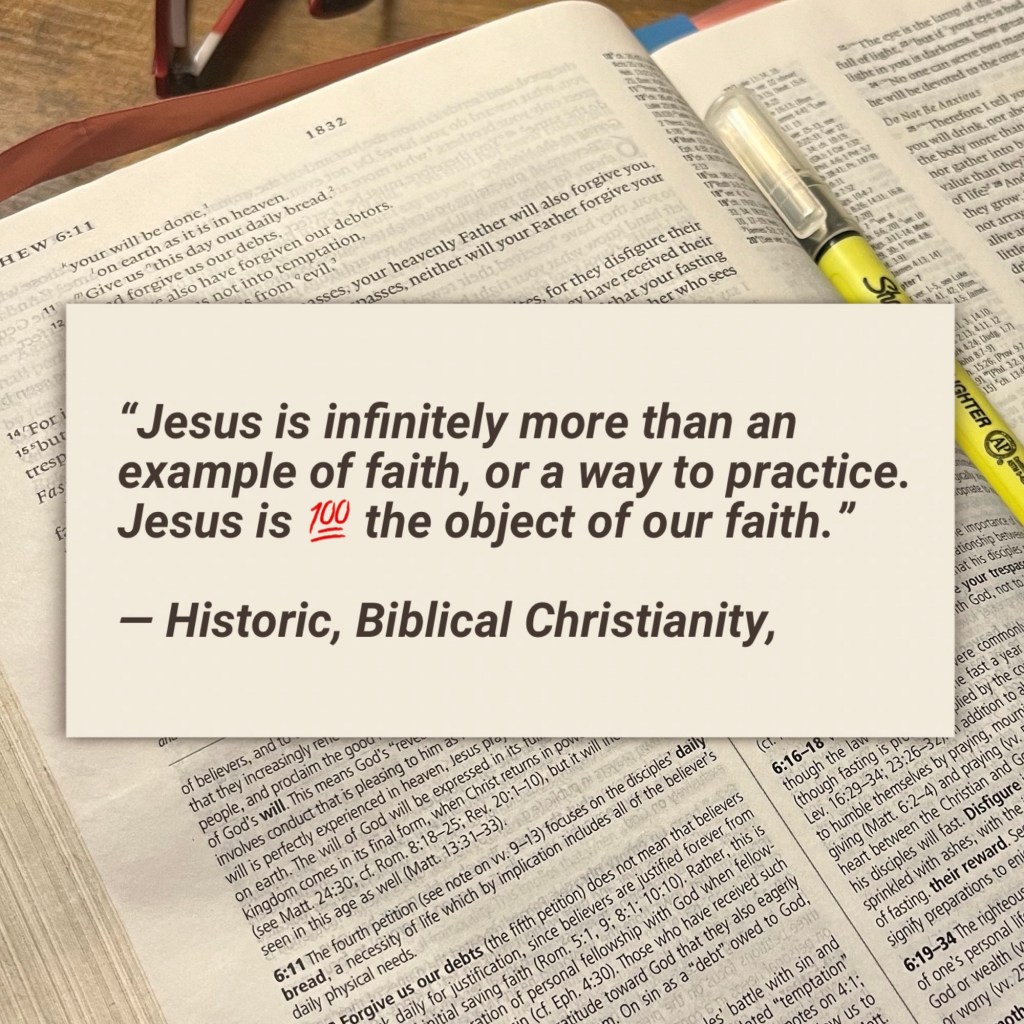
Friends, Jesus demonstrated in real time and space who He was (and still is). God’s love came down and put upon Himself a human nature to fulfill His promise: rescuing humanity (Ge 3:15; Jn 2:12; 3:26). This is captured vividly in Mark’s letter. Remaining fully God, fully veiled in a human nature, Jesus fulfilled the Law of God perfectly on our behalf. Going to the cross, Jesus paid the debt you and I owe, and raising bodily in a transformed body, Jesus made a way back to God which only God could make. Jesus’s work on our behalf saves us. As pastor and author Michael Horton articulates, “He suffered as God because only God had the power to save; He suffered as man because only man owed the debt.” You see, Jesus is not a mere model of faith for Christians… Jesus is the object of our faith.
“I will put enmity between you and the woman, and between your offspring and her offspring; he shall bruise your head, and you shall bruise his heel.” (Genesis 3:15)
“Surely he has borne our griefs and carried our sorrows; yet we esteemed him stricken, smitten by God, and afflicted. 5 But he was pierced for our transgressions; he was crushed for our iniquities; upon him was the chastisement that brought us peace, and with his wounds we are healed. 6 All we like sheep have gone astray; we have turned—every one—to his own way; and the Lord has laid on him the iniquity of us all.” (Isaiah 53:4-6)
“but God shows his love for us in that while we were still sinners, Christ died for us.“ (Romans 5:8)
“He committed no sin, neither was deceit found in his mouth. 23 When he was reviled, he did not revile in return; when he suffered, he did not threaten, but continued entrusting himself to him who judges justly. 24 He himself bore our sins in his body on the tree, that we might die to sin and live to righteousness. By his wounds you have been healed. 25 For you were straying like sheep, but have now returned to the Shepherd and Overseer of your souls.” (1 Peter 2:22-25)
God’s plan of salvation for humanity was not just for those living in the first century, but it is for all of humanity. Every human needs to be saved from his or her sin. This plan was retroactive for those living before God’s incarnation as well as for those who would come afterwards. It’s for this very reason that God both planned and superintended the construction of the Bible so that we can all know his plan of salvation.
“Then he (Jesus) said to them, ‘These are my words that I spoke to you while I was still with you, that everything written about me in the Law of Moses and the Prophets and the Psalms must be fulfilled.’ 45 Then he opened their minds to understand the Scriptures, 46 and said to them, ‘Thus it is written, that the Christ should suffer and on the third day rise from the dead, 47 and that repentance for the forgiveness of sins should be proclaimed in his name to all nations, beginning from Jerusalem. 48 You are witnesses of these things. 49 And behold, I am sending the promise of my Father upon you. But stay in the city until you are clothed with power from on high.‘” (Luke 24:44-49)
“Inasmuch as many have undertaken to compile a narrative of the things that have been accomplished among us, 2 just as those who from the beginning were eyewitnesses and ministers of the word have delivered them to us, 3 it seemed good to me also, having followed all things closely for some time past, to write an orderly account for you, most excellent Theophilus, 4 that you may have certainty concerning the things you have been taught.” (Luke 1:1-4)
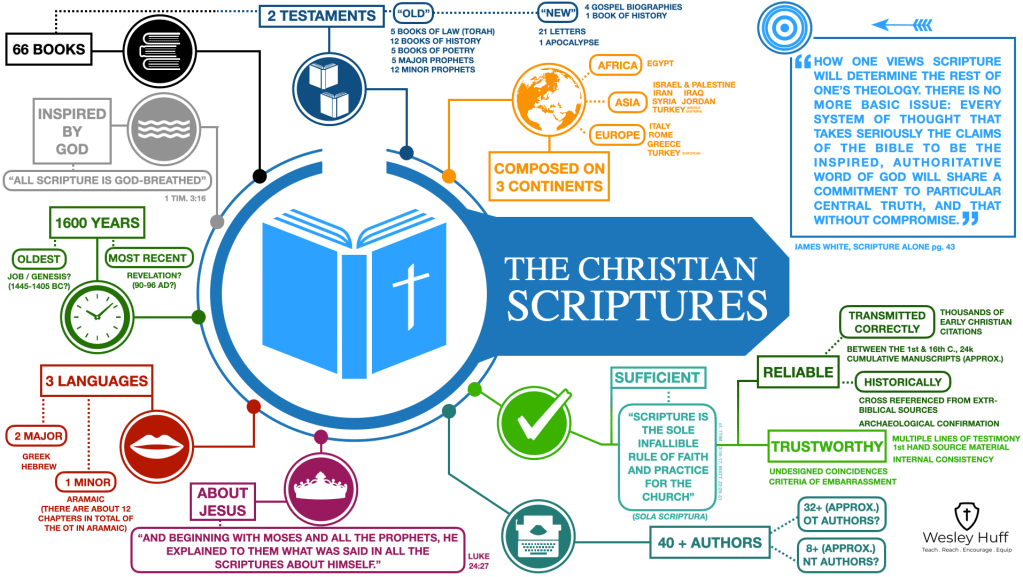
The Bible is a codex of 66 books penned by more than 40 writers on 3 different continents (Africa, Europe, and Asia), in 3 different languages (Hebrew, Aramaic, and Greek), with a steadfast message testifying to God as the One True God who is faithful to save. Per John Wenham, from his book Christ and the Bible, “To him (Jesus), what Scripture says, God says” (p. 17).
Infographic: Wes Huff
“Then the Lord said to Moses, ‘Writethis as a memorial in a book and recite it in the ears of Joshua, that I will utterly blot out the memory of Amalek from under heaven.’” Exodus 17:14
“But the Helper, the Holy Spirit, whom the Father will send in my name, he will teach you all things and bring to your remembrance all that I have said to you.” John 14:26
“I do not ask for these only, but also for those who will believe in me through their word, ” John 17:20
The late Voddie Baucham described the Bible in this way: “I choose to believe the Bible because it’s a reliable collection of historical documents written by eyewitnesses, during the lifetime of other eyewitnesses…who report supernatural events that took place in fulfillment of specific prophecies, and claim their writings are divine rather than human in origin” (here is the quote source).
“For whatever was written in former days was written for our instruction, that through endurance and through the encouragement of the Scriptures we might have hope.” (Romans 15:4)
“For we did not follow cleverly devised myths when we made known to you the power and coming of our Lord Jesus Christ, but we were eyewitnesses of his majesty. 17 For when he received honor and glory from God the Father, and the voice was borne to him by the Majestic Glory, “This is my beloved Son, with whom I am well pleased,” 18 we ourselves heard this very voice borne from heaven, for we were with him on the holy mountain. 19 And we have the prophetic word more fully confirmed, to which you will do well to pay attention as to a lamp shining in a dark place, until the day dawns and the morning star rises in your hearts, 20 knowing this first of all, that no prophecy of Scripture comes from someone’s own interpretation. 21 For no prophecy was ever produced by the will of man, but men spoke from God as they were carried along by the Holy Spirit.” (2 Peter 1:16-21)
“But as for you, continue in what you have learned and have firmly believed, knowing from whom you learned it 15 and how from childhood you have been acquainted with the sacred writings, which are able to make you wise for salvation through faith in Christ Jesus. 16 All Scripture is breathed out by God and profitable for teaching, for reproof, for correction, and for training in righteousness, 17 that the man of God may be complete, equipped for every good work.” (2 Timothy 3:14-17)
Where did Christianity get its name?
Per historian Justo L. Gonzalez, “The early Christians did not believe that they were following a new religion (worldview). They were Jews, and their main difference with the rest of Judaism was that they were convinced that the Messiah (Christ) had come, whereas other Jews continued awaiting his advent.” (p. 41) [2] Nancy Pearcey says it this way in her book Finding Truth, “The Christian message does not begin with ‘accept Christ as your Savior’; it begins with ‘in the beginning God created the heavens and the earth’” (p.45).
Initially, the Romans viewed early Christians as a variant sect of Judaism. That is, until people from outside of Judaism became followers of Jesus as well. The title “Christian” was given to them by authorities in Antioch to designate them as a group (Acts 11:26; 1 Peter 4:16).
Early Christians believed that Jesus had fulfilled the prophecies about the Messiah in the Old Testament. The works Jesus had performed, and the worship he had received, made it clear to these early Christians that Jesus was who he claimed to be: God incarnate.
Do we have the original message?
One objection cited by numerous Muslim apologists (regarding the Islamic Dilemma) is that Allah was speaking about the inspiration, preservation, and authority of the original Torah and Gospel. It’s their belief that what we have today is not the original but is instead a corrupted version.
So how do we know that what we have today matches the original?
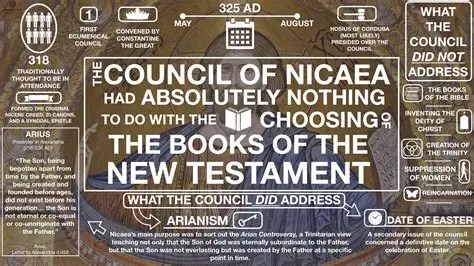
To know if we have an accurate message in our Bibles today, we need to examine if the copies were early, plentiful (for cross-checking and comparing), and consistent (or were they altered after the originals). It’s also important to address the role of the Council of Nicaea (AD 325) in church history and whether this council had any say in what books were inspired (authoritative).
Early
What did the earliest followers of Jesus teach? This is crucial! This is what the Islamic Dilemma is addressing. In order to do this with integrity, let’s go to the Gospel letter thought to be the earliest of the four gospel accounts by numerous scholars — Mark. The Gospel of Mark was recorded with “internal and external data pointing to Rome as the place of composition around the mid-to-late 50’s.”[3] And while Mark was not an eyewitness to Jesus’s earthly ministry, he wrote Peter’s testimony with care and urgency.
Jesus’s crucifixion most likely occurred in A.D. 30 or 33; therefore, the documentation provided by Mark is approximately 20 years later. This is incredible news when referring to ancient documents! For example, the first written copy of Caesar’s Gallic Wars appeared approximately 950 years later, with the first extant copy of Tacitus’s Annals showing up 1,000 years afterwards! [4]
“Famous British manuscript expert Sir Frederick Kenyon summed up the matter well when he declared that: ‘The interval between the dates of original composition and the earliest extant evidence becomes so small as to be in fact negligible, and the last foundation for any doubt that the Scriptures have come down substantially as they were written has now been removed. Both the authenticity and the general integrity of the books of the New Testament may be regarded as finally established‘ (Kenyon, The Bible and Archaeology, 288).” Norman Geisler (source)
Given that Mark’s letter was Peter’s eyewitness account of Jesus’ teachings and miracles, we would expect the earliest eyewitness report to boldly acknowledge Jesus’s self-proclamations to be the long-awaited Messiah (God the Son, incarnate). And if we take time to actually study Mark for ourselves, we would find Jesus demonstrating his identity as God incarnate in nearly every single chapter of Mark! We just need to read the texts versus readily believing every online pundit (this includes me).
It should also be noted that both Paul and Peter were martyred at the hands of Nero in the mid to late 60s AD. This means that every letter written by these two men was within 20-35 years after the crucifixion and bodily resurrection of Jesus (250-300 years before the council of Nicaea). Here is a powerful example of how the events recounted by Peter in Mark’s letter parallel those of Psalm 22.
Mark 15
“And when the sixth hour had come, there was darkness over the whole land until the ninth hour. 34 And at the ninth hour Jesus cried with a loud voice, ‘Eloi, Eloi, lema sabachthani?’ which means, ‘My God, my God, why have you forsaken me?’ 35 And some of the bystanders hearing it said, ‘Behold, he is calling Elijah.’ 36 And someone ran and filled a sponge with sour wine, put it on a reed and gave it to him to drink, saying, ‘Wait, let us see whether Elijah will come to take him down.’ 37 And Jesus uttered a loud cry and breathed his last. 38 And the curtain of the temple was torn in two, from top to bottom. 39 And when the centurion, who stood facing him, saw that in this way he breathed his last, he said, ‘Truly this man was the Son of God!’” (Mark 15)
“Then he said to them, ‘These are my words that I spoke to you while I was still with you, that everything written about me in the Law of Moses and the Prophets and the Psalms must be fulfilled.’ 45 Then he opened their minds to understand the Scriptures, 46 and said to them, ‘Thus it is written, that the Christ should suffer and on the third day rise from the dead, 47 and that repentance for the forgiveness of sins should be proclaimed in his name to all nations, beginning from Jerusalem. 48 You are witnesses of these things. 49 And behold, I am sending the promise of my Father upon you. But stay in the city until you are clothed with power from on high.’” (Luke 24:44-49)
Psalm 22
“My God, my God, why have you forsaken me? Why are you so far from saving me, from the words of my groaning? 2 O my God, I cry by day, but you do not answer, and by night, but I find no rest. 3 Yet you are holy, enthroned on the praises of Israel. 4 In you our fathers trusted; they trusted, and you delivered them. 5 To you they cried and were rescued; in you they trusted and were not put to shame. 6 But I am a worm and not a man, scorned by mankind and despised by the people. 7 All who see me mock me; they make mouths at me; they wag their heads; 8 “He trusts in the Lord; let him deliver him; let him rescue him, for he delights in him!” 9 Yet you are he who took me from the womb; you made me trust you at my mother’s breasts. 10 On you was I cast from my birth, and from my mother’s womb you have been my God. 11 Be not far from me, for trouble is near, and there is none to help. 12 Many bulls encompass me; strong bulls of Bashan surround me; 13 they open wide their mouths at me, like a ravening and roaring lion. 14 I am poured out like water, and all my bones are out of joint; my heart is like wax; it is melted within my breast; 15 my strength is dried up like a potsherd, and my tongue sticks to my jaws; you lay me in the dust of death. 16 For dogs encompass me; a company of evildoers encircles me; they have pierced my hands and feet— 17 I can count all my bones— they stare and gloat over me; 18 they divide my garments among them, and for my clothing they cast lots. 19 But you, O Lord, do not be far off! O you my help, come quickly to my aid! 20 Deliver my soul from the sword, my precious life from the power of the dog! 21 Save me from the mouth of the lion! You have rescued me from the horns of the wild oxen! 22 I will tell of your name to my brothers; in the midst of the congregation I will praise you: 23 You who fear the Lord, praise him! All you offspring of Jacob, glorify him, and stand in awe of him, all you offspring of Israel! 24 For he has not despised or abhorred the affliction of the afflicted, and he has not hidden his face from him, but has heard, when he cried to him. 25 From you comes my praise in the great congregation; my vows I will perform before those who fear him. 26 The afflicted shall eat and be satisfied; those who seek him shall praise the Lord! May your hearts live forever! 27 All the ends of the earth shall remember and turn to the Lord, and all the families of the nations shall worship before you. 28 For kingship belongs to the Lord, and he rules over the nations. 29 All the prosperous of the earth eat and worship; before him shall bow all who go down to the dust, even the one who could not keep himself alive. 30 Posterity shall serve him; it shall be told of the Lord to the coming generation; 31 they shall come and proclaim his righteousness to a people yet unborn, that he has done it.”
But even before Mark’s letter was a creed which was sung by Christians, soon after Jesus’s crucifixion and bodily resurrection. Paul knew of this creed. He later penned this creed of the early church into his first letter to the church in Corinth (mid-50’s AD), a decade before his martyrdom by Nero (AD 64).
“For I delivered to you as of first importance what I also received: that Christ died for our sins in accordance with the Scriptures, 4 that he was buried, that he was raised on the third day in accordance with the Scriptures, 5 and that he appeared to Cephas, then to the twelve. 6 Then he appeared to more than five hundred brothers at one time, most of whom are still alive, though some have fallen asleep. 7 Then he appeared to James, then to all the apostles. 8 Last of all, as to one untimely born, he appeared also to me.” (1 Corinthians 15:3-8)
Even atheist New Testament scholars agree that this creed was remarkably early! Friends, this was nearly 300 years before the Council of Nicaea. [5]
“Gerd Lüdemann: An atheistic NT professor at Göttingen, Lüdemann dates the elements in the tradition to the first two years after the crucifixion of Jesus, as mentioned in various sources. You can find his arguments in The Resurrection of Jesus: History, Experience, Theology (Fortress, 1994)’ [6]
What does this teachable song (creed) communicate?
✔️Jesus of Nazareth was a real man (Jewish). ✔️Jesus died for our sins. ✔️Jesus’s life, death, and bodily resurrection were promised in the Hebrew Scriptures (Old Testament). ✔️Jesus appeared bodily to Peter, James, the Disciples, and 500+ people (at one time). These were eyewitnesses available for fact-checking. ✔️This creed was proclaimed, sung, & written down very early — within months of Jesus’s bodily resurrection in either AD 30 or 33. It existed before Paul’s conversion.
Plentiful
Not only are the New Testament documents early, but they are also plentiful!! Per Andreas Köstenberger and Michael Kruger in their book TheHeresy of Orthodoxy, “By contrast, the New Testament manuscripts stand out as entirely unique in this regard. Although the exact count is always changing, currently we possess over 5,500 manuscripts (in whole or in part) of the New Testament in Greek alone. No other document of antiquity even comes close. Moreover, we possess thousands more manuscripts in other languages” (pgs 207-208). As Dr. Daniel Wallace often recounts, “We have an embarrassment of riches” when it comes to the number of copies we’ve been given!
Having numerous copies affords us the ability to compare and contrast the documents with one another. With thousands of copies at hand, we are thereby able to locate spelling differences as well as scrutinize whether doctrinal changes have been made. And while textual critics have identified more than 400,000 differences among the 5,500 Greek manuscripts, 99% of these differences (“variants”) were attributed to spelling differences. The conclusion: no significant doctrinal differences exist! This is preservation!!
Regarding preservation versus corruption, someone (monk, scribe, etc) would have had to change hundreds of copies of manuscripts in Greek, Coptic, Latin, and other languages, all the while keeping it all secret. This is implausible.
Consistent
So far, we have pointed out the early nature of the New Testament documents and the abundance of copies available to us today (by the sovereignty of God). Due to the plentiful nature of the manuscripts, we can compare and contrast them with academic scrutiny for any doctrinal changes. We can then conclude that the message we have today is consistent with the earliest manuscripts, pointing to the preservation of the Gospels.
“New Testament textual transmission didn’t happen in a single line of succession but rather in multiple streams, with many people making many copies, creating a wealth of manuscript data.” Wes Huff (source)
The reality is that our current Bibles are constructed (except for the New World Translation and the Passion Translation) from the earliest copies of both the Old and New Testament documents (not from the most recent). With this in view, how then do we address the TikTok apologists who fervently and confidently look to the Council of Nicaea to discredit the Bible’s authority and preservation?
The Council of Nicaea
Is it historically accurate to assert that a fourth-century church council was responsible for creating the biblical canon? Let’s take a look an objective look at history and assess this popular claim!
“There is no historical basis for the idea that Nicaea established the canon and created the Bible.” Dr. John M. Meade (source)
When looking into the reliability of ancient documents, Wes Huff has become a trusted resource! In his article, What Happened at the Council of Nicaea, Huff explains, “One of the main characters in the Da Vinci Code, Leigh Teabing, states at one point that, “Constantine commissioned and financed a new Bible, which omitted those gospels that spoke of Christ’s human traits and embellished those gospels that made him godlike” (Brown, 325). These sorts of ideas didn’t start with Dan Brown; the story in one form or another has been floating around for decades and even centuries before any such works of popular fiction.” [8]
Infographic made by Wes Huff
John M. Meade, the director of the Text and Canon Institute, speaks to the “works of popular fiction” as mentioned by Wes Huff: “Voltaire earlier mentions that Constantine convened the council. At Nicaea, then, the fathers distinguished the canonical from the apocryphal books by prayer and a miracle. The publication of Pappus’s 1601 edition of Synodicon Vetus—and the subsequent citing of the miracle at Nicaea, especially by Voltaire in his Dictionary—appears to be the reason Dan Brown could narrate the events so colorfully and why many others continue to perpetuate this legend.” [9]
So what exactly happened at the Council of Nicaea in AD 325?
Per ancient documents specialist Wes Huff, “The first Council of Nicaea, which took place between May and August in 325 AD in what is now İznik, Turkey, was an ecumenical council called to deal with a specific theological problem. Its purpose was to sort out the Arian Controversy – a Trinitarian heresy being promoted by a presbyter in North Africa named Arius, teaching not only that the Son of God was eternally subordinate to the Father, but that the Son was not everlasting but created by God the Father at a specific point in time. Arius, in his letter to Alexandria, wrote that: “The Son, being begotten apart from time by the Father, and being created and founded before ages, did not exist before his generation… the Son is not eternal or co-equal or co-unoriginate with the Father” (Letter to Alexandria 4:458). [8]
Neither the Roman Emperor Constantine nor the bishops present at the Council of Nicaea created the biblical canon we have today. Instead, the bishops simply acknowledged the biblical canon, utilizing those books already recognized as authoritative as their standard (canon) for determining what Jesus taught about his identity (divinity).
Christian apologist and author Michael Kruger puts it this way, “The bottom line is that the earliest Christians didn’t really have to ‘choose’ the four gospels from among all the others. Rather the four canonical gospels were simply the ones that had been there from the very beginning. The early church didn’t pick the gospels, but inherited them.” [12] Oh, and the council also discussed the date of Easter. But there is no mention of these men creating the concept of the Trinity, the divinity of Jesus, or the canon of Scriptures.
🚨Something to consider: If Allah revealed His Word (Quran) to Muhammad between AD 610 and AD 632, as Muslims purport, then he should have known about the Council of Nicaea, because it took place three hundred years prior. Therefore, if he had known of any corruption, he would not have encouraged Muhammad to seek out the “previous Scriptures” for wisdom. Again, something to chew upon.
9 minutes
Christian Attestation (1st and 2nd centuries) Prior to Nicaea
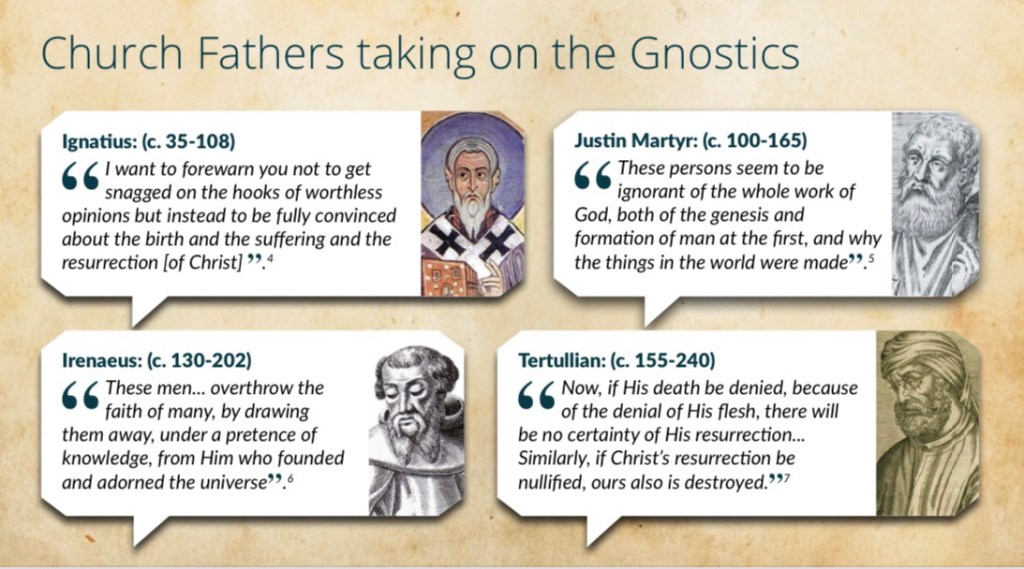
Christian apologist Tim Barnett explains that “Many people think Emperor Constantine invented the deity of Christ in the fourth century, but a look at quotes from the early church fathers shows this is an egregious misrepresentation of the facts. In my mentoring letter this month, I offered a short list of quotations to demonstrate that the early church believed Jesus is God. Now I’d like to make the argument even stronger by offering thirty-six quotations from nine different early church fathers. All of these quotations predate the Council of Nicea.” [10]
Here are 3 quotes from Barnett’s article:
“Polycarp (AD 69-155) was the bishop at the church in Smyrna. Irenaeus tells us Polycarp was a disciple of John the Apostle. In his Letter to the Philippians he says,
‘Now may the God and Father of our Lord Jesus Christ, and the eternal high priest himself, the Son of God Jesus Christ, build you up in faith and truth…and to us with you, and to all those under heaven who will yet believe in our Lord and God Jesus Christ and in his Father who raised him from the dead.’”1
“Justin Martyr (AD 100-165) was an Christian apologist of the second century.
‘And that Christ being Lord, and God the Son of God, and appearing formerly in power as Man, and Angel, and in the glory of fire as at the bush, so also was manifested at the judgment executed on Sodom, has been demonstrated fully by what has been said.’”
“Irenaeus of Lyons (AD 130-202) was bishop of Lugdunum in Gaul, which is now Lyons, France. Irenaeus was born in Smyrna in Asia Minor, where he studied under bishop Polycarp, who in turn had been a disciple of John the Apostle.
‘For I have shown from the Scriptures, that no one of the sons of Adam is as to everything, and absolutely, called God, or named Lord. But that He is Himself in His own right, beyond all men who ever lived, God, and Lord, and King Eternal, and the Incarnate Word, proclaimed by all the prophets, the apostles, and by the Spirit Himself, may be seen by all who have attained to even a small portion of the truth. Now, the Scriptures would not have testified these things of Him, if, like others, He had been a mere man…. He is the holy Lord, the Wonderful, the Counselor, the Beautiful in appearance, and the Mighty God, coming on the clouds as the Judge of all men;—all these things did the Scriptures prophesy of Him.’”
As these quotes vividly demonstrate, two hundred years before the Council of Nicaea, Jesus was worshipped as God. What is equally critical to acknowledge is that these men quoted the New Testament Scriptures in their writings (again, well before the Council of Nicaea)! For example, Polycarp, who was a disciple of John, quoted 17 of the 27 NT letters in his cover letter to the Philippian church! These men knew that God’s inspired word was given by God through men to men, relayed through eyewitness accounts, not speculations and myths.
“We ourselves heard this very voice borne from heaven, for we were with him on the holy mountain. 19 And we have the prophetic word more fully confirmed, to which you will do well to pay attention as to a lamp shining in a dark place, until the day dawns and the morning star rises in your hearts, 20 knowing this first of all, that no prophecy of Scripture comes from someone’s own interpretation. 21 For no prophecy was ever produced by the will of man, but men spoke from God as they were carried along by the Holy Spirit.” (2 Peter 1:18-21)
Why are the Gnostic Gospels excluded?
Why weren’t the Gnostic gospels grafted into the biblical canon? The reasons for this are rational: 1) The Gnostic gospels were written inthe 2nd century, well after the eyewitnesses were gone (no one to fact-check their stories), and 2) the content of these books did not match the teachings of Jesus (as documented by his Disciples/eyewitnesses).
Michael Kruger holds no punches in describing Gnosticism as “a heretical version of Christianity.” [11] The Gnostic gospels promulgated a flawed and warped spin of Christianity, which counters biblical Christianity on fundamental matters: Jesus’s divinity, Jesus’s incarnation, and Jesus’s resurrection. Wes Huff elaborates:
“Historical Christianity pretty clearly states that salvation is something outside of you that’s imparted to you by the finished work of Christ on the cross, but in Gnosticism, salvation is something that’s inside of you, and you realize it by understanding and knowing the secret knowledge that not only is Jesus divine, but you’re divine, and you can unlock that divinity.
So, a lot of the Gnostic gospels are nonsensical, and nonsensical on purpose. And they’re nonsensical on purpose because the idea is, if you understand them, then it’s because you understand the secret knowledge. If you don’t understand them, it’s because you don’t understand the secret knowledge. Sometimes you’ll read through these, and you’ll think, ‘What on earth is being talked about?’ That’s almost on purpose because they’re not meant to be understood. They’re not meant to be clear.
Let me just look at a section from the Gospel of Mary Magdalene for you to illustrate this.
‘The first is darkness. The second, desire. Then, ignorance, fear of death, power of the flesh, foolish reason, and self-righteous materialism. These are the powers of anger and doubt. And ask, ‘From where did you come, killer of men? Where are you heading, slayer of space?’ My soul replied, ‘What bound me is dead. That enveloped me has been vanquished. My desires are over, and ignorance is no more. In this life, I was freed from the world and the chains of forgetfulness. From now on, I will rest in the eternal now, for this age, this Aeon, and its stillness.’ Mary fell silent, for this was the truth Jesus had revealed.’” [13]
17 minutes
3 minutes with Wes Huff
75 minutes with Dr. David Wood
So why were the Gnostic Gospels excluded from the biblical canon (well before the Council of Nicaea)? I’ll humbly allow F.F. Bruce to answer this: “The Gnostic schools lost because they deserved to lose” (Canon of Scripture, 277) [11] Mic drop.
In conclusion, the New Testament Scriptures were written early, their paper trail is abundant, and their preservation is verified historically! By God’s sovereign design, we have God’s authoritative words to humanity, preserved and kept for us. Friends, you can trust them!
The grass withers, the flower fades, but the word of our God will stand forever.” (Isaiah 40:8)
Additional Resouces
Essentials of Christianity
35 minutes with Dr. Kevin Lewis
60 minutes
What Christians Should Know about Islam
52 minutes
Jesus is God
“The truth is, the witness of the New Testament, with regard to Jesus as the object of faith, is an absolutely unitary witness. The thing is rooted far too deep in the records of primitive Christianity ever to be removed by any critical process. The Jesus spoken of in the New Testament was no mere teacher of righteousness, no mere pioneer in a new type of religious life, but One who was regarded, and regarded Himself, as the Saviour whom men could trust.”
J. Gresham Machen; Christianity & Liberalism, p. 73.
“Relating to Jesus as God is also crucial to the message we take to the rest of the world. We must know whom we represent if we are to represent him faithfully. Our Christian walk, witness, and worship all must reflect a sound understanding of the identity of our Lord Jesus Christ.”
2 minutes with Wes Huff (Flagrant Podcast Interview)
28 minutes with GodLogic.
Jesus Outside of the Bible
And even if someone were to ignore the eyewitness accounts recorded within the New Testament, regarding Jesus and the early church, there would still exist a “robust description of Jesus and his followers from ancient, non-Christian voices (ninety-two historical figures).” Jesus was a real man who claimed to be God through his forgiving of sins, his accepting worship, and fulfillment of prophecy (hundreds of Old Testament prophecies). [5]
Friends, my husband and I have the wonderful opportunity to teach an “Apologetics 101” to middle schools students this month, and therefore I am creating games via Wordwall and Kahoot for their families to play together at home.
Please feel free to use these as well as to share!
Dr. Hazen points to Christianity as unique from other religions as it is not a “blind leap of faith,” nor dependent upon a subjective, emotional experience. Sisters, Christianity is actually testable! God, in His wisdom and mercy, has provided historical evidence regarding the Truth claims of Christianity. And believe it or not, it all hinges upon Jesus’s Resurrection! Paul (formerly Saul) to the Church in Corinth, highlights the fact that “if Christ has not been raised” then we are still in our sins and the most to be pitied.
Now I would remind you, brothers, of the gospel I preached to you, which you received, in which you stand, 2 and by which you are being saved, if you hold fast to the word I preached to you—unless you believed in vain.
3 For I delivered to you as of first importance what I also received: that Christ died for our sins in accordance with the Scriptures, 4 that he was buried, that he was raised on the third day in accordance with the Scriptures, 5 and that he appeared to Cephas, then to the twelve. 6 Then he appeared to more than five hundred brothers at one time, most of whom are still alive, though some have fallen asleep. 7 Then he appeared to James, then to all the apostles. 8 Last of all, as to one untimely born, he appeared also to me.
1 Corinthians 3-8
Now look at verses 12-15…
12 Now if Christ is proclaimed as raised from the dead, how can some of you say that there is no resurrection of the dead? 13 But if there is no resurrection of the dead, then not even Christ has been raised. 14 And if Christ has not been raised, then our preaching is in vain and your faith is in vain. 15 We are even found to be misrepresenting God, because we testified about God that he raised Christ, whom he did not raise if it is true that the dead are not raised. 16 For if the dead are not raised, not even Christ has been raised. 17 And if Christ has not been raised, your faith is futile and you are still in your sins. 18 Then those also who have fallen asleep in Christ have perished. 19 If in Christ we have hope in this life only, we are of all people most to be pitied.
1 Cor 12-19
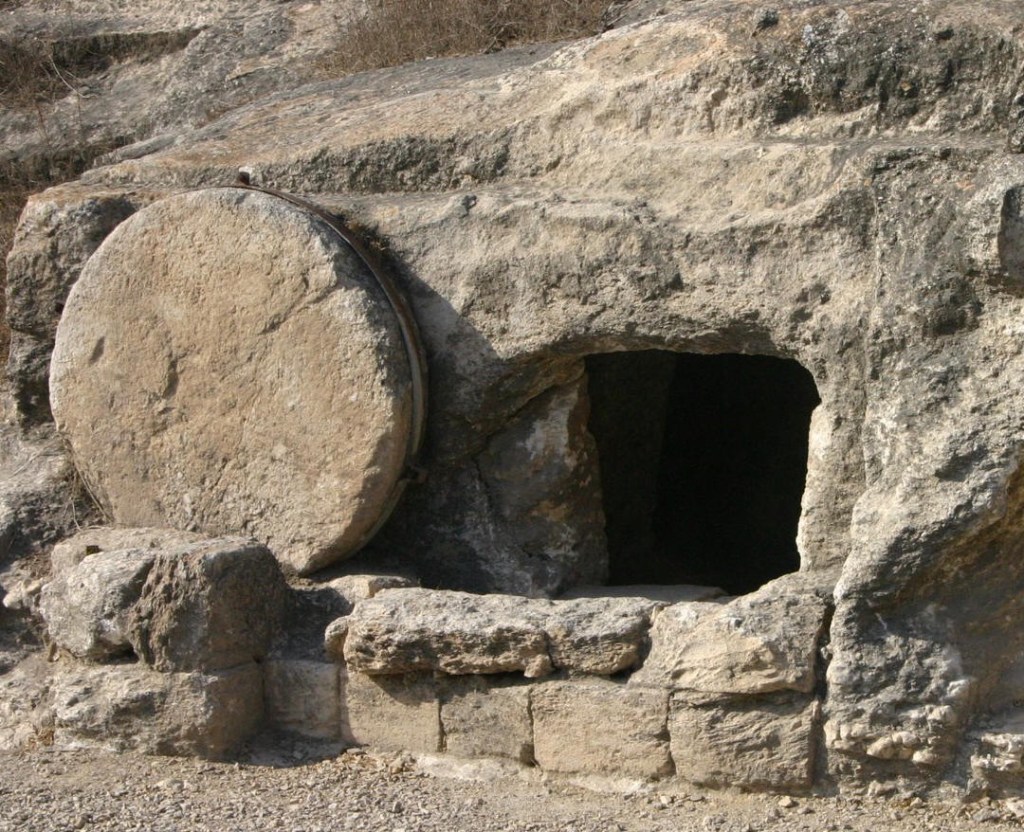
Paul wrote this from the perspective of someone who had persecuted the followers of Christ before his conversion (only 2-3 years after Jesus’s crucifixion). If the resurrection wasn’t true then their preaching about Jesus’s preeminent deity (Lordship), death, and resurrection was not only “futile” but “misrepresenting God.” Christianity is verifiable, as it rests upon the empty tomb, eyewitness testimony, as well as the transformed lives of it’s followers. If you or someone you know is wanting to investigate Christianity, you can do so! Pray and look into the historical evidence for the Resurrection…God will help you!
Another fact that sets Christianity apart from other religious worldviews is God’s Grace. Biblically speaking, Grace (“Charis”), is God’s unmerited favor. A favor that cannot be earned, but is freely given. As explained by Dr. Hazen, “(With Christianity) there’s no crawling over jagged rocks for miles to lay some offering in some temple. There’s no sitting in lotus positions for hours-on-end hoping to move inwardly toward enlightenment, and there’s no ladder to climb unendingly towards the stratosphere of God. Salvation (in relation to Christianity) is just given to you!” Dr. Hazen explains that many of us succumb to the false dogma of working toward salvation; hence, perceiving Christianity as just another religion that requires folks to “do a bunch of stuff.” When we fall into the snare of “building our own ladders” to Heaven, we miss the point of Grace entirely…leaning instead into the trappings of self-reliance! Jonathan Edwards articulated this reality powerfully when stating, “You contribute nothing to your salvation except the sin that made it necessary.” Friends, God made a way back to Himself that only He could make. God sent His one and only Son down from Heaven, in human flesh, (John 1:14; 3:16) to pay a debt that only He could pay. A rescue that only He could make. “Amazing Grace…Who saved a wrtetch like me.”
But God, being rich in mercy, because of the great love with which he loved us, 5 even when we were dead in our trespasses, made us alive together with Christ—by grace you have been saved— 6 and raised us up with him and seated us with him in the heavenly places in Christ Jesus, 7 so that in the coming ages he might show the immeasurable riches of his grace in kindness toward us in Christ Jesus. 8 For by grace you have been saved through faith. And this is not your own doing; it is the gift of God, 9 not a result of works, so that no one may boast.
What is a “Worldview?” As defined by Ligonier Ministries, “a worldview is an overall view of the world. It’s not a physical view of the world, but rather a philosophical view, an all-encompassing perspective on everything that exists and matters to us. A person’s worldview represents his most fundamental beliefs and assumptions about the universe he inhabits. It reflects how he would answer all the “big questions” of human existence: fundamental questions about who and what we are, where we came from, why we’re here, where (if anywhere) we’re headed, the meaning and purpose of life, the nature of the afterlife, and what counts as a good life here and now.”
For point #3, Dr. Craig Hazen exclaims that, “Christianity has a tremendous worldview fit, as it paints a picture of the world that matches the way the world really is.” For example, Christianity doesn’t look at the existence of evil and suffering in the world and call it, Maya (an illusion). Biblical and Historical Christianity deals with the reality of our brokenness “head-on!” In Hinduism, someone’s suffering is viewed as a part of their karma…to interfere would be harmful to them. In contrast, God’s Word (Scripture) and Grace encourages Christians to get into the “trenches” with those who are hurting. We are comforted by knowing that Jesus Himself suffered on our behalf. Christianity doesn’t ignore evil and suffering but instead provides the history behind it, calls it by name (sin), and delivers a rescue plan that only God could accomplish for us.
This final point is essential. When you speak with friends, family, coworkers, and neighbors,…how do they describe Jesus? Do they refer to Jesus as a “good teacher,” “a wise prophet,” or “a highly evolved man?” Or do they call Him, “Lord,” as Jesus claimed to be? Investigating Jesus’s self-made proclamations is the most important research any person could undertake. And Christianity focuses upon these assertions. (We will dig-into this more in the paragraphs below)
Hazen explains in his talks that “everybody wants a piece of Jesus” in their religious worldview. He goes on to share that “in Hinduism, Jesus emerges in some Hindus’ minds as either the greatest, or one of the greatest, teachers ever to walk the earth. In Buddhism, Jesus was thought to be an actual incarnation of the Buddha, himself! If not, then he (Jesus) certainly is a great Bodhisattva in the Mahayana tradition…who leads people up to the precipice of enlightenment. “In Islam,” Hazen continues, “Jesus is figured as greater than Mohammad, was considered born of a virgin, and remembered as a miracle worker.” But Christianity has Jesus at the center. Now, for anyone doubting Jesus’s existence, why would most major world religions acknowledge him? (More information on the historical Jesus below)
Christianity acknowledges the claims made by Jesus, as both historically verifiable and true. You see, Jesus did not mince words when he boldly described himself as both the “Son of Man” and “Son of God.” These two titles pointed to Jesus’s preeminent, divine nature. Jesus was stating that he was/is Lord! Something the other major world religions do not ascribe. This proclamation (as shared by both C.S. Lewis and Josh McDowell) lends itself to 3 possibilities for those researching Jesus’s claims: 1) Jesus was telling the truth, 2) lying, or 3) talking as a Lunatic. Sisters, a “good person,” “prophet,” or “wise teacher” would not be a liar or a lunatic. He is either who He professed to be or not! Let’s think about this further…Should a liar be esteemed as highly as Jesus is in most world religions?
Another argument utilized by skeptics as to counter Jesus’s assertions of Lordship is to accuse his followers of writing-in these claims later in history. This could be termed the, “Legend argument.” However, as Dr. Gary Habermas explains, the claims of Jesus’s deity go back to the empty tomb and resurrection. Too soon for legends to be forumulated. Those who saw Jesus resurrected (500+ eyewitnesses) were both teaching and singing creeds that prolifically pointed to 3 distinct components: Jesus’s place in the Godhead, his death, as well as his resurrection. These teachings (homologia) fueled the persecutions of Jesus’s followers by those who were zealous for God’s old covenant. Numerous Christians were martyred for sharing these passionate convictiond, one of whom was Stephen. Saul was present when Stephen was stoned (Acts 7), which happened before Saul’s Damascus Road experience… which historians place just 2 to 3 years (A.D. 32-33) after Jesus’s crucifixion (A.D. 30). The implications of the early teachings and creeds is not only foundational in debunking the Legend Argument but further testifies to the personal convictions of the early Christians regarding the Lordship of Jesus. This evidence regarding Jesus’s life, death, and empty tomb is unchallenged by most non-Christian scholars. Notable mentions would be Bart Ehrman, Gerd Ludemann, and John Dominic Crossan.
“Jesus’ death by crucifixion under Pontius Pilate is as sure as anything historical can ever be. For if no follower of Jesus had written anything for one hundred years after his crucifixion, we would still know about him from two authors not among his supporters. Their names are Flavius Josephus and Cornelius Tacitus.” – Crossan
Friends, it’s my hope and prayer that this post encourages you to examine the claims of Christianity. In His mercy, God has provided all of us with abundant evidence for defending the reasons for the hope that we have in the Gospel of Jesus. You might not need these facts, and yet someone you know…might. But don’t put someone’s salvation upon yourself, as that is something only the Holy Spirit accomplishes.
“And if some folks walked away from Jesus not believing, why would we think that most will walk away from us believing?! At the least, we can put a stone in their shoe.”
When someone examines the Christology of the early Church, he or she would survey whether the early followers of Jesus viewed him as fully divine and that pre-existed before becoming human (“High Christology”). One support of this high view of Christology is 1 Corinthians 15.
Paul penned 1 Corinthians 15 to the church in Corinth ~8-10 years prior to his martyrdom by Nero in AD 64. Within his letter is an early song or creed (v 3-8) which was sung by followers of Jesus, within 2-3 years of His bodily resurrection in AD 30 or 33 during Passover. [1]
What does this “homologia” communicate?
✔️Jesus of Nazareth was a real man (Jewish). ✔️Jesus died for our sins. ✔️Jesus’s life, death, and bodily resurrection were promised in the Hebrew Scriptures (Old Testament). ✔️Jesus appeared bodily to Peter, James, the Disciples, and to more than 500 people. ✔️This was proclaimed, sung, & written down very early.
Per historian Justo L. Gonzalez, “The early Christians did not believe that they were following a new religion (worldview). They were Jews, and their main difference with the rest of Judaism was that they were convinced that the Messiah (Christ) had come, whereas other Jews continued awaiting his advent.” [2]
Early Christians believed Jesus had fulfilled the prophecies pertaining to the Messiah from the Old Testament scriptures. The works Jesus had performed, the status He claimed to share with the Father, and the worship he had received, made it clear to these early Christians that Jesus was God incarnate (Ps 22; Isaiah 9:6; 53; Mk 2; John 1:1-3; 8:58; 20:28). [3]
The hope God has provided is trustworthy and true, no matter our mood or circumstance. We can think upon the historical reality of the cross when we doubt and rejoice in the significance of the empty tomb in our hardships. What God has done for us (on our behalf) is the greatest gift ever given!
For the entire month of January, my husband and I were given the wonderful opportunity to teach four, 45-minute apologetics classes to 10-15 Middle School students…and we absolutely loved it! Teaching these students was a genuine honor!
First of all, it’s incredibly important that I define what Apologetics means.
“but in your hearts honor Christ the Lord as holy, always being prepared to make a defense to anyone who asks you for a reason for the hope that is in you; yet do it with gentleness and respect,”
1 Peter 3:15
Also see: Jude 1:3, and 2 Corinthians 10:5.
Apologetics gets its name from the Greek word “apologia” which refers to making a reasonable case for a truth claim. Giving an apologia is something we all do, daily! Oftentimes, you might hear some folks make a case (apologia) for not giving a defense (apologia). Which only reinforces the necessity of apologetics.
When Steve and I were thinking upon the numerous evidences for God’s existence, and wanting to make these observations memorable for our students, a very unlikely resource came to mind: a Stop sign. That’s right— an everyday Stop Sign. 🛑 It was our hope that every time these kiddos saw a Stop Sign, he or she would think upon what they had learned…and that these evidences for God would encourage them (especially in times of difficulty).
First of all, we know that Stop signs are not illusions…but are very real. They can they be seen and touched, as well as remind us that the cars coming from other directions are very real.
Secondly, Stop signs can be objectively known by all people everywhere. My opinion about them does not change what they are. Stop signs will always mean “stop,” and they cannot contradict themselves (“stop” does not mean “go”). Stop signs remind us that objective, knowable truth exists…for all people, everywhere. [1]
Thirdly, Stop Signs have not always existed. Stop signs, like all of creation, had a beginning. In other words, they had a cause outside of themselves. The cause which created the Stop sign is not within the Stop sign but cares for (sustains) the Stop sign. [2]
This is like God! Our Triune God (Father, Son, & Holy Spirit) created the universe and everything in it…upholding the universe by the word of His power. God is both transcendent and present (Psalm 24; Ps 46:10; Col 1:16-18; Heb 1:3)
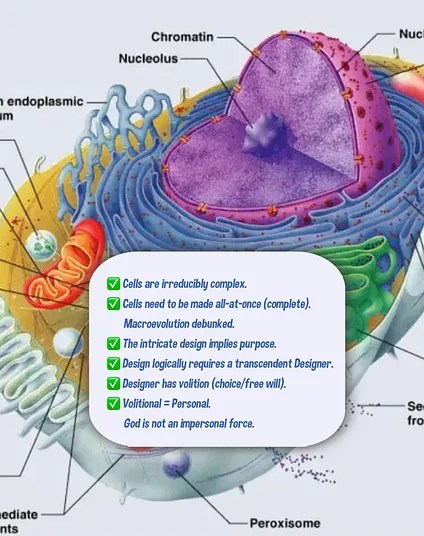
Fourth point: Stop signs demonstrate a designer exists! They have an intelligible messsge which we can understand (“stop”), they contain 8 sides, are red in color, and covered in easy to see reflective paint, and have a purpose. The intentional design of the Stop sign is a SIGN that someone volitionally planned and created these safety mechanisms! [3]
Lastly (but not least), the fact that we would need Stop signs points to the acknowledgment of a Moral law existing outside of all of us, but acknowledged by all of us. We may not agree about all moral issues, but we should all agree that right and wrong exist. [4]
Just cut someone in line at the grocery store— the reactions from those around you will reinforce that a transcendent standard of right is real (Romans 2).
With all of this being said, it’s my hope that whenever we see a Stop sign that we consider God.
“For his invisible attributes, namely, his eternal power and divine nature, have been clearly perceived, ever since the creation of the world, in the things that have been made. So they are without excuse.” Romans 1:20
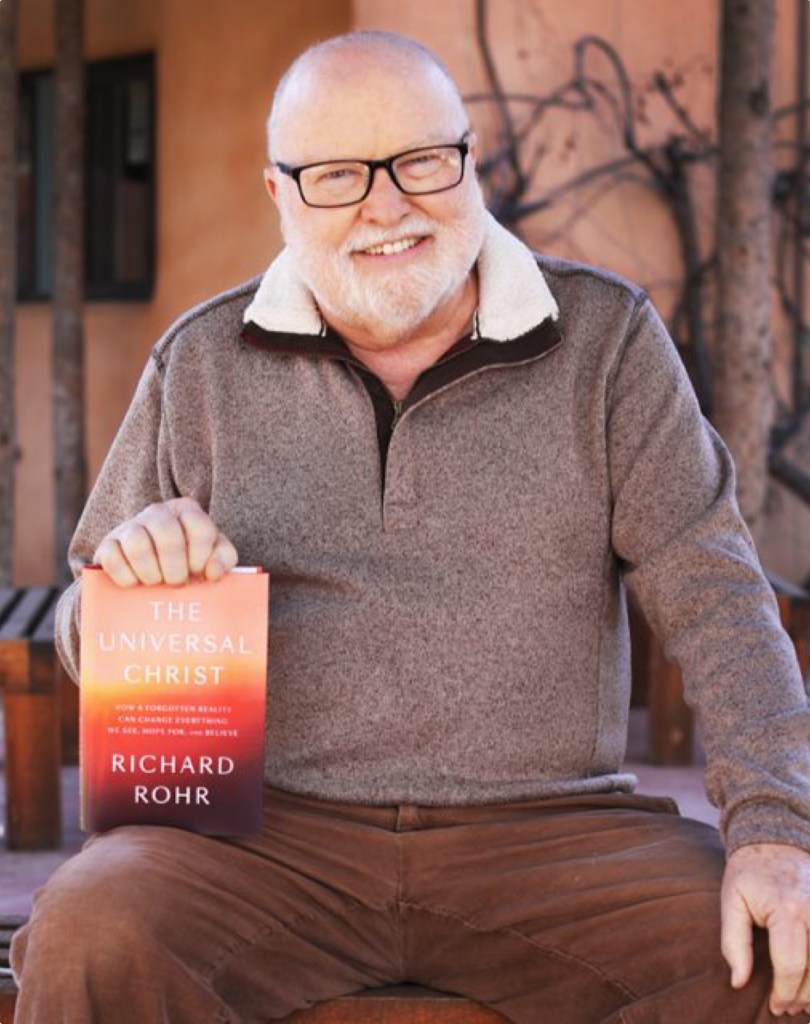
“God is [not] too fussy about his name or her name.” – Richard Rohr; March 25, 2012 (17:45).
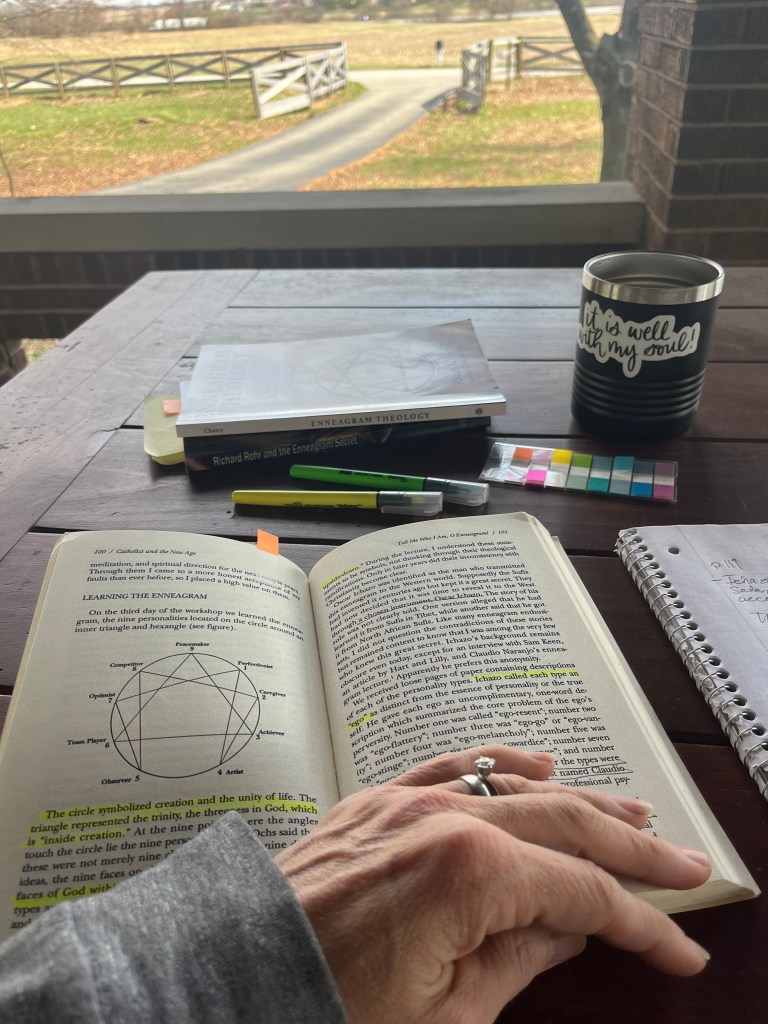
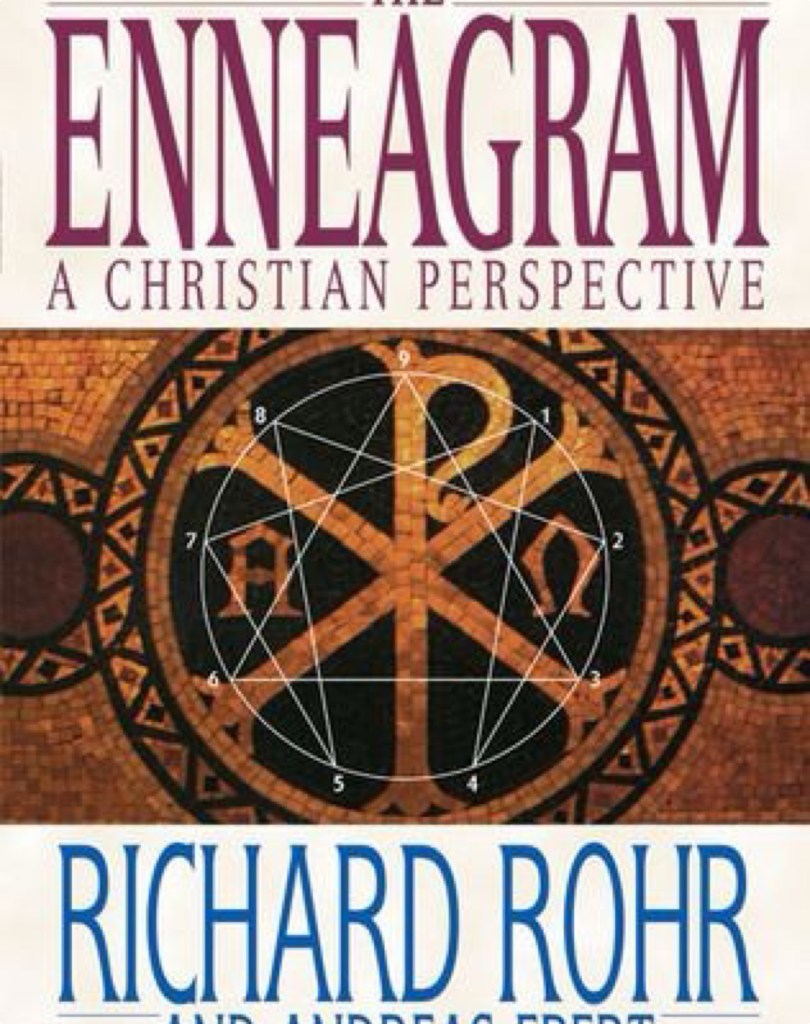
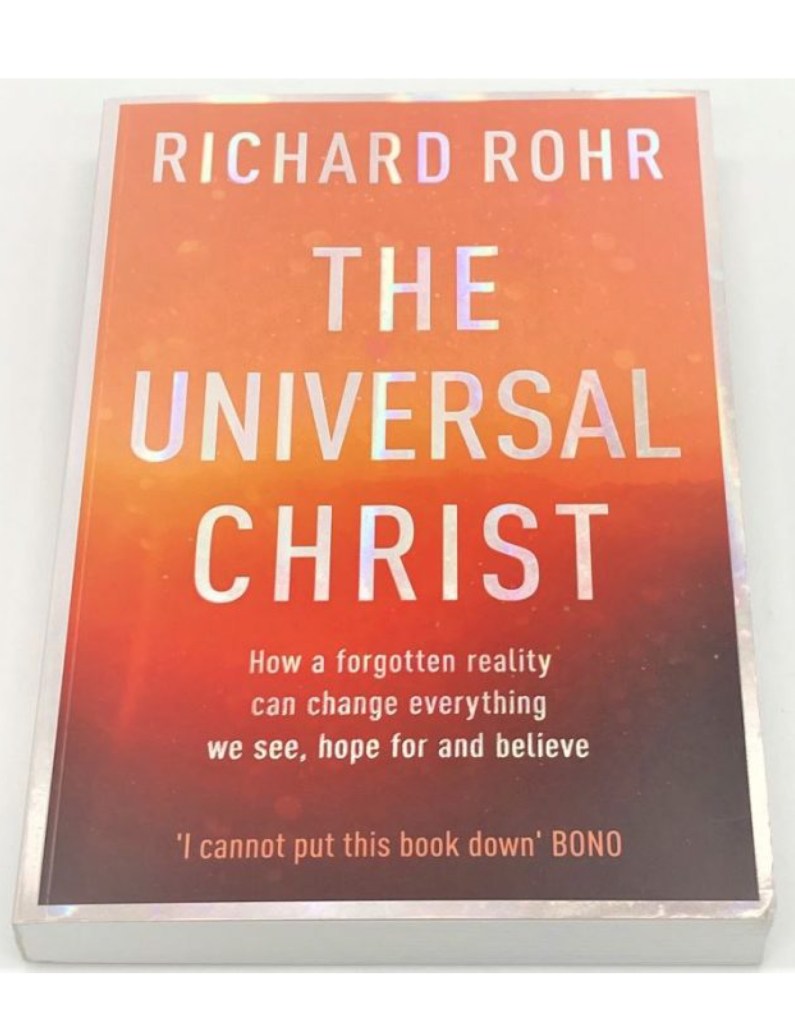
This side-by-side chart was compiled with the genuine prayer that it might be a helpful resource for anyone wanting to know how Richard Rohr’s theology and anthropology compare with Christianity. In order to accomplish this important task, Friar Rohr’s own words needed to be shared here. Quotes from Rohr’s books, devotionals, and interviews (along with their sources) are organized next to corresponding commentary by Christian theologians and examined by Scripture.
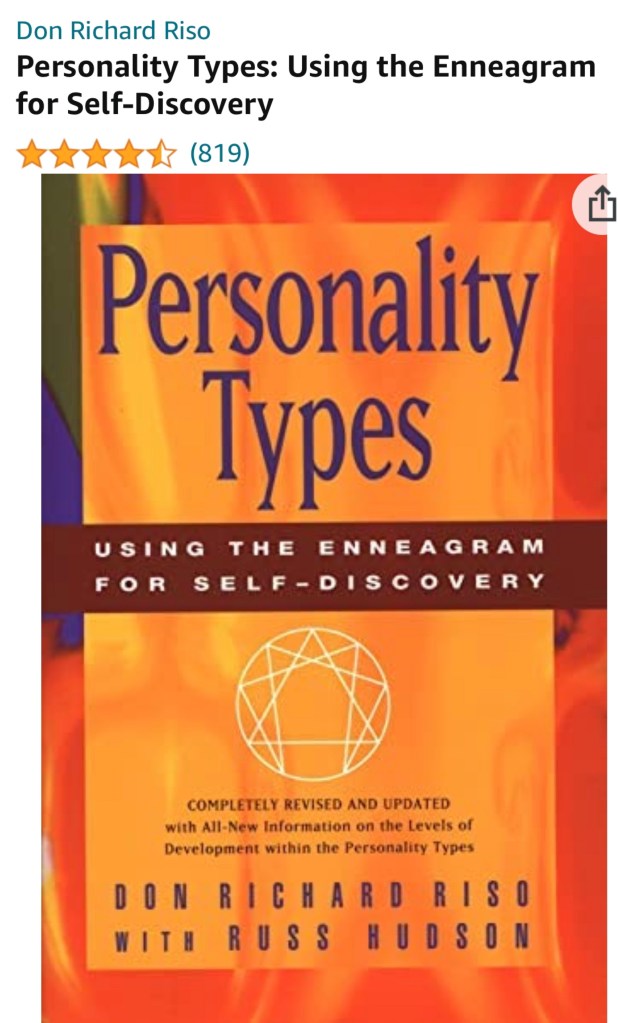
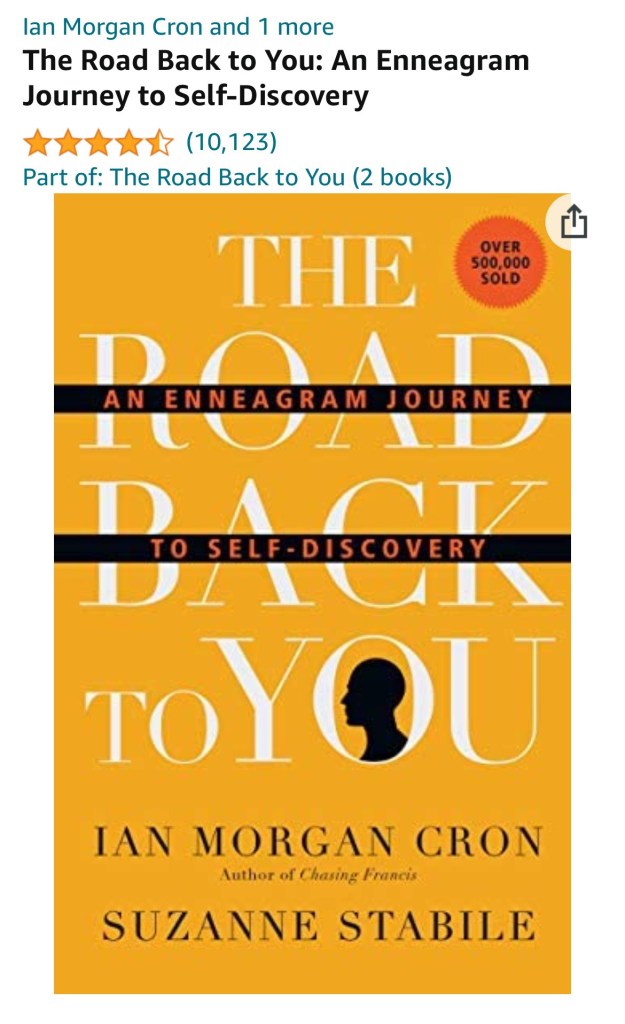
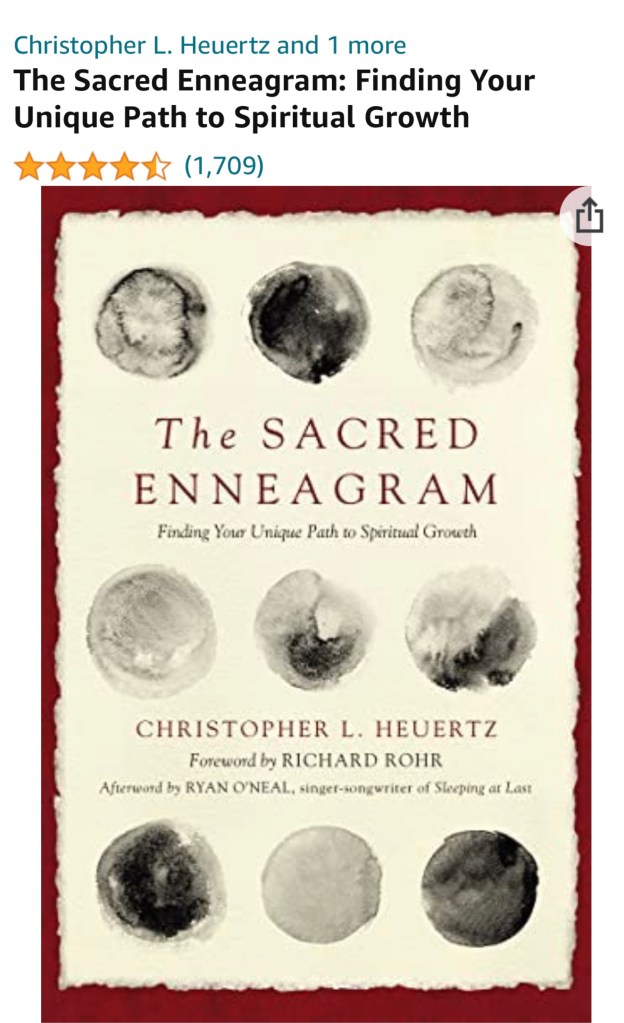
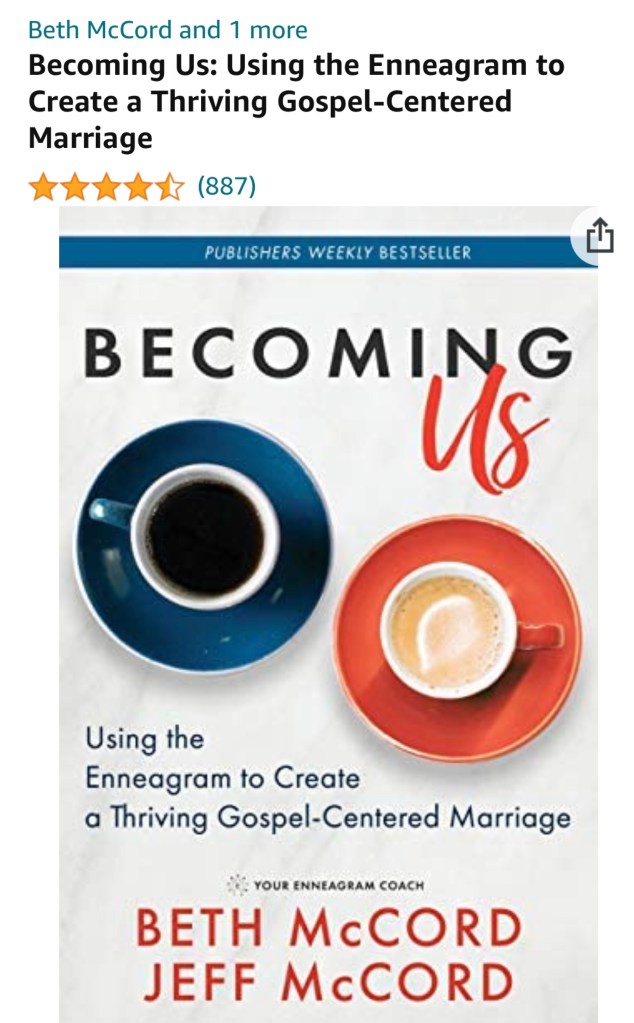
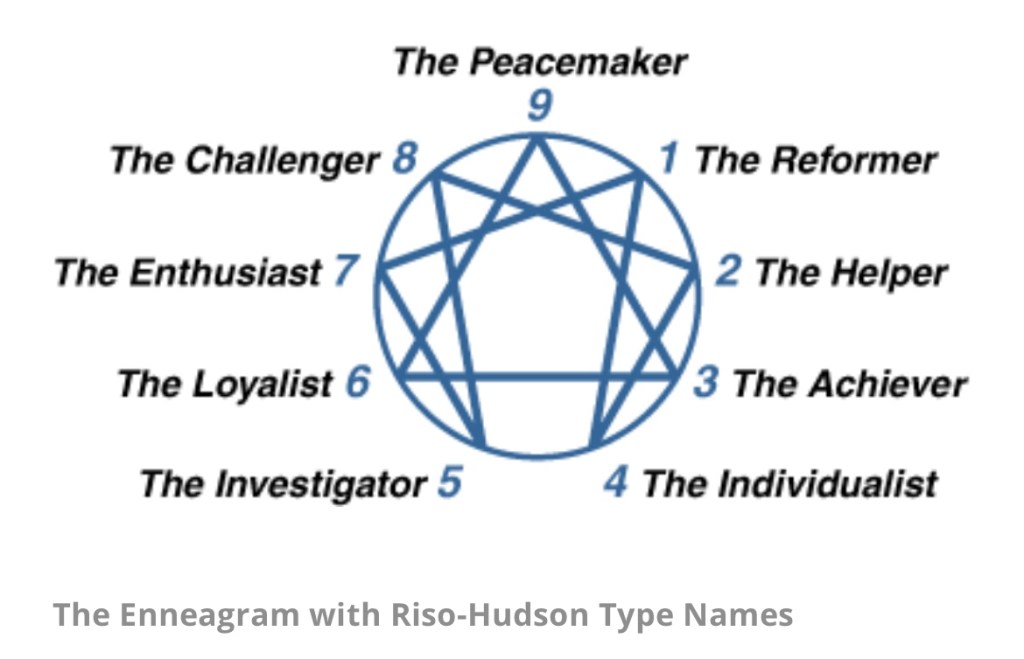
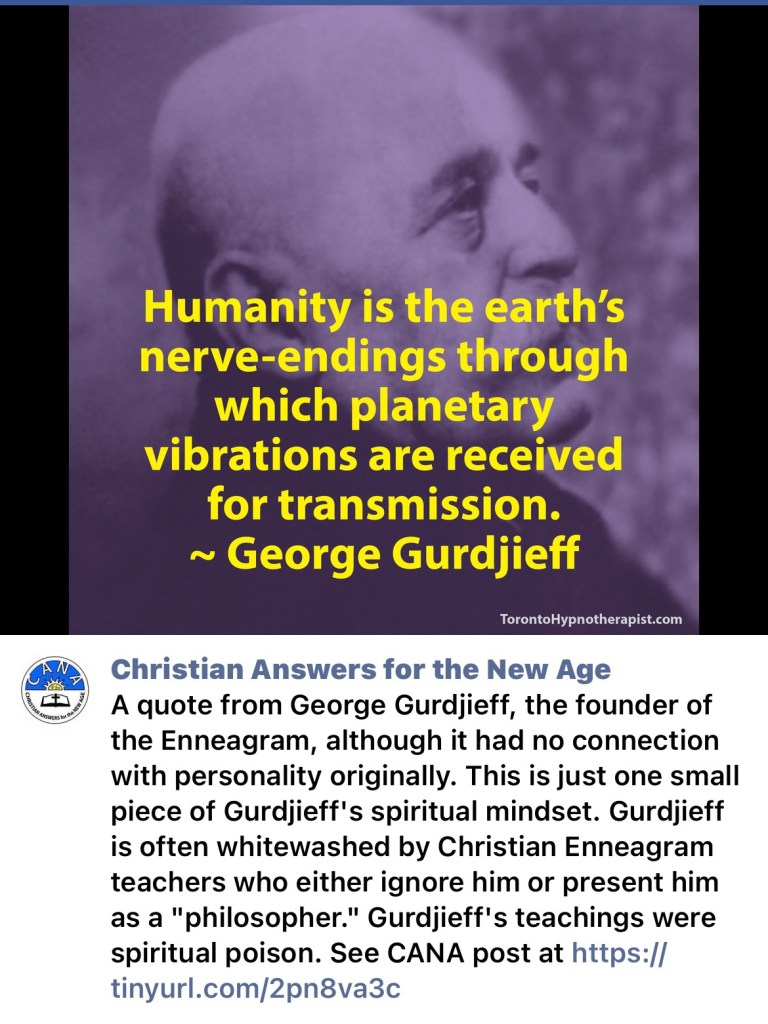
This task was needed due to Rohr’s salient impact through popular enneagram enthusiasts— Cron, Stabile, Heuertz, McCord, and Comer. The influence Rohr has had through the Enneagram has reached the YouVersion Bible app, which features a Bible plan for one of Rohr’s books.
“One cannot disconnect the Enneagram from Richard Rohr, which is why it is essential to know his beliefs, especially since the writers of the two main books in use among evangelicals are his students and have taught at his Center for Action and Contemplation.”
Don and Joy Veinot & Montenegro (Richard Rohr and the Enneagram Secret)📙
Friends, secondary teachings can be discussed respectfully over multiple cups of coffee or tea; however, the essential teachings of Christianity are not malleable. It’s both responsible and loving to test whether Rohr’s usage of Christian terminology matches the definitions provided within the Scriptures (Acts 17:11; 20:28).
“To him (Jesus), what Scripture says, God says.” John Wenham (Christ and the Bible)
“But test everything; hold fast what is good.” 1 Thessalonians 5:21
Richard Rohr’s Theology vs Biblical Christianity
Angels
Rohr says:
“If we want to take the notion of angels, demons, and the principalities and powers seriously, we will have to go back to the biblical understanding of spirits in all its profundity and apply it freshly to our situation today.” (5)
“When Paul talks about the ‘devil,’ he uses words like ‘powers,’ ‘principalities,’ and ‘thrones’ (see Ephesians 6:12). These are almost certainly his pre-modern words for what we would now call corporations, institutions, nation-states, and organizations that demand our full allegiance and thus become, in many ways, idolatrous—not just ‘too big to fail,’ but even too big to be criticized. Suddenly, the medieval notion of devils comes very close to home.” (6)
Christian perspective:
Got Questions Ministries provides us a biblical perspective of Angels:
“Angels are personal spiritual beings who have intelligence, emotions, and will. This is true of both the good and evil angels (demons). Angels possess intelligence (Matthew 8:29; 2 Corinthians 11:3; 1 Peter 1:12), show emotion (Luke 2:13; James 2:19; Revelation 12:17), and exercise will (Luke 8:28-31; 2 Timothy 2:26; Jude 6). Angels are spirit beings (Hebrews 1:14) without true physical bodies. Although they do not have physical bodies, they are still personalities and occasionally take on physical bodies.” (10)
Scripture says:
“For he will command his angels concerning you to guard you in all your ways.” Psalm 91:11
“And the angels who did not stay within their own position of authority, but left their proper dwelling, he has kept in eternal chains under gloomy darkness until the judgment of the great day—” Jude 1:6
“Above him stood the seraphim. Each had six wings: with two he covered his face, and with two he covered his feet, and with two he flew.” Isaiah 6:2
“Do you think that I cannot appeal to my Father, and he will at once send me more than twelve legions of angels?” Matthew 26:53
Bible
Rohr says:
Veinot and Montenegro– “Rohr views the Bible as a collection of books that merely record the authors’ experience of God or convery who they thought God was. The Bible is not viewed as God’s revelation. Rohr states, ‘Just as the Bible takes us through many stages of consciousness and history, it takes us individually a long time to move beyond our need to be dualistic, judgmental, accusatory, fearful, blaming, egocentric, and earning – and to see as Jesus sees.’” (7)
Rohr claims: “The Bhagavad Gita is a part of the Perennial Tradition. It’s not Jewish, it’s not Christian, but it’s inspired.” (8)
Jonah in the fish is more about symbolism, than an actual event. (9)
“I’m highly formed by things like spiral dynamics and evolutionary consciousness and developmental psychology and I look at the Bible and I clearly see that there are writings that represent very primitive levels of consciousness that’s not to say they’re uninspired but they reflect a pretty violent dualistic punitive wrathful notion of God.” (108)
“I see the Bible as charting that growth and that change so it is inspired but I guess this sounds radical to an evangelical but I can’t say that every lie in the bible is equally inspired there’s clearly a growth in our understanding of who God is.” (108)
Christian perspective:
In his article, “Why I don’t Flow with Richard Rohr,” a review about Rohr’s book, Divine Dance, Professor Dr. Fred Sanders, explains that Rohr views Scripture as a “morally polluted text with false statements in it.” (4)
Pastor Voddie Baucham explains that “the Bible is a reliable collection of historical documents written by eyewitnesses, during the lifetime of other eyewitnesses…who report supernatural events that took place in fulfillment of specific prophecies,…and claim their writings are divine rather than human in origin.” (2)
Christian apologist Wes Huff:
“What we call the Bible was put together over 1600 years, on 3 continents, by close to 40 different authors, in 3 different languages. Some of its writers were kings, others teachers, shepherds and fishermen. The early Christians inherited the Jewish Scriptures (what we call the Old Testament) a collection composed of the same 39 books we have in the first portion of our Bibles.
Contrary to what many believe or have heard, the New Testament books were not chosen or voted on, but instead, were recognized as the writings closest to the community surrounding Jesus. What we actually have is a direct connection to the life and teaching of Jesus. Jesus’ disciples mentored others, who we call the Apostolic Fathers, who then comment on what books did or didn’t have a history going back to the words and teachings of Jesus.” (3)
Per Dr. Gary Habermas, Jesus the Scriptures as God’s word to us – authoritative and true. (11)
“To him [Jesus], what Scripture says, God says.” – John Wenham (109)
“All Scripture is breathed out (inspired) by God and profitable for teaching, for reproof, for correction, and for training in righteousness, that the man of God may be complete, equipped for every good work.” 2 Timothy 3:16-17
“Heaven and earth will pass away, but my words will not pass away.” – Jesus (Matthew 24:35)
“The grass withers, the flower fades, but the word of our God will stand forever.” Isaiah 40:8
“Whoever believes in me, as the Scripture has said, ‘Out of his heart will flow rivers of living water.’” John 7:38
“For whatever was written in former days was written for our instruction, that through endurance and through the encouragement of the Scriptures we might have hope.” Romans 15:4
“I [Jesus] do not ask for these only, but also for those who will believe in me through their word,” John 17:20
“For no prophecy was ever produced by the will of man, but men spoke from God as they were carried along by the Holy Spirit.” 2 Peter 1:21
Christ
Rohr says:
“Long before Jesus’s personal incarnation, Christ was deeply embedded in all things – as all things! The Christ Mystery is the New Testament’s attempt to name this visibility or see-ability that occurred on the first day.” (12)
“Deep within the cave of my heart, a depth that belongs to me alone, I recognize a fire that burns brilliantly and glows with warmth. Through that glowing fire I see the outline of a face, the face of Christ, but I also see my face, and then I begin to see Christ’s face as my face. Sometimes I cannot tell Christ’s face from my own face, and all at once I recognize a single face whose eyes are looking inward and outward.” (111)
“‘Christ’ is a word for the Primordial Template (Logos or Word) through whom ‘all things came into being, and not one thing had its being except through him’ (John 1:3). Seeing in this way has reframed, reenergized, and broadened my own religious belief, and I believe it could be Christianity’s unique contribution among the world religions.” (14)
“Christ was the Alpha point. Good biblical theology calls creation itself the birth of the Christ, the materialization of God. Whenever matter and spirit coincide, you have the Christ Mystery, which is a phrase the Apostle Paul introduces.” (17)
Christian perspective:
The NASB Hebrew-Greek Study Bible defines “Christ” of “Messiah” (Acts 2:36). In the Greek, Christ is written as “Christos” (5547) which means “Anointed, primarily to the high priesthood.” (16)
Dr. Michael A. Rydelnik delivers a biblical definition of “Christ” on pages 31 & 32 of the Moody Handbook of Messianic Prophecy: “The Messiah is described in the Bible beginning with the word, ‘Messiah’ or ‘Anointed One,’ and then in a variety of other ways. All of the following provide a portrait of the future messianic figure. The Messiah is the eschatological, royal, Servant of the Lord, springing from the Davidic dynasty, who is consecrated by God to provide redemption from sin, bring deliverance for Israel, rule the world, and establish a kingdom of peace, justice, nad righteousness.” (15)
“And if those days had not been cut short, no human being would be saved. But for the sake of the elect those days will be cut short.Then if anyone says to you, ‘Look, here is the Christ!’ or ‘There he is!’ do not believe it. For false christs and false prophets will arise and perform great signs and wonders, so as to lead astray, if possible, even the elect.” Matthew 24:22-24
John the Baptist: “He confessed, and did not deny, but confessed, ‘I am not the Christ.’” John 1:20
“And the Word became flesh and dwelt among us, and we have seen his glory, glory as of the only Son from the Father, full of grace and truth.” John 1:14
“Because, if you confess with your mouth that Jesus is Lord and believe in your heart that God raised him from the dead, you will be saved.” Romans 10:9
Contemplative Prayer
Rohr says:
“We need contemplative practices to loosen our egoic attachment to certainty and retrain our minds to understand the wisdom of paradox.” (103)
“Contemplative prayer is largely just being present: holding the tension instead of even talking it through, offering the moment to God instead of fixing it by words and ideas, loving reality as it is instead of understanding it fully. In our daily lives, this prayer is most commonly articulated as a willingness to say, ‘I don’t know.’ We must not push the river, we must just trust that we are already in the river, and God is the certain flow and current.” (103)
“‘I must be ‘nothing’ in order to be open to all of reality and new reality. The Zen master calls this state ‘the face we had before we were born.’ Paul would call it who you are: ‘in Christ, hidden in God’ (Col. 3:3). I just say it is who you are before you did anything right or anything wrong, who you are before you thought about who you are. Our thinking doesn’t make it so. Thinking creates the ego self, the self of reputation, the insecure self. Contemplation recognizes the Godself, the Christself of abundance and security.” (104)
Seminary professor and author, Dr. Douglas Groothuis:
“The biggest danger to which one is exposed in the contemplative movement is a subtle erosion of the Creator/creature distinction toward a monistic or ‘synthesis of all things’ understanding. This has much in common with Eastern mysticism that basically teaches all is one and all is divine by nature.” (123)
“What is biblical prayer? Evangelical writer and teacher Kenneth Boa describes it as ‘personal communion and dialogue with the living God.’ This statement should be uncontroversial (if one means the God of the Bible), but supporters of CP would add that the deepest, most profound form of prayer is of the contemplative variety. To avoid confusion, ‘contemplative,’ used in this context, is not synonymous with awareness or concentration. Rohr defines contemplation as ‘an alternative consciousness that refuses to identify with or feed what are only passing shows.’ These “passing shows” are one’s thoughts.” (105)
“However, such a concept of contemplative prayer is challenged by our Lord himself. When Jesus taught his disciples what to do until his return, he instructed, ‘But keep on the alert at all times, praying that you may have strength to escape all these things that are about to take place, and to stand before the Son of Man’ (Luke 21:36).27 Mental passivity combined with an ‘open heart’ and the refusal to interact with thoughts appears incompatible with Jesus’ divine injunction…Additionally, when Jesus taught on prayer, he said not to ‘use meaningless repetition as the Gentiles do’ (Matt. 6:7; see also vss. 8–13). Repetition itself is not the problem, but meaningless repetition, which is specifically advocated by CP.” (105)
“The support lent to CP tends to be full of partial truths, much hermeneutical error, and the imprecise use of language. Contemplative prayer misrepresents key attributes of God. He is transcendent yet always personal; he is not reducible to mere impersonal forces or literal light, and he is certainly not a state without properties (as is the non-dualistic Hindu concept of Brahman). We know and communicate with this personal God through personal means, not through transcendence of personality. Thus, CP is at worst spiritually dangerous, and at best does not appear to serve any sanctifying purpose. Therefore, we have no good reason to engage in the practice. Still, we must continue to intelligently and prayerfully converse with fellow believers regarding this trend. Thinking Christians should not be silent about this error.” (105)
What am I to do? I will pray with my spirit, but I will pray with my mind also; I will sing praise with my spirit, but I will sing with my mind also.” 1 Corinthians 14:15
“Do not be anxious about anything, but in everything by prayer and supplication with thanksgiving let your requests be made known to God.” Philippians 4:6
“Praying at all times in the Spirit, with all prayer and supplication. To that end, keep alert with all perseverance, making supplication for all the saints,” Ephesians 6:18
“Pray then like this: “Our Father in heaven, hallowed be your name. Your kingdom come, your will be done, on earth as it is in heaven. Give us this day our daily bread, and forgive us our debts, as we also have forgiven our debtors. And lead us not into temptation, but deliver us from evil.” Matthew 6:9-13
“Is anyone among you suffering? Let him pray. Is anyone cheerful? Let him sing praise.” James 5:13
“If any of you lacks wisdom, let him ask God, who gives generously to all without reproach, and it will be given him.” James 1:5
“And when you pray, do not heap up empty phrases as the Gentiles do, for they think that they will be heard for their many words.” Matthew 6:7“Blessed is the man who walks not in the counsel of the wicked, nor stands in the way of sinners, nor sits in the seat of scoffers; but his delight is in the law of the Lord, and on his law he meditates day and night. He is like a tree planted by streams of water that yields its fruit in its season, and its leaf does not wither. In all that he does, he prospers. The wicked are not so, but are like chaff that the wind drives away. Therefore the wicked will not stand in the judgment, nor sinners in the congregation of the righteous;” Psalm 1:1-6
Crucifixion
Rohr says:
“The Divine Mind transforms all human suffering by identifying completely with the human predicament and standing in full solidarity with it from the beginning to end. This is the real meaning of crucifixion. The cross is not just a singular event. It’s a statement from God that reality has a cruciform pattern.” (18)
“Necessary suffering has been the shape of the universe.” (19)
“There is a cruciform shape to reality, it seems. Loss precedes all renewal; emptiness makes way for every new infilling; every transformation in the universe requires the surrendering of a previous ‘form.’” (20)
Christian perspective:
Dr. Michael McClymond unpacks Rohr’s teaching about Jesus’s Crucifixion: Per Rohr, Crucifixion is “something that happened to Jesus and should happen to us too. The biblical death-and-resurrection story teaches us that everyone has to let go of egoistic attachments (‘crucifixion’) so as to be reborn (‘resurrection’). Jesus’s death was ‘God’s great act of solidarity’ with humanity, and “not some bloody transaction ‘required’ by God’s offended justice in order to rectify the problem of human sin.’ Jesus’s death didn’t accomplish redemption. Instead, I am Jesus, you are Jesus, everyone is Jesus—that is where Rohr ends up.” (21)
Per Got Questions Ministries, “Crucifixion was invented and used by other people groups, but it was ‘perfected’ by the Romans as the ultimate execution by torture. The earliest historical record of crucifixion dates to c. 519 BC. The victim of crucifixion was first severely scourged or beaten, an ordeal that was life-threatening by itself. Then he was forced to carry the large wooden crossbeam to the site of the crucifixion. Bearing this load was not only extremely painful after the beating, but it added a measure of shame as the victim was carrying the instrument of his own torture and death. It was like digging one’s own grave.” (22)
Scripture says:
“Surely he has borne our griefs and carried our sorrows; yet we esteemed him stricken, smitten by God, and afflicted. But he was pierced for our transgressions; he was crushed for our iniquities; upon him was the chastisement that brought us peace, and with his wounds we are healed. All we like sheep have gone astray; we have turned—every one—to his own way; and the Lord has laid on him the iniquity of us all.” Isaiah 53:4-6
“For Christ also suffered once for sins, the righteous for the unrighteous, that he might bring us to God, being put to death in the flesh but made alive in the spirit,” 1 Peter 3:18
“And they clothed him in a purple cloak, and twisting together a crown of thorns, they put it on him. And they began to salute him, ‘Hail, King of the Jews!’ And they were striking his head with a reed and spitting on him and kneeling down in homage to him. And when they had mocked him, they stripped him of the purple cloak and put his own clothes on him. And they led him out to crucify him.” Mark 15:17-26
Devil
Rohr says:
Satan is a symbol or a concept (archetypal), not a literal being. “We need personification to take concepts and abstractions seriously.” (23)
“The word ‘devil,’ like ‘demon,’ is a personification of a power that is hard to name or describe because it’s so disguised and even idealized as good and necessary.” (24)
“Sanctified and legitimated violence— violence that is deemed necessary to control the angry flesh and the world run amuck”(24)
Satan is likened to when we operate in the New Age concept of the ego, and therefore operate in certainty/dualism and thereby scapegoat our own “blindness” to non-dual thinking upon others. (23)
“The ego, and also the corporate ego, is often personified in world Scriptures [sic] as the devil or Satan.” (25)
Christian perspective:
Wayne Grudem: “The name ‘Satan’ is a Hebrew word that means ‘adversary.’ The New Testament also uses the name ‘Satan,’ simply taking it over from the Old Testament.” (26)
Got Questions Ministries: “The Bible explicitly informs us of the existence of Satan. He is described as the enemy of man (Genesis 3:15), the father of lies (John 8:44b), and the accuser (Revelation 12:10), among other things. The very name ‘Satan’ means ‘adversary.’ Isaiah 14:12–17 explains that Satan was originally an angelic being, but he decided he wanted the honor and worship due only to God and was thrown out of heaven (also see Ezekiel 28:11–17).” (27)
Jesus was a real man who proved to be the promised Messiah/Christ. His claim to be God (God the Son) was also vindicated. And therefore, since Jesus spoke of the Devil as a real being, it would be wise to follow His lead (Mt 13:38-39; John 8:44, 12:31, 14:30, and more).
Scripture says:
“And no wonder, for even Satan disguises himself as an angel of light.” 2 Corinthians 11:14
“You are of your father the devil, and your will is to do your father’s desires. He was a murderer from the beginning, and does not stand in the truth, because there is no truth in him. When he lies, he speaks out of his own character, for he is a liar and the father of lies.” John 8:44
“And he said to them, ‘I saw Satan fall like lightning from heaven.’” Luke 10:18
“And the devil who had deceived them was thrown into the lake of fire and sulfur where the beast and the false prophet were, and they will be tormented day and night forever and ever.” Revelation 20:10
“‘How you are fallen from heaven, O Day Star, son of Dawn! How you are cut down to the ground, you who laid the nations low! You said in your heart, “I will ascend to heaven; above the stars of God I will set my throne on high; I will sit on the mount of assembly in the far reaches of the north; I will ascend above the heights of the clouds; I will make myself like the Most High.” But you are brought down to Sheol, to the far reaches of the pit.’” Isaiah 14:12-15
Dualism
Rohr says:
“Dualistic thinking, or the ‘egoic operating system,’ as my friend and colleague Cynthia Bourgeault calls it, is our way of reading reality from the position of our private and small self. ‘What’s in it for me?’ ‘How will I look if I do this?’ This is the ego’s preferred way of seeing reality.’” (28)
“The dualistic mind is essentially binary, either/or thinking. It knows by comparison, opposition, and differentiation.” (28)
Rohr claims that we are not able to either accept or understand how Jesus can be both divine and human with our dualistic minds. (29)
Christian perspective:
The Christian perspective is to renew our minds with the Holy Spirit’s help through reading God’s Word, not removing our minds (opening them up to any voice/thought which enters). We need to test what is coming into our minds to make sure those thoughts are good (2 Cor 10:5; 1 Thes 5:21; 1 John 4:1).
“Rohr commonly asserts that we need to move from a dual mindset (not making or discerning distinctions). Rohr accepts dualism for practical things like doing math or learning to drive, but he associates dualism with judgment and condemnation in a spiritual context. For Rohr, a change in consciousness is needed as a part of ‘Emerging’ (Progressive) Christianity.” (112)
“Rohr equates ‘dualistic thinking’ with division and strife…Therefore, he teaches we need to move to a new, ‘non-dual consciousness.’ One way this is to come about is through what Rohr terms ‘contemplation.’” (30)
Scripture says:
“Do not be conformed to this world, but be transformed by the renewal of your mind, that by testing you may discern what is the will of God, what is good and acceptable and perfect.” Romans 12:2
“We destroy arguments and every lofty opinion raised against the knowledge of God, and take every thought captive to obey Christ,” 2 Corinthians 10:5
“but test everything; hold fast what is good. 22 Abstain from every form of evil. 23 Now may the God of peace himself sanctify you completely, and may your whole spirit and soul and body be kept blameless at the coming of our Lord Jesus Christ. 24 He who calls you is faithful; he will surely do it.” 1 Thessalonians 5:21-24
Enneagram
Rohr says:
On page xvi of Ebert’s and Rohr’s book, The Enneagram: A Christian Perspective, Rohr shares this about the Enneagram:
“Andreas Ebert and I again offer the Enneagram as a very ancient Christian tool for the discernment of spirits, the struggle with our capital sin, our ‘false self,’ and the encounter with our True Self in God. Anything this powerful and this converting is sure to be fought and resisted by the egocentric self, and even by control-needy prelates.” (31)
On page xxi, Rohr continues, “It is no surprise me that the Enneagram is so distasteful to soft spirituality and even to individualistic spirituality.” (31)
1m40s “…how can it [Enneagram] be so true because scientifically we can’t prove it.” (106)
11m “Unless you tame your demons you will never know your angels…[The genius of the Enneagram], where it’s uniquely Christian, is we are going to make the devil work for God.” (106)
“The Enneagram’s root sins or passions can be seen as nine different ways of ‘missing the mark’ (hamartia), nine ways of being disconnected from God’s Presence—our essence—here and now. By viewing our Enneagram compulsions as reminders to return to presence, we can become aware of the Divine Presence in us and around us and we can share that love with a hurting world.” (107)
“In the Enneagram tradition, ‘sin’ is simply that which doesn’t work, i.e. self-defeating behavior. Our root capital sins can be understood as emergency solutions that we developed in early childhood as a way of coping with our environment. At the time, these coping mechanisms were necessary for survival. But the older we grow, the more they get in the way of living freely as our True Self.” (107)
“Teresa of Ávila said that the sinner is actually one who does not love himself or herself enough. We do not see or admire the whole self; so we split and try to love the good self and reject the bad self. But Jesus told us to let the weeds and the wheat grow together until the harvest, lest we destroy the wheat by trying to pull up the weeds (see Matthew 13:24-30). The Enneagram allows us to see and embrace our shadow, the part of us that most carries our shame. Only with some degree of non-dual consciousness can we hold imperfection and beauty together in what Merton called ‘a hidden wholeness.’” (107)
Christian perspective:
Is the Enneagram Christian? No.
The Enneagram was created by George I. Gurdjieff in 1916 for the purpose of gleaning knowledge from the Cosmos as well as for creating “sacred dances” (using an occult number wrapped around the shape: 142587).
Divination is the act of seeking information from any spiritual sources other than God, which is *prohibited* by God (Deut 18; Galatians 5). Therefore, this man-made tool is not spiritually neutral. Nor is it “redeemable.”
Does God redeem Diviners? Yes! But not the act of divination.
Is the Enneagram ancient? Possibly, but not likely.
The shape (1916; Gurdjieff) and its accompanying “types” (1969-1971; Claudio Naranjo) are not ancient. However, the worldview behind its formation is incredibly ancient (Panentheism mixed with Gnosticism). It needs to be shared that neither Panentheism nor Gnosticism are compatible with Christianity. In fact, both John and Paul were countering Gnosticism in the 1st century (John 1; Colossians 2). As Marcia has wisely shared in interviews, “The Enneagram is not like meat sacrificed to idols. The Enneagram is the idol itself.”
Rhenn Cherry (Enneagram Theology: Is It Christian, p.115): “The Enneagram journey to True Self is a diversion from recognizing the reality of man’s fallen nature and need for redemption, which is made possible only through the saving work of the incarnate and resurrected God-Man. Ultimately, the Enneagram journey of self-discovery makes the need for the Person and work of the biblical Christ Jesus of Nazareth, go away. Richard Rohr and the authors he mentored have offered adopters of the Enneagram a mislabeled (Christian) tool that misdiagnoses their problem (lack of self-knowledge) and proposes an amusing, misguided path (Enneagram) to a solution (True Self) that does not exist. The Enneagram is a proverbial road to nowhere that provides its own peculiar language and sense of inclusion for its travelers to amuse themselves along the way to a mythical destination.” (122)
Don & Joy Veinot and Marcia Montenegro (Richard Rohr and the Enneagram Secret; p. 81): “If Rohr’s teachings are true, we must abandon what the historic Christian church has taught and maintained since its inception. If they (Rohr’s teachings) are false, Richard Rohr must be exposed as a false teacher, and the occult ‘spiritual tool’ called the Enneagram must be abandoned. Today, as in the days of Elijah, the people must choose whom they will serve.”
Ancient Faith or New Age Deception (Marcia Montenegro): Don & Joy Veinot and Marcia Montenegro (Richard Rohr and the Enneagram Secret; p. 81): “If Rohr’s teachings are true, we must abandon what the historic Christian church has taught and maintained since its inception. If they (Rohr’s teachings) are false, Richard Rohr must be exposed as a false teacher, and the occult ‘spiritual tool’ called the Enneagram must be abandoned. Today, as in the days of Elijah, the people must choose whom they will serve.”
“When you come into the land that the Lord your God is giving you, you shall not learn to follow the abominable practices of those nations. There shall not be found among you anyone who burns his son or his daughter as an offering, anyone who practices divination or tells fortunes or interprets omens, or a sorcerer or a charmer or a medium or a necromancer or one who inquires of the dead, for whoever does these things is an abomination to the Lord. And because of these abominations the Lord your God is driving them out before you.” Deuteronomy 18:9-12
“And a number of those who had practiced magic arts brought their books together and burned them in the sight of all. And they counted the value of them and found fifty thousand pieces of silver.” Acts 19:19
*These magicians did not incorporate magic (syncretism) back into their lives. Nor did they call it “Gospel-Centered Magic.” They chose God and trusted His way.*
“For rebellion is as the sin of divination, and presumption is as iniquity and idolatry. Because you have rejected the word of the Lord, he has also rejected you from being king.” 1 Samuel 15:23
“Now the works of the flesh are evident: sexual immorality, impurity, sensuality,idolatry, sorcery, enmity, strife, jealousy, fits of anger, rivalries, dissensions, divisions,envy, drunkenness, orgies, and things like these. I warn you, as I warned you before, that those who do such things will not inherit the kingdom of God.” Galatians 5:19-21
“As we were going to the place of prayer, we were met by a slave girl who had a spirit of divination and brought her owners much gain by fortune-telling. She followed Paul and us, crying out, “These men are servants of the Most High God, who proclaim to you the way of salvation.” And this she kept doing for many days. Paul, having become greatly annoyed, turned and said to the spirit, ‘I command you in the name of Jesus Christ to come out of her.” And it came out that very hour.’” Acts 16:16-18
“See to it that no one takes you captive by philosophy and empty deceit, according to human tradition, according to the elemental spirits of the world, and not according to Christ. For in him the whole fullness of deity dwells bodily, and you have been filled in him, who is the head of all rule and authority.” Colossians 2:8-10
False Self (Ego/Small Self)
Rohr says:
“The false self only lies because it somehow is a lie.” (32)
“The false self lives in unconsciousness, and we do evil only when we are unconscious.” (32)
“Most people are not sinners; they are just ignorant.” (32)
“The false self is bogus more than bad; it pretends to be more than it is…It’s a costume.” (33)
“When you are connected to the Whole, you no longer need to protect or defend the part [False Self]. You are now connected to something inexhaustible.” (33) “If you do not let go of your false self at the right time and in the right way, you remain stuck, trapped, and addicted. Your false self is a social and mental construct to get you started on your life journey. It is a set of agreements between you and your parents, your family, your school chums, your partner or spouse, your culture, and your religion. It is your ‘container.’” (33)
“The false self, which we might also call the ‘small self,’ is merely your launching pad: your appearance, your education, your job, your money, your success, and so on. These are the trappings of ego that help you get through an ordinary day. They are what Bill Plotkin wisely calls your ‘survival dance,’ but they are not yet your “sacred dance.’” (33)
“Your false self is not bad or inherently deceitful. Your false self is actually quite good and necessary as far as it goes.”(33)
“Your False Self is your necessary warm-up act, the ego part of you that establishes your separate identity, especially in the first half of life. Basically it is your incomplete self trying to pass for your whole self.” (34)
Christian perspective:
Marcia Montenegro (Christian Answers for the New Age) & Don and Joy Veinot:
“The ‘false self’ is a concept used repeatedly by Rohr and forms a central purpose of the Enneagram: to uncover this ‘false self’ and realize or awaken to the ‘true self.’”(35)
In Chapter 6 of Richard Rohr and the Enneagram Secret, Veinot and Montenegro explain that Rohr views “The False Self [as] simply a substitute for our deeper and deepest truth.” Rohr’s usage of the false/true self concepts cannot be applied to Christianity, for Scripture teaches us that every human falls short of the glory of God (Romans 3:23).
McClymond: “For someone like ‘Rohr, Jesus may be a helpful figure, but he can’t be indispensable, because it’s quite possible to pass from the incomprehension of the ‘false self’ into the wisdom of the ‘true self’—without hearing the name of Jesus or believing in him. Rohr’s position thus amounts to a doctrine of self-salvation—and completely eclipses the historical reality of Jesus.” (21)
We should all acknowledge that people are often tempted to lie and deceive one another (ie, make false claims, hide shame, etc), but we do not possess a false self. Biblically, there is only one “self.” Instead of “false” or “true,” we are either “dead” (Eph 2) or “alive” (2 Cor 5:17).
Scripture says:
“But God shows his love for us in that while we were still sinners, Christ died for us.” Romans 5:8
“The Lord is not slow to fulfill his promise as some count slowness, but is patient toward you, not wishing that any should perish, but that all should reach repentance.” 2 Peter 3:9
“For by grace you have been saved through faith. And this is not your own doing; it is the gift of God, not a result of works, so that no one may boast.” Ephesians 2:8-9
“For if God did not spare angels when they sinned, but cast them into hell and committed them to chains of gloomy darkness to be kept until the judgment;if he did not spare the ancient world, but preserved Noah, a herald of righteousness, with seven others, when he brought a flood upon the world of the ungodly; if by turning the cities of Sodom and Gomorrah to ashes he condemned them to extinction, making them an example of what is going to happen to the ungodly; and if he rescued righteous Lot, greatly distressed by the sensual conduct of the wicked (for as that righteous man lived among them day after day, he was tormenting his righteous soul over their lawless deeds that he saw and heard); then the Lord knows how to rescue the godly from trials, and to keep the unrighteous under punishment until the day of judgment,and especially those who indulge in the lust of defiling passion and despise authority.” 2 Peter 2:4-10
“You are of your father the devil, and your will is to do your father’s desires. He was a murderer from the beginning, and does not stand in the truth, because there is no truth in him. When he lies, he speaks out of his own character, for he is a liar and the father of lies.” John 8:44
God
Rohr says:
“God is [not] too fussy about his name or her name.” – Richard Rohr; March 25, 2012 (17:45).
“An active, life-giving flow, toward them, through them, and even as them, made the language of Trinity an honest description of what they knew was happening to them—every day, in every way. For a Trinitarian believer, God is a verb much more than a noun.” (40)
“God is dynamic—a verb rather than a static name.”(41) “God is never an object to be found or possessed as we find other objects, but the One who shares your own deepest subjectivity – or your ‘self.’ We normally called it our soul. Religion called it ‘the Divine Indwelling.’” (42)
“Everything you see, think, feel, and imagine is part of and never apart from the same Source. We call this Source by such names as God, Reality, Brahman, Allah, One, Krishna, the Absolute, and the Nondual. The list of names is long; the reality to which they all point is the same. —Rami Shapiro” (43)
“This Infinite Primal Source somehow poured itself into finite, visible forms, creating everything from rocks to water, plants, organisms, animals, and human beings. This self-disclosure of whomever you call God into physical creation was the first Incarnation (the general term for any enfleshment of spirit), long before the personal, second Incarnation that Christians believe happened with Jesus.” (44)
“Monotheism — whether Jewish, Christian, or Islamic — takes God to be separate from the created world in His being; He is transcendent, unchangeable, omnipotent, omnipresent, omniscient, and wholly good.
The cosmos possesses none of these qualities because it is contingent, finite, changeable, and marred by sin. Christianity affirms that despite this Creator/creation distinction, humans are made in God’s image and likeness (Genesis 1:26; 9:6; James 3:9) and that God Himself incarnated once-for-all in the person of Jesus, the Christ, to redeem fallen creatures (and the whole universe) through His perfect life, atoning death, and space-time resurrection (1 Corinthians 15:1-8). At his Second Advent, He will purge, judge, and redeem the world (Acts 1:8; Romans 8:18–23). Moreover, God is with us (Matthew 1:23) and in His followers (Colossians 1:27). But this hardly makes creatures one in essence with God, since creatures remain contingent and finite beings and can never become infinite as God is infinite.” (45)
Scripture says:
“For I the Lord do not change; therefore you, O children of Jacob, are not consumed.” Malachi 3:6
“There is none holy like the Lord: for there is none besides you; there is no rock like our God.” 1 Samuel 2:2
“Jesus Christ is the same yesterday and today and forever.” Hebrews 13:8
“He is the radiance of the glory of God and the exact imprint of his nature, and he upholds the universe by the word of his power. After making purification for sins, he sat down at the right hand of the Majesty on high,” Hebrews 1:3
“Every good gift and every perfect gift is from above, coming down from the Father of lights, with whom there is no variation or shadow due to change.” James 1:17
“For there is one God, and there is one mediator between God and men, the man Christ Jesus,” 1 Timothy 2:5
“God is not man, that he should lie, or a son of man, that he should change his mind. Has he said, and will he not do it? Or has he spoken, and will he not fulfill it?” Numbers 23:19
“Who alone has immortality, who dwells in unapproachable light, whom no one has ever seen or can see. To him be honor and eternal dominion.” 1 Timothy 6:16
Gospel
Rohr says:
“The foundational good news is that creation and humanity have structurally been in this (‘Trinitarian’) flow from the very beginning.” (36)
“To preach and know the gospel we must get the ‘who’ right! What is the self we are working with? Who are we? Where do we objectively abide? Where did we come from? Is our DNA divine or is it depraved?” (37) “Some will think that I am arrogantly talking about ‘personally divine’ and eagerly dismiss this way of talking about resurrection as heresy, arrogance, or pantheism. The Gospel is much more subtle than that. Jesus’ life and his risen body say instead that the discovery of our own divine DNA is the only, full, and final meaning of being human. The True Self is neither God nor human. The True Self is both at the same time, and both are a toral gift.” (38)
Christian perspective:
First and foremost, “Gospel” is the Greek word meaning “Good News.”
Per page 4 of R.C. Sproul’s booklet entitled, What is the Gospel, God is the author of the Gospel (Romans 1), He reveals it to us by His Word, with its authority and truth resting on God alone.
“The Gospel is called the ‘good news’ because it addresses the most serious problem that you and I have as human beings, and that problem is simply this: God is holy and He is just, and I’m not. And at the end of my life, I’m going to stand before a just and holy God, and I’ll be judged. And I’ll be judged either on the basis of my own righteousness – or lack of it – or the righteousness of another.
The good news of the Gospel is that Jesus lived a life of perfect righteousness, of perfect obedience to God, not for His own well being but for His people. He has done for me what I couldn’t possibly do for myself. But not only has He lived that life of perfect obedience, He offered Himself as a perfect sacrifice to satisfy the justice and the righteousness of God.” (39)Dr. Douglas Groothuis:
“Given Rohr’s emanational metaphysics based on the Perennial Tradition, it is no surprise that he distorts the gospel. If God loves the world by becoming it, then there is no sin to be atoned for through Christ’s substitutionary sacrifice on the cross. Rohr says we should contemplate this idea: ‘I have never been separate from God, nor can I be, except in my mind’. This cuts against the grain of the biblical understanding of the fall and sin and undermines the biblical account of salvation. I cite only Isaiah to refute Rohr: “Your iniquities have separated you from your God; your sins have hidden his face from you, so that he will not hear (Isaiah 59:2).’ (45)The Gospel | Paul Washer | HeartCry Missionary Society
Scripture says:
“Now I would remind you, brothers, of the gospel I preached to you, which you received, in which you stand, and by which you are being saved, if you hold fast to the word I preached to you—unless you believed in vain. For I delivered to you as of first importance what I also received: that Christ died for our sins in accordance with the Scriptures, that he was buried, that he was raised on the third day in accordance with the Scriptures,” 1 Corinthians 15:1-4
“And you were dead in the trespasses and sins in which you once walked, following the course of this world, following the prince of the power of the air, the spirit that is now at work in the sons of disobedience—among whom we all once lived in the passions of our flesh, carrying out the desires of the body and the mind, and were by nature children of wrath, like the rest of mankind. But God, being rich in mercy, because of the great love with which he loved us, even when we were dead in our trespasses, made us alive together with Christ—by grace you have been saved—and raised us up with him and seated us with him in the heavenly places in Christ Jesus, so that in the coming ages he might show the immeasurable riches of his grace in kindness toward us in Christ Jesus. For by grace you have been saved through faith. And this is not your own doing; it is the gift of God, not a result of works, so that no one may boast.” Ephesians 2:1-9
Holy Spirit
Rohr says:
“That’s the beginning of the flow, and that flow is so infinitely true that it becomes itself, and that’s called the Holy Spirit, which is shared with everything.” (46)
“Soul, consciousness, love, and the Holy Spirit can all be thought of as one and the same. Each of these point to something that is larger than the self, shared with God, and even eternal.” (47)
“The Spirit and consciousness, and love, are the same thing. You can use these three words interchangeably.” (48)
“Simply put, the Bible declares that the Holy Spirit is God. The Bible also tells us that the Holy Spirit is a divine person, a being with a mind, emotions, and a will.
We can know that the Holy Spirit is indeed a divine person because He possesses a mind, emotions, and a will. The Holy Spirit thinks and knows (1 Corinthians 2:10). The Holy Spirit can be grieved (Ephesians 4:30). The Spirit intercedes for us (Romans 8:26-27). He makes decisions according to His will (1 Corinthians 12:7-11). The Holy Spirit is God, the third Person of the Trinity. As God, the Holy Spirit can truly function as the Comforter and Counselor that Jesus promised He would be (John 14:16, 26; 15:26).” (49)
Scripture says:
“The Spirit of God has made me, and the breath of the Almighty gives me life.” Job 33:4
“But the Helper, the Holy Spirit, whom the Father will send in my name, he will teach you all things and bring to your remembrance all that I have said to you.” John 14:6
“Likewise the Spirit helps us in our weakness. For we do not know what to pray for as we ought, but the Spirit himself intercedes for us with groanings too deep for words.” Romans 8:26
“And Peter said to them, ‘Repent and be baptized every one of you in the name of Jesus Christ for the forgiveness of your sins, and you will receive the gift of the Holy Spirit.’” Acts 2:38
Image of God
Rohr says:
“Being made in the ‘image of God,’ says that our family of origin is divine. Our core is original blessing, not original sin. This says that our starting point is totally positive. As the first chapter of the Bible says, it is “very good” (1:31). We do have someplace good to go home to. When the beginning is right, the rest is made considerably easier.”(50)
“The Holy Spirit holds this divine image within every created thing, and becomes its “soul.” (51)
“Teresa [Ávila] says our soul refers to our God-given godly nature. Your God-given godly nature is the infinite reality of you. You’re worth all that God is worth. You are as precious as God is precious.” (51)
“Being made in the image of God makes humans valuable. If there’s no God, there’s no chance we’re made in His image. That means we’re the result of an impersonal process like evolution. Only if we’re made in God’s image can we be something different than every other living thing.
Being made in the image of God makes all humans equally valuable. If there’s no God, then we have no soul and we’re merely material objects. If we’re just physical, though, what one trait does every human share equally that would make sense of the idea that every human is of equal value? Nothing! Only if we’re made in God’s image is it possible.
Being made in the image of God gives value to those considered ‘less than’ valuable. If humans are not endowed with value by God, then what determines human worth? But if human worth is not determined by what they can do, but rather by who they are (image bearers of God), then the unborn, elderly, and disabled are as valuable as everyone else.” (52)
“So God created man in his own image, in the image of God he created him; male and female he created them.” Genesis 1:27
“Whoever sheds the blood of man, by man shall his blood be shed, for God made man in his own image.” Genesis 9:6
Incarnation
Rohr says: “When Christians hear the word ‘incarnation,’ most of us think about the birth of Jesus, who personally demonstrated God’s radical unity with humanity. But I want to suggest that the first Incarnation was the moment described in Genesis 1, when God joined in unity with the physical universe and became the light inside of everything. This, I believe, is why light is the subject of the first day of creation.” (53)
“God’s presence in the general word ‘flesh’ (John 1:14). John is speaking of the ubiquitous Christ we continue to encounter in other human beings, a mountain, a blade of grass, or a starling.” (53)
“I want to suggest that the first Incarnation was the moment described in Genesis 1, when God joined in unity with the physical universe and became the light inside of everything.” (113)
Christian perspective:
Dr. Douglas Groothuis– “The Incarnation happened but once — in the coming of the Lord Jesus Christ, who alone has all authority: “God placed all things under his feet and appointed him to be head over everything for the church” (Ephesians 1:22). That cannot be rightly affirmed by anyone else. To think otherwise is to mutilate Holy Scripture beyond recognition (2 Peter 3:16; Matthew 15:1–6). The Incarnation means that the eternal Word, without ceasing to be God, took on one true human nature in the person of Jesus, who was the one and only Christ or Messiah.” (45)
Scripture says:
“And the Word became flesh and dwelt among us, and we have seen his glory, glory as of the only Son from the Father, full of grace and truth.” John 1:14
“Great indeed, we confess, is the mystery of godliness: He was manifested in the flesh, vindicated by the Spirit, seen by angels, proclaimed among the nations, believed on in the world, taken up in glory.” 1 Timothy 3:16
“But when the fullness of time had come, God sent forth his Son, born of woman, born under the law,” Galatians 4:4
“For in him the whole fullness of deity dwells bodily,” Colossians 2:9
Jesus
Rohr says:
“Jesus is The Great Reconnector—by modeling his own objective connection with God and telling us to do the same.” (54)
“Jesus was objectively Christ from his birth in Bethlehem, his conception in Nazareth, just like you and I are objectively Christ.” (55)
“Jesus coming out of the world instead of coming into the world.” (55)
“Many Christians simply believe in a Supreme Being who made all things; that Supreme Being happens to be Jesus. He was the available God figure in Europe, so we pushed him into that position, while avoiding Jesus’ living message: that the human and the divine coexist in him. He is actually a ‘third something.’” (56)
“Is the universe itself eternal, or is the universe a creation in time as we know it—like Jesus himself?” (57)
“Christ is eternal; Jesus is born in time. Jesus without Christ invariably becomes a time-bound and culturally-bound religion that excludes much of humanity from Christ’s embrace. On the other end, Christ without Jesus would easily become an abstract metaphysics or a mere ideology without personal engagement. We must believe in Jesus and Christ.” (58)
“But instead of saying that God came into the world through Jesus, maybe it would be better to say that Jesus came out of an already Christ-soaked world. The second Incarnation flowered out of the first, out of God’s loving union with physical creation.” (114)
“In Christianity, we have made the mistake of limiting the Creator’s presence of just one human manifestation, Jesus.” (115)
“Rohr would have us believe that Jesus and the Christ are two separate entities. And for Rohr, Christ is the more important of the two. Thus, we need not submit to Jesus as Savior and Lord to go along with the divine throb and flow of an evolving universe. That would be too narrow-minded. God does not care if we ‘get this name right.’ However, Paul, an authority higher than Rohr, taught that at the “nameof Jesus every knee should bow…and every tongue acknowledges that Jesus Christ is Lord” (Philippians 2:9–10, emphasis added; see also Acts 4:12). Jesus’ rebuke to the Pharisees applies equally to Rohr: ‘Woe to you…because you have taken away the key to knowledge. You yourselves have not entered, and you have hindered those who were entering” (Luke 11:52).’” (45)
“Therefore God has highly exalted him and bestowed on him the name that is above every name, so that at the name of Jesus every knee should bow, in heaven and on earth and under the earth,” Philippians 2:9-10
“Beloved, do not believe every spirit, but test the spirits to see whether they are from God, for many false prophets have gone out into the world. By this you know the Spirit of God: every spirit that confesses that Jesus Christ has come in the flesh is from God, and every spirit that does not confess Jesus is not from God. This is the spirit of the antichrist, which you heard was coming and now is in the world already.” 1 John 4:1-3
“For to us a child is born, to us a son is given; and the government shall be upon his shoulder, and his name shall be called Wonderful Counselor, Mighty God, Everlasting Father, Prince of Peace.” Isaiah 9:6 Jesus said to them, “Truly, truly, I say to you, before Abraham was, I am.” John 8:58
“Yet for us there is one God, the Father, from whom are all things and for whom we exist, and one Lord, Jesus Christ, through whom are all things and through whom we exist.” 1 Corinthians 8:6
“He is the radiance of the glory of God and the exact imprint of his nature, and he upholds the universe by the word of his power. After making purification for sins, he sat down at the right hand of the Majesty on high,” Hebrews 1:3
“Waiting for our blessed hope, the appearing of the glory of our great God and Savior Jesus Christ,” Titus 2:13
“And now, Father, glorify me in your own presence with the glory that I had with you before the world existed.” John 17:5
Non Dualism
Rohr says:
“Nonduality is not a part of the innate vocabulary of the Christian spiritual tradition. It’s a ‘loan word’: a term imported from Eastern religions, which first became widely popular in the West during the second half of the twentieth century.” (59)
“Nonduality is sometimes described as non polarization or the capacity to be open, inclusive, and tolerant of paradox.” (59)
“By definition, all mystical experience is nondual: the classic descriptions of mystical experience inevitably feature that brief, overpowering sense of the boundaries dissolving and finding oneself at one with everything.” (59)
“Classically known as ‘the unitive state,’ the highest level of spiritual attainment.” (59)
Veinot and Montenegro: “For Rohr, contemplation is the method to bring one to the realization that he or she is already ‘in’ Christ, and to the non-dualistic understanding that all is ‘one’ with what he calls ‘Divine Reality” (seemingly, his term for God). Rohr is, therefore, a passionate advocate of contemplative practices, including Contemplative Prayer. This type of prayer is not normative prayer as found in Scripture, but rather, it is a certain method that is more akin to Eastern meditation techniques.” (30)
Dr. Groothuis distinguishes Christianity from nondualism here: “Pantheistic monism (nondualism), a worldview that has influenced the West largely through transcendental meditation and the New Age movement. As taught by Sankara (AD 788-820), non dualistic Hinduism claims that reality is ultimately one (monism). All apparent distinctions, dualities, and diversities are not real but illusory (maya) and due to our ignorance (avidya) of ultimate reality. This ultimate reality of great oneness or nonduality is called Brahman…
Monism cannot become merged with monotheism. Nondualism denies the duality of the Creator-creature distinction affirmed by Christianity. While Christianity teaches that the creation is not divine, non dualistic Hinduism teaches that there is nothing but divine, and the self itself is divine in essence.” (61)
Scripture says:
“Because they exchanged the truth about God for a lie and worshiped and served the creature rather than the Creator, who is blessed forever! Amen.” Romans 1:25
“Paul, an apostle—not from men nor through man, but through Jesus Christ and God the Father, who raised him from the dead—” Galatians 1:1
“Oh, the depth of the riches and wisdom and knowledge of God! How unsearchable are his judgments and how inscrutable his ways! “For who has known the mind of the Lord, or who has been his counselor?” “Or who has given a gift to him that he might be repaid?” For from him and through him and to him are all things. To him be glory forever. Amen.” Romans 11:33-36
“The God who made the world and everything in it, being Lord of heaven and earth, does not live in temples made by man, nor is he served by human hands, as though he needed anything, since he himself gives to all mankind life and breath and everything.” Acts 17:24-25
Panentheism
Rohr says:
“The divine dance isn’t a closed circle; we’re all invited in!” (62)
“I’m not saying that God is all things or that all things are God (pantheism). I am saying that each living thing reveals some aspect of God. God is greater than the whole of our universe, and as Creator inter-penetrates all created things (panentheism).” (63)
“When God manifests spirit through matter, then matter becomes a holy thing. The material world is the place where we can comfortably worship God just by walking on it, loving it, and respecting it. Everything visible, without exception, is the outpouring of God. What else could it really be?” (63)
“Panentheism: ‘Term coined by K. C. F. Krause (1781–1832) the view that God is in all things. This view also sees the world and God as mutually dependent for their fulfillment.’” (64)
“Panentheism: Meaning ‘all is in God,’ this view equates the universe with God (like pantheism) but allows God to have a separate identity distinct from the universe (unlike pantheism). In panentheism, everything that exists is contained within God, but God is separate from and greater than everything that exists.” (64)
Dr. Groothuis: “Rohr’s worldview is not monotheism, but rather pantheism (all is divine) or, perhaps, panentheism (all is in God’s being). He manipulates Scripture to teach this. For example, he refers to Colossians 3:11 as saying, “There is only Christ. He is everything and he is in everything.’ This is pantheism. But the actual biblical text says, ‘Here there is no Gentile or Jew, circumcised or uncircumcised, barbarian, Scythian, slave or free, but Christ is all, and is in all.’ It thus refers to the unity that all believers have in Christ, not their deity. No credible translation backs up Rohr’s mistranslation–misinterpretation. It is a classic case of reading into a text something that is not there at all (eisegesis).” (45)
Scripture says:
“For as the heavens are higher than the earth, so are my ways higher than your ways and my thoughts than your thoughts.” Isaiah 55:9“Oh, the depth of the riches and wisdom and knowledge of God! How unsearchable are his judgments and how inscrutable his ways!For who has known the mind of the Lord, or who has been his counselor?”Or who has given a gift to him that he might be repaid?”For from him and through him and to him are all things. To him be glory forever. Amen.” Romans 11:33-36“But, he said, ‘you cannot see my face, for man shall not see me and live.’” Exodus 33:20“Every good gift and every perfect gift is from above and comes down from the Father of lights, with whom is no variableness nor shadow of turning.” James 1:17
Perennialism
Rohr says:
“The things I teach come from a combination of inner and outer authority, drawn from ‘personal experience’ and a long lineage of the ‘perennial tradition’ as Aldous Huxley, Huston Smith, Ken Wilber, and many others have called it.” (65)
“The Perennial Tradition points to recurring themes and truths within all of the world’s religions. At their most mature level, religions cultivate in their followers a deeper union with God, with each other, and with reality—or what is.” (65)
“Perennial Tradition: 1.) There is a Divine Reality underneath and inherent in the world of things. 2.)There is in the human soul a natural capacity, similarity, and longing for this Divine Reality. 3.) The final goal of all existence is union with Divine Reality.”(66)
“Most of the Perennial Traditions have offered explanations, and they usually go something like this: Everything that exists in material form is the offspring of some Primal Source, which originally existed only as Spirit.” (113)
Enneagram enthusiast, Tyler Staton, cited information from one of Richard Rohr’s devotionals in Staton’s book “Praying Like Monks, Living Like Fools.” And while this is not a reason to abandon Staton, it certainly provides evidence that caution is needed– “13. See Richard Rohr, “Contemplation and Compassion: The Second Gaze,” in Contemplation in Action (New York: Crossroad, 2006), 15–16.”
Tyler Staton also shares a quote from Rohr via the Pattern Podcast which focused upon Lectio Divina. (124)
Christian perspective:
“Perennial Philosophy (or Perennial Tradition or Perennial Wisdom), is the belief that all religions share the same core truth, accessed by mysticism. In this view, our deepest self has always been connected to God, and in Christian Perennial Wisdom, is the Christ-self and is our True Self. As in the New Age and in many Eastern religions, one must have an awakening to gain a new perception of reality in order to realize these new truths about the self.” (67)
Jones writes, “As British playwright George Bernard Shaw said, ‘There is only one religion, though there are a hundred versions of it.’ What is this ‘one religion’? The expression that put everything together for me in the last few years of my research on paganism is the classical, coded term, ‘perennial philosophy’ (philosophia perennis), sometimes also called philosophia occulta or magia. The phrase was coined in the late 17th or early 18th century by mathematician and philosopher Gottfried Leibniz, 5 but the idea goes back into the mists of time. The term was made famous by Aldous Huxley, author of Brave New World. In his book The Perennial Philosophy, Huxley defines the term:
‘[The perennial philosophy recognizes] a divine Reality substantial to the world of things … and finds in the soul something similar to, or even identical with, divine Reality…Rudiments of the perennial philosophy may be found among the traditionary lore of primitive peoples in every region of the world, and in its fully developed forms it has a place in every one of the higher religions.’”
Dr. Jones continues: “The perennial philosophy goes by other names as well. Wiccans speak of the ‘Old Wisdom,’ encapsulated in the phrase, ‘as above, so below,’ a phrase one finds both in Freemasonry (‘Let that which is below be as that which is above’) and in ancient Gnosticism (as in the Gospel of Philip: ‘I came to make [the things below] like the things [above…]). It also recalls ancient Hermeticism, which has recently been revived by Rhonda Byrne in her bestselling book The Secret. In her introduction, Byrne speaks of the ‘Great Secret’ of past spirituality and cites the so-called Emerald Tablet from 3000 BC, on which is etched you guessed it ‘As above, so below.’ Such teaching is found in Sufism (Islamic mysticism), especially among modern Sufis, and was used by George Gurdjieff to create the Enneagram.” (112)
Scripture says:
“For the wrath of God is revealed from heaven against all ungodliness and unrighteousness of men, who by their unrighteousness suppress the truth.For what can be known about God is plain to them, because God has shown it to them. For his invisible attributes, namely, his eternal power and divine nature, have been clearly perceived, ever since the creation of the world, in the things that have been made. So they are without excuse. For although they knew God, they did not honor him as God or give thanks to him, but they became futile in their thinking, and their foolish hearts were darkened.Claiming to be wise, they became fools,and exchanged the glory of the immortal God for images resembling mortal man and birds and animals and creeping things.” Romans 1:18-23
“As you come to him, a living stone rejected by men but in the sight of God chosen and precious,” 1 Peter 2:4
“No one has ascended into heaven except he who descended from heaven, the Son of Man.” John 3:13
“Therefore God has highly exalted him and bestowed on him the name that is above every name,” Philippians 2:9
“For there is one God, and there is one mediator between God and men, the man Christ Jesus,” 1 Timothy 2:5
“Jesus said to him, “I am the way, and the truth, and the life. No one comes to the Father except through me.” John 14:6
“And there is salvation in no one else, for there is no other name under heaven given among men by which we must be saved.” Acts 4:12
“Do not think that I have come to abolish the Law or the Prophets; I have not come to abolish them but to fulfill them.” Matthew 5:17
“Then he said to them, ‘These are my words that I spoke to you while I was still with you, that everything written about me in the Law of Moses and the Prophets and the Psalms must be fulfilled.’ Then he opened their minds to understand the Scriptures, and said to them, ‘Thus it is written, that the Christ should suffer and on the third day rise from the dead, and that repentance for the forgiveness of sins should be proclaimed in his name to all nations, beginning from Jerusalem. You are witnesses of these things.’” Luke 24:44-48
Propitiation
Rohr says:
“[A] universal at-one-ment, instead of any notion of sacrifice, which implies an angry God who needs to be bought off.” (68)
“As long as we employ any retributive notion of God’s offended justice (required punishment for wrongdoing), we trade our distinctive Christian message for the cold, hard justice that has prevailed in many cultures throughout history. We offer no redemptive alternative, but actually sanctify the very ‘powers and principalities’ that Paul says unduly control the world (Ephesians 3:9-10; 6:12). We stay inside the small ‘myth of redemptive violence’—which might just be the dominant story line of history. I think the punishment model is buried deep in most peoples’ brain stem.” (117)
“The theory of substitutionary atonement has inoculated us against the true effects of the Gospel, causing us to largely ‘thank’ Jesus instead of honestly imitating him. At its worst, it has led us to see God as a cold, brutal figure who demands acts of violence before God can love creation.” (117)
“Surely one of the most counterproductive things Christians have done is add to those reasons by presenting “God the Father” as a tyrant, a sadist, a rage-aholic dad, or just an unreliable lover.” (121)
“In recent centuries one theory did take over. It was often referred to as the ‘penal substitutionary atonement theory,’ especially once it was developed after the Reformation…It is just a theory…They early church never heard of this [substitutionary atonement].” (121)
J. Gresham Machen: “‘Christ died’ – that is history; ‘Christ died for our sins’ – that is doctrine. Without these two elements, joined in an absolutely indissoluble union, there is no Christianity.” (119)
Rohr’s Christ is not Jesus. Rohr’s Christ did not die for our sins. Friar Rohr offers a message counter to Christianity.
Machen: “And this Bible doctrine [atonement] is not intricate or subtle. On the contrary, though it involves mysteries, it is itself so simple that a child can understand it. ‘We deserved eternal death, the Lord Jesus, because He loved us, died instead of us on the cross’ – surely there is nothing so very intricate about that. It is not the Bible doctrine of the atonement which is difficult to un- derstand – what are really incomprehensible are the elaborate modern efforts to get rid of the Bible doctrine in the interests of human pride.” (120)
“Through Christ’s atoning and penal sacrifice, those who have faith in Christ are washed clean from sin and receive His perfect righteousness (Ephesians 2:8; 2 Corinthians 5:21). This is called the great exchange, but it could be called the great transaction. And this transaction does lead to godly transformation.” Groothuis (62)Per Michael McClymond, Rohr “dismisses all biblical language of atonement — such as sacrifice, expiation, paying the price — as contextual “metaphors” that reflect a fallacious ‘transactional thinking.’” (21)
“Propitiation means ‘averting the wrath of God by the offering of a gift.’ It refers to the turning away of the wrath of God as the just judgment of our sin by God’s own provision of the sacrifice of Jesus Christ on the cross.” (69)
“Even though God is a God of infinite love, he does not show mercy at the expense of his justice, so propitiation is the way that the loving God shows us mercy justly.” (69)
“In other words, what God requires, God himself provides in Christ. And Christ willingly undertakes his work as propitiator (the one who offers the gift of propitiation) and propitiation (the gift of propitiation itself). He is, by his own choice and for our sake, priest and sacrifice, mediator, and gift.” (69)
Francis Schaeffer, from his book Escape from Reason: “Jesus died on the cross in substitution and as a propitiation in order to save men from their true guilt. We need to learn that, when we begin to tamper with the scriptural concept of true, moral guilt, whether it be psychological tampering, theological tampering or any other kind of tampering, our view of what Jesus did will no longer be scriptural. Christ died for a man who had true moral guilt because he had made a real and true choice.” (116)
Stephen J. Wellum, in chapter six of his book God the Son Incarnate: The Doctrine of Christ (Foundations of Evangelical Theology):
“Since therefore the children share in flesh and blood, he himself likewise partook of the same things, that through death he might destroy the one who has the power of death, that is, the devil, and deliver all those who through fear of death were subject to lifelong slavery. For surely it is not angels that he helps, but he helps the offspring of Abraham. Therefore, he had to be made like his brothers in every respect, so that he might become a merciful and faithful high priest in the service of God, to make propitiation for the sins of the people. For because he himself has suffered when tempted, he is able to help those who are being tempted.” (118)
Scripture says:
For I delivered to you as of first importance what I also received: that Christ died for our sins in accordance with the Scriptures, 4 that he was buried, that he was raised on the third day in accordance with the Scriptures, 5 and that he appeared to Cephas, then to the twelve. 6 Then he appeared to more than five hundred brothers at one time, most of whom are still alive, though some have fallen asleep.” 1 Corinthians 15:3-6*
“In this is love, not that we have loved God but that he loved us and sent his Son to be the propitiation for our sins. Beloved, if God so loved us, we also ought to love one another.” 1 John 4:1-3
“He is the propitiation for our sins, and not for ours only but also for the sins of the whole world.” 1 John 2:2
“Since, therefore, we have now been justified by his blood, much more shall we be saved by him from the wrath of God.” Romans 5:9
“For then he would have had to suffer repeatedly since the foundation of the world. But as it is, he has appeared once for all at the end of the ages to put away sin by the sacrifice of himself.”Hebrews 9:26
“The next day he saw Jesus coming toward him, and said, ‘Behold, the Lamb of God, who takes away the sin of the world!’” John 1:29
“Whom God put forward as a propitiation by his blood, to be received by faith. This was to show God’s righteousness, because in his divine forbearance he had passed over former sins. It was to show his righteousness at the present time, so that he might be just and the justifier of the one who has faith in Jesus.” Romans 3:25-26
Resurrection
Rohr says:
“Resurrection is saying that matter and spirit have been working together from the first moment of the big bang.” (70)
“Resurrection is not about a man returning to his body, nearly as much as a universal man leading us into a universal future – and doing that by making use of all the past and transforming it.” (71)
“Resurrection fits into this shift in point of view beautifully and necessarily. Jesus died. Christ arose. That’s precisely what the transformation is – Christ’s consciousness untied from a specific place and time.” (72)
“Resurrection is incarnation come to its logical and full conclusion.” (73)
Christian perspective:
Dr. Sean McDowell: “The historical fact of the resurrection is the very foundation for the Christian faith. It is not an optional article of faith—it is the faith! The resurrection of Jesus Christ and Christianity stand or fall together. One cannot be true without the other. Belief in the truth of Christianity is not merely faith in faith—ours or someone else’s—but rather faith in the risen Christ of history. Without the historical resurrection of Jesus, the Christian faith is a mere placebo. The resurrection has been the focus of the church since its inception.” (74)
“Jesus said to her, “I am the resurrection and the life. Whoever believes in me, though he die, yet shall he live,” John 11:25“And you killed the Author of life, whom God raised from the dead. To this we are witnesses.” Acts 3:15
“But if there is no resurrection of the dead, then not even Christ has been raised. 14 And if Christ has not been raised, then our preaching is in vain and your faith is in vain. 15 We are even found to be misrepresenting God, because we testified about God that he raised Christ, whom he did not raise if it is true that the dead are not raised. 16 For if the dead are not raised, not even Christ has been raised. 17 And if Christ has not been raised, your faith is futile and you are still in your sins.” 1 Corinthians 15:13-17
Salvation
Rohr says:
“Salvation is a gradual realization of who we are—and always have been—and will be eternally.” (75)
“We’re saved because we’re connected—not because we’re worthy.” (76) “In the human mind of Christ, every part of creation knows itself as (1) divinely conceived, (2) beloved of God, (3) crucified, and (4) finally reborn. He [Risen Christ] carries us across with him, assures us it is okay, and thus models the full journey and final direction of consciousness. That is my major thesis about how Jesus ‘saves us.’” (77)
Christian perspective:
Dr.Michael McClymond possets, “Rohr’s position amounts to a doctrine of self-salvation – and completely eclipses the historical reality of Jesus.” (21)
“Rohr advances that Salvation doesn’t come through Jesus. Instead, Rohr proposes that Jesus merely modeled Salvation by demonstrating solidarity with the marginalized and oppressed. Solidarity would then be the outward result of Rohr’s “True Self” at work. Is it true that Jesus showed compassion towards men, women, and children from all areas of life (widow, orphan, prostitute, rich, poor, etc)? Yes! This is true! However, Jesus’s compassion came from being God, the Son…Not an enlightened man. Nor did Jesus advocate that people follow their hearts. He encouraged them to take up their cross and follow Him (Matthew 16:24).” (21)
Salvation, as presented biblically, is one of immense mercy and grace, from God to humanity. Man cannot boast in his Salvation for it is given by God, through His saving work on our behalf (Eph 2; 1 Cor 15; 1 John 4).
Scripture says:
“And you were dead in the trespasses and sinsin which you once walked, following the course of this world, following the prince of the power of the air, the spirit that is now at work in the sons of disobedience—among whom we all once lived in the passions of our flesh, carrying out the desires of the body and the mind, and were by nature children of wrath, like the rest of mankind. But God, being rich in mercy, because of the great love with which he loved us, even when we were dead in our trespasses, made us alive together with Christ—by grace you have been saved—and raised us up with him and seated us with him in the heavenly places in Christ Jesus, so that in the coming ages he might show the immeasurable riches of his grace in kindness toward us in Christ Jesus.For by grace you have been saved through faith. And this is not your own doing; it is the gift of God, not a result of works, so that no one may boast.” Ephesians 2:1-9
“For I delivered to you as of first importance what I also received: that Christ died for our sins in accordance with the Scriptures, that he was buried, that he was raised on the third day in accordance with the Scriptures,” 1 Corinthians 15:3-4
“And I will pour out on the house of David and the inhabitants of Jerusalem a spirit of grace and pleas for mercy, so that, when they look on me, on him whom they have pierced, they shall mourn for him, as one mourns for an only child, and weep bitterly over him, as one weeps over a firstborn.” Zechariah 12:10
“Behold, he is coming with the clouds, and every eye will see him, even those who pierced him, and all tribes of the earth will wail on account of him. Even so. Amen.” Revelation 1:9
“So Christ, having been offered once to bear the sins of many, will appear a second time, not to deal with sin but to save those who are eagerly waiting for him.” Hebrews 9:28
“For the Lord himself will descend from heaven with a cry of command, with the voice of an archangel, and with the sound of the trumpet of God. And the dead in Christ will rise first. Then we who are alive, who are left, will be caught up together with them in the clouds to meet the Lord in the air, and so we will always be with the Lord.” 1 Thessalonians 4:16-17
Second Coming
Rohr says:
“This is why I (Richard) say we need to switch our thinking from ‘Jesus came to fulfill us’ to ‘we have come to fulfill Christ.’ We are a part of this ever-growing cosmic Christ that is coming to be in this one great big act of giving birth described in Romans 8:22.” (78)
“He’s unfolding. As you know, I think I say later in the book, for me, that’s the meaning of the second coming of Christ. There was the personal body in Jesus, now the unfolding mystery of the body of Christ is the second coming, and the second coming is nonstop.” (79)
“The second coming of Jesus Christ is the hope of believers that God is in control of all things, and is faithful to the promises and prophecies in His Word. In His first coming, Jesus Christ came to earth as a baby in a manger in Bethlehem, just as prophesied. Jesus fulfilled many of the prophecies of the Messiah during His birth, life, ministry, death, and resurrection. However, there are some prophecies regarding the Messiah that Jesus has not yet fulfilled. The second coming of Christ will be the return of Christ to fulfill these remaining prophecies. In His first coming, Jesus was the suffering Servant. In His second coming, Jesus will be the conquering King. In His first coming, Jesus arrived in the most humble of circumstances. In His second coming, Jesus will arrive with the armies of heaven at His side.” (80)
Scripture says:
“For all have sinned and fall short of the glory of God,” Romans 3:23
“If we say we have no sin, we deceive ourselves, and the truth is not in us. If we confess our sins, he is faithful and just to forgive us our sins and to cleanse us from all unrighteousness. If we say we have not sinned, we make him a liar, and his word is not in us.” 1 John 1:8-10
And he said, “What comes out of a person is what defiles him. For from within, out of the heart of man, come evil thoughts, sexual immorality, theft, murder, adultery, coveting, wickedness, deceit, sensuality, envy, slander, pride, foolishness. All these evil things come from within, and they defile a person.” Mark 7:20-23
“Behold, I was brought forth in iniquity, and in sin did my mother conceive me.” Psalm 51:5
“In this the love of God was made manifest among us, that God sent his only Son into the world, so that we might live through him.In this is love, not that we have loved God but that he loved us and sent his Son to be the propitiation for our sins.” 1 John 4:9-10
Sin
Rohr:
Per John Mark Comer’s website: “Richard Rohr defined sin this way: ‘Sins are fixations that prevent the energy of life, God’s love, from flowing freely. (They are) self-erected blockades that cut us off from God and hence from our own authentic potential.’” (source) “A chosen state of separation from God, not just moral purity.” (81)
“The great illusion that we must all overcome is that of separateness.”(82)
“Self-destructive illusion is that we are separate and alone.”(83)
“Sin is a mistake about who you are and whose you are.” (83)
Page 51 of Immortal Diamond: “Only the False Self can and will sin. The False Self lies because it is somehow a lie. It steals because it has allowed itself to be stolen. As Jesus said to those who were killing him, false selves ‘do not even know what they are doing (Luke 23:34).’”
Through Adam, the inherent inclination to sin entered the human race, and human beings became sinners by nature. When Adam sinned, his inner nature was transformed by his sin of rebellion, bringing to him spiritual death and depravity that would be passed on to all who came after him. We are sinners because we sin and we sin because we are sinners. This passed-on depravity is known as inherited sin. Just as we inherit physical characteristics from our parents, we inherit our sinful nature from Adam. King David lamented this condition of fallen human nature in Psalm 51:5: “Surely I was sinful at birth, sinful from the time my mother conceived me.”
Another type of sin is known as imputed sin. Imputed sin is the result of our having been credited with the guilt of Adam’s sin (Romans 5:18). To impute is ‘to take something that belongs to someone and credit it to another’s account,’ and imputed sin is Adam’s guilt attributed to or credited to us. All human beings are counted as having sinned in Adam and thus deserving the same punishment for sin as Adam. After Adam’s sin, everyone was subject to death, even before the Mosaic Law was given, because of imputed sin, which affects our standing before God.” (85)
Scripture says:
“For all have sinned and fall short of the glory of God,” Romans 3:23
“If we say we have no sin, we deceive ourselves, and the truth is not in us. If we confess our sins, he is faithful and just to forgive us our sins and to cleanse us from all unrighteousness. If we say we have not sinned, we make him a liar, and his word is not in us.” 1 John 1:8-10
And he said, “What comes out of a person is what defiles him. For from within, out of the heart of man, come evil thoughts, sexual immorality, theft, murder, adultery, coveting, wickedness, deceit, sensuality, envy, slander, pride, foolishness. All these evil things come from within, and they defile a person.” Mark 7:20-23
“Behold, I was brought forth in iniquity, and in sin did my mother conceive me.” Psalm 51:5
“In this the love of God was made manifest among us, that God sent his only Son into the world, so that we might live through him.In this is love, not that we have loved God but that he loved us and sent his Son to be the propitiation for our sins.” 1 John 4:9-10
Soul
Rohr says:
“The spiritual path should be about helping you learn where your true ground, your deepest truth, and your eternal life really are. Our common phrase for that is ‘finding your soul.’”(84)
“Teresa [Ávila] says our soul refers to our God-given godly nature. Your God-given godly nature is the infinite reality of you. You’re worth all that God is worth. You are as precious as God is precious.” (86)
“Our unique little bit of heaven was installed by the Manufacturer at its beginning! We are given a span of years to discover it, to choose it, and to live our own unique destiny to the full. The discovery of our own soul is frankly what we are here for.” (84)
“Your soul is who you are in God and who God is in you.” (84)
“The word ‘God’ simply doesn’t capture this infinite depth of my soul that stretches toward an endless horizon.” (87)
Christian perspective:
Per Biola Professor J.P. Moreland–
“[The Soul is] an immaterial thing that contains consciousness and animates the body…The human soul would be the only soul that’s made in the image of God, obviously, and it may be the only soul that can survive the death of the body.” (88)
Dr. Sean McDowell explains that humans are body AND soul. Here he provides three evidences for the soul:
1.) Free will. We have the capacity to make choices. 2.) Near Death Experiences. Medically dead individuals who are later revived and provide testimony of experiences after death.3.) Differences between the Mind and the Brain. There are parts of our mind or soul which cannot be explained in physical terms (i.e., thoughts, pain, etc.). (88)
“Behold, all souls are mine; the soul of the father as well as the soul of the son is mine: the soul who sins shall die.” Ezekiel 18:4
“You shall love the Lord your God with all your heart and with all your soul and with all your might.” Deuteronomy 6:5
“For what will it profit a man if he gains the whole world and forfeits his soul? Or what shall a man give in return for his soul?” Matthew 16:26
“And do not fear those who kill the body but cannot kill the soul. Rather fear him who can destroy both soul and body in hell.” Matthew 10:28“Why are you cast down, O my soul, and why are you in turmoil within me? Hope in God; for I shall again praise him, my salvation and my God.” Psalm 43:5
“Let us therefore strive to enter that rest, so that no one may fall by the same sort of disobedience. For the word of God is living and active, sharper than any two-edged sword, piercing to the division of soul and of spirit, of joints and of marrow, and discerning the thoughts and intentions of the heart. And no creature is hidden from his sight, but all are naked and exposed to the eyes of him to whom we must give account.” Hebrews 4:11-13
Transformation
Rohr says:
“conversion, change of consciousness, change of mind.” (90)
“Transformation is often more about unlearning than learning, which is why the religious traditions call it ‘conversion’ or ‘repentance.’” (102)
“Transformation is a process of letting go. The word ‘change’ normally refers to new beginnings. But transformation, the mystery we’re examining, more often happens not when something new begins but when something old falls apart. The pain of something old falling apart—chaos—invites the soul to listen at a deeper level. It invites and sometimes forces the soul to go to a new place because the old place is falling apart. The mystics use many words to describe this chaos: fire, darkness, death, emptiness, abandonment, trial, the Evil One.” (90)
Christian perspective:
Dr. Douglas Groothius— “By making a spurious concept of ‘the universal Christ’ more important that the historical Jesus Christ, Rohr detaches redemption from Jesus’ shed blood on the cross, which was given to redeem sinners (1 Jn 1:7; He 9:12, etc.). Christ’s work was indeed ‘transactional,’ and thank God it was. Through Christ’s atoning and penal sacrifice, those who have faith in Christ are washed clean from sin and receive His perfect righteousness (Eph 2:8; 2 Co 5:21). This is called the great exchange, but it could be called the great transaction. And this transaction does lead to godly transformation. Christ-followers are forgiven of their sins, justified, given the righteousness of Christ, born again, filled with the Holy Spirit, made agents of God’s unstoppable and eternal Kingdom, and given a new dynamic to worship God and serve their neighbor in the Holy Spirit’s power through plenteous good works (James 2:14–26; Ephesians 2:8–10; John 15:1–8). That is the real gospel. That is what turned the world upside down (Acts 17:6). That is what can turn the world upside down again. Rohr’s false religion will not.” (45)
Per ReasonsforJesus.com, “It should be noted that there is a huge difference between the Christian experience of being ‘born again’ and the experience of enlightenment, as described among New Agers. The born-again believer comes into a relationship with God (through the washing away of sin by the blood of Jesus) and by the Spirit of God entering into a person from without. The supposed enlightened person realizes that he or she is God by awakening an innate divine essence that is within all people.” (91)
Scripture says:
“so that no human being might boast in the presence of God. And because of him you are in Christ Jesus, who became to us wisdom from God, righteousness and sanctification and redemption, so that, as it is written, ‘Let the one who boasts, boast in the Lord.’” 1 Corinthians 1:29-31
“I appeal to you therefore, brothers, by the mercies of God, to present your bodies as a living sacrifice, holy and acceptable to God, which is your spiritual worship.Do not be conformed to this world, but be transformed by the renewal of your mind, that by testing you may discern what is the will of God, what is good and acceptable and perfect.” Romans 12:1-2
“Create in me a clean heart, O God, and renew a right spirit within me. Cast me not away from your presence, and take not your Holy Spirit from me. Restore to me the joy of your salvation, and uphold me with a willing spirit.” Psalm 51:10-11
“If we confess our sins, he is faithful and just to forgive us our sins and to cleanse us from all unrighteousness.” 1 John 1:9
“From now on, therefore, we regard no one according to the flesh. Even though we once regarded Christ according to the flesh, we regard him thus no longer.Therefore, if anyone is in Christ, he is a new creation. The old has passed away; behold, the new has come. All this is from God, who through Christ reconciled us to himself and gave us the ministry of reconciliation;” 2 Corinthians 5:16-18
“And I am sure of this, that he who began a good work in you will bring it to completion at the day of Jesus Christ.” Philippians 1:6
Trinity
Rohr says:
“Creation must then be seen as ‘the fourth person of the Blessed Trinity.’” (62)
“The Trinity encapsulates a paradigm of change and transformation based on an ancient principle known as the Law of Three—or ternary metaphysics.” (93)
“Instead, I think their [Christian mystics] primal experience of God, as an active, life-giving flow, toward them, through them, and even as them, made the language of Trinity an honest description of what they knew was happening to them—every day, in every way. For a Trinitarian believer, God is a verb much more than a noun.” (94)
“A Relational Flow was their [Saints/Mystics] deepest identity and the very structure of their soul…They also employed metaphors like wind, fire, flowing water, and descending dove—exactly as Jesus himself had done.” (94)
“It took the Christian community three centuries to clarify what he was talking about. Although they coined the word Trinity (which is not found in the Bible), it was then largely shelved and ignored, as most Christians emphasized external practices, rituals, moral behavior, social prayer, and belonging systems, rather than an inner experience of God.” (94)
Dr. James White: “Within the one being that is God, there exists eternally three coequal and coeternal persons, namely, the Father, the Son, and the Holy Spirit.” (95)
Dr. Douglas Groothuis: “There is but one infinite-personal God (Deut 6:4; Ja 2:19), who exists eternally and co-equally in three persons as Father, Son, and Holy Spirit (Mt 28:19). This is a three-in-one relationship. The Second Person of the Trinity is referred to as the Word (Greek: Logos) who ‘was with God and was God’ and who ‘created all things’ (Jn 1:1–3). This Word took on a human nature in space-time history as Jesus of Nazareth (Jn 1:14). Rohr says that the Greek means that the Word became human nature and that this applies to all humans (5). This is absurd, since the context speaks of the individual Jesus uniquely coming into the world (John 1:1–18). Rohr wants to take what only Christ, the God–man, possesses and extend it to humanity. That is to confuse the creation with the Creator (Ro 1:25). That is no small error.” (45)
Fred Sanders: [Rohr] “tends toward the subversion and replacement of the Christian doctrine of the triune God. It’s a theological Trojan horse designed to bring a hostile metaphysic into the heart of the church.” (4)
Scripture says:
And John bore witness: “I saw the Spirit descend from heaven like a dove, and it remained on him.I myself did not know him, but he who sent me to baptize with water said to me, ‘He on whom you see the Spirit descend and remain, this is he who baptizes with the Holy Spirit.’ And I have seen and have borne witness that this is the Son of God.” John 1:32-34
Go therefore and make disciples of all nations, baptizing them in the name of the Father and of the Son and of the Holy Spirit,” Matthew 28:19
“Yet for us there is one God, the Father, from whom are all things and for whom we exist, and one Lord, Jesus Christ, through whom are all things and through whom we exist.” 1 Corinthians 8:6
“In the beginning was the Word, and the Word was with God, and the Word was God.” John 1:1
And the Holy Spirit descended on him in bodily form, like a dove; and a voice came from heaven, “You are my beloved Son; with you I am well pleased.” Luke 3:22
“And the Word became flesh and dwelt among us, and we have seen his glory, glory as of the only Son from the Father, full of grace and truth.” John 1:14
True Self
Rohr says:
Within the Opening Credits of Rohr’s book, Immortal Diamond, Rohr states that the True Self is hidden behind the Ego/False Self/Small Self (life experiences, culture, etc.).
“Our True Self is that part of us that knows who we are and whose we are, although largely unconsciously.” (96)
A few sentences later, Rohr helps his readers understand that he is NOT representing historic Christianity: Rohr shares that “The clarification and rediscovery of the True Self lays a solid foundation—and a clear initial goal—for all religion. We cannot build any serious spiritual house if we do not first find something solid and foundational to build on—inside our self! ‘Like knows like’ is the principle. God-in-us already knows, loves, and serves God in everything else.” (96)
Marcia Montenegro (Christian Answers for the New Age), Don Veinot, and Joy Veinot approach the topic of the True/False Self thoroughly in Chapter 6 of their book, Richard Rohr and the Enneagram Secret—
“Rather than finding an ‘Authentic Self,’ the Scriptures teach Christians to yield to God’s Word and the Holy Spirit and ‘to be conformed to the image of His Son’ through the power of the Holy Spirit (Acts 5:29; Hebrews 5:9; Romans 8:29). If anything, it is the opposite of and in opposition to the idea found in the Enneagram’s ‘True Self.’ The ‘new self’ is ‘hidden with Christ’ (Colossians 3:3), not a ‘pure essence’ or ‘authentic self’ unearthed via the Enneagram. It is a supernatural work resulting from salvation by faith in the true Jesus Christ.”
GotQuestions gives an example of how Rohr’s usage of “True Self” aligns more with Hinduism then with Christianity: “Inside everything, including the human soul, there is a reality that is not maya, which is called atman, sometimes translated as “true self” or “inner self.” The atman is eternal and is itself the core essence of each individual, the personality. Hinduism teaches that where the atman or true self resides, there is God. The atman provides humans with their consciousness and gives them divine qualities. According to Hinduism, “The Supreme Lord is situated in everyone’s heart . . . and is directing the wanderings of all living entities, who are seated as on a machine, made of the material energy” (Bhagavad Gita, 18.61).” (101)
Scripture says:
“Worthy are you, our Lord and God, to receive glory and honor and power, for you created all things, and by your will they existed and were created.” Revelation 4:11
“Therefore, if anyone is in Christ, he is a new creation. The old has passed away; behold, the new has come.” 2 Corinthians 5:17
“Do not lie to one another, seeing that you have put off the old self with its practices and have put on the new self, which is being renewed in knowledge after the image of its creator.” Colossians 3:9-10
“For we are his workmanship, created in Christ Jesus for good works, which God prepared beforehand, that we should walk in them.” Ephesians 2:10
“And I will give them one heart, and a new spirit I will put within them. I will remove the heart of stone from their flesh and give them a heart of flesh, that they may walk in my statutes and keep my rules and obey them. And they shall be my people, and I will be their God.” Ezekiel 11:9-10
(This demonstrates God is a personal and volitional, with a designed plan to change humanity at another point in time. Pointing to the Gospel).
“To put off your old self, which belongs to your former manner of life and is corrupt through deceitful desires, and to be renewed in the spirit of your minds, and to put on the new self, created after the likeness of God in true righteousness and holiness.” Ephesians 4:22-24
Until Christian leaders discover for themselves the riches of Scripture and the insights of holy men and women of the past, the spiritually hungry people of our time may pick up The Universal Christ at the library or bookstore, and suppose that this is a book of Christian spirituality. They’ll take home this lump of stone in place of bread. Shepherds and teachers, give heed.” – Seminary Professor Michael McClymond (21)
“Pay careful attention to yourselves and to all the flock, in which the Holy Spirit has made you overseers, to care for the church of God, which he obtained with his own blood.” Acts 20:28
Seminary professor and author Dr. Douglas Groothuis and Melissa Dougherty
12. Rohr, Richard. 2021. The Universal Christ: How a Forgotten Reality Can Change Everything We See, Hope For, and Believe. N.p.: Crown Publishing Group.
15. Rydelnik, Michael, and Edwin Blum, eds. 2019. The Moody Handbook of Messianic Prophecy: Studies and Expositions of the Messiah in the Old Testament. N.p.: Moody Publishers.
16. Zodhiates, Dr S., and Warren P. Baker, eds. 2014. The Hebrew-Greek Key Word Study Bible: Nasb-77 Edition, Burgundy Genuine Indexed. N.p.: A M G Publishers.
18. Rohr, Richard. 2021. The Universal Christ: How a Forgotten Reality Can Change Everything We See, Hope For, and Believe. N.p.: Crown Publishing Group. Page 147.
112. Jones, Peter. 2015. The Other Worldview: Exposing Christianity’s Greatest Threat. N.p.: Faithlife Corporation; Chapter 4.
113.Rohr, Richard. 2021. The Universal Christ: How a Forgotten Reality Can Change Everything We See, Hope For, and Believe. N.p.: Crown Publishing Group. Page 12-13.
114..Rohr, Richard. 2021. The Universal Christ: How a Forgotten Reality Can Change Everything We See, Hope For, and Believe. N.p.: Crown Publishing Group. Page 15.
115. Rohr, Richard. 2021. The Universal Christ: How a Forgotten Reality Can Change Everything We See, Hope For, and Believe. N.p.: Crown Publishing Group. Page 17.
116. Schaeffer, Francis A. 2006. Escape from Reason. N.p.: InterVarsity Press. Page 33.
118. Wellum, Stephen J. 2016. God the Son Incarnate: The Doctrine of Christ. Edited by John S. Feinberg. N.p.: Crossway.
119. Machen, J. G. 2023. Christianity and Liberalism. N.p.: Ligonier Ministries. Page 23.
120. Machen, J. G. 2023. Christianity and Liberalism. N.p.: Ligonier Ministries. Page 100.
121.Rohr, Richard. 2021. The Universal Christ: How a Forgotten Reality Can Change Everything We See, Hope For, and Believe. N.p.: Crown Publishing Group. Page 139-140.
When we gaze upon creation, we are all confronted with the reality (ironically) that what is beheld is not an illusion.
Think about it with me…
Design Demonstrates a Designer
The earth spinning away from the sun at the perfect tilt, as to display a glorious sunset— this is an objective reality. It’s knowable truth.
What is subjective is our opinion of the sunset.
The trees are real. Our DNA is real. The stars are real. That truck approaching as you cross the street is real. And the pain one experiences at the loss of a child is very real. We might not understand why these things exist, but the fact of the matter is that they do… and they have not always been here.
Mathematics, gravity, DNA, trees, and oceans are realities which came to be from a starting point.
And the fact that each had a beginning implies a Designer outside of themselves — One who is personal, rational, and intelligent. For design needs to have a transcendent designer! Someone who chooses to create… Who has a purpose for creating! And from what we can all see (through sunrises, flowers, cardinals, and babies), this design is so good. Therefore, our designer is good.
“For ever since the world was created, people have seen the earth and sky. Through everything God made, they can clearly see his invisible qualities—his eternal power and divine nature. So they have no excuse for not knowing God.” Paul (Romans 1:20; ~AD 56)
Goodness, Love, and Justice
You see — this world is most certainly not an illusion. But it’s not random, either. This is all here, on purpose! It was planned! Why? Because love begets more love.
One notable example of God’s goodness (showing His good character) is the good design of creation. Every human born experiences a real world intentionally designed for him or her to not only breathe air, feel love, and observe the beauty of a sunrise, but he or she can flourish here. Like a parent who prepares a room in his or her home for a baby yet to be born, God has given us a world in which we can grow, move, create, steward, and enjoy. Through what we all can see, we all know that this goodness implies love, because love is good.
The love and community we desire and enjoy existed before it was created. Per Christian Apologist Francis Schaeffer, “The universe had a personal beginning — a personal beginning on the high order of the Trinity. That is, before ‘in the beginning’ the personal was already there. Love and thought and communication existed prior to the creation of the heavens and the earth. Modern man is deeply plagued by the question ‘Where do love and communication come from?’” (Genesis in Space and Time, p.21).
Schaeffer continues, ‘In the beginning’ is a technical term stating the fact that at this particular point of sequence there is a creation ex nihilo — a creation out of nothing. All that is, except for God himself who already has been, now comes into existence. Before this, there was a personal existence — love and communication. Prior to the material universe (whether we think of it as mass or energy), before the creation of all else, there is love and communication. This means that love and communication are intrinsic. And hence, when modern man screams for love and communication (as he so frequently does), Christians have an answer: There is value to love and value to communication because it is rooted into what intrinsically always has been” (p.24).
Both Love and Community were enjoyed by God the Father, God the Son, and God the Holy Spirit is evident in how God made us. Love needed to have existed outside of us, prior to us, in order for it to be a part of our purpose. Purpose implies that a design exists. And design shows that a transcendent designer exists. To add to this — a personal creation demonstrates a personal designer is necessary.
As Schaeffer so eloquently demonstrates, God needs to be both personal to create, and has to be three persons in order to BE love. Throughout Scripture, both the Old and New Testaments, God is shown to be one Being (or Essence = God) and multi-personal (Father, Son, and Holy Spirit). You see, God by definition is perfect, holy, and necessary. God should not need anything (aseity). However, a God who needs something is lacking something and therefore is not perfect. Therefore, any God who needs to create something to love is lacking love. This type of God consists of 1 Person, which shows us the necessity of why God needs to be Triune — The Father, Son, and Holy Spirit have been loving one another from eternity past. There is no lack in God. Instead, they created out of love, to share their love, for the purpose of love.
“Then God said, ‘Let us make man in our image, after our likeness. And let them have dominion over the fish of the sea and over the birds of the heavens and over the livestock and over all the earth and over every creeping thing that creeps on the earth.’” Genesis 1:26
“And the Word became flesh and dwelt among us, and we have seen his glory, glory as of the only Son from the Father, full of grace and truth.” John 1:14
Because our designer IS love, we are all created with love in mind. It’s a common attribute we all share. Humanity can communicate through smiles, hugs, handshakes, and poetry, and we all witness a deep need within us all to love and to be loved.
And yet, you might be asking the very logical question: Then why do we hurt one another? Why do we need the justice system (police, courts, jails, etc.)?
Humanity was gifted free will…but because of our choice to follow our own hearts instead of God’s ways, we are steadfastly prone to want justice handed out as we want it to be. We arrogantly think everything revolves around us!
I guess you can say that instead of wanting what is best for us, we want to “do it [our] way.” 🎶 And when we don’t get what we want— we blame God for our choices.
God being Love (love isn’t God, btw) logically points to His goodness. And His goodness coincides with His justice.
For a good God needs to be a just God (impartial, holy, and perfect). A God who is partial and needy is not good and cannot be trusted.
But God can be trusted because He is Good = Love = Just.
What is Real?
What is real is that you are loved and are created with a very important purpose. You are created to be loved and to love. You and I were created to know God. When we allow ourselves to think deeply and logically (in times of boredom and retreat away from our phones, tv’s, and computers), we can know that we really do have this need for love and that only God can meet that real need.
God has demonstrated His character to us through both His good design and His faithfulness to keep His promise to save us. In His wisdom, God knew we would need His words written down for future generations so that they and we could learn more about His character (and our need for salvation), through what has happened in History.
But God, because of His faithful and charitable love, didn’t leave us in the mess WE created.
It was Jesus’ mission to be the “second Adam” (1 Cor 15) — tempted as Adam was (and as we are) but without sin. Jesus lived a sinless life on behalf of all of humanity. Friends, Jesus didn’t come to abolish the Law, he came to “fulfill” it! (Matt 5). Something only God could do!
The Judge of every soul was judged on our behalf (Isaiah 53:5-6; Jn 5). The good Shepherd willingly laid his life down for his sheep (Jn 10; Matt 26:24). The Author of life defeated death (Acts 3:15; 1 Cor 15). His righteous work — as a substitute for our sin-stained works (2 Cor 5:21). All of this was planned! It was Jesus’ mission!
Friends, this good news God has given humanity is not a myth… It took place in real time and space (AD 33). It can be examined historically. And it has tremendous purpose — our Salvation! What God has done for us is the greatest act of love humanity has ever witnessed! It was not deserved. Nor can it be earned. It is a free gift of God to us (Eph 2:1-9).
“He suffered as God because only God had the power to save; He suffered as Man because only man owed the debt.” – Michael Horton
To summarize why this world is not an illusion (nor left to the survival of the fittest):
Something cannot come from nothing.
Impersonal cannot design personal.
Unconsciousness cannot produce consciousness.
Chaos cannot create order.
Goodness is demonstrated through design.
Goodness implies a loving designer.
Love implies a just, fair, and faithful creator.
And creator implies owner, King, and judge.
Friends, think upon these things. This world is not an illusion, and neither is the good news God has given us! The Creator of the universe, photosynthesis, the honeybee’s waggle dance, and our DNA, is our very present help in need (Ps 46). The King of Kings is our hope and our salvation. By trusting in the historical reality of what He has done for you and me, we are freely able to know God and His goodness, freely. Why choose any other way? It’s available to ALL who call upon Him (Romans 10).
“In this is love, not that we have loved God but that he loved us and sent his Son to be the propitiation for our sins.” John (1 John 4:10)
“Rejoice in the Lord always; again I will say, rejoice. 5 Let your reasonableness be known to everyone. The Lord is at hand; 6 do not be anxious about anything, but in everything by prayer and supplication with thanksgiving let your requests be made known to God. 7 And the peace of God, which surpasses all understanding, will guard your hearts and your minds in Christ Jesus. Finally, brothers, whatever is true, whatever is honorable, whatever is just, whatever is pure, whatever is lovely, whatever is commendable, if there is any excellence, if there is anything worthy of praise, think about these things. 9 What you have learned and received and heard and seen in me—practice these things, and the God of peace will be with you” Paul (Philippians 4:4-9).
Recommended resources:
Dr. John Lennox from Oxford dialogues with Steven Bartlett for 90 minutes about God, worldviews, and AI.
Amazon:
In this book, you’ll:
Understand like never before how Jesus—the most significant person in history—changed the world and why he still matters today.
Learn how to think like a cold-case detective by using an innovative and unique “fuse and fallout” investigative strategy, which you can also use to examine other claims of history.
Explore and learn how to respond to common objections to Christianity.
Creative, compelling, and fully illustrated, Person of Interest will strengthen the faith of believers while engaging those who are skeptical and distrusting of the New Testament gospel accounts.
Amazon:
Biblical Christianity is more than just another private religious view. It’s more than just a personal relationship with God or a source of moral teaching.
Christianity is a picture of reality.
It explains why the world is the way it is. When the pieces of this puzzle are properly assembled, we see the big picture clearly. Christianity is a true story of how the world began, why the world is the way it is, what role humans play in the drama, and how all the plotlines of the story are resolved in the end.
In The Story of Reality, bestselling author and host of Stand to Reason, Gregory Koukl, explains the five words that form the narrative backbone of the Christian story. He identifies the most important things that happen in the story in the order they take place:
God
Man
Jesus
Cross
Resurrection
If you are already a Christian, do you know and understand the biblical story? And for those still seeking answers to the questions of life, this is an invitation to hear a story that explains the world in a way nothing else will. This story can change your life forever.
Per historian Justo L. Gonzalez, “The early Christians did not believe that they were following a new religion (worldview). They were Jews, and their main difference with the rest of Judaism was that they were convinced that the Messiah (Christ) had come, whereas other Jews continued awaiting his advent.” (p. 41)
In fact, early believers in Jesus did not refer to themselves as “Christians.” Instead, the title “Christian” was given to them by authorities in Antioch as a way to designate them as a group (Acts 11:26; 1 Pe 4:16).
For years, the Romans viewed early Christians as a variant sect of Judaism. That is until people from outside of Judaism became followers of Jesus as well.
Historian Justo Gonzalez continues: “For those early Chrisitans, Judaism was not a rival religion to Christianity, but the same faith, even though those who followed it did not see or believe that the prophecies (of the Hebrew Scriptures/Old Testament) had been fulfilled” by Jesus. Please read Luke 24.
These early followers were not following a mythological tale. Nor were they staking their lives, literally, on wishing thinking. They saw Jesus back-up his claims to be God incarnate (Mk 2; Jn 5:17-18, 8:28).
Per Cold Case Detective and Christian Apologist, J. Warner Wallace, even if someone were to ignore the eyewitness accounts compiled within the New Testament, he or she would still have a “robust description of Jesus and his followers from ancient, non-Christian voices” after Jesus’s crucifixion and empty tomb…(ninety-two historical figures).
“Biblical faith isn’t a blind faith that operates without any reason to believe- rather, it looks at the evidence. In fact that is one of the reasons the apostles of Jesus recorded many of the miraculous signs performed by Jesus: ‘These [signs] are written down so that you may continue to believe that Jesus is the Messiah’ (John 20:31).” Dr. Sean McDowell
“Christianity, if false, is of no importance, and if true, of infinite importance, the only thing it cannot be is moderately important.”
“Even if you silenced the voices of the New Testament authors, you would still have a robust description of Jesus and his followers from ancient, hostile non-Christian voices in the fallout…There are more non-Christian voices in this extrabiblical collection (ninety-two historical figures) than Christian ones, and regardless of their social stature, ethnicity, motivation, or region, the common description of Jesus (at their core) remains the same.” (p. 110)
“Jesus doesn’t matter because He influenced the world. Jesus influenced the world because He matters…Jesus is who He said he was: God incarnate.“ (p. 255)
J. Warner Wallace: Person of Interest
The Chart below contains examples of both Christian and non-Christian attestations of Jesus’s existence. These quotes are from the first and second centuries (well before the Council of Nicaea). It’s my hope and prayer that the resources shared below will equip you for conversations with friends, family, and neighbors needing historical evidence that Jesus was a real Jewish man, who was crucified and worshiped.
Early References to Jesus Outside of the Bible Google Document Format (useful for printing): Click here.
*Reference Point: Jesus’s crucifixion, empty tomb, & bodily resurrection occurred around AD 30 or 33.
Name
Quote
Topics Covered
Thallus (AD 52)
Samarian historian
Non-Christian
“Another historian, Sextus Julius Africanus, wrote a text entitled History of the World in AD 221 which quoted Thallus’s chronicled statement pertaining to the darkness that was observed at the time of Jesus’s death.” [1] “On the whole world there pressed a most fearful darkness; and the rocks were rent by the earthquake, and many places in the Judea and other districts were thrown down. This darkness Thallus, in the third book of his History, calls, as appears to me without reason, an eclipse of the sun.” [1] Julius Africanus’s historical writings
– Jesus existed.- Jesus died.- Notable weather conditions coincided with Jesus’s death.
Josephus (AD 37-101)
Jewish historian
Non-Christian
“Now there was about this time Jesus, a wise man. For he was a doer of startling deeds, a teacher of such men as receive the truth with pleasure. And he gained a following both among many Jews and many of Greek origin. And when Pilate, at the suggestion of the principal men amongst us, condemned him to the cross, those that loved him at the first did not forsake him. And the tribe of Christians, so named from him, are not extinct at this day.” [2] Josephus’s Antiquities of the Jews (18:3:3)
– Jesus existed.- Brother of James.- Referred to Jesus as a wise man.- Referred to Pontius Pilate.- Acknowledged that Jesus performed miracles.
Clement (AD 70-96)
First century church leader in Rome
Christian
Clement “wrote a letter to the church at Corinth (ca. AD 70-96). In it he speaks of the teachings of Jesus (13:1), his death (21:6), and his resurrection from the dead (24:1).” [5] The First Letter of Clement to Rome
– Jesus existed.- Affirms Jesus’s death and resurrection.
Ignatius (AD 50-117)
Disciple of John, Bishop in Antioch
Christian
“For our God, Jesus the Christ, was conceived by Mary according to God’s plan, both from the seed of David and of the Holy Spirit.” [3] Ignatius, Letter to the Ephesians, 18.2
– Jesus existed.- Jesus was the promised Messiah.- Jesus is God.
Tacitus (AD 56-120)
Ancient Roman historian
Non-Christian
“Consequently, to get rid of the report, Nero fastened the guilt and inflicted the most exquisite tortures on a class hated for their abominations, called Christians by the populace. Christus, from whom the name had its origin, suffered the extreme penalty during the reign of Tiberius at the hands of one of our procurators, Pontius Pilatus, and a most mischievous superstition, thus checked for the moment, again broke out not only in Judea, the first source of the evil, but even in Rome, where all things hideous and shameful from every part of the world find their centre and become popular.” [4] Annals 12
– Jesus (Christus) existed.- Jesus had followers.- Pontius Pilate existed.- Nero persecuted Christians.-Tacitus “hated” Christians because their allegiance was to Jesus not to the worshiped gods of the culture.
Polycarp (AD 69-155)
Disciple of John, Bishop at Smyrna
Christian
“Now may the God and Father of our Lord Jesus Christ, and the eternal high priest himself, the Son of God Jesus Christ, build you up in faith and truth…and to us with you, and to all those under heaven who will yet believe in our Lord and God Jesus Christ and in his Father who raised him from the dead.” [3]The Letter of Polycarp to the Philippians12.2
– Polycarp was martyred for being a Christian.- Preached Jesus was a real man. – Preached that Jesus was/is God.
Mara Bar-Serapion (AD 70 – Unknown)
Stoic (Syrian) philosopher
Non-Christian
“What benefit did the Athenians obtain by putting Socrates to death? Famine and plague came upon them as judgment for their crime. Or, the people of Samos for burning Pythagoras? In one moment their country was covered with sand. Or the Jews by murdering their wise king?…After that their kingdom was abolished. God rightly avenged these men…The wise king…Lived on in the teachings he enacted.” [4] A Letter of Mara, Son of Serapion
– Jesus existed.- Confirmed Jesus’s Jewish heritage.- Claimed Jesus was wise. – Affirmed Jesus’s death.
– Jesus existed.- Justin was martyred for following Jesus.- Jesus was/is God.- Jesus was the Messiah.
Pliny the Younger (AD 61-113)
Governor of Bithynia; Connected with Trajan
Non-Chrisitan
“Th never to falsify their wordey (the Christians) were in the habit of meeting on a certain fixed day before it was light, when they sang in alternate verses a hymn to Christ, as to a god, and bound themselves by a solemn oath, not to any wicked deeds, but never to commit any fraud, theft or adultery,, nor deny a trust when they should be called upon to deliver it up; after which it was their custom to separate, and then reassemble to partake of food—but food of an ordinary and innocent kind.” [4] Pliny, Letters 10.96-97 (Pliny to the Emperor Trajan)
– Followers of Jesus worshiped him as God. – Christ was a reference to Jesus.
– Jesus was referred to as Chrestus.- Jesus had followers
Phlegon of Tralles (AD 140)
Historian
Non-Christian
Origen refers to Phlegon’s book of history: “And with regard to the eclipse in the time of Tiberius Caesar, in whose reign Jesus appears to have been crucified, and the great earthquakes which then took place, Phlegon too, I think, has written in the thirteenth or fourteenth book of his Chronicles” [5] Origen, Against Celsus, 2.14. Online
– Jesus existed.- Jesus was crucified.- Notable weather phenomenon occurred around the time of Jesus’s death.
Lucian of Samosata (AD 166)
Greek Satirist
Non-Christian
“The Christians, you know, worship a man to this day,–the distinguished personage who introduced their novel rites, and was crucified on that account…. You see, these misguided creatures start with the general conviction that they are immortal for all time, which explains the contempt of death and voluntary self-devotion which are so common among them; and then it was impressed on them by their original lawgiver that they are all brothers, from the moment that they are converted, and deny the gods of Greece, and worship the crucified sage, and live after his laws.” [5] The Lucian of Samosata Project
– Jesus existed.- Jesus had followers.- Jesus was crucified.- Affirmed that Christians would not worship the gods of Greece.
“The narration of the facts is history; the narration of the facts with the meaning of the facts is doctrine. ‘Suffered under Pontius Pilate, was crucified, dead and buried’ that is history. ‘He loved me and gave Himself for me’ that was the Christianity of the primitive Church.”
– J. Gresham Machen; Christianity & Liberalism, p. 25
26 minutes
45 minutes with Dr. Mikel Del Rosario
43 Minute with Dr. Craig Hazen from Biola
13 minutes with Steven Bancarz
J. Warner Wallace; Cold Case Christianity. Page 216.
“And behold, Jesus met them and said, ‘Greetings!’ And they came up and took hold of his feet and worshiped him.”
Matthew 28:9
Any theology which proposes that Jesus’s claim to be God was a later development of the Church (invented by the Disciples) is not only dismissing the veracity of the Scriptures, but also ignores God’s sovereign work in real time and space (history facts).
History shows us:
✔️Jesus was a real Jewish man who claimed to be God, ✔️ Who died on a Roman cross, ✔️ Who produced an empty tomb, and ✔️ Who had followers which were convinced that he had appeared to them bodily after his death. ✔️ Many of these followers were martyred for their testimony about Jesus!
The teaching about Jesus’s divinity was immediate…with days of the resurrection (not a later invention).
📙New Testament Scolar, Peter J. Williams writes:
“The rapid spread of Christianity may have relevance for investigating the reliability of the Gospels. Surely, the more widespread Christianity became, the harder it would have been for anyone to change its message and beliefs. This would have been particularly so if the Christians were paying a high price for their faith. Scholars who argue that core Christian beliefs, such as the idea that Jesus rose from the dead after his crucifixion, were innovations arising as Christianity spread by word of mouth need to suggest when this might have happened. The idea that core beliefs arose decades after Christianity began to spread does not explain why Christianity proved popular in the first place or how people who adhered to a version of Christianity without these beliefs later came to adopt them.
The later agreement of Christians that Jesus Christ was God’s Son, prophesied by the Jewish Scriptures, crucified for sins, and raised from the dead by God is best explained by supposing that these and other central beliefs were established before Christianity began to spread.”
“The heavens declare the glory of God, and the sky above proclaims his handiwork.” Psalm 19:1
(King David;~1010 BC)📕
When we gaze upon a beautiful sunrise, a newborn baby, a painting, and/or consider the finely engineered design of our DNA, it’s more than reasonable to conclude that these intricate “somethings” could not have come from nothing.
The fact that they exist demonstrates that they had a beginning. And the reality that they had a starting point makes us aware of a cause outside of themselves, which brought them (intentionally) into existence. [1]
Design is evidence of a Designer. The universe, and everyting in it, showcases a timeless, powerful, transcendent, personal, and good Designer (Ge 1:1; Ro 1:20; Col 1:16). [2]
And because God exists, miracles are possible. Given that God created the universe and everything in it – walking on water, changing water into wine, and resurrecting highly probable. It’s like asking Micheal Jordan to dribble a basketball. [3]
And while we reflect God’s design, it’s incredibly important to remember that we are not the Designer. There is only one God, and we are not Him. This fact should steer our minds upward, not inward (Pr 3:5-6; Jn 3; Col 3).🙏🏼📕
“I lift up my eyes to the hills. From where does my help come? My help comes from the LORD, who made heaven and earth.” Psalm 121:1-2
“Now these Jews were more noble than those in Thessalonica; they received the word with all eagerness, examining the Scriptures daily to see if these things were so.”
Acts 17:11
Friends, no matter how popular the author or inspirational the message, it’s imperative that we readily test every message being taught about Jesus (in books, through podcasts, or at conferences) alongside the Bible. Especially when an author endorses the theology of Richard Rohr (Acts 17:11; 1 Thes 5:21)!
With this in view, we need to be willing to respectfully and responsibility examine books which are flooding the church doors. Even if our dear friends are excited about them.
Remember— even Peter needed corrected by Paul when Peter was adding to the grace of the cross (as documented in Galatians 2). Ladies, if Peter needed corrected, it’s highly likely that you and I will need correction at points in our walks, too.
John Mark Comer
John Mark Comer’s books are a wonderful example of why popularity does not necessarily mean biblical. Comer has not only been a guest on Ian Cron’s Enneagram podcast, but he also endorses the Enneagram via his Practicing the way website.
Even more concerning than promoting a pseudoscientific tool designed within New Age Spiritualism (Enneagram), Comer overtly endorsesRichard Rohr.🚩 Seminary professor and respected author Dr. Douglas Groothuis describes Richard Rohr as “a heretic in the robes of a Franciscan priest. To be more specific, he is a wolf in sheep’s clothing, a false teacher, and a deceiver (see Matthew 7:15–19; Acts 20:29–31). Basing his teaching primarily on eastern mysticism rather than biblical Christianity.”(1)
But don’t take Dr. Groothuis’s word for it, read Rohr’s firsthand! Here is a quote by Friar Rohr from an interview on August 3, 2019 via the Another Name for Everything with Richard Rohr podcast:
“Jesus was objectively Christ from his birth in Bethlehem, his conception in Nazareth, just like you and I are objectively Christ.” (2)
Succinctly stated, Richard Rohr teaches a very Jesus and a different gospel (2 Cor 11:4; 1 John 4:1-1). Richard Rohr preaches that “Jesus and Christ are not exactly the same.” (3) Rohr asserts that Christ entered the material world through the “Big Bang,” bringing a divine DNA into all materials things. (4) According to Rohr, all material things share the same Christ. The human Jesus, included. For more quotes by Richard Rohr (sources included), please refer to this printable chart. This evidence should compel us to take JMC’s endorsement of Rohr’s very seriously!
“I urge you, brothers and sisters, to watch out for those who cause divisions and put obstacles in your way that are contrary to the teaching you have learned. Keep away from them.” Romans 16:17
I am astonished that you are so quickly deserting him who called you in the grace of Christ and are turning to a different gospel— not that there is another one, but there are some who trouble you and want to distort the gospel of Christ. But even if we or an angel from heaven should preach to you a gospel contrary to the one we preached to you, let him be accursed. As we have said before, so now I say again: If anyone is preaching to you a gospel contrary to the one you received, let him be accursed.” Galatians 1:6-9
When we read Comer’s teaching about sin, we also notice the words “Shadow Side” attached. Friends, this terminology (Shadow Side) was developed by Swiss Psychiatrist Carl Jung (1875-1961), a colleague of Sigmund Freud. In his article entitled, “The Big Question: Are You a Oneist or a Twoist?,” Dr. Peter Jones describes Jung as the Father of both Neo-Gnosticism and the New Age. (5) Seminary professor and respected author Douglas Groothuis, Ph.D. adds that “a careful consideration of the sources and nature of Jungian thought reveals a world view utterly and inexorably alien to biblical faith.” (6) Friends, Carl Jung’s perspective of sin is not biblical (Christian), and therefore should be rejected.
Dr. Douglas Groothuis and Melissa Dougherty
As I continued to read Comer’s website further, another concern jumped forward. Under his Practicing the Way “free resources” a statement under “Crafting a Rule of Life” which is a fitting works-based thesis for the entire resource:
“Transformation is possible, but it’s not inevitable.” – JMC
Friends, the last I checked God’s Word, God is the only one who both sanctifies and transforms us. It’s a promise. And God always keeps His word. Richard Rohr believes that Jesus is a mere model of faith (8), not the object of our faith. (9) Rohr’s perspective of Jesus is therefore opposed to historic (biblical) Christianity. Given Comer’s admiration for Rohr, and his apparent belief that transformation is works-based, we need to be very careful not to promote John Mark Comer’s teaching at this time.
*It is also important to note that I have written to Comer regarding the Richard Rohr research Comer asking for his stance on Rohr (through his church in Los Angeles, Facebook, as well as through the Practicing the Way website. So far, there has been no response from Comer…but let’s keep praying!
“And I am sure of this, that he who began a good work in you will bring it to completion at the day of Jesus Christ.”
Philippians 1:6
“Now may the God of peace himself sanctify you completely, and may your whole spirit and soul and body be kept blameless at the coming of our Lord Jesus Christ.”
1 Thessalonians 5:23
For more information pertaining to Richard Rohr and those influenced by his theology, please follow Marcia Montenegro and Christian Answers for the New Age.
“Lesson 2: The Big Question: Are You a Oneist or a Twoist? | Biblical Worldview II: Seeing a World of Difference.” n.d. Blue Letter Bible Institute. Accessed November 19, 2024. https://study.bible/lesson/575.
The Enneagram was created by George I. Gurdjieff in 1916 for the purpose of gleaning knowledge from the Cosmos as well as for creating “sacred dances” (using an occult number wrapped around the shape: 142587).
Divination is the act of seeking information from any spiritual sources other than God, which is prohibited by God (Deut 18; Galatians 5). And therefore, this man-made tool is not spiritually neutral. Nor is it “redeemable.”
Does God redeem Diviners? Yes! But not the act of divination.
✔️Is it ancient?
The shape (1916; Gurdjieff) and it’s accompanying “types” (1969-1971; Claudio Naranjo) are not ancient. However, the worldview behind its formation is incredibly ancient (Panentheism mixed with Gnosticism).
It needs to be shared that neither Panentheism nor Gnosticism are compatible with Christianity. In fact, both John and Paul were countering Gnosticism in the 1st century (John 1; Colossians 2).
As Marcia has wisely shared in other interviews, “The Enneagram is not like meat sacrificed to idols. The Enneagram is the idol itself.”
For a comprehensive overview of the important details shared above, please check-out Don & Joy Veinot’s and Marcia Montenegro’s book, Richard Rohr and the Enneagram Secret! It’s an essential resource pertaining to Enneagram research!
Lastly, Midwest Christian Outreach has both produced and compiled an incredible playlist of educational videos anyone can watch while walking on a treadmill, making dinner, folding laundry dry, or flying on a plane. If reading isn’t your preferred way of gleaning information, these videos are invaluable!
Even John the Baptist, whom Jesus said, “among those born of women no one greater than John the Baptist has appeared,” proclaimed that he was not the Christ (Matthew 11:11; Jn 1:19-20).
The scriptures demonstrate that Jesus was/is both fully God, and fully human. Why is this so important?
Seminary professor and author articulates the importance of acknowledging Jesus’s humanity and divinity with one succinct statement:
“He suffered as God because only God had the power to save; He suffered as man because only man owed the debt.”
As GoodFriday draws near, think upon the immense love of God which stepped into our place, adding upon Himself humanity, and doing what we are unable to do: save ourselves. Only Jesus is the long-awaited Messiah (Christ). And only God is God.
✔️Mowing our neighbor’s lawn. ✔️Shoveling a widow’s snowy driveway. ✔️Taking meals to new parents. ✔️Giving money to combat human-trafficking. ✔️Sharing our dinner tables with those who are new to town. ✔️Listening to a grieving friend for as long as it takes. ✔️Forgiving those who have wronged us.
Yes, let’s keep doing all of the above, and more!
And…
Let’s always be prepared to share the #reason for the #hope that you have, with gentleness and respect (1 Peter 3:15). Let’s be prayerfully prepared to explain why we love in these ways, and from Whom this love comes! For His glory, alone.
“For I am not ashamed of the gospel, for it is the power of God for salvation to everyone who believes, to the Jew first and also to the Greek.” Romans 1:16
More pertaining to the scientific veracity of the Enneagram:
According to an interview with Dr. Rhenn Cherry, a Biblical Counselor who wrote his PhD dissertation on the Enneagram, approximately 139 doctoral-level mental health professionals, with an average of 26 years experience, participated in a peer reviewed study in 2015 which found the Enneagram placing 2nd to last place on the first round of testing and last on the 2nd round…out of 36 protocols.
The Enneagram is not a valid scientific tool pertaining to Personality, even if marketed as such.
Friends, Jesus’s claim to be God is captured in Scripture for us, and has been an essential teaching of Christianity from the very beginning of the Church (~AD 30).
Despite its historical significance, Mikel shares that only 43% of surveyed professing Christians today accept the teaching that Jesus is God(!).
Concurrently, a recent Barna poll demonstrates a similar statistic: just 37% of professing Christian pastors hold to a biblical worldview, with 67% accepting spiritual syncretism (research shared below). It’s apparent that Christians need more time in the Scriptures!
For this reason…please grab your Bible, play this video, and follow along with Mikel’s 40-minute lecture. It’ll encourage and equip you, immensely!
Tim Barnett: “Many people think Emperor Constantine invented the deity of Christ in the fourth century, but a look at quotes from the early church fathers shows this is an egregious misrepresentation of the facts. In my mentoring letter this month, I offered a short list of quotations to demonstrate that the early church believed Jesus is God. Now I’d like to make the argument even stronger by offering thirty-six quotations from nine different early church fathers. All of these quotations predate the Council of Nicea.”
You might be asking, “Isn’t the Enneagram just a personality test?” At first glance, that is all the Enneagram appears to be…which seems harmless. So why write this?
With the Enneagram becoming a growing focus within numerous evangelical churches (i.e. utilized for staff trainings, hiring of staff members, discipleship, etc), it’s incredibly important that we slow down and “interview” the Enneagram.
We prayerfully need to conduct a background check (ie What are the roots? Is it Christian?), not to mention examine the theology of its teachers, authors, etc (How do they define the nature of God? Who is Jesus? What is sin? What is Salvation?)
This post will provide notable research as to help you test the claims of Enneagram proponents, as well as to determine if the Enneagram is indeed Biblical. Friends, there is nothing unkind about doing so…it’s actually what we are supposed to do! (1 Thessalonians 5:21; 1 John 4:1; Acts 17)
“As Christians, it is important to investigate any new practice or teaching prior to use, and the Enneagram is no different.”
Dr. Chris Berg
Contrary to claims made by Cron, Stabile, Rohr, McCord, and Heuertz, the Enneagram does not have ancient roots, nor is it Christian. Far from it, actually! The nine-pointed diagram itself was constructed in 1916 by an Armenian esoteric philosopher named, George Gurdjieff, as a way to know the secrets of cosmic reality. According to Gurdjieff’s pupil, P.D. Ouspensky (1878-1947), the enneagram circle with 9 points was designed as “…a ‘cosmic blueprint’ — a diagrammatic representation of the fundamental laws that create and sustain everything from the whole of Creation to individual organisms. The Enneagram demonstrates the interaction of the Law of Three and the Law of Seven that gives rise to all phenomena…All of Creation, the Physical world, the Subtle world, the Causal world and beyond that the Absolute – everything is contained in 9.” For more on this please click here.
Fast forward to the late 1960’s and you will find both Oscar Ichazo and Claudio Naranjo creatively utilizing Gurdjieff’s invention for new purposes. Please read the timeline below for more in-depth information pertaining to Ichazo and Naranjo. However, because these two men are considered the primary authors of the Enneagram of Personality, it’s critical that I detail how they derived the personality traits. Ichazo, a Bolivian philosopher, attached “Ego Fixations” to the 9 points, all the while claiming he was inspired and guided by two Spirit Guides named, Metatron and the Green Qu’Tub.
“What evidence do we have that there’s one capital sin at the core of your personality? Except Oscar Ichazo and his spirit Metatron said so.”
Father Mitch Pacwa
Say what?! Yes, you read that correctly. It was the testimony of both Ichazo and Naranjo that Spirit Guides had provided explicit guidance regarding the development of the personality types and traits. Friends, that’s serious. Let that sink in, please.
Claudio Naranjo confessed in a video interview from 2010 that he and Ichazo not only fabricated the lore of ancient origins but also confided that the Enneatype descriptions were submitted through Automatic Writing. This demonstrates that this tool is not spiritually neutral. It was not inspired by God but by means of divination. Per Got Questions, Divination refers to uncovering hidden knowledge by supernatural means (article). God redeems persons who commit divination, but not the act of divination itself. It’s seeking another spirit for guidance…that’s not ok! (Deut 18; and Acts 19).
There shall not be found among you anyone who burns his son or his daughter as an offering, anyone who practices divination or tells fortunes or interprets omens, or a sorcerer 11 or a charmer or a medium or a necromancer or one who inquires of the dead, 12 for whoever does these things is an abomination to the Lord.
Deuteronomy 18:10-12
While the origins are shown to be nefarious at best, what is most concerning is the theology attached to the Enneagram. As you will see from the videos and links provided within this post, what is promoted by the Enneagram authors mentioned above is not in-line with essential Christian doctrine… but is instead a pragmatic syncretism of various spiritual doctrines pointing heavily to aGnostic worldview. The “Enneagram Wisdom” is not wisdom you and I should take to heart, friends. It’s spiritual guidance from spiritual sources which are not obedient to God, and therefore will lead you away from His Word.
“Gnosticism presents a radically self-centred alternative gospel. Instead of pointing to Christ, Gnosticism proclaims that salvation comes from inside, finding your true identity within. It denies the goodness of the Creator and the glory of his creation. It denies the Incarnation, the resurrection and the need for redemption. Gnosticism sets itself against true Christianity at every point. It has been described as the ultimate heresy. This false teaching was faced by the Church in the second and third centuries AD.”
“Beloved, do not believe every spirit, but test the spirits to see whether they are from God, for many false prophets have gone out into the world.”
1 John 4:1
Friends, when an author slaps scripture upon a New Age tool, does it then become Christian? Per GK Chesterton, no more than standing in a garage makes someone a car!
Sadly, this is what we are witnessing with the Enneagram. A tool designed to seek spiritual guidance and instruction from spirits disobedient to God cannot be Christianized by human will. Sinners (ie. former adulterers, psychics, liars, etc) can be saved by the Grace of God through the Gospel but not the sin (adultery, divination, lying, etc).
Praying with fervency that the information shared within this post will greatly assist you on the “interviewing” journey. If you have any questions along the way, please do not hesitate to email me (gal220black@gmail.com)… I’ll certainly reach-out to the experts and see if I can get some answers for you! Reader, you are loved!
As research from Ron Huggins, Marcia Montenegro, Midwest Christian Outreach, and Father Mitch Pacwa has demonstrated, the earliest evidence we have for the existence of the Enneagram is around AD 1916 with George Gurdjieff. Gurdjieff was an Arminian esoteric philosopher and the sole architect of the 9-pointed shape called the Enneagram. And this was confirmed in a video shared below, where Claudio Naranjo (the inventor of the Enneatypes), labeled Gurdjieff as the inventor of Enneagram. Elaborating further, Naranjo described the inherent design as mathematical not psychological, and that it did not originate by way of Christianity. It’s inherent design was and is actually heavily influenced by Gnosticism as well as the Occult. To quote Gurdjieff, “All knowledge can be included in the Enneagram and with the help of the Enneagram it can be interpreted. And in this connection only what a man is able to put into the Enneagram does he actually know, that is, understand. What he cannot put into the Enneagram makes books and libraries entirely unnecessary. Everything can be included and read in the Enneagram.” To Gurdjieff and his followers, the Enneagram (through the Law of 3 and the Law of 7) provided a manner in which all knowledge included in the cosmos could be known….
“(Gurdjieff’s) Enneagram to describe one’s essential nature as opposed to one’s personality”
Christopher Heuertz, The Sacred Enneagram, page 46.
“If you meditate and the Devil comes, make the Devil meditate.”
Gurdjieff
“It is only by grounding our awareness in the living sensation of our bodies that the ‘I Am,’ our real presence, can awaken.”
Gurdjieff
2. P. D. Ouspensky
Russian writer Piotr Demianovich Ouspensky 1878-1947
Per Wikipedia, “Ouspensky studied the Gurdjieff system directly under Gurdjieff’s own supervision for a period of ten years, from 1915 to 1924.” Neither Gurdjieff or his pupil, Ouspensky, utilized the Enneagram for the purposes of personality. However, Ouspensky was curious what he could find by wrapping the planets around the Enneagram…(see Rodney Collin). Ouspensky went on to author at least 4 books about Gurdjieff, “The Fourth Way,” as well as “In Search of the Miraculous,” are included in those works.
“If a man gives way to all his desires, or panders to them, there will be no inner struggle in him, no ‘friction,’ no fire. But if, for the sake of attaining a definite aim, he struggles with desires that hinder him, he will then create a fire which will gradually transform his inner world into a single whole.”
“The problem of Eternity, of which the face of the Sphinx speaks, takes us into the realm of the impossible. Even the problem of Time is simple in comparison with the problem of Eternity.”
“A New Model of the Universe: Principles of the Psychological Method in Its Application to Problems of Science, Religion and Art”. Book by P.D. Ouspensky, 1931.
Enter Rodney Collin. According to Wikipedia, Collin “was a British writer in the area of spiritual growth. His work was heavily influenced by his teacher P. D. Ouspensky and, through him, G. I. Gurdjieff and their system of spiritual development. Collin was one of the most well-known of Ouspenky’s students not to mention a prolific writer.” Around 1954, Rodney Collin was the first to apply an element of personality to the Enneagram which corresponded to Ouspensky’s planetary assignments.
“Collin claimed that once you’ve become firmly cognizant of your own planetary personality type you can improve yourself by trying to incorporate elements from the first two planetary types, as it were, downstream in the enneagram flow sequence from your own according to the formula 142857. So, for example, if you are a martial type (point 5 on Collin’s enneagram), you can improve yourself by incorporating features first from the Jovial type (point 7), and then second from the Lunar type, representing “cool instinctive certainty” (point 1).”
Oscar Ichazo, like Ouspensky and Collin, was a follower of Gurdjieff’s esoteric teaching. In 1968, Ichazo founded the Arica School in Arica, Chile which focused upon both New Age and Occultic practices. Per Wikipedia and Ramparts magazine, Ichazo’s Arica School promulgated “A body of techniques for cosmic consciousness-raising and an ideology to relate to the world in an awakened way.”
Per the research of Brandon Medina, Marcia Montenegro, Midwest Christian Outreach, and Dr. Ron Huggins, Ichazo claimed to had been inspired and guided by two Spirit Guides: “Metatron” and the “Green Qu’Tab. It was during this time at the Arica School, while being instructed by these “fallen angels,” that Ichazo reports seeing a vision of 108 enneagram shapes…picking the modern day design as his own invention. Upon each point, Oscar was inspired to place what he called “Ego Fixations.” According to Gnostic philosophy, these fixations exemplify what is termed as the False Self. Gnosticism proposes that we have a True is pure, divine Self which has never been separated from God. Ichazo believed that if we shed the “False Self,” how we see ourselves via our emotions and experiences, we can unmask the True Self.
Per an article on CatholicCulture.org, Father Mitch Pacwa explained that Metatron told Ichazo “to take the Enneagram — just as a drawing without any names on it—and on the Enneagram place the capital sins.” Pacwa goes on to say, “Wait a minute—how many capital sins are there? 7, so he didn’t have enough, so he made up 2 more. For No.3, appropriately enough, he added the capital sin of “deceit”. Then for the No.6 he added “cowardice”. He put the other capital sins—1 Anger, 2 Pride, 4 Envy, 5 Avarice, 7 Gluttony, 8 Lust, and then of course, indolence is sloth. So he put the 7 capital sins plus deceit and cowardice on the points, and then gave them these names of ego-flattery etc. And that’s all that he had. That’s all that Ichazo had from the spirit.”
Mitch Pacwa asked a necessary question, “What evidence do we have that there’s one capital sin at the core of your personality? Except Oscar Ichazo and his spirit Metatron said so.”
Many of those who had believed came forward, confessing and making their deeds known. 19 Large numbers of those who had practiced magic collected their books and burned them up in the presence of everyone. When the value of the books was added up, it was found to total 50,000 silver coins.
Acts 19 (post-cross. God redeems the sinner, not the practices)
Claudio Naranjo, a Chilean Psychiatrist and spiritual seeker, traveled to the Arica School with the intention of learning from Oscar Ichazo. Claudio specialized with psychogenic drugs and spirit contact in hopes to grow spiritually. In an interview from 2011 (here), Naranjo shares that affinity and appreciation for Shamanism. As defined by the Society for Samantic Practice, “Shamanism is the world’s oldest spiritual path coupled with practical strategies for survival. It is a nature-based path of direct revelation meaning that each person has access to Spirit and spirits without need of any hierarchical structure.” This further exemplifies Claudio Naranjo’s Worldview, which is far from Christian. Often termed the “Father of the Enneagram,” Claudio confesses per the video shared here that the personality types added to the 9 points were derived predominantly through spirit contact…by way of Automatic Writing.
1m 40 confession of Naranjo regarding both origins and design.
2010 interview in Germany. Naranjo provides details distinguishing the original design by Gurdjieff (Mathematical) with both his and Ichazo’s (Psychological). He also explicitly proclaims at the 3-minute mark that the Enneagram wasn’t/isn’t Christian.
Lord your God is giving you, you must not learn the abhorrent practices of those nations. 10 There must never be found among you anyone who sacrifices his son or daughter in the fire, anyone who practices divination, an omen reader, a soothsayer, a sorcerer, 11 one who casts spells, one who conjures up spirits, a practitioner of the occult, or a necromancer.
Deuteronomy 18
*God is unchanging (immutable). He redeems creation through the work of His Son, Jesus, but not the idolatrous acts that seek other spiritual influences. This is important to understand, Biblically.
Per Jesuits.org, “In the 1970s, Catholic theology students were taught the Enneagram in Chicago by Father Fr. Ochs, S.J. Ochs changed the Enneagram to suit his theological purpose of integrating the Enneagram with the teachings of St Ignatius Loyola..” It was through the instruction of Bob Oches at the Chicago seminary that Father Mitch Pacwa learned it, later teaching it to Richard Rohr, Don Riso, and others.
Per New Dimensions Radio, “Helen Palmer is an internationally recognized teacher of intuition, and the best-selling author of five works in the human consciousness sector. Helen’s work with the Enneagram was the subject of a 2003 PBS documentary entitled, “Breaking Out of the Box: Discovering the Enneagram. ” Palmer is head of the Center for Enneagram Studies and Teaching. Helen Palmer and Bob Oches both trained directly under Claudio Naranjo and had an incredible impact, per their own confessions, upon both Christopher Heuertz and Beth McCord.
“The immediate goal is to recognize the inner patterns that drive your outer behavior. These patterns vary according to the type of person you are, and can be internally witnessed by a faculty of spiritual awareness commonly called the Inner Observer“. – Helen Palmer
What does Richard Rohr say about Helen Palmer? “She was a Psychic…I mean a psychic intuitive. She was convinced that you could train people to be psychic (‘read the soul’)!” This clip was at the 19-minute mark:https://youtu.be/AmZnedWQGM0
Suppose a prophet or one who foretells by dreams should appear among you and show you a sign or wonder, 2 and the sign or wonder should come to pass concerning what he said to you, namely, “Let us follow other gods”—gods whom you have not previously known—“and let us serve them.” 3 You must not listen to the words of that prophet or dreamer, for the Lord your God will be testing you to see if you love him with all your mind and being.
Deuteronomy 13
“Don’t turn to psychics or mediums to get help. That will make you unclean. I am the LORD your god.”
Leviticus 19:31
“Also many of those who were now believers came, confessing and divulging their practices.19 And a number of those who had practiced magic arts brought their books together and burned them in the sight of all. And they counted the value of them and found it came to fifty thousand pieces of silver. 20 So the word of the Lord continued to increase and prevail mightily.”
Father Mitch Pacwa, an American Jesuit Priest, was trained to utilize the Enneagram by Bon Oches at their seminary in Chicago. Pacwa later taught an Enneagram course to the most central person in this entire timeline, Franciscan Friar Richard Rohr. Upon discovering the rather dubious origins of the Enneagram, Fr Pacwa promptly condemned its usage, and set-forth to warn other Catholics!
“I have mentioned all this in terms of its roots, to de-mythologise the absolute nonsensical myth of it being a 2000-year-old Sufi system. That is untrue. It’s less than 30 years old. I don’t intend to say in any way that the Catholic teachers of the Enneagram are promoting pantheism; they don’t know its pantheistic roots; they don’t know about its occultic roots; they don’t know that it came from spirit channelling; they don’t know that it was originally a form of fortune-telling. They haven’t got a clue of that. They all believe the old myth — or the not so old myth — the 30-year-old myth of it being an ancient system.” – Mitch Pacwa
Now I urge you, brothers and sisters, to watch out for those who create dissensions and obstacles contrary to the teaching that you learned. Avoid them! 18 For these are the kind who do not serve our Lord Christ, but their own appetites. By their smooth talk and flattery they deceive the minds of the naive. 19 Your obedience is known to all and thus I rejoice over you. But I want you to be wise in what is good and innocent in what is evil.
Romans 16
Do not participate in the unfruitful deeds of darkness, but rather expose them.
Don Riso, an ex-Jesuit, studied the Enneagram from the same man that taught Fr Mitch Pacwa,Bob Ochs. Per Wikipedia, “In 1987, Riso published his 12 years of Enneagram thinking in his first book, Personality Types: Using the Enneagram for Self-Discovery. This work showed the influence of Carl Gustav Jung and also of Karen Horney. Three years later he published Understanding the Enneagram.” Approximately 10 years after his book had published, Riso co-founded the Enneagram Institute in Stone Ridge, New York.
“One of the ego’s main defenses against doing so (experiencing our Essence) is the belief that spirituality is something rarefied, impractical, and very far away. In fact, it is closer than we think, as the mystics assure us: we do not have to go anywhere or accomplish anything. What we must learn is to stop running away from ourselves . . . The good news is that you are already here: your Essence already exists entirely and perfectly . . . We do not need to learn something new or anything to be our True Nature. Spiritual progress involves seeing what is right under our noses – really, what is right under the layers of our personality. Spiritual work is therefore a matter of subtraction, of letting go, rather than of adding anything to what is already present.”
In the quote above from Don Riso’s book, “The Wisdom of the Enneagram: The Complete Guide to Psychological and Spiritual Growth for the Nine Personality Types,” two capitalized words jump out us immediately, “Essence” and “True Nature?” Friends, these are not Christian terms but instead are Gnostic. Gnosticism is very complex, but at the heart of it all is a different God, a very different Christ, a divine human nature (given a “spark”), and a salvation which is obtained through enlightenment. Per GotQuestions.org, “Psychologist C. G. Jung praised Gnosticism as superior to traditional Christianity as a way of thinking.” And Jungian psychology is a huge part of the Enneagram family tree; especially with Richard Rohr! For more pertaining to Gnosticism, GotQuestions has a concise definition here. However, if you want an intensive lesson, please check-out this 1-hour video by Remnant Radio here.
Let’s take a look at how a Gnostic website defines, “Essence.” GnosticsStudies.org, articulates Essence in this way, “What makes every newborn child beautiful and adorable is its Essence; the Essence in itself constitutes our true reality… The Essence that each one of us carries within our Interior comes from above, from Heaven, from the stars…” But that’s not all!
“Unquestionably, the marvelous Essence emanates from the note “LA” of the Cosmic Octave (The Milky Way, the Galaxy we live in). The precious Essence passes through the note “SOL” (the Sun) and then passes through the note “FA” (the Planetary Zone) entering into this world and penetrating into our own interior.
Our parents created the appropriate body for the reception of this Essence that emanates from the Stars… Essence is the basis of the human being’s physical, emotional and mental makeup.”
And you were dead in the trespasses and sins2 in which you once walked, following the course of this world, following the prince of the power of the air, the spirit that is now at work in the sons of disobedience— 3 among whom we all once lived in the passions of our flesh, carrying out the desires of the body and the mind, and were by nature children of wrath, like the rest of mankind. 4 But God, being rich in mercy, because of the great love with which he loved us, 5 even when we were dead in our trespasses, made us alive together with Christ—by grace you have been saved— 6 and raised us up with him and seated us with him in the heavenly places in Christ Jesus, 7 so that in the coming ages he might show the immeasurable riches of his grace in kindness toward us in Christ Jesus.8 For by grace you have been saved through faith. And this is not your own doing; it is the gift of God, 9 not a result of works, so that no one may boast.
Ephesians 2:1-9
And Jesus said to him, “Why do you call me good? No one is good except God alone.
“Type isn’t a ‘type’ of person, but a path to God.”
Russ Hudson
Co-founder of the Enneagram Institute with Don Riso, Russ Hudson is keeping extremely busy with his Enneagram workshops. The following is a description for a conference taking place in July of 2022: “More people are aware of the Enneagram than ever before. But in many cases, this powerful system of transformation is reduced to a simple typology without any reference to its rich history and roots, not to mention its original purpose.” According to his website, www.Russhudson.com, Hudson is “the founder and president of Russ Hudson Consulting, and is the co-founder of the Enneagram Institute as well as a Founding Director and former Vice-President of the International Enneagram Association—a global organization advancing knowledge of the subject.”
“but test everything; hold fast what is good. 22 Abstain from every form of evil.”
1 Thessalonians 5:21
“Russ worked with Don Riso for several years to develop a scientifically-validated test instrument, the Riso-Hudson Enneagram Type Indicator (RHETI), now considered a standard test in the Enneagram field. The RHETI has been used by Fortune 500 companies including Amoco, AT&T, DuPont, Motorola, General Motors (Cadillac Division), Prudential Insurance, and SONY.”
General Conclusion “Unless you’ve done graduate work in psychometrics, the scientific data probably doesn’t mean a whole lot to you (which is why there are two parts to this article). For those who have studied psychometrics, it’s a no-brainer that the enneagram simply cannot do all its proponents claim it can. Any scientist who studies personality would simply look at the reliability scores and conclude the test is not accurate enough to be helpful, and therefore, they wouldn’t use it because the potential for harm will be too high. I hope this information is helpful and informative, for those who’ve been silently skeptical of the enneagram and for those who are fans of it. My goal was and is to be as objective as possible, which is why I included statistics that may have been hard to understand. In this article, I mostly wanted to get the data out. In part 2, I explain why the enneagram still seems to work (for some), why it matters if we use it or not, and offer recommendations for better tools that can be used as a replacement.”
Rohr explains at the 1:35 minute mark why the Enneagram is NOT a tool derived through Scientific study and testing. Instead, the Enneagram is a man-made tool designed to give spiritual guidance. Acknowledging this foundational aspect of the Enneagram negates the Genetic Fallacy argument that it can be redeemed for Christian use despite its origins. Seeking spiritual input from fallen angels is not safe. God forbids it (Deuteronomy 18; Acts 19).
But of all of the concerns presented thus far, possibly the most pertinent to consider is the theology of Richard Rohr.
“We overcome our evil not by a frontal and heroic attack, but by recognizing it, naming it, and letting it go. The Enneagram works by insight. Once we see our False Self for what it is, we are no longer attached to it, and it no longer blocks us from realizing our inherent union with God. The Enneagram helps us see our own compulsive blindness and how we are acting at cross-purposes with our best interest. Realizing that, we can eventually flow with our gift and integrate our sin, our shadow, our failure, the “stone” which we rejected. We finally see that I am what I am, good and bad put together into one self; and God’s mercy is so great and God’s love is so total that God uses even my sin in my favor! God is using all of me to bring me to God. That is the Good News!” 🚩
I am astonished that you are so quickly deserting him who called you in the grace of Christ and are turning to a different gospel (“good news”)—7 not that there is another one, but there are some who trouble you and want to distort the gospel of Christ.
Galatians 1:6-7
Now I would remind you, brothers, of the gospel I preached to you, which you received, in which you stand, 2 and by which you are being saved, if you hold fast to the word I preached to you—unless you believed in vain. 3 For I delivered to you as of first importance what I also received: that Christ died for our sins in accordance with the Scriptures, 4 that he was buried, that he was raised on the third day in accordance with the Scriptures,5 and that he appeared to Cephas, then to the twelve. 6 Then he appeared to more than five hundred brothers at one time, most of whom are still alive, though some have fallen asleep. 7 Then he appeared to James, then to all the apostles. 8 Last of all, as to one untimely born, he appeared also to me.9 For I am the least of the apostles, unworthy to be called an apostle, because I persecuted the church of God. 10 But by the grace of God I am what I am, and his grace toward me was not in vain. On the contrary, I worked harder than any of them, though it was not I, but the grace of God that is with me. 11 Whether then it was I or they, so we preach and so you believed.
1 Corinthians 15:1-11
12 Now if Christ is proclaimed as raised from the dead, how can some of you say that there is no resurrection of the dead? 13 But if there is no resurrection of the dead, then not even Christ has been raised. 14 And if Christ has not been raised, then our preaching is in vain and your faith is in vain. 15 We are even found to be misrepresenting God, because we testified about God that he raised Christ, whom he did not raise if it is true that the dead are not raised.16 For if the dead are not raised, not even Christ has been raised. 17 And if Christ has not been raised, your faith is futile and you are still in your sins.
1 Corinthians 15:12-17
Because, if you confess with your mouth that Jesus is Lord and believe in your heart that God raised him from the dead, you will be saved. For with the heart one believes and is justified, and with the mouth one confesses and is saved. For the Scripture says, “Everyone who believes in him will not be put to shame.” For there is no distinction between Jew and Greek; for the same Lord is Lord of all, bestowing his riches on all who call on him. For “everyone who calls on the name of the Lord will be saved.”
Romans 10:9-13
And you were dead in the trespasses and sins2 in which you once walked, following the course of this world, following the prince of the power of the air, the spirit that is now at work in the sons of disobedience— 3 among whom we all once lived in the passions of our flesh, carrying out the desires of the body and the mind, and were by nature children of wrath, like the rest of mankind. 4 But God, being rich in mercy, because of the great love with which he loved us, 5 even when we were dead in our trespasses, made us alive together with Christ—by grace you have been saved— 6 and raised us up with him and seated us with him in the heavenly places in Christ Jesus, 7 so that in the coming ages he might show the immeasurable riches of his grace in kindness toward us in Christ Jesus.8 For by grace you have been saved through faith. And this is not your own doing; it is the gift of God, 9 not a result of works, so that no one may boast. 10 For we are his workmanship, created in Christ Jesus for good works, which God prepared beforehand, that we should walk in them.
Ephesians 2:1-9
“The whole Enneagram diagram is called ‘the face of God.’ If you could look out at reality with nine pairs of eyes and honor all of them, you would look at reality through the eyes of God.” 🚩
Richard Rohr, “The Enneagram (part 1)” May 26, 2014; Rohr’s Daily Meditations
Per Rohr’s bio at the Center of Action and Contemplation, Franciscan friar Rohr is an ecumenical teacher who bears witness to the deep wisdom of Christian mysticism and traditions of action and contemplation. He professes to follow what is called, Perennial Wisdom, as well as sees God and Creation through the lens of Panentheism.
Rohr’s theological and anthropological views are being introduced to the evangelical church through his books, “The Enneagram: A Christian Perspective” as well as the “The Universal Christ.” Both which have had an incredible impact upon numerous pastors and authors, namely Suzanne Stabile, Ian Cron, Christopher Hereutz, Rob Bell, Beth McCord, David G. Benner, and Oprah Winfrey. Most of whom have been incredibly influential regarding the Enneagram entering the Church. Borrowed from researched conducted by Christian Apologists, Steven Bancarz and Alisa Childers (here), Richard Rohr advocates the following unbiblical viewpoints regarding Jesus and the Biblical Gospel…
Rohr’s claims will be be listed first 🚩, with a Biblical response shared afterwards 🔍.
🚩 Rohr claims that the Big Bang was his Christ’s first incarceration with Jesus being the 2nd. This showcases a blur between the Creator and Creation, and promotes both God snd man as being one in essence…this lends itself to Panentheism. 🔍 Per Christian Apologist, Norman Geisler, “Panentheists think of God as a finite, changing, director of world affairs who works in cooperation with the world in order to achieve greater perfection in his nature…they believe the world is God’s body.”1 (Romans 3:23; Isaiah 59; Ephesians 3; Malachi 3:6 God affirms, “I the Lord do not change;”James 1:17; Numbers 23:19; 1 Samuel 15:29; Isaiah 46:9-11; and Ezekiel 24:14.)
🚩Rohr claims that Jesus and the Christ are two different/separate beings. 🔍 Biblically, we know by studying God’s Word that the term “Christ” is the Greek translation of the Hebrew word, “Messiah.” Christ is also read, “Anointed One.” By reading what God has intentionally gifted us (the Bible), “Christ” is not a separate Being, as is proclaimed in Gnosticism, but is instead a title as well as a role for which Jesus was meant to fulfill. Acts17:2-3; John 20:28; Acts 2:36; 1 Corinthians 15:3-4; 2 John 1:7)
🚩Rohr advocates that You and I are Christ. Rohr reports that we are actually the Christ. He teaches that sin blinds us to this purposed reality, and that we just need to be conscious of this. Per New Age beliefs, this is dependent upon a works-based path of spiritual maturity; The concepts being taught by Richard Rohr mimic Brahman more than Christianity; (🔍Matthew 24; Isaiah 45:5; Romans 8; Eph 2)
🚩Rohr writes in the “Universal Christ” that we should worship dirt and rocks, then trees, and then angels, … each before we worship God (🔍Luke 4:8; Romans 1:23-24)
🚩Rohr declares that God doesn’t have a name; (🔍YAHWEH Exodus 3:14, 6:3)
🚩Rohr instructs that the “True Self” is the Divine Self or the part of us that has NEVER been separated from God. (🔍Romans 6:23; Ephesians 2:1)
58 minutes with Richard Rohr. Please emulate the Berean example of Acts 17 and examine the theology presented here alongside Scripture.
According to seminary professor and author Douglas Groothuis, “Richard Rohr is a heretic in the robes of a Franciscan priest. To be more specific, he is a wolf in sheep’s clothing, a false teacher, and a deceiver (see Matthew 7:15–19; Acts 20:29–31). Groothuis backs-up his “strong claims” in his article for the Christian Review Institute, “A Heretic’s Christ, a False Salvation: A Review of The Universal Christ: How a Forgotten Reality Can Change Everything We See, Hope for, and Believe Richard Rohr.” Click here for the article. Friends, Paul passionately warned the church to be both aware of as well as prepared for those proclaiming “a different Jesus, a different spirit, and a different gospel” (2 Corinthians 11). And sadly, Richard Rohr is promulgating a different Jesus, a different spirit, and a very different gospel. We need to pray for Friar Rohr.
10. Ian Cron, Suzanne Stabile, Christopher Heuertz, and Beth McCord
Per Ian Cron’s website, Cron is recognized as “a bestselling author, psychotherapist, Enneagram teacher, Episcopal priest, and the host of the popular podcast “Typology,” which has over 20 million downloads.” Cron, an admirer of Richard Rohr, has had an incredible impact upon many hearts through both his books and podcasts.
Within the first few chapters of The Road Back To You, Ian Cron provides us with two red flags 🚩 to thoughtfully consider. Firstly, under the chapter entitled, “A Curious Theory of Unknown Origin,” Ian enthusiastically discloses the expansive impact Hudson, Palmer and Rohr have had upon his Enneagram education. This should immediately cause us to pause and evaluate Mr. Cron’s worldview, and how much both Gnosticism (secret wisdom) and Perennial Wisdom have influenced his own theology. Secondly, in chapter 2, Cron reinforces our need to our responsibly “test the spirits” (1 John 4) when articulating that the purpose of the Enneagram is to bring us back to our “Authentic Self- the beautiful essence of who we are.” This terminology is NOT referring to our “new life” in Christ, which Paul teaches in 2 Corinthians 5:17, Ephesians 4:24, and Galatians 2:20, boldly instead reflects the same worldviews of Ichazo, Naranjo, and Rohr regarding the Gnostic Christ as the “Divine Self” which has always been within you.🚩 Ian goes on to say, regarding the “Authentic Self” (Chapter 2), “As (Thomas) Merton put it, ‘Before we can become who we really are, we must become conscious of the fact that the person we think we are, here and now, is at best an imposter and a stranger.’ Becoming conscious is where the Enneagram comes in.”
Per Marcia Montenegro’s article, “The Christian Enneagram Authors: What You Should Know and Why,” Cron refers to the “Enneagram as coming ‘outside’ of the Christian tradition and thus acknowledges it is derived from non-Christian teachings (which is true). Rather shockingly, Cron also tells Beatrice Chestnut that ‘If you told me there was no trinity, it probably wouldn’t change any of my plans for today.’ For a professing Christian to say the Trinity has no import for one’s life is either to dismiss it as inconsequential or as possibly untrue. This is quite a reckless statement.” Marcia goes on to lovingly alert, Ian Cron held an Enneagram seminar called “Luminous” with New Age Enneagram teacher and psychotherapist Beatrice Chestnut in 2019.
“The Enneagram doesn’t put you in a box. It shows you the box you’re already in and how to get out of it.”
Per her website, SuzanneStabile.com, “Suzanne Stabile is a highly sought after speaker and teacher, known for her engaging laugh, personal vulnerability and creative approach to Enneagram instruction. After 25 years of studying the enneagram, learning from people’s stories, cultivating relationships, and learning under Father Richard Rohr, she has become a bestselling author and world class teacher of the enneagram and how individuals can best utilize this spiritual tool.”
For the word of God is living and active, sharper than any two-edged sword, piercing to the division of soul and of spirit, of joints and of marrow, and discerning the thoughts and intentions of the heart.13 And no creature is hidden from his sight, but all are naked and exposed to the eyes of Him to whom we must give account.
Hebrews 4:12-13
14 Since then we have a great high priest who has passed through the heavens, Jesus, the Son of God, let us hold fast our confession. 15 For we do not have a high priest who is unable to sympathize with our weaknesses, but one who in every respect has been tempted as we are, yet without sin. 16 Let us then with confidence draw near to the throne of grace, that we may receive mercy and find grace to help in time of need.
Hebrews 4:14-16
Three times I pleaded with the Lord about this, that it should leave me. 9 But he said to me, “My grace is sufficient for you, for my power is made perfect in weakness.” Therefore I will boast all the more gladly of my weaknesses, so that the power of Christ may rest upon me.10 For the sake of Christ, then, I am content with weaknesses, insults, hardships, persecutions, and calamities. For when I am weak, then I am strong.
2 Corinthians 12:8-10
But God chose what is foolish in the world to shame the wise; God chose what is weak in the world to shame the strong; 28 God chose what is low and despised in the world, even things that are not, to bring to nothing things that are, 29 so that no human being might boast in the presence of God.30 And because of him[e] you are in Christ Jesus, who became to us wisdom from God, righteousness and sanctification and redemption, 31 so that, as it is written, “Let the one who boasts, boast in the Lord.”
1 Corinthians 1:26-31
As cited by Marcia Montenegro, Suzanne explains that “when people begin to commit themselves to a deeper spiritual journey, the first two things that happen are they run into the fact that they don’t like themselves. And the Enneagram helps you get over that. And the second thing is struggles with family of origin and with other people. And the Enneagram helps you get over that.” — From https://bit.ly/2HIqpOL
Notice how the Enneagram is touted as the tool to help us “get over” both our personal and interpersonal brokenness. The Enneagram seems to be the prominent hero of our story, per Suzanne Stabile, not the Biblical Gospel of Jesus. This is a heartbreaking observation regarding the Enneagram!
Marcia Montenegro provides a wonderful resource regarding Russ Hudson and Suzanne Stabile on her Christian Answers for the New Age (Facebook), click here.
“So how have we gotten so far off track? How do we heal ourselves from the false identities we’ve reinforced? Ultimately, how do we find our way home to the God of love and our true identity? This is where the Enneagram comes in. It reveals our path for recovering our true identity and helps us navigate the journey home to God.” (23)
Chris Heuertz, The Sacred Enneagram: Finding Your Unique Path to Spiritual Growth
5 Trust in the Lord with all your heart, and do not lean on your own understanding. 6 In all your ways acknowledge him, and he will make straight your paths. 7 Be not wise in your own eyes; fear the Lord, and turn away from evil. 8 It will be healing to your flesh and refreshment to your bones.
Proverbs 3:5-8
Per Christopher Heuertz’s webpage, Chris was first introduced to the Enneagram in the slums of Cambodia, and was later “trained under some of the great living Enneagram masters — including Father Richard Rohr.” Heuertz exploded onto the Enneagram scene with his incredibly popular 2017 book, “The Sacred Enneagram: Finding Your Unique Path to Spiritual Growth” (printed by Zondervan), promting a handful of pastors and seminary professors to respectfully vet Heuertz’s theology. One of those professors was Dr. Kenneth Berding from Biola University. Dr. Berding’s book review of “The Sacred Enneagram” is not only FILLED with quotes collected directly from the source (Heuertz), but tests them responsibly against scripture: *How does The Sacred Enneagram approach the essential Christian doctrines of God’s nature, *the Lordship of Jesus, *Sin, *Salvation, *Sanctification, and the avoidance of syncretism. The following two-paragraph quote encompasses the conclusion of Berding’s book reveiw:
“Christopher Heuertz is promoting many false doctrines in his book The Sacred Enneagram. I write this with great grief and deep sorrow. The Sacred Enneagram is full of incorrect and misleading religious assertions. His teaching does not match what the Bible communicates regarding sin, salvation, sanctification, and probably also other core doctrines such as the nature of God, the person of Jesus Christ, and the atonement. He portrays the Enneagram as sacred, powerful, searching, alive. He mixes false religious ideas together with Christianity, and seems unconcerned about the Enneagram’s syncretistic origins.
I hope that Christians henceforth will be careful of Mr. Heuertz’s teachings. As I mentioned above, I’m relatively new to the discussion, and so haven’t yet been able to determine whether there are any positive uses for the Enneagram (somehow untethered from its mystical and religious overtones) or whether we should avoid the Enneagram altogether. I can say that if a book written by a professing Christian and published by an evangelical publisher can go this far astray, then, at the very least, we need to proceed with caution.”
“Now I urge you, brethren, keep your eye on those who cause dissensions and hindrances contrary to the teaching which you learned, and turn away from them.“
Romans 16:17
Be on guard for yourselves and for all the flock, among which the Holy Spirit has made you overseers, to shepherd the church of God which He purchased with His own blood.
“They’ll say well that’s not in the Bible,” she says. “Well, the Myers-Briggs isn’t in the Bible. You know, there are lots of things that aren’t in the Bible but are still helpful.”
(Oh man, don’t get me started regarding “Pragmatism!” – Mer)
As found on McCord’s professional website, Your Enneagram Coach, her mission is to come “alongside individuals and help them re-write their story, allowing them to see that lasting change, meaningful relationships, and a life of deep purpose is possible. This passion is what drove her to create this community, a safe place for individuals to explore the Enneagram.”
“To be fair, self-help isn’t all bad. It’s not like Scripture tells us to sit back and just pray about all our bad habits and watch them magically disappear. Rather, the message we would like to emphasize is that self-helpism has limits. There is a line between being good stewards of our bodies, emotions, and behaviors versus trying to change our own hearts or sin nature apart from the Holy Spirit’s sanctifying work. The message within self-helpism (and within every “ism” mentioned in this book) is idolatry: Humanity takes something good and even powerful, and then mistakes it for God—giving it powers that are God’s alone.”
Per a wonderfully comprehensive article written by Brandon Medina, Medina quotes the words of Richard Rohr from a daily devotional written on May 25, 2014 (found here). Rohr said “the enneagram is used to discern spirits, to help recognize your False Self, and lead you to encounter your True Self in God.” Rohr goes on to write that “we need support in unmasking our False Self and distancing ourselves from our illusions. With the self-knowledge that the Enneagram gives us, we are not dealing only with the acknowledgment of sin. (Note: In the Enneagram tradition, ‘sin’ is simply that which doesn’t work, i.e. self-defeating behavior.)”🚩 These quotes by Rohr further demonstrate that the Enneagram is something that cannot be Christian-ized by the addition of Scripture. And therefore, despite what the McCords might champion, it’s NOT spiritually neutral! Therefore, its promotion as a “Christ-centered” tool is extremely misleading. For more information from Brandon Medina’s, The Enneagram – A History (Part 3), please click here.
Friends, I earnestly hope and pray this reaches Beth…as I would genuinely appreciate dialoguing about all of this with her over a cup of coffee. When thinking upon how the church has arrived at this place regarding the Enneagram, Galatians 2 comes to mind readily. Written by Paul to the church of Galatia before he was martyred in AD 64, the letter to the Galatians passionately encouraged the church to remember the one true Gospel of Jesus; especially in-the-face-of false teachings. It was in this letter that Paul also documented an interaction with his Brother-in-Christ, Peter, and how even Peter needed direct encouragement. Paul had personally witnessed how Peter was being pressured by the circumcision party to add the cross of Grace when he had visited:
But when they (pro-circumcision party) arrived, he (Peter) stopped doing this and separated himself because he was afraid of those who were pro-circumcision.13 And the rest of the Jews also joined with him in this hypocrisy, so that even Barnabas was led astray with them.
Galatians 2:11-13
We can learn so, very much from that interaction between Paul and Peter when it comes to the Enneagram! God has intentionally provided us with this historical account of one friend lovingly providing needed correction to another (face-to-face) so that we could witness community at work! Paul knew that the cause of the Gospel was way too significant for fear to inhibit correction. And I would humbly speculate that Peter was sincerely grateful for his brother’s boldness! Friends, if Peter, a man who both walked and talked with God (Jesus, the 2nd Person of the Trinity) face-to-face, was capable of making mistakes (post-cross), you and I most certainly will! And when we do, let’s pray that a sister and/or brother will follow the example provided to us in Galatians 2, and remind us of the Gospel of Grace…
Faithful are the wounds of a friend; profuse are the kisses of an enemy.
Proverbs 27:6
Do your best to present yourself to God as one approved, a worker who has no need to be ashamed, rightly handling the word of truth.
2 Timothy 2:15
All Scripture is breathed out by God and profitable for teaching, for reproof, for correction, and for training in righteousness, 17 that the man of God may be complete, equipped for every good work.
2 Timothy 3:16-17
Elijah came near to all the people and said, “How long will you go limping between two different opinions? If the LORD is God, follow him; but if Baal, then follow him.” And the people did not answer him a word.
1 Kings 18:21
Notable Resources
“Nothing in the Bible indicates God cares about personality traits. Peter was impulsive (as we see from some passages), Moses was insecure regarding his speech, Paul wrote he had a thorn in his side (we don’t know what that was), Gideon made a lot of bad decisions, and on and on. God used them despite all of this. God cares about character, not personality. He cares about obedience.” 💥
Marcia Montenegro
60 minutes with Marcia Montenegro
65 minutes with seminary professor, Dr. Ron Huggins
40 minutes with seminary professor and author, Dr. Doug Groothuis. A Christian perspective.
As Sunday rapidly approaches, please consider examining the claims Jesus made about Himself. Friends, if His resurrection didn’t happen, Christianity isn’t a viable worldview…it would be futile and misleading. Christianity’s existence hinges entirely on Jesus’s resurrection. (1 Corinthians 15)
As you research, you will find approximately 130 attestations, both Christian and non-Christian (Greco-Roman, Syrian, and Jewish), referencing Jesus outside of the New Testament. A few examples of these historical sources are Flavius Josephus, Suetonius, and Cornelius Tacitus. And what do they show us? Jesus was a real man, he was crucified on a Roman cross, and produced an empty tomb. Not to mention had numerous followers who were martyred for what they earnestly believed. These facts are undesputed by the vast majority of modern day scholars (non-Christian, included).
“Jesus’ death by crucifixion under Pontius Pilate is as sure as anything historical can ever be. For if no follower of Jesus had written anything for one hundred years after his crucifixition, we would still know about him from two authors not among his supporters. Their names are Flavius Josephus and Cornelius Tacitus.”
– John Dominic Crossan
Friends, pour out your heart as you investigate…every hurt, every doubt, and every concern. Genuinely look into Jesus’s claims. Why not? C.S. Lewis articulated it well, “Christianity, if false, is of no importance, and if true, of infinite importance. The only thing it cannot be is moderately important.”
His,
Meridith
C.S. Lewis addresses Jesus’s Claims
I am trying here to prevent anyone saying the really foolish thing that people often say about Him [that is, Christ]: ‘I’m ready to accept Jesus as a great moral teacher, but I don’t accept His claim to be God.’ That is the one thing we must not say. A man who was merely a man and said the sort of things Jesus said would not be a great moral teacher. He would either be a lunatic–on a level with the man who says he is a poached egg–or else he would be the Devil of Hell. You must make your choice. Either this man was, and is, the Son of God: or else a madman or something worse…. You can shut Him up for a fool, you can spit at Him and kill Him as a demon; or you can fall at His feet and call Him Lord and God. But let us not come up with any patronising nonsense about His being a great human teacher. He has not left that open to us. He did not intend to.”
Now I want to make clear for you, brothers and sisters, the gospel that I preached to you, that you received and on which you stand, 2 and by which you are being saved, if you hold firmly to the message I preached to you—unless you believed in vain. 3 For I passed on to you as of first importance[c]what I also received—that Christ died for our sins according to the scriptures, 4 and that he was buried, and that he was raised on the third day according to the scriptures, 5 and that he appeared to Cephas, then to the twelve. 6 Then he appeared to more than 500 of the brothers and sisters at one time, most of whom are still alive, though some have fallen asleep. 7 Then he appeared to James, then to all the apostles. 8 Last of all, as though to one born at the wrong time, he appeared to me also. 9 For I am the least of the apostles, unworthy to be called an apostle, because I persecuted the church of God. 10 But by the grace of God I am what I am, and his grace to me has not been in vain. In fact, I worked harder than all of them—yet not I, but the grace of God with me. 11 Whether then it was I or they, this is the way we preach and this is the way you believed.
No Resurrection?
12 Now if Christ is being preached as raised from the dead, how can some of you say there is no resurrection of the dead? 13 But if there is no resurrection of the dead, then not even Christ has been raised. 14 And if Christ has not been raised, then our preaching is futile and your faith is empty. 15 Also, we are found to be false witnesses about God, because we have testified against God that he raised Christ from the dead, when in reality he did not raise him, if indeed the dead are not raised. 16 For if the dead are not raised, then not even Christ has been raised. 17 And if Christ has not been raised, your faith is useless; you are still in your sins. 18 Furthermore, those who have fallen asleep[k] in Christ have also perished. 19 For if only in this life we have hope in Christ, we should be pitied more than anyone.
20 But now Christ has been raised from the dead, the firstfruits of those who have fallen asleep. 21 For since death came through a man,[l] the resurrection of the dead also came through a man. 22 For just as in Adam all die, so also in Christ all will be made alive. 23 But each in his own order: Christ, the firstfruits; then when Christ comes, those who belong to him. 24 Then comes the end, when he hands over the kingdom to God the Father, when he has brought to an end all rule and all authority and power. 25 For he must reign until he has put all his enemies under his feet. 26 The last enemy to be eliminated is death. 27 For he has put everything in subjection under his feet. But when it says “everything” has been put in subjection, it is clear that this does not include the one who put everything in subjection to him. 28 And when all things are subjected to him, then the Son himself will be subjected to the one who subjected everything to him, so that God may be all in all.
29 Otherwise, what will those do who are baptized for the dead? If the dead are not raised at all, then why are they baptized for them? 30 Why too are we in danger every hour? 31 Every day I am in danger of death! This is as sure as my boasting in you, which I have in Christ Jesus our Lord. 32 If from a human point of view I fought with wild beasts at Ephesus, what did it benefit me? If the dead are not raised, let us eat and drink, for tomorrow we die. 33 Do not be deceived: “Bad company corrupts good morals.”[v]34 Sober up as you should, and stop sinning! For some have no knowledge of God—I say this to your shame!
The Resurrection Body
35 But someone will say, “How are the dead raised? With what kind of body will they come?” 36 Fool! What you sow will not come to life unless it dies. 37 And what you sow is not the body that is to be, but a bare seed—perhaps of wheat or something else. 38 But God gives it a body just as he planned, and to each of the seeds a body of its own. 39 All flesh is not the same: People have one flesh, animals have another, birds and fish another. 40 And there are heavenly bodies and earthly bodies. The glory of the heavenly body is one sort and the earthly another. 41 There is one glory of the sun, and another glory of the moon and another glory of the stars, for star differs from star in glory.
42 It is the same with the resurrection of the dead. What is sown is perishable, what is raised is imperishable. 43 It is sown in dishonor, it is raised in glory; it is sown in weakness, it is raised in power; 44 it is sown a natural body, it is raised a spiritual body. If there is a natural body, there is also a spiritual body. 45 So also it is written, “The first man, Adam, became a living person”; the last Adam became a life-giving spirit. 46 However, the spiritual did not come first, but the natural, and then the spiritual. 47 The first man is from the earth, made of dust; the second man is from heaven. 48 Like the one made of dust, so too are those made of dust, and like the one from heaven, so too those who are heavenly. 49 And just as we have borne the image of the man of dust, let us also bear the image of the man of heaven.
50 Now this is what I am saying, brothers and sisters: Flesh and blood cannot inherit the kingdom of God, nor does the perishable inherit the imperishable. 51 Listen, I will tell you a mystery: We will not all sleep, but we will all be changed— 52 in a moment, in the blinking[ae] of an eye, at the last trumpet. For the trumpet will sound, and the dead will be raised imperishable, and we will be changed. 53 For this perishable body must put on the imperishable, and this mortal body must put on immortality. 54 Now when this perishable puts on the imperishable, and this mortal puts on immortality, then the saying that is written will happen,
“Death has been swallowed up in victory.” 55 “Where, O death, is your victory? Where, O death, is your sting?”
56 The sting of death is sin, and the power of sin is the law. 57 But thanks be to God, who gives us the victory through our Lord Jesus Christ! 58 So then, dear brothers and sisters, be firm. Do not be moved! Always be outstanding in the work of the Lord, knowing that your labor is not in vain in the Lord.
“As Christians, it is important to investigate any new practice or teaching prior to use, and the Enneagram is no different.”
Dr. Christopher Berg
Sections Below:
What is the Enneagram?
Inherent Design and History
Psychometrics
Richard Rohr
Can the Enneagram be redeemed?
Know yourself to know God?
Conclusion
Links to articles and video resources
Scripture references
Apologetics
For a timeline format containing the major proponents of Enneagram history, please read “The Enneagram Family Tree” (here).
What is the Enneagram?
You might be asking, “Isn’t the Enneagram just a personality test?” And at first glance, that is all the Enneagram appears to be…which seems harmless. So why write this?
With the Enneagram becoming a growing focus within numerous evangelical churches (i.e. utilized for staff trainings, hiring of staff members, discipleship, marriage retreats, as well as the headliner for various sermon series), it’s incredibly important that we slow down and take the Enneagram through the interviewing process… conducting a background check, not to mention examining it’s references. (1 Thessalonians 5:21; 1 John 4:1; Acts 17)
Inherent Design and Timeline
Is the Enneagram an ancient tool? And is it Christian? Please watch this 10-minute video from 2010 regarding the Origins of the Enneagram.
Contrary to claims made by Cron, Stabile, Rohr, McCord, and Heuertz, the Enneagram does not have ancient roots, nor is it Christian. Far from it, actually! The nine-pointed diagram itself was constructed in 1916 by an Armenian esoteric philosopher named George Gurdjieff, as a way to know the secrets of cosmic reality. According to Gurdjieff’s pupil, P.D. Ouspensky (1878-1947), the enneagram circle with 9 points was designed as “…a ‘cosmic blueprint’ — a diagrammatic representation of the fundamental laws that create and sustain everything from the whole of Creation to individual organisms. The Enneagram demonstrates the interaction of the Law of Three and the Law of Seven that gives rise to all phenomena…All of Creation, the Physical world, the Subtle world, the Causal world, and beyond that the Absolute – everything is contained in 9.” For more on this, please click here.
“Pay careful attention to yourselves and to all the flock, in which the Holy Spirit has made you overseers, to care for the church of God, which he obtained with his own blood.”
Acts 20:28
Fast forward to the 1960’s and we find the very first application of personality types to the Enneagram. Enter Oscar Ichazo into the timeline of the Enneagram. Oscar Ichazo was a Bolivian-born spiritual seeker who was a follower of Gurdjieff’s esoteric teaching. In 1968, Ichazo founded the Arica School in Arica, Chile, which focused on both New Age and Occult practices. Per Wikipedia and Ramparts magazine, Ichazo’s Arica School promulgated “A body of techniques for cosmic consciousness-raising and an ideology to relate to the world in an awakened way.”
Per the research of Brandon Medina, Marcia Montenegro, and Dr. Ron Huggins, Ichazo claimed to had been inspired and guided by two Spirit Guides: “Metatron” and the “Green Qu’Tab. It was during this time at the Arica School, while being instructed by these “fallen angels,” that Ichazo reports seeing a vision of 108 enneagram shapes…picking the modern day design as his own invention. Upon each point, Oscar was inspired to place what he called “Ego Fixations.” According to Gnostic philosophy, these fixations exemplify what is termed the False Self. Gnosticism proposes that we have a True Self, also termed the Divine Selfor Pure Self, which has never been separated from God. Ichazo believed that if we shed the “False Self,” how we see ourselves via our emotions and experiences, we can unmask the True Self. Father Mitch Pacwa, a former teacher of the Enneagram, asks a necessary question: “What evidence do we have that there’s one capital sin at the core of your personality? Except Oscar Ichazo and his spirit, Metatron said so.”
Claudio Naranjo, a Chilean Psychiatrist and student of Oscar Ichazo, is often thought to be the architect of the modern-day enneagram of personality. Naranjo was a man who experimented with both psychedelics and spirit contact as a way to grow spiritually. As you can view for yourself via the video above, Claudio Naranjo confesses that he derived each trait predominantly throughAutomatic Writing(spirit contact and divination). This means that Naranjo received the enneatypes primarily via channeling Spirit Guides as they wrote for him. It goes without saying that this is not a Christian practice, nor something that was redeemed by the cross. These spirits are not ones who obey God nor worship Him. Therefore, we can be certain that they do not have God’s interests in mind, nor what is best in terms of our salvation, healing, and/or growth. (Col 2:8; 1 Tim 4:1)
“There must never be found among you anyone who…practices divination, an omen reader, a soothsayer, a sorcerer, one who casts spells, one who conjures up spirits, a practitioner of the occult, or a necromancer.”
Deuteronomy 18:10-11
Per Marcia Montenegro, and her article “What about the Enneagram,” written for Southern Evangelical Seminary, “One of Naranjo’s students at Esalen, the Jesuit Bob Ochs, took the Enneagram to the Roman Catholic world and taught it to several priests. Richard Rohr, a Franciscan priest, later co-wrote The Enneagram: A Christian Perspective. Rohr, who had much influence on Rob Bell and Brian McLaren, continued to have an influence on the developing Progressive movement in Christianity. It is the popularity of his book that got the Enneagram into the evangelical church. One major avenue was via books by his students Chris Heuertz, The Sacred Enneagram (Zondervan), and Ian Cron and Suzanne Stabile, who wrote The Road Back to You (InterVarsity Press).” Friends, this was the path of the Enneagram from Gurdjieff to the church.
And while the origins are shown to be nefarious at best, what is most concerning is the theology attached to the Enneagram. As you will see from the videos and links provided within this post, what is promoted by the Enneagram authors mentioned above is not in line with essential Christian doctrine… but is instead a pragmatic syncretism of various spiritual doctrines pointing heavily to aGnostic worldview. Richard Rohr and his mentees focus heavily upon contemplation, which is “unlearning” what we have gleaned about God, man, sin, and salvation through the Church, and thereby encourages Christian’s to be open to learning from other religions…such as Buddhism. For a clip of Rohr speaking, please click here. More videos of Richard Rohr are included below. Friends, when an author slaps scripture upon a New Age tool, does it then become Christian? Per GK Chesterton, no more than standing in a garage makes someone a car. Yet sadly, this is what we are witnessing with the Enneagram.
“The Enneagram is not like meat sacrificed to idols. The Enneagram IS the idol.”
Marcia Montenegro
“Gnosticism presents a radically self-centered alternative gospel. Instead of pointing to Christ, Gnosticism proclaims that salvation comes from inside, finding your true identity within. It denies the goodness of the Creator and the glory of his creation. It denies the Incarnation, the resurrection and the need for redemption. Gnosticism sets itself against true Christianity at every point. It has been described as the ultimate heresy. This false teaching was faced by the Church in the second and third centuries AD.”
Christian Institute, Gnosticism
With all of this in view, the promotion of the Enneagram as Christian is both incredibly misleading and heartbreakingly deceptive. The ancient wisdom advertised by the authors above was a fabrication originated by Claudio Naranjo (and his cohort Oscar Ichazo) in the mid-20th century. To quote Naranjo, “I thought of Oscar Wilde who said, ‘if you want something to be famous, attribute it to a famous person.’” So, there it is…a confession of the Enneagram’s erroneous beginnings.
“I appeal to you, brothers, to watch out for those who cause divisions and create obstacles contrary to the doctrine that you have been taught; avoid them. For such persons do not serve our Lord Christ, but their own appetites, and by smooth talk and flattery they deceive the hearts of the naive. For your obedience is known to all, so that I rejoice over you, but I want you to be wise as to what is good and innocent as to what is evil. The God of peace will soon crush Satan under your feet. The grace of our Lord Jesus Christ be with you.”
Romans 16:17-20
1 hour with Marcia Montenegro regarding the New Age roots and influence of the Ennegram.
1 hour with professor, Dr. Ron Huggins. An in-depth history lesson and timeline.
Naranjo’s details the true design of the Enneagram (Mathematical), and explicitly states it was not Christian (3:00).
Psychometrics
But examine all things; hold fast to what is good. Stay away from every form of evil.
1 Thessalonians 5:21-22
Let’s thoughtfully examine any research that speaks to whether the Enneagram is a scientifically reliable personality tool. According to an interviewwith Dr. Rhenn Cherry, a Biblical Counselor who wrote his PhD dissertation on the Enneagram, approximately 139 doctoral-level mental health professionals, with an average of 26 years experience, participated in a peer reviewed study in 2015 which found the Enneagram placing 2nd to last place on the first round of testing and last on the 2nd round out of 36 protocols. The Enneagram is not a valid scientific tool pertaining to Personality, even if marketed as such. The article can be found here.
“This begins with recognizing that the Enneagram can’t be reduced to a personality test and that we have much more to learn. As Russ Hudson frequently emphasizes, ‘Type isn’t’ a ‘type’ of person, but a path to God.’🚩 The nine types of the Enneagram form a sort of color wheel that describes the basic archetypes of humanity’s tragic flaws, sin tendencies, primary fears, and unconscious needs. The understanding of these components, when shaped through contemplative practice, helps us wake up to our True Self and come home to our essential nature.” 🚩
For an in-depth review of Christopher Heuertz’s book, “The Sacred Enneagram,” by Biola University’s Kenneth Berding, please click here.
“Examine me, O God, and probe my thoughts. Test me, and know my concerns. See if there is any idolatrous way in me, and lead me in the everlasting way.”
Psalm 139:23-24
“For the word of God is living and active, sharper than any two-edged sword, piercing to the division of soul and of spirit, of joints and of marrow, and discerning the thoughts and intentions of the heart.”
Hebrews 4:12
The reason why the Enneagram performs so poorly psychometrically is because it was not designed as a personality tool. Per the quote above by Enneagram author, Christopher Hereutz, the Enneagram is intended to help us find what both Gnostic and New Age teachers call the True Self or Essence. Their True Self anthology/theology demoted that we have never been separated from God, and that the False Self (ignorance/sin) is the mask we wear. Per Hereutz, the Enneagram was not meant to be a Personality assessment. And as we have gleaned, nor was it Christian. For additional research regarding the psychometric underpinnings of the Enneagram, please view Jay Medenwaldt’s research (click here).
Father Mitch Pacwa, an American Jesuit priest as well as a former enneagram teacher in the 1970’s, asked the following questions in a recording found here called, Catholics and the New Age: 1) How do we know there are only 9 personality types? 2) If 9 is correct, how do we know these are the correct 9? Fr Pacwa not only digs extensively into theological concerns if the enneagram, but also encourages his listeners to look for the evidence behind the claims. Friends, when we combine the psychometric findings with Claudio Naranjo’s confession, we arrive at the same conclusion held by Theology Mom, Krista Bontrager, “In sum, I think the best we can say is that the Enneagram is unsubstantiated pseudo-science. At worst, it might be a demonically inspired framework.”
“The books by Gurdjieff’s disciples and articles about Oscar Ichazo prove they practiced occultism and that occultism is interwoven with the enneagram itself. Therefore, I believe Christians need to be aware of the enneagram’s occult origins so they can prevent occult traces from infecting their faith in Christ Jesus.”
“Unless you’ve done graduate work in psychometrics, the scientific data probably doesn’t mean a whole lot to you (which is why there are two parts to this article). For those who have studied psychometrics, it’s a no-brainer that the enneagram simply cannot do all its proponents claim it can. Any scientist who studies personality would simply look at the reliability scores and conclude the test is not accurate enough to be helpful, and therefore, they wouldn’t use it because the potential for harm will be too high. I hope this information is helpful and informative, for those who’ve been silently skeptical of the enneagram and for those who are fans of it. My goal was and is to be as objective as possible, which is why I included statistics that may have been hard to understand. In this article, I mostly wanted to get the data out. In part 2, I explain why the enneagram still seems to work (for some), why it matters if we use it or not, and offer recommendations for better tools that can be used as a replacement.”
Jay Mendenwaldt, “The Enneagram, Science, and Christianity (Part 1)”
“Let nobody deceive you with empty words, for because of these things God’s wrath comes on the sons of disobedience. 7 Therefore do not be sharers with them, 8 for you were at one time darkness, but now you are light in the Lord. Live like children of light— 9 for the fruit of the light consists in all goodness, righteousness, and truth— 10 trying to learn what is pleasing to the Lord. 11 Do not participate in the unfruitful deeds of darkness, but rather expose them.”
Ephesians 5:6-11
Richard Rohr
“We overcome our evil not by a frontal and heroic attack, but by recognizing it, naming it, and letting it go. The Enneagram works by insight. Once we see our False Self for what it is, we are no longer attached to it, and it no longer blocks us from realizing our inherent union with God. The Enneagram helps us see our own compulsive blindness and how we are acting at cross-purposes with our best interest. Realizing that, we can eventually flow with our gift and integrate our sin, our shadow, our failure, the “stone” which we rejected. We finally see that I am what I am, good and bad put together into one self; and God’s mercy is so great and God’s love is so total that God uses even my sin in my favor! God is using all of me to bring me to God. That is the Good News!” 🚩🚩 (This is not from God, friends! – Mer)
“And what I am doing I will continue to do, in order to undermine the claim of those who would like to claim that in their boasted mission they work on the same terms as we do. 13 For such men are false apostles, deceitful workmen, disguising themselves as apostles of Christ. 14 And no wonder, for even Satan disguises himself as an angel of light.15 So it is no surprise if his servants, also, disguise themselves as servants of righteousness. Their end will correspond to their deeds.”
2 Corinthians 11:14-15
“I am astonished that you are so quickly deserting him who called you in the grace of Christ and are turning to a different gospel—7 not that there is another one, but there are some who trouble you and want to distort the gospel of Christ. 8 But even if we or an angel from heaven should preach to you a gospel contrary to the one we preached to you, let him be accursed.”
Galatians 1:6-8
But of all of the concerns presented thus far, possibly the most pertinent to consider is the theology of Richard Rohr. Rohr, the author of “The Enneagram: A Christian Perspective” and “The Universal Christ,” is a self-professed Panentheist who follows what’s termed Perennial Wisdom, and is viewed as an esteemed spiritual mentor by Suzanne Stabile, Ian Cron, Christopher Hereutz, Rob Bell, Beth McCord, David G. Benner, and Oprah Winfrey. Most of whom have been incredibly influential regarding the Enneagram entering the Church. Borrowed from research conducted by Christian Apologists, Steven Bancarz and Alisa Childers, Richard Rohr advocates the following unbiblical viewpoints 🚩 regarding Jesus and the Biblical Gospel…The Biblical response 🔍to Rohr’s claims will be in parentheses ().
🚩Rohr advocates that You and I are Christ. Rohr reports that we are actually the Christ. He teaches that sin blinds us to this purposed reality, and that we just need to be conscious of this. Per New Age beliefs, this is dependent upon a works-based path of spiritual maturity; The concepts being taught by Richard Rohr mimic Brahman more than Christianity; (🔍Matthew 24; Isaiah 45:5; Romans 8; Eph 2)
🚩Rohr writes in the “Universal Christ” that we should worship dirt and rocks, then trees, and then angels, … each before we worship God (🔍Luke 4:8; Romans 1:23-24)
🚩Rohr declares that God doesn’t have a name; (🔍YAHWEH Exodus 3:14, 6:3)
🚩Rohr instructs that the “True Self” is the Divine Self or the part of us that has NEVER been separated from God. (🔍Romans 6:23; Ephesians 2:1)
“As Russ Hudson frequently emphasizes, ‘Type isn’t a ‘type’ of person, but a path to God.” The nine types of the Enneagram form a sort of color wheel that describes the basic archetypes of humanity’s tragic flaws, sin tendencies, primary fears, and unconscious needs. The understanding of these components, when shaped through contemplative practice, helps us wake up to our True Self and come home to our essential nature.‘”
The claims above are not only contrary to the biblical Gospel but also present a false view of Jesus’s identity. Jesus was not a created being, born with the purpose of showing us the way to enlightenment. Jesus is the 2nd Person of the Trinity…the Son of God. He is Lord! Richard also jokes in the 1-hour video shared below that Christ was not Jesus’s last name but a separate being altogether! To Rohr, Jesus was was a highly evolved human who was speaking on behalf of the Christ, and that we essentially need the Christ, not Jesus. This is extremely important to understand! 🚩
“Be careful not to allow anyone to captivate you through an empty, deceitful philosophy that is according to human traditions and the elemental spirits of the world, and not according to Christ..”
Colossians 2:8
“All Scripture is breathed out by God and profitable for teaching, for reproof, for correction, and for training in righteousness, that the man of God may be complete, equipped for every good work.”
2 Timothy 3:16-17
41 minutes with seminary professor and author, Dr Doug Groothuis.
Dr. Patrick Mitchell, a Senior Lecturer in Theology at the Irish Bible Institute, has written a book review on Rohr’s The Universal Christ which provides a snapshot of Rohr’s theology in this quote: “Ironically, for someone who champions inclusion, those that do not agree are caricatured as ‘primitive, exclusionary and fear-based’. In The Universal Christ, sin is reduced to recognising that ‘I have never been separate from God nor can I be, except in my mind.’ The cross is reinterpreted as our ‘negative experiences’ and the gospel is psychologised as self-acceptance. In other words, it is hard to read Rohr as a Christian author at all.” Friends, examining Richard Rohr’s theology is of utmost importance when promoting the Enneagram, as so many Enneagram authors have been impacted by his books.
“I have never been separate from God, nor can I be, except in my mind.” 🚩
Richard Rohr, “The Universal Christ” page 44
“The whole Enneagram diagram is called ‘the face of God.’ If you could look out at reality with nine years of eyes and honor all of them, you would look at reality through the eyes of God.” 🚩
Richard Rohr, “The Enneagram (part 1)” May 26, 2014; Rohr’s Daily Meditations
Per former New Age teacher now Christian, Steven Bancarz, we also need to watch for Fallacies of Equivocation when reading Richard Rohr’s book, “The Universal Christ.” What is a Fallacy of Equivocation? According to Answers in Genesis, these deceptive practices involve shifting “from one meaning of a word to another within an argument.” For example, a Fallacy of Equivocation utilized by Rohr would be defining Christ as the physical light of the world (i.e. found in rocks, etc). This is also termed a “Bait and Switch tactic.” Twisting scripture as to advance a false gospel happens more often than we realize… Which is why we should always be testing what we hear and read alongside God’s Word. (1 John 4:2; 1 Cor 11)
“ I am astonished that you are so quickly deserting the one who called you by the grace of Christ and are following a different gospel— 7 not that there really is another gospel, but there are some who are disturbing you and wanting to distort the gospel of Christ. 8 But even if we (or an angel from heaven) should preach a gospel contrary to the one we preached to you, let him be condemned to hell! 9 As we have said before, and now I say again, if any one is preaching to you a gospel contrary to what you received, let him be condemned to hell!10 Am I now trying to gain the approval of people, or of God? Or am I trying to please people? If I were still trying to please people, I would not be a slave of Christ!”
Galatians 1:6-10
15 minutes with Steven Bancarz. Jesus is Lord, not a highly evolved man, or purely an example of Enlightenment (as Rohr would purport).
But I am afraid that as the serpent deceived Eve by his cunning, your thoughts will be led astray from a sincere and pure devotion to Christ. 4 For if someone comes and proclaims a different Jesus than the one we proclaimed, or if you receive a different spirit from the one you received, or if you accept a different gospel from the one you accepted, you put up with it readily enough.
2 Corinthians 11:3-4
Answer me, O Lord, answer me, so these people will know that you, O Lord, are the true God and that you are winning back their allegiance.”
1 Kings 18:37
15 minutes with Richard Rohr as he shares about his book/theology (“Universal Christ”). Biblically, we know that “Christ” is the Greek translation of the Hebrew word, “Messiah.” To Rohr, “Christ” means something altogether different. Please grab your Bible and watch this clip. (Acts 17) 🚩
Can the Enneagram Be Redeemed?
Given the Enneagram’s occult origins, the question of whether the Enneagram can be redeemed for Christian usage is a common one. The scripture reference utilized by numerous Enneagram proponents is found in a letter written by Paul to Timothy while Timothy was serving the Church in Ephesus. Let’s read 1 Corinthians 10 here in context:
For I do not want you to be unaware, brothers, that our fathers were all under the cloud, and all passed through the sea, 2 and all were baptized into Moses in the cloud and in the sea, 3 and all ate the same spiritual food,4 and all drank the same spiritual drink. For they drank from the spiritual Rock that followed them, and the Rock was Christ.5 Nevertheless, with most of them God was not pleased, for they were overthrown in the wilderness.
6 Now these things took place as examples for us, that we might not desire evil as they did.7 Do not be idolaters as some of them were; as it is written, “The people sat down to eat and drink and rose up to play.” 8 We must not indulge in sexual immorality as some of them did, and twenty-three thousand fell in a single day. 9 We must not put Christ to the test, as some of them did and were destroyed by serpents, 10 nor grumble, as some of them did and were destroyed by the Destroyer. 11 Now these things happened to them as an example, but they were written down for our instruction, on whom the end of the ages has come.12 Therefore let anyone who thinks that he stands take heed lest he fall. 13 No temptation has overtaken you that is not common to man. God is faithful, and he will not let you be tempted beyond your ability, but with the temptation he will also provide the way of escape, that you may be able to endure it.
14 Therefore, my beloved, flee from idolatry.15 I speak as to sensible people; judge for yourselves what I say. 16 The cup of blessing that we bless, is it not a participation in the blood of Christ? The bread that we break, is it not a participation in the body of Christ?17 Because there is one bread, we who are many are one body, for we all partake of the one bread. 18 Consider the people of Israel: are not those who eat the sacrifices participants in the altar? 19 What do I imply then? That food offered to idols is anything, or that an idol is anything? 20 No, I imply that what pagans sacrifice they offer to demons and not to God. I do not want you to be participants with demons. 21 You cannot drink the cup of the Lord and the cup of demons. You cannot partake of the table of the Lord and the table of demons. 22 Shall we provoke the Lord to jealousy? Are we stronger than he?
23 “All things are lawful,” but not all things are helpful. “All things are lawful,” but not all things build up.24 Let no one seek his own good, but the good of his neighbor. 25 Eat whatever is sold in the meat market without raising any question on the ground of conscience. 26 For “the earth is the Lord’s, and the fullness thereof.” 27 If one of the unbelievers invites you to dinner and you are disposed to go, eat whatever is set before you without raising any question on the ground of conscience. 28 But if someone says to you, “This has been offered in sacrifice,” then do not eat it, for the sake of the one who informed you, and for the sake of conscience— 29 I do not mean your conscience, but his. For why should my liberty be determined by someone else’s conscience? 30 If I partake with thankfulness, why am I denounced because of that for which I give thanks?
31 So, whether you eat or drink, or whatever you do, do all to the glory of God. 32 Give no offense to Jews or to Greeks or to the church of God, 33 just as I try to please everyone in everything I do, not seeking my own advantage, but that of many, that they may be saved.
Per the ESV Study Bible, exegesis of this passage focuses upon the themes of idolatry and conscience. Paul provides the Corinthians Church instruction throughout his first letter regarding how to navigate being a Christian in a pagan culture. And we can relate still today! Looking to verses 14-33, Food is addressed specifically as an example: If we are dining with others on their private homes or purchasing food at the farmers market, Paul recommends that we not ask if it has been offered to idols as that would be unkind. The animal was created by God and therefore good. We are not addressing the pursuit of idols…idolatry is NOT a creation of God but an invention of man.
Christian, we were bought with a price! We were redeemed by the blood of the Lamb! And one day (hopefully soon), Jesus will return. God will create a new Heaven and a New Earth where there will be no more tears and no more pain (Revelation 21:4). But should we keep sowing the flesh in light of His abundant grace? (Galatians 6) As Paul pleaded, “By no means!” (Romans 6) In Acts 19, Luke records Paul being in Ephesus sharing the Gospel of Grace with some of the magicians and exorcists in the city. Upon receiving Jesus as Lord, those who were formally practitioners of divination, were then redeemed by the Blood of the Lamb. However those practices were NOT. Even though this event occurred after the cross, magic and exorcism were not redeemed.
Many of those who had believed came forward, confessing and making their deeds known. 19 Large numbers of those who had practiced magic collected their books and burned them up in the presence of everyone. When the value of the books was added up, it was found to total 50,000 silver coins. 20 In this way the word of the Lord continued to grow in power and to prevail.
Acts 19:18-20
Friends, God redeems liars (creation), but He doesn’t redeem lying. God redeems people from the sin of idolatry, but doesn’t condone the worship of anything other than Himself. God forgives those who commit adultery, but in no way does He redeem adultery. Therefore, while all things are lawful, not all things are profitable. Lying is not profitable. Adultery is not profitable. Idolatry is not profitable. And as you can guess, neither is divination! Even if one of these behaviors appears to be helpful. Sisters, “helpful” does not always equate to God’s best for us. And “helpful” in our limited wisdom may actually be deceptive and harmful! That’s why we need God’s Word (the Bible) as to examine what we are experiencing. The Holy Spirit will never contradict Himself, He will always point us to Truth.
For more information regarding the question of Christianizing the Enneagram, please read this article by Marcia Montenegro and Midwest Christian Outreach (here).
Know Yourself, Know God?
Friends, has anyone ever taking something you’ve said out of context and utilized it for nefarious purposes? Sadly, I imagine that most of us have experienced this. One proof-texting example pertaining to the Enneagram is from Augustine’s Prayer (John Calvin is often referenced alongside Augustine). Let’s take a look at the prayer for ourselves and exegete whether Augustine is advocating this type of sentiment (looking within as to know God):
“Lord Jesus, let me know myself and know You, And desire nothing save only You. Let me hate myself and love You. Let me do everything for the sake of You. Let me humble myself and exalt You. Let me think of nothing except You. Let me die to myself and live in You. Let me accept whatever happens as from You. Let me banish self and follow You, And ever desire to follow You. Let me fly from myself and take refuge in You, That I may deserve to be defended by You. Let me fear for myself, let me fear You, And let me be among those who are chosen by You. Let me distrust myself and put my trust in You. Let me be willing to obey for the sake of You. Let me cling to nothing save only to You, And let me be poor because of You. Look upon me, that I may love You. Call me that I may see You, And for ever enjoy You. Amen.” —St. Augustine of Hippo
To quote Marcia Montenegro (here), “Augustine is being taken entirely out of context! Augustine was talking about knowing one’s self as a sinner who therefore needs God, and his prayer was that he would forget self and think more on God.” When we look to scripture, we see and hear over and over God’s loving instruction to look to Him first (Matthew 6:33), and to set our minds of things above (Colossians 3). Jesus, Lord and God, admonished Peter in Matthew 16 for turning relying upon human wisdom instead of upon God’s word.
For this reason we also, from the day we heard about you, have not ceased praying for you and asking God to fill you with the knowledge of his will in all spiritual wisdom and understanding, 10 so that you may live worthily of the Lord and please him in all respects—bearing fruit in every good deed, growing in the knowledge of God, 11 being strengthened with all power according to his glorious might for the display of all patience and steadfastness, joyfully 12 giving thanks to the Father who has qualified you to share in the saints’ inheritance in the light.
Colossians 1:9-12
So Peter took him aside and began to rebuke him: “God forbid, Lord! This must not happen to you!” 23 But he turned and said to Peter, “Get behind me, Satan! You are a stumbling block to me, because you are not setting your mind on God’s interests, but on man’s.”24
Matthew 16:22
Therefore, if you have been raised with Christ, keep seeking the things above, where Christ is, seated at the right hand of God. 2 Keep thinking about things above, not things on the earth, 3 for you have died and your life is hidden with Christ in God.
Colossians 3:1-3
This misquoting of both Calvin and Augustine by various authors and pastors might possibly be due to a misunderstanding of terminology. Further demonstrating the profound impact Fr. Rohr’s theology is having upon countless churches! Richard Rohr’s “True Self,” a term suggesting that every human is inherently divine, is apparently being confused with the “new self” as taught by Paul in Ephesians 4:24. To reiterate, the True Self/Divine Self is both a Gnostic belief taught by New Age practitioners that our true essence has always been divine…never having been seperated from God (and perhaps, equal with God). But according to God’s Word, Adam and Eve chose disobeidence, and sin therefore entered the human-line. With hearts focused upon self-preservation and comfort, we are no longer able to discern God’s will apart from His intervention. Enter the Gospel of Jesus, and the words that point to Him (the Bible). Without God’s Word dividing the soul and the spirit (Hebrews 4:12), we will easily be swayed to follow our emotions as well as the cunning philosophies of this world.
Trust in the Lord with all your heart, and do not rely on your own understanding. 6 Acknowledge Him in all your ways, and He will make your paths straight. 7 Do not be wise in your own estimation; fear the Lord and turn away from evil.
Proverbs 3:5-7
Biblically speaking, we won’t be able to know God by looking within, but we CERTAINLY, by God’s Grace alone, will come to know more and more each and every day our desperate need for Him. (Philippians 1:6; Psalm 139:23-24). And as we grow in knowing our need, we also grow in celebrating the immense gift of the Gospel…alongside community. We would no longer view someone else as tied to a trait but as a sinner like us, saved by Grace, and being santified by Jesus alone. Reader, please check anything I say both against the Bible for yourself as well as alongside the sources (Enneagram authors) shared within this post.
“for all have sinned and fall short of the glory of God.
Romans 3:23
In Conclusion
The Enneagram was birthed byNew Age practices and philosophy in the 20th century (not ancient), is promoted in churches by means of Pragmatism (“whatever works = truth”), and advocates a gospel that is contrary to the Biblical Gospel (not Christian). And friends, even if there were ancient connections, the theology is teaching a “different Jesus” and a “different gospel”…it is not Christian. In light of the evidence that the Enneagram is not a spiritually neutral tool and that it’s Psychometrics are incredibly poor, why would we promote it?
“To be fair, self-help isn’t all bad. It’s not like Scripture tells us to sit back and just pray about all our bad habits and watch them magically disappear. Rather, the message we would like to emphasize is that self-helpism has limits. There is a line between being good stewards of our bodies, emotions, and behaviors versus trying to change our own hearts or sin nature apart from the Holy Spirit’s sanctifying work. The message within self-helpism (and within every ‘ism’ mentioned in this book) is idolatry: Humanity takes something good and even powerful, and then mistakes it for God—giving it powers that are God’s alone.”
It’s important to remember that if Peter, a disciple who walked with and talked with the Son of God, could be swayed to add to the cross of Christ (the Gospel)… So can we! Please read the full chapter of Galatians 2, as God has given us an historical example of God-fearing man needing lovingly bold correction. (2 Timothy 3) Reader, there is no question that every single one of us WILL need correction and reproof. But faithful is the correction that comes from a friend. (Proverbs 27:5-6) It takes immense prayer and grace-driven courage to address matters where you feel as though you’re going against the grain…to chose sound doctrine over what’s popular and trendy.
“Nothing in the Bible indicates God cares about personal traits. Peter was impulsive (as we see from some passages), Moses was insecure regarding his speech, Paul wrote he had a thorn in his side (we don’t know what that was), Gideon made a lot of bad decisions, and on and on. God used them despite all of this. God cares about character, not personality. He cares about obedience.”
Marcia Montenegro
Ladies, looking within only gets our minds set upon ourselves, and places our own reasonings and emotional perspectives in the driver’s seat. (Prov 3:5-7; Col 3:2) And that matters immensely! For what we focus upon often consumes us, and what consumes us ultimately leads us. And what leads us, inevitably rules our hearts. And what rules our hearts can certainly dominate the content of our conversations.
Wes Huff infographic
Friends, there’s nothing more significant than the Gospel of Jesus, and nothing more crucial to share! Sisters, any tool or teaching that makes you or I the hero of our story, is a tool or teaching to crucify. “It’s no longer I who live, but Christ who lives in me.” It’s not about us! It’s all about Him! And we live this life trusting in the Son of God who loved us and gave His life for us. We trust in His work,…not in our own. We can rest in the mind-blowing gift it is to be His, and that according to His Word: God’s got this!
“I have been crucified with Christ, and it is no longer I who live, but Christ lives in me. So the life I now live in the body, I live because of the faithfulness of the Son of God, who loved me and gave himself for me.”
Galatians 2:20
The question that needs to be prayed over now is this: “If God made it clear that you should surrender the Enneagram…would you?”
Meridith
Articles and Video Resources
Origins, designed purpose, and current usage explained. 56 minutes with Alisa Childers and Marcia Montenegro
2 hours and 12 minutes with Midwest Christian Outreach, Pastor Justin Peters (starting at 5 minutes in), and Dr. Ron Huggins (1:06 time stamp)- Origins, History, and Pragmatism
Nearly 2-hours of testimony, as well as Q&A. The first 1/2 provides a powerful testimony from a Pastor’s wife who had both taught and utilized the enneagram at church.
80 minutes with for Enneagram teacher, Fr Mitch Pacwa, regarding the origins and worldview (theological and anthropological) of the enneagram.
Nearly 2 hours of remarkable information pertaining to the Enneagram: It’s origin, history, current usage, the Genetic Fallacy, Richard Rohr, and much more. Apologia Studios hosts Marcia Montenegro.
Pragmatism on display…Todd Wilson and Marcia Montenegro debate regarding the Enneagram.
Dr. Jay Medenwaldt (Ph.D., Baylor University; M.Div., Denver Seminary; M.A.; University of Colorado, Colorado Springs B.S.; U.S. Air Force Academy) shares the scientific findings pertaining to the Enneagram. Is it reliable? Or it is merely a pragmatic hat-trick?
60 minutes with Sean McDowell and Chris Berg
(3h 12m) Alisa Childers and Steven Bancarz both thoughtfully and comprehensively examine Rohr’s The Universal Christ against the Bible.
Deuteronomy 18:9-14 “When you come into the land that the Lord your God is giving you, you shall not learn to follow the abominable practices of those nations. There shall not be found among you anyone who burns his son or his daughter as an offering, anyone who practices divination or tells fortunes or interprets omens, or a sorcerer or a charmer or a medium or a necromancer or one who inquires of the dead, for whoever does these things is an abomination to the Lord. And because of these abominations the Lord your God is driving them out before you. You shall be blameless before the Lord your God, for these nations, which you are about to dispossess, listen to fortune-tellers and to diviners. But as for you, the Lord your God has not allowed you to do this.”
Acts 19:18-20 “Also many of those who were now believers came, confessing and divulging their practices. And a number of those who had practiced magic arts brought their books together and burned them in the sight of all. And they counted the value of them and found it came to fifty thousand pieces of silver. So the word of the Lord continued to increase and prevail mightily.” *Post Resurrection
Colossians 2:6-8 “Therefore, as you received Christ Jesus the Lord, so walk in him, rooted and built up in him and established in the faith, just as you were taught, abounding in thanksgiving.See to it that no one takes you captive by philosophy and empty deceit, according to human tradition, according to the elemental spirits of the world, and not according to Christ (Jesus).” *Paul may have been addressing Gnosticism here.
2 Corinthians 11:13-15 “For such men are false apostles, deceitful workmen, disguising themselves as apostles of Christ. And no wonder, for even Satan disguises himself as an angel of light. So it is no surprise if his servants, also, disguise themselves as servants of righteousness. Their end will correspond to their deeds.” *Test every message alongside Scripture.
Matthew 24:24 “Then if anyone says to you, ‘Look, here is the Christ!’ or ‘There he is!’ do not believe it. For false christs and false prophetswill arise and perform great signs and wonders,so as to lead astray, if possible, even the elect…” *Jesus speaking
Jeremiah 14:14 “And the Lord said to me: “The prophets are prophesying lies in my name. I did not send them, nor did I command them or speak to them. They are prophesying to you a lying vision, worthless divination, and the deceit of their own minds.”
1 Corinthians 15 “Now I would remind you, brothers, of the gospel I preached to you, which you received, in which you stand,2 and by which you are being saved, if you hold fast to the word I preached to you—unless you believed in vain. 3 For I delivered to you as of first importance what I also received: that Christ died for our sins in accordance with the Scriptures,4 that he was buried, that he was raised on the third day in accordance with the Scriptures,5 and that he appeared to Cephas, then to the twelve. 6 Then he appeared to more than five hundred brothers at one time, most of whom are still alive, though some have fallen asleep.7 Then he appeared to James, then to all the apostles. 8 Last of all, as to one untimely born, he appeared also to me…”
Galatians 2:20 “I have been crucified with Christ. It is no longer I who live, but Christ who lives in me. And the life I now live in the flesh I live by faith in the Son of God, who loved me and gave himself for me.”
Psalm 50 El, God, the Lord[b] has spoken, and summoned the earth to come from the east and west.[c] 2 From Zion, the most beautiful of all places,[d] God has come in splendor.[e] 3 “May our God come and not be silent.” Consuming fire goes ahead of him, and all around him a storm rages.[f] 4 He summons the heavens above, as well as the earth, so that he might judge his people.[g] 5 He says:[h] “Assemble my covenant people before me,[i] those who ratified a covenant with me by sacrifice.”[j] 6 The heavens declare his fairness,[k] for God is judge.[l] (Selah) 7 He says:[m] “Listen, my people. I am speaking! Listen, Israel. I am accusing you.[n] I am God, your God! 8 I am not condemning[o] you because of your sacrifices, or because of your burnt sacrifices that you continually offer me.[p] 9 I do not need to take[q] a bull from your household or goats from your sheepfolds. 10 For every wild animal in the forest belongs to me, as well as the cattle that graze on a thousand hills.[r] 11 I keep track of[s] every bird in the hills, and the insects[t] of the field are mine. 12 Even if I were hungry, I would not tell you, for the world and all it contains belong to me. 13 Do I eat the flesh of bulls? Do I drink the blood of goats?[u] 14 Present to God a thank offering. Repay your vows to the Most High.[v] 15 Pray to me when you are in trouble.[w] I will deliver you, and you will honor me.”[x] 16 God says this to the evildoer:[y] “How can you declare my commands, and talk about my covenant?[z] 17 For you hate instruction and reject my words.[aa] 18 When you see a thief, you join him;[ab] you associate with men who are unfaithful to their wives.[ac] 19 You do damage with words,[ad] and use your tongue to deceive.[ae] 20 You plot against your brother;[af] you slander your own brother.[ag] 21 When you did these things, I was silent, so you thought I was exactly like you.[ai] But now I will condemn[aj] you and state my case against you.[ak] 22 Carefully consider this, you who reject God.[al] Otherwise I will rip you to shreds[am] and no one will be able to rescue you. 23 Whoever presents a thank offering honors me.[an] To whoever obeys my commands, I will reveal my power to deliver.”
1 John 4:1-3 “Beloved, do not believe every spirit, but test the spirits to see whether they are from God, for many false prophets have gone out into the world. By this you know the Spirit of God: every spirit that confesses that Jesus Christ has come in the flesh is from God, and every spirit that does not confess Jesus is not from God. This is the spirit of the antichrist, which you heard was coming and now is in the world already.”
Hebrews 1:1-2 ”Long ago, at many times and in many ways, God spoke to our fathers by the prophets, but in these last days he has spoken to us by his Son, whom he appointed the heir of all things, through whom also he created the world.”
James 1:5 “If any of you lacks wisdom, let him ask God, who gives generously to all without reproach, and it will be given him.”
2 Timothy 3:16 “All Scripture is breathed out by God and profitable for teaching, for reproof, for correction, and for training in righteousness,”
Colossians 3:1-3 “If then you have been raised with Christ, seek the things that are above, where Christ is, seated at the right hand of God. Set your minds on things that are above, not on things that are on earth. For you have died, and your life is hidden with Christ in God.”
John 14:6 Jesus said to him, “I am the way, and the truth, and the life. No one comes to the Father except through me.
Matthew 24:24 “For false christs and false prophets will arise and perform great signs and wonders, so as to lead astray, if possible, even the elect.”
Ephesians 5:11 “Take no part in the unfruitful works of darkness, but instead expose them.”
2 Timothy 3:2 “For people will be lovers of self, lovers of money, proud, arrogant, abusive, disobedient to their parents, ungrateful, unholy,”
1 Thessalonians 5:21-22 “But test everything; hold fast what is good. Abstain from every form of evil.”
Proverbs 3:5-7 “5 Trust in the Lord with all your heart, and do not lean on your own understanding. In all your ways acknowledge Him, and He will make straight your paths. Be not wise in your own eyes; fear the Lord, and turn away from evil.
Colossians 2:8 “See to it that no one takes you captive by philosophy and empty deceit, according to human tradition, according to the elemental spirits of the world, and not according to Christ.”
Peter 1:20-21 “But know this first of all, that no prophecy of Scripture is a matter of one’s own interpretation, for no prophecy was ever made by an act of human will, but men moved by the Holy Spirit spoke from God.”
1 Peter 1:10-12 “Concerning this salvation, the prophets who prophesied about the grace that was to be yours searched and inquired carefully, inquiring what person or time the Spirit of Christ in them was indicating when he predicted the sufferings of Christ and the subsequent glories. It was revealed to them that they were serving not themselves but you, in the things that have now been announced to you through those who preached the good news to you by the Holy Spirit sent from heaven, things into which angels long to look.”
Ephesians 2:1-10 “And you were dead in the trespasses and sins in which you once walked, following the course of this world, following the prince of the power of the air, the spirit that is now at work in the sons of disobedience— among whom we all once lived in the passions of our flesh, carrying out the desires of the body and the mind, and were by nature children of wrath, like the rest of mankind. But God, being rich in mercy, because of the great love with which he loved us, even when we were dead in our trespasses, made us alive together with Christ—by grace you have been saved— and raised us up with him and seated us with him in the heavenly places in Christ Jesus, so that in the coming ages he might show the immeasurable riches of his grace in kindness toward us in Christ Jesus. For by grace you have been saved through faith. And this is not your own doing; it is the gift of God, not a result of works, so that no one may boast. For we are his workmanship, created in Christ Jesus for good works, which God prepared beforehand, that we should walk in them.”
Hosea 4:1-3, 5-6 “Hear the word of the Lord, O children of Israel, for the Lord has a controversy with the inhabitants of the land. There is no faithfulness or steadfast love, and no knowledge of God in the land; there is swearing, lying, murder, stealing, and committing adultery; they break all bounds, and bloodshed follows bloodshed. Therefore the land mourns, and all who dwell in it languish, and also the beasts of the field and the birds of the heavens, and even the fish of the sea are taken away. You shall stumble by day; the prophet also shall stumble with you by night; and I will destroy your mother. My people are destroyed for lack of knowledge; because you have rejected knowledge, I reject you from being a priest to me. And since you have forgotten the law of your God, I also will forget your children.”
Apologetics
Who is Jesus?
6 minutes
44 minutes
10 minutes with Nabeel
What is the Gospel?
2 minutes with Greg Koukl
20 minutes with David Wood – Made in the Image of God
Do You Trust the Bible?
3 minutes with Mike Winger. “Test everything by Scripture.”
57 minutes with Voddie Baucham
130 minutes with Dan Wallace
Essential Christian Doctrine
60 minutes with Alisa and Krista
18 minutes with Nabeel Qureshi
Evidence for the Resurrection
46 minutes with Gary Habermas, Darrell Bock, and Mikel Del Rosario
Updated post from 2021. Apologetics are provided at the end regarding Jesus, the reliability of the New Testament, evidence for the Resurrection, and the Biblical Gospel.
What isPragmatismexactly?
An post written in September of 2021:
“Pragmatism, a philosophy developed by Charles Sanders Pierce in 1870, champions the premise that truth is proved by whether or not the idea in question works. Basically, if something works and is found useful to you…then it’s true. It advocates a way to find meaning apart from God’s Word, and relies upon the material world for guidance.
At the heart of Pragmatism this is misplaced authority.
Spurgeon puts it this way, ‘Whatever a man depends upon, whatever rules his mind, whatever governs his affections, whatever is the chief object of his delight, is his god.’ When we place our reliance upon anything or anyone, we give it or them authority! And to what or whom we assign authority, we obey! Friends, Pragmatism is most certainly a concern for all of us!”
Pragmatism has always been a struggle for humanity. The mission statement of our former life was often a Pragmatic one. Doing “whatever works” frequently advocates the easy road. It’s tangible, seemingly controllable, and most often, immediate. Choosing “whatever seems right” provides our impatient hearts with the appearance of helpfulness, and the impression of practicality. We make the common mistake of equating “helpful” as “good,” and then our emotions lead the way. In these post-postmodern times, both the admonition to “You do you,” and the attitude that anything goes only amplifies the “broad way” of pragmatism. After all, how could something be wrong if it is helping me? But at the end of the day, doing “whatever works” in the pursuit of truth makes us evermore burdened, and exceedingly weary… All because we chose to do what resembled easy, versus what is best: being devoted to prayer, and reading His Word.
“Let the word of Christ dwell in you richly, teaching and admonishing one another in all wisdom, singing psalms and hymns and spiritual songs, with thankfulness in your hearts to God.”
Colossians 3:16
But when it comes to Truth, it is neither defendant upon an emotion nor guided by human reasoning. Instead, Truth is a Person. (John 14:6). Jesus is the Truth, the Way, and the Life. No one gets to the Father except through Him. When Jesus was lovingly describing to His disciples what was to happen to Him, Peter “rebuked” Jesus and pleaded for another way. Peter was examining Jesus’s plan through Peter’s own lens of human understanding, and did not find it immediately helpful (it seems):
“From that time Jesus began to show his disciples that he must go to Jerusalem and suffer many things from the elders and chief priests and scribes, and be killed, and on the third day be raised. And Peter took him aside and began to rebuke him, saying, “Far be it from you, Lord! This shall never happen to you.” But he turned and said to Peter, “Get behind me, Satan! You are a hindrance to me. For you are not setting your mind on the things of God, but on the things of man.””
Matthew 16:21-23
How often do we do the same as Peter: Setting our minds upon the things of man instead of things of God (reading His Word)? Truth put on human skin, was crucified upon a cross, and then rose again three days later. That plan did not appear pragmatic to Peter beforehand, perhaps (Matthew 16)…but it was the work Jesus came to accomplish. As Spurgeon once encouraged, “When you cannot trace His hand, trust His heart.” The work that Jesus performed on the cross was necessary. It was planned out of His love and is complete in every way. A quote that hits to the heart of spiritual pragmatism is this one by Dr. Michael Rydelnik:
“Faith in Christ is not true because it works, rather faith in Christ works because it’s True.”
Rydelnik
Gals, we are witnessing Spiritual Pragmatism all around us today…in our homes, as well as within many of our churches. What should we do? Two things, friend: 1) Pray to God often, and 2) get into His Word daily. We need to prayerfully discern who’s voice is guiding us! The voice of culture? The voice of practicality? The voice of worldly comfort and self-reliance? In a world where there are many voices, we need the help of God’s Word to test every message carefully. God’s Word is a precious gift to us…so we need to be reading it as often as possible. Friend, no question is too lofty, no sorrow is too deep, and no past is beyond His Grace. Instead of relying upon “whatever works” and appears helpful, lean into God’s sovereignty and pray. Wait upon His strength and wisdom…and dwell in the Scriptures daily. His timing is never late, and His purposes are always best. And friend, also make sure you dive into a Gospel-driven community often. (Hebrews 10:25) Jesus is sufficient for every need you have today… Keep trusting!
His,
Mer
Resources
“Stop not comparing yourself with others who call themselves Christians. Compare yourself to the Scripture.”
Paul Washer
A powerful 60 minutes with Voddie Baucham.
90-minute debate between Pastor Todd Wilson and Marcia Montenegro, moderated by Justin Brierley. This discussion provides an eye-opening perspective of spiritual pragmatism.
80 minutes w/ Dr. Levin Lewis and Pastor Costi Hinn.
“The Word of God I think of as a straight edge, which shows up our own crookedness. We can’t really tell how crooked our thinking is until we line it up with the straight edge of Scripture.”
Elisabeth Elliot
1 Kings 18:21 “And Elijah came near to all the people and said, “How long will you go limping between two different opinions? If the Lord is God, follow him; but if Baal, then follow him.” And the people did not answer him a word.”
Proverbs 3:5-6 “Trust in the Lord with all your heart, and do not lean on your own understanding. In all your ways acknowledge Him, and He will make straight your paths. Be not wise in your own eyes; fear the Lord, and turn away from evil.”
John 15:5 “…for apart from Me (Jesus), you can do nothing.”
Matthew 6:33 “But seek first the kingdom of God and his righteousness, and all these things will be added to you.”
Proverbs 1:7 “The fear of the Lord is the beginning of knowledge; fools despise wisdom and instruction”
Colossians 3:2 “Set your minds on things that are above, not on things that are on earth.
Revelation 3:2 “Wake up, and strengthen what remains and is about to die, for I have not found your works complete in the sight of my God.”
Revelation 3:2-6 “Wake up, and strengthen what remains and is about to die, for I have not found your works complete in the sight of my God. Remember, then, what you received and heard. Keep it, and repent. If you will not wake up, I will come like a thief, and you will not know at what hour I will come against you. Yet you have still a few names in Sardis, people who have not soiled their garments, and they will walk with me in white, for they are worthy. The one who conquers will be clothed thus in white garments, and I will never blot his name out of the book of life. I will confess his name before my Father and before his angels. He who has an ear, let him hear what the Spirit says to the churches.’”
1 Corinthians 2:2-5 “For I decided to know nothing among you except Jesus Christ and him crucified. And I was with you in weakness and in fear and much trembling, and my speech and my message were not in plausible words of wisdom, but in demonstration of the Spirit and of power, so that your faith might not rest in the wisdom of men but in the power of God.”
Matthew 16:23 “But he turned and said to Peter, “Get behind me, Satan! You are a hindrance to me. For you are not setting your mind on the things of God, but on the things of man.”
Isaiah 55:8-9 “For my thoughts are not your thoughts, neither are your ways my ways, declares the Lord. For as the heavens are higher than the earth, so are my ways higher than your ways and my thoughts than your thoughts.”
Galatians 1:6-10 “I am astonished that you are so quickly deserting him who called you in the grace of Christ and are turning to a different gospel— not that there is another one, but there are some who trouble you and want to distort the gospel of Christ. But even if we or an angel from heaven should preach to you a gospel contrary to the one we preached to you, let him be accursed. As we have said before, so now I say again: If anyone is preaching to you a gospel contrary to the one you received, let him be accursed. For am I now seeking the approval of man, or of God? Or am I trying to please man? If I were still trying to please man, I would not be a servant of Christ.”
2 Timothy 4:1-8 “I charge you in the presence of God and of Christ Jesus, who is to judge the living and the dead, and by his appearing and his kingdom: preach the word; be ready in season and out of season; reprove, rebuke, and exhort, with complete patience and teaching. For the time is coming when people will not endure sound teaching, but having itching ears they will accumulate for themselves teachers to suit their own passions, and will turn away from listening to the truth and wander off into myths. As for you, always be sober-minded, endure suffering, do the work of an evangelist, fulfill your ministry. For I am already being poured out as a drink offering, and the time of my departure has come. I have fought the good fight, I have finished the race, I have kept the faith. Henceforth there is laid up for me the crown of righteousness, which the Lord, the righteous judge, will award to me on that day, and not only to me but also to all who have loved his appearing.”
Matthew 7:13-14 ““Enter by the narrow gate. For the gate is wide and the way is easy that leads to destruction, and those who enter by it are many. For the gate is narrow and the way is hard that leads to life, and those who find it are few.”
Matthew 6:25-33 “Therefore I tell you, do not be anxious about your life, what you will eat or what you will drink, nor about your body, what you will put on. Is not life more than food, and the body more than clothing? Look at the birds of the air: they neither sow nor reap nor gather into barns, and yet your heavenly Father feeds them. Are you not of more value than they? And which of you by being anxious can add a single hour to his span of life?And why are you anxious about clothing? Consider the lilies of the field, how they grow: they neither toil nor spin, yet I tell you, even Solomon in all his glory was not arrayed like one of these. But if God so clothes the grass of the field, which today is alive and tomorrow is thrown into the oven, will he not much more clothe you, O you of little faith? Therefore do not be anxious, saying, ‘What shall we eat?’ or ‘What shall we drink?’ or ‘What shall we wear?’ For the Gentiles seek after all these things, and your heavenly Father knows that you need them all. But seek first the kingdom of God and his righteousness, and all these things will be added to you.”
Psalm 92:5 “How great are your works, O Lord! Your thoughts are very deep!”
Proverbs 14:12 and 16:25 “There is a way that seems right to a man, but its end is the way to death.”
Jeremiah 17:9 “The heart is deceitful above all things, and desperately sick; who can understand it?”
Psalm 9:16 “The Lord has made himself known; he has executed judgment; the wicked are snared in the work of their own hands.”
James 1:5-6 “If any of you lacks wisdom, let him ask God, who gives generously to all without reproach, and it will be given him. But let him ask in faith, with no doubting, for the one who doubts is like a wave of the sea that is driven and tossed by the wind.”
Jeremiah 17:7-8 “Blessed is the man who trusts in the Lord, whose trust is the Lord. He is like a tree planted by water, that sends out its roots by the stream, and does not fear when heat comes, for its leaves remain green, and is not anxious in the year of drought, for it does not cease to bear fruit.”
1 Corinthians 15:58 “Therefore, my beloved brothers, be steadfast, immovable, always abounding in the workof theLord, knowing that in the Lord your labor is not in vain.”
Colossians 1:10 “so as to walk in a manner worthy of the Lord, fully pleasing to him: bearing fruit in every good work and increasing in the knowledge of God
Colossians 3:23 “Whatever you do, work heartily, as for the Lord and not for men,
Psalm 139:23-24 “Search me, O God, and know my heart! Try me and know my thoughts! And see if there be any grievous way in me, and lead me in the way everlasting”
Isaiah 40:28-31 “Have you not known? Have you not heard? The Lord is the everlasting God, the Creator of the ends of the earth. He does not faint or grow weary; his understanding is unsearchable. He gives power to the faint, and to him who has no might he increases strength. Even youths shall faint and be weary, and young men shall fall exhausted; but they who wait for the Lord shall renew their strength; they shall mount up with wings like eagles; they shall run and not be weary; they shall walk and not faint.”
Psalm 46:10 “Be still, and know that I am God.”
James 4:8 “Draw near to God, and he will draw near to you. Cleanse your hands, you sinners, and purify your hearts, you double-minded.”
2 Peter 2:1-3 “But false prophets also arose among the people, just as there will be false teachers among you, who will secretly bring in destructive heresies, even denying the Master who bought them, bringing upon themselves swift destruction. And many will follow their sensuality, and because of them the way of truth will be blasphemed. And in their greed they will exploit you with false words. Their condemnation from long ago is not idle, and their destruction is not asleep.”
2 Corinthians 11:3-4 “But I am afraid that as the serpent deceived Eve by his cunning, your thoughts will be led astray from a sincere and pure devotion to Christ. For if someone comes and proclaims another Jesus than the one we proclaimed, or if you receive a different spirit from the one you received, or if you accept a different gospel from the one you accepted, you put up with it readily enough.”
1 Peter 3:15
“but in your hearts honor Christ the Lord as holy, always being prepared to make a defense to anyone who asks you for a reason for the hope that is in you; yet do it with gentleness and respect,”
1 Peter 3:15
Jesus
6 minutes
18 minutes w/ Nabeel Qureshi
44 minutes w/ Mikel Del Rosario
The Gospel
20 minutes
70 minutes
Trust God’s Word
Per GotQuestions: “How we respond to God’s written Word and the Word made flesh has an eternal impact on us. Since God’s Word is truth, rejecting the Bible and rejecting Jesus is rejecting God Himself. Believing, cherishing, studying, and obeying God’s Word is the key to salvation, understanding God, and living abundantly (John 10:10). No matter what we may face in this world, we are sustained by the truth prayed over us in Jesus’ prayer: “Sanctify them by the truth; your word is truth” (John 17:17).”
Dear Reader, for a brief moment, let’s reason together through a hypothetical situation. Imagine that you had just moved into a new home and couldn’t wait to invite dear friends over for dinner. After providing your address, you were immensely grateful to remember that a ginormous pot hole 🕳 existed within the road leading to your home. The GPS won’t pick this up of course, so you make sure to alert your friends in advance.
This menacing hole had already flattened one of your tires, not to mention made you late for an important presentation at work. The hole is hard enough to locate at dusk…so it will certainly be extra illusive at 6pm in December. Needless to say, you lovingly warn your friends of this genuine concern…and pray that they remember.
Your warning ⚠️ was not motivated out of self-righteousness, nor was it meant to wound or belittle. However, the exposure of the pot hole was given out of an authentic care for your friends’ welfare. It was your responsibility as a friend. You knew it was there, and were keenly aware at how easily new drivers could hit it. Especially if the driver was potentially distracted by the cares of the day, was on his or her cellphone, or was driving later in the dark. To know about the hole, and then choosing not share about it, would be inexcusable. Don’t you agree?
The “pot hole” that I am lovingly wanting to help expose is one that is not new, but has been around since Eden. Gals, we have the blessed perspective of God’s Word (History) as to show us that Eve was deceived. But if we are brutally honest, we fall (no pun-intended) into deceptive reasoning more than we care to admit. We also, just like Eve had done, make decisions according to what appears pleasing to the eyes and wise in our own understanding. She wanted more knowledge (gnosis) than what she had been given, and she trusted her emotions instead of resting in God’s character. Does this sound familiar? Don’t we do those same things? Combine the sinful need to be like God with not trusting His Word, and we are traversing down the harmful road of Pragmatism (“whatever works”).
See to it that no one takes you captive by philosophy and empty deceit, according to human tradition, according to the elemental spirits of the world, and not according to Christ.
Colossians 2:8
“The New Age Movement, also termed ‘Progressive Spirituality,’ is that sneaky pot hole which needs to be a topic of real discussion for churches, TODAY! A recent Pew Study has revealed that more than 60% of professing Christians ascribe legitimacy to at least of these four New Age beliefs, including the belief in psychics, reincarnation and in astrology. This does not include the spiritualism behind yoga, the belief that karma exists, or that the law of attraction is real.
This is genuinely alarming! With all of this in view, we need to lovingly alert others regarding the real dangers of New Age practices, and how they have been leading hearts away from God’s Word in many of our churches…as we speak.”
Beloved, do not believe every spirit, but test the spirits to see whether they are from God, for many false prophets have gone out into the world.
1 John 4:1
Readers, below are links to incredibly insightful resources that not only educate regarding the history of New Age practices and philosophies, but also examine them against Scripture. It’s my genuine hope and prayer that you take time to peruse the information available here…And that you not leave this blog not only more confident in your beliefs, but also with a greater awareness of New Age doctrine and programming. Here’s a powerful quote by Hillary Morgan Ferrer, from her book, Mama Bear Apologetics: “What you tolerate today, you accept tomorrow. What you accept today, you embrace tomorrow. What you embrace today, you promote tomorrow.” With God’s help, we can avoid these types of spiritual pot holes…by testing every message carefully alongside God’s Word (the Bible). Let’s pray, pray, and pray some more, Sisters! 🙏🏼
God’s got this,
Mer
What is the New Age Movement?
60 minutes with Alisa Childers and Melissa Dougherty
“I think the greatest weakness in the church today is that almost no one believes that God invests His power in the Bible. Everyone is looking for power in a program, in a methodology, in a technique, in anything and everything but that in which God has placed it—His Word. He alone has the power to change lives for eternity, and that power is focused on the Scriptures.”
R.C. Sproul
Deuteronomy 18:9-12 “When you come into the land that the Lord your God is giving you, you shall not learn to follow the abominable practices of those nations. There shall not be found among you anyone who burns his son or his daughter as an offering, anyone who practices divination or tells fortunes or interprets omens, or a sorcerer or a charmer or a medium or a necromancer or one who inquires of the dead, for whoever does these things is an abomination to the Lord. And because of these abominations the Lord your God is driving them out before you.”
John 14:6 Jesus said to him, “I am the way, and the truth, and the life. No one comes to the Father except through me.
2 Corinthians 11:4 “And no wonder, for even Satan disguises himself as an angel of light.”
1 Timothy 4:1 “Now the Spirit expressly says that in later times some will depart from the faith by devoting themselves to deceitful spirits and teachings of demons,”
Acts 19:18-20 “Also many of those who were now believers came, confessing and divulging their practices. And a number of those who had practiced magic arts brought their books together and burned them in the sight of all. And they counted the value of them and found it came to fifty thousand pieces of silver. So the word of the Lord continued to increase and prevail mightily.”
1 John 4:4 “Little children, you are from God and have overcome them, for he who is in you is greater than he (satan) who is in the world.”
Zechariah 10:2 “For the household gods utter nonsense, and the diviners see lies; they tell false dreams and give empty consolation. Therefore the people wander like sheep; they are afflicted for lack of a shepherd.”
Exodus 20:3 “You shall have no other gods before Me.”
Galatians 5:19-21 “Now the works of the flesh are evident: sexual immorality, impurity, sensuality, idolatry, sorcery, enmity, strife, jealousy, fits of anger, rivalries, dissensions, divisions, envy, drunkenness, orgies, and things like these. I warn you, as I warned you before, that those who do such things will not inherit the kingdom of God.”
Jeremiah 14:14 “And the Lord said to me: “The prophets are prophesying lies in my name. I did not send them, nor did I command them or speak to them. They are prophesying to you a lying vision, worthless divination, and the deceit of their own minds.”
James 4:7 “Submit yourselves therefore to God. Resist the devil, and he will flee from you.”
Matthew 24:24 “For false christs and false prophets will arise and perform great signs and wonders, so as to lead astray, if possible, even the elect.” (Self-Deification; Universal Christ; Panentheism; Christ Consciousness)
2 Chronicles 33:6 “And he burned his sons as an offering in the Valley of the Son of Hinnom, and used fortune-telling and omens and sorcery, and dealt with mediums and with necromancers. He did much evil in the sight of the Lord, provoking him to anger.”
Jeremiah 27:9 “So do not listen to your prophets, your diviners, your dreamers, your fortune-tellers, or your sorcerers, who are saying to you, ‘You shall not serve the king of Babylon.’
2 Thessalonians 2:9 “The coming of the lawless one is by the activity of Satan with all power and false signs and wonders,”
Ephesians 5:11 “Take no part in the unfruitful works of darkness, but instead expose them.”
1 Chronicles 10:13 “So Saul died for his breach of faith. He broke faith with the Lord in that he did not keep the command of the Lord, and also consulted a medium, seeking guidance.”
2 Timothy 4:3-4 “For the time is coming when people will not endure sound[a]teaching, but having itching ears they will accumulate for themselves teachers to suit their own passions, 4 and will turn away from listening to the truth and wander off into myths.“
2 Kings 23:24 “Moreover, Josiah put away the mediums and the necromancers and the household gods and the idols and all the abominations that were seen in the land of Judah and in Jerusalem, that he might establish the words of the law that were written in the book that Hilkiah the priest found in the house of the Lord.”
2 Timothy 3:2 “For people will be lovers of self, lovers of money, proud, arrogant, abusive, disobedient to their parents, ungrateful, unholy,”
1 John 3:8-10 “Whoever makes a practice of sinning is of the devil, for the devil has been sinning from the beginning. The reason the Son of God appeared was to destroy the works of the devil. No one born of God makes a practice of sinning, for God’s seed abides in him, and he cannot keep on sinning because he has been born of God. By this it is evident who are the children of God, and who are the children of the devil: whoever does not practice righteousness is not of God, nor is the one who does not love his brother.”
Acts 16:16 “As we were going to the place of prayer, we were met by a slave girl who had a spirit of divination and brought her owners much gain by fortune-telling.”
1 Peter 5:8 “Be sober-minded; be watchful. Your adversary the devil prowls around like a roaring lion, seeking someone to devour.”
1 John 4:1-3 “Beloved, do not believe every spirit, but test the spirits to see whether they are from God, for many false prophets have gone out into the world. By this you know the Spirit of God: every spirit that confesses that Jesus Christ has come in the flesh is from God, and every spirit that does not confess Jesus is not from God. This is the spirit of the antichrist, which you heard was coming and now is in the world already.”
1 Corinthians 5:5 “You are to deliver this man to Satan for the destruction of the flesh, so that his spirit may be saved in the day of the Lord.”
Ephesians 6:11 “Put on the whole armor of God, that you may be able to stand against the schemes of the devil.”
Ezekiel 13:20 “Therefore thus says the Lord God: Behold, I am against your magic bands with which you hunt the souls like birds, and I will tear them from your arms, and I will let the souls whom you hunt go free, the souls like birds.”
1 Thessalonians 5:21-22 “But test everything; hold fast what is good. Abstain from every form of evil.”
Ladies, did you realize that Satan, “The Father of Lies,” (John 8:44) is well-versed regarding scripture? He sure is! This is extremely important to understand! For quoting the Bible doesn’tnecessarily equate to correctness nor to worshipping God.
According to a recent 2022 poll by Arizona Christian University, only 37% of professing Christian pastors hold to a biblical worldview. Therefore, the tendency towards eisegesis, interpreting the Bible through the lens of “preference” vs accuracy, is highly probable.
One profound example of Satan twisting scripture was when Jesus was fasting the wilderness for 40 days and 40 nights. (Matthew 4) After the fast, Jesus was hungry…Satan then approached Him and arrogantly questioned Jesus’s identity as God’s own Son. Mind-blowing, haughtiness! Satan continued to tempt Jesus…How?? By quoting scripture. He spoke words you and I would read in the Bible and hear at church. But Satan’s motives were to utilize those verses in ways that would benefit his own agenda (ie “eisegesis”)…and he perpetuates this scheme still, today.
We demolish arguments and every pretension that sets itself up against the knowledge of God, and we take captive every thought to make it obedient to Christ.
2 Cor 10:5
The Father of Lies takes what is Biblical and twists it. His irreverence is intentional and his deception, crafty. One of his the most salient schemes is placing the focus upon ourselves, instead of upon God. Satan wants us out of God’s Word, off of our knees, and isolated – out of community and obsessed with “Self.” Nevertheless, despite his continuing efforts to alter our understanding of Truth, He can’t change Truth. God’s one and only Son is Truth. (John 14:6) And God’s Word is Truth. For this reason, we need to test the spirits by measuring every teaching against God’s Word alone. We shouldn’t rely solely upon a teaching we hear from a stage or a podcast, but we genuinely need to get into the Word for ourselves, and pray for God to lead.
“Submit yourselves therefore to God. Resist the devil, and he will flee from you.”
James 4:7
Be encouraged, Ladies! Jesus endured temptation without sin. Jesus wasn’t deceived by Satan’s lies, but instead succeeded where Adam and Eve had failed. He later took our sin upon Himself… cancelling our debt… nailing it to the cross. And Because of what He has done for us, we can now approach the Throne of Grace through Him. It is with Jesus’s help, that we can test every message carefully: in prayer and by His Word. We can also grow in Christ within a Gospel-Driven community... knowing that God will work through our brothers and sisters in Christ as to lovingly correct us when needed. Gals, no matter what may come, lean-into prayer… soak-up His Word… and “be a Berean.” Test what you hear. God’s got you. ♥️🙏🏼
Let the word of Christ dwell in you richly, teaching and admonishing one another in all wisdom, singing psalms and hymns and spiritual songs, with thankfulness in your hearts to God.
Col 3:16
Praying with and for you,
Mer
3 minutes with Mike Winger
Referenced Scripture
John 14:6 “Jesus said to him, “I am the way, and the truth, and the life. No one comes to the Father except through me.”
John 1:1,14 “In the beginning was the Word, and the Word was with God, and the Word was God…And the Word became flesh and dwelt among us, and we have seen his glory, glory as of the only Son from the Father, full of grace and truth.”
1 Thessalonians 5:16-18 “pray without ceasing, give thanks in all circumstances; for this is the will of God in Christ Jesus for you.”
1 John 4:1 “Beloved, do not believe every spirit, but test the spirits to see whether they are from God, because many false prophets have gone out into the world.”
Ephesians 6:12 “For we do not wrestle against flesh and blood, but against the rulers, against the authorities, against the cosmic powers over this present darkness, against the spiritual forces of evil in the heavenly places.”
Hebrews 4:14-16 “Since then we have a great high priest who has passed through the heavens, Jesus, the Son of God, let us hold fast our confession. For we do not have a high priest who is unable to sympathize with our weaknesses, but one who in every respect has been tempted as we are, yet without sin. Let us then with confidence draw near to the throne of grace, that we may receive mercy and find grace to help in time of need.”
Genesis 3:1-7 “Now the serpent was more crafty than any other beast of the field that the Lord God had made. He said to the woman, “Did God actually say, ‘You shall not eat of any tree in the garden’?” 2 And the woman said to the serpent, “We may eat of the fruit of the trees in the garden, 3 but God said, ‘You shall not eat of the fruit of the tree that is in the midst of the garden, neither shall you touch it, lest you die.’” 4 But the serpent said to the woman, “You will not surely die. 5 For God knows that when you eat of it your eyes will be opened, and you will be like God, knowing good and evil.” 6 So when the woman saw that the tree was good for food, and that it was a delight to the eyes, and that the tree was to be desired to make one wise, she took of its fruit and ate, and she also gave some to her husband who was with her, and he ate. 7 Then the eyes of both were opened, and they knew that they were naked.”
Matthew 6:33 “But seek first the kingdom of God and his righteousness, and all these things will be added to you.”
Colossians 3:16 “Let the word of Christ dwell in you richly, teaching and admonishing one another in all wisdom, singing psalms and hymns and spiritual songs, with thankfulness in your hearts to God.”
John 16:13 “When the Spirit of truth comes, he will guide you into all the truth, for he will not speak on his own authority, but whatever he hears he will speak, and he will declare to you the things that are to come.”
Hebrews 4:12 “For the word of God is living and active, sharper than any two-edged sword, piercing to the division of soul and of spirit, of joints and of marrow, and discerning the thoughts and intentions of the heart.”
Acts 16:16-18 “As we were going to the place of prayer, we were met by a slave girl who had a spirit of divination and brought her owners much gain by fortune-telling. She followed Paul and us, crying out, “These men are servants of the Most High God, who proclaim to you the way of salvation.” And this she kept doing for many days. Paul, having become greatly annoyed, turned and said to the spirit, “I command you in the name of Jesus Christ to come out of her.” And it came out that very hour.”
Hebrews 10:24-25 “And let us consider how to stir up one another to love and good works, not neglecting to meet together, as is the habit of some, but encouraging one another, and all the more as you see the Day drawing near.”
2 Timothy 2:16-17 “All Scripture is breathed out by God and profitable for teaching, for reproof, for correction, and for training in righteousness, that the man of God may be complete, equipped for every good work.”
1 Peter 5:8 “Be sober-minded; be watchful. Your adversary the devil prowls around like a roaring lion, seeking someone to devour.”
2 Corinthians 11:13-15 “For such men are false apostles, deceitful workmen, disguising themselves as apostles of Christ. And no wonder, for even Satan disguises himself as an angel of light. So it is no surprise if his servants, also, disguise themselves as servants of righteousness. Their end will correspond to their deeds.”
2 Peter 2:1-3 “But false prophets also arose among the people, just as there will be false teachers among you, who will secretly bring in destructive heresies, even denying the Master who bought them, bringing upon themselves swift destruction. And many will follow their sensuality, and because of them the way of truth will be blasphemed. And in their greed they will exploit you with false words. Their condemnation from long ago is not idle, and their destruction is not asleep.”
Matthew 7:15-20 “Beware of false prophets, who come to you in sheep’s clothing but inwardly are ravenous wolves. 16 You will recognize them by their fruits. Are grapes gathered from thornbushes, or figs from thistles?17 So, every healthy tree bears good fruit, but the diseased tree bears bad fruit. 18 A healthy tree cannot bear bad fruit, nor can a diseased tree bear good fruit. 19 Every tree that does not bear good fruit is cut down and thrown into the fire. 20 Thus you will recognize them by their fruits.”
2 Timothy 4:3-4 “For the time is coming when people will not endure sound teaching, but having itching ears they will accumulate for themselves teachers to suit their own passions, 4 and will turn away from listening to the truth and wander off into myths.”
Colossians 2:8 “See to it that no one takes you captive by philosophy and empty deceit, according to human tradition, according to the elemental spirits of the world, and not according to Christ.”
Jude 1:4 “For certain people have crept in unnoticed who long ago were designated for this condemnation, ungodly people, who pervert the grace of our God into sensuality and deny our only Master and Lord, Jesus Christ.”
Romans 16:17-18 “I appeal to you, brothers, to watch out for those who cause divisions and create obstacles contrary to the doctrine that you have been taught; avoid them. For such persons do not serve our Lord Christ, but their own appetites, and by smooth talk and flattery they deceive the hearts of the naive.”
Ephesians 4:14 “So that we may no longer be children, tossed to and fro by the waves and carried about by every wind of doctrine, by human cunning, by craftiness in deceitful schemes.”
1 Corinthians 1:18-25 “18 For the word of the cross is folly to those who are perishing, but to us who are being saved it is the power of God. 19 For it is written,
“I will destroy the wisdom of the wise, and the discernment of the discerning I will thwart.”
20 Where is the one who is wise? Where is the scribe? Where is the debater of this age? Has not God made foolish the wisdom of the world? 21 For since, in the wisdom of God, the world did not know God through wisdom, it pleased God through the folly of what we preach[b] to save those who believe.22 For Jews demand signs and Greeks seek wisdom, 23 but we preach Christ crucified, a stumbling block to Jews and folly to Gentiles,24 but to those who are called, both Jews and Greeks, Christ the power of God and the wisdom of God. 25 For the foolishness of God is wiser than men, and the weakness of God is stronger than men.”
1 Corinthians 6:11 “And such were some of you. But you were washed, you were sanctified, you were justified in the name of the Lord Jesus Christ and by the Spirit of our God.”
1 Corinthians 8:1 “Now concerning food offered to idols: we know that “all of us possess knowledge.” This “knowledge” puffs up, but love builds up.
1 Corinthians 8:5-6 “For although there may be so-called gods in heaven or on earth—as indeed there are many “gods” and many “lords”— yet for us there is one God, the Father, from whom are all things and for whom we exist, and one Lord, Jesus Christ, through whom are all things and through whom we exist.”
1 Corinthians 10:13-14 “No temptation has overtaken you that is not common to man. God is faithful, and he will not let you be tempted beyond your ability, but with the temptation he will also provide the way of escape, that you may be able to endure it. Therefore, my beloved, flee from idolatry.”
Romans 12:2 “Do not be conformed to this world, but be transformed by the renewal of your mind, that by testing you may discern what is the will of God, what is good and acceptable and perfect”
2 Corinthians 4:1-3 “Therefore, having this ministry by the mercy of God, we do not lose heart. But we have renounced disgraceful, underhanded ways. We refuse to practice cunning or to tamper with God’s word, but by the open statement of the truth we would commend ourselves to everyone’s conscience in the sight of God. And even if our gospel is veiled, it is veiled to those who are perishing.”
James 1:17 “Every good gift and every perfect gift is from above, coming down from the Father of lights, with whom there is no variation or shadow due to change.”
Provided here for you is a collection of Scriptures pertaining to God’s comfort, sprinkled with quotes by Christian author and speaker, Elisabeth Elliot (1926-2015).
2 Corinthians 1:3-4 “Blessed be the God and Father of our Lord Jesus Christ, the Father of mercies and God of all comfort, who comforts us in all our affliction, so that we may be able to comfort those who are in any affliction, with the comfort with which we ourselves are comforted by God.”
…the God of all comfort, who comforts us in all our affliction…
2 Cor 1:3-4
Psalm 46:10 “Be still, and know that I am God.”
2 Corinthians 4:16-18 “So we do not lose heart. Though our outer self is wasting away, our inner self is being renewed day by day. For this light momentary affliction is preparing for us an eternal weight of glory beyond all comparison, as we look not to the things that are seen but to the things that are unseen. For the things that are seen are transient, but the things that are unseen are eternal.”
Psalm 46:1 “God is our refuge and strength, a very present help in trouble.”
God is our refuge, our strength, and a very present help in trouble.
PSALM 46:10
Psalm 23:4 “Even though I walk through the valley of the shadow of death, I will fear no evil, for You are with me; Your rod and Your staff, they comfort me.”
Isaiah 43:2 “When you pass through the waters, I will be with you; and through the rivers, they shall not overwhelm you; when you walk through fire you shall not be burned, and the flame shall not consume you.”
I will be with you
Isa 43:2
Psalm 40:1-2 “I waited patiently for the Lord; He inclined to me and heard my cry. He drew me up from the pit of destruction, out of the miry bog, and set my feet upon a rock, making my steps secure. He put a new song in my mouth, a song of praise to our God. Many will see and fear, and put their trust in the Lord.”
Hebrews 13:5-6 He has said, “I will never leave you nor forsake you.” So we can confidently say, “The Lord is my helper; I will not fear; what can man do to me?”
The Lord is my Helper; I will not fear;
Heb 13:5-6
1 Peter 5:6-7 “Humble yourselves, therefore, under the mighty hand of God so that at the proper time He may exalt you, casting all your anxieties on Him, because He cares for you.”
Romans 5:3-5 “Not only that, but we rejoice in our sufferings, knowing that suffering produces endurance, and endurance produces character, and character produces hope, and hope does not put us to shame, because God’s love has been poured into our hearts through the Holy Spirit who has been given to us.”
1 Peter 1:6-7 “In this you rejoice, though now for a little while, if necessary, you have been grieved by various trials, so that the tested genuineness of your faith—more precious than gold that perishes though it is tested by fire—may be found to result in praise and glory and honor at the revelation of Jesus Christ.”
Psalm 18:30 “This God—His way is perfect; the word of the Lordproves true; He is a shield for all those who take refuge in Him.
Psalms 13:3, 5-6 “Consider me and answer, Lord my God. Restore brightness to my eyes;…But I have trusted in Your faithful love; my heart will rejoice in Your deliverance. I will sing to the Lord because He has treated me generously.”
Blessed are those who mourn, for they shall be comforted.
Matt 5:4
Genesis 41:52 “The name of the second he called Ephraim, ‘For God has made me fruitful in the land of my affliction.’” (John 15:5; 1 Cor 1:30; 2 Cor 12:9)
2 Corinthians 4:17 “For this light momentary affliction is preparing for us an eternal weight of glory beyond all comparison…”
Matthew 11:28-30 “Come to Me, all who labor and are heavy laden, and I will give you rest. Take My yoke upon you, and learn from Me, for I am gentle and lowly in heart, and you will find rest for your souls. For My yoke is easy, and My burden is light.”
I will give you rest. – Jesus
Matthew 11:28
Psalm 119:76 “Let your steadfast love comfort me according to your promise to Your servant.”
Psalm 119:50 “This is my comfort in my affliction, that Your promise gives me life.”
Romans 8:18 “For I consider that the sufferings of this present time are not worth comparing with the glory that is to be revealed to us.”
His Faithfulness is a shield
Psalm 91
Psalm 91:1-16 “He who dwells in the shelter of the Most High will abide in the shadow of the Almighty. I will say to the Lord, “My refuge and my fortress, my God, in whom I trust.” For He will deliver you from the snare of the fowler and from the deadly pestilence. He will cover you with His pinions, and under His wings you will find refuge; His faithfulness is a shield and buckler. You will not fear the terror of the night, nor the arrow that flies by day,”
Matthew 5:1-48 “Seeing the crowds, He went up on the mountain, and when He sat down,Hhis disciples came to him. And He opened His mouth and taught them, saying: “Blessed are the poor in spirit, for theirs is the kingdom of heaven. “Blessed are those who mourn, for they shall be comforted. “Blessed are the meek, for they shall inherit the earth.”
Psalm 27:14 “Wait for the Lord;…let your heart take courage; wait for the Lord!”
John 16:22 “So also you have sorrow now, but I will see you again, and your hearts will rejoice, and no one will take your joy from you.”
The Peace of God will guard your hearts and minds in Christ Jesus
Phi 4:6-7
Philippians 4:6-7 “do not be anxious about anything, but in everything by prayer and supplication with thanksgiving let your requests be made known to God. And the Peace of God, which surpasses all understanding, will guard your hearts and your minds in Christ Jesus.”
Ephesians 2:13 “But now in Christ Jesus you who once were far off have been brought near by the blood of Christ.”
Psalm 16:1-2 “Preserve me, O God, for in you I take refuge. I say to the LORD, “You are my Lord; I have no good apart from You.”
God, in You I take refuge.
Psalm 16
Psalm 16:5-6 “The LORD is my chosen portion and my cup; You hold my lot. The lines have fallen for me in pleasant places; indeed, I have a beautiful inheritance.”
Psalm 16:11 “You make known to me the path of life; in Your presence there is fullness of joy; at Your right hand are pleasures forevermore.”
Psalm 126:5 “Those who sow in tears shall reap with shouts of joy!”
Nehemiah 8:11 “…for the joy of the Lord is your strength.”
His joy will be your strength
Neh 8:11
Isaiah 41:10 “Fear not, for I am with you; be not dismayed, for I am your God; I will strengthen you, I will help you, I will uphold you with my righteous right hand.”
Matthew 28:30 “And behold, I am (Jesus) with you always, to the end of the age.”
Psalm 34:18 “The Lord is near to the brokenhearted and saves the crushed in spirit.”
The Lord saves the crushed in spirit
Psalm 34:18
Matthew 5:3-4 “Blessed are the poor in spirit, for theirs is the kingdom of heaven. “Blessed are those who mourn, for they shall be comforted.”
Revelation 21:4 “He will wipe away every tear from their eyes, and death shall be no more, neither shall there be mourning, nor crying, nor pain anymore, for the former things have passed away.”
Psalm 147:3 “He heals the brokenhearted and binds up their wounds.”
Habakkuk 3:17-19 “Though the fig tree should not blossom, nor fruit be on the vines, the produce of the olive fail and the fields yield no food, the flock be cut off from the fold and there be no herd in the stalls, yet I will rejoice in the Lord; I will take joy in the God of my salvation. God, the Lord, is my strength; He makes my feet like the deer’s; He makes me tread on my high places.”
The Lord is my strength
Hab 3:18-19
Psalm 23:1-6 “The Lord is my shepherd; I shall not want. He makes me lie down in green pastures. He leads me beside still waters. He restores my soul. He leads me in paths of righteousness for his name’s sake. Even though I walk through the valley of the shadow of death, I will fear no evil, for you are with me; your rod and your staff, they comfort me. You prepare a table before me in the presence of my enemies; you anoint my head with oil; my cup overflows.”
Isaiah 53:3-4 “He was despised and rejected by men; a man of sorrows, and acquainted with grief; and as one from whom men hide their faces He was despised, and we esteemed him not. Surely He has borne our griefs and carried our sorrows;”
He has borne (taken upon Himself) our griefs and carried our sorrows;
Isa 53
Romans 8:35,37-39 “Who shall separate us from the love of Christ? Shall tribulation, or distress, or persecution, or famine, or nakedness, or danger, or sword? …No, in all these things we are more than conquerors through him who loved us. For I am sure that neither death nor life, nor angels nor rulers, nor things present nor things to come, nor powers, nor height nor depth, nor anything else in all creation, will be able to separate us from the love of God in Christ Jesus our Lord.”
Nothing can separate us from God’s Love
Romans 8
Romans 8:24-25 “For in this hope we were saved. Now hope that is seen is not hope. For who hopes for what he sees? But if we hope for what we do not see, we wait for it with patience.”
Isaiah 66:13 “As one whom his mother comforts, so I will comfort you; you shall be comforted in Jerusalem.”
Hebrews 12:2-3 “…looking to Jesus, the founder and perfecter of our faith, who for the joy that was set before Him endured the cross, despising the shame, and is seated at the right hand of the throne of God. Consider Him who endured from sinners such hostility against Himself, so that you may not grow weary or fainthearted.
John 16:33 “I have said these things to you, that in Me you may have peace. In the world you will have tribulation. But take heart; I have overcome the world.”
But take heart; I have overcome the world. – Jesus
John 16:33
Romans 8:28 “And we know that for those who love God all things work together for good, for those who are called according to His purpose.”
Philippians 4:6 “Do not be anxious about anything, but in everything by prayer and supplication with thanksgiving let your requests be made known to God.”
Psalm 55:22 “Cast your burden on the Lord, and he will sustain you…”
Isaiah 40:29-31 “He gives power to the faint, and to him who has no might he increases strength. Even youths shall faint and be weary, and young men shall fall exhausted; but they who wait for the Lord shall renew their strength; they shall mount up with wings like eagles; they shall run and not be weary; they shall walk and not faint.”
Nahum 1:7 The Lord is good, a stronghold in the day of trouble; He knows those who take refuge in Him.
The Lord is good, a stronghold in the day of trouble; He knows those who take refuge in Him.
Nahum 1:7
Job 5:11 “He sets on high those who are lowly, and those who mourn are lifted to safety.”
Psalm 116:15 “Precious in the sight of the Lord is the death of His saints.”
Psalm 46:1 “God is our refuge and strength, a very present help in trouble.”
By the power of the Holy Spirit you may abound in hope.
Rom 15:13
Psalm 27:1 “The Lord is my light and my salvation; whom shall I fear? The Lord is the stronghold of my life; of whom shall I be afraid?”
Isaiah 51:3 “For the Lord comforts Zion; He comforts all her waste places and makes her wilderness like Eden, her desert like the garden of the Lord; joy and gladness will be found in her, thanksgiving and the voice of song.”
John 14:1 “Let not your hearts be troubled. Believe in God; believe also in me.
Psalm 116:1-2 “I love the Lord, because He has heard my voice and my pleas for mercy. Because He inclined His ear to me, therefore I will call on Him as long as I live.”
1 Thessalonians 5:11 “Therefore encourage one another and build one another up, just as you are doing.”
2 Corinthians 1:4-7 “Who comforts us in all our affliction, so that we may be able to comfort those who are in any affliction, with the comfort with which we ourselves are comforted by God. For as we share abundantly in Christ’s sufferings, so through Christ we share abundantly in comfort too. If we are afflicted, it is for your comfort and salvation; and if we are comforted, it is for your comfort, which you experience when you patiently endure the same sufferings that we suffer. Our hope for you is unshaken, for we know that as you share in our sufferings, you will also share in our comfort.”
…so that we may be able to comfort those who are in any affliction, with the comfort with which we ourselves are comforted by God.
2 CoR 1
Isaiah 40:8 “The grass withers, the flower fades, but the word of our God will stand forever.”
Romans 15:13 “May the God of hope fill you with all joy and peace in believing, so that by the power of the Holy Spirit you may abound in hope.”
Romans 8:18 “For I consider that the sufferings of this present time are not worth comparing with the glory that is to be revealed to us.”
Christ in you
Gal 2:20
Galatians 2:20 “I have been crucified with Christ. It is no longer I who live, but Christ who lives in me. And the life I now live in the flesh I live by faith in the Son of God, who loved me and gave Himself for me.”
1 Thessalonians 5:16-18 “Rejoice always, pray without ceasing, give thanks in all circumstances; for this is the will of God in Christ Jesus for you.”
Proverbs 3:5-6 “Trust in the Lord with all your heart, and do not lean on your own understanding. In all your ways acknowledge him, and he will make straight your paths.”
Psalm 18:2 “The Lord is my rock and my fortress and my deliverer, my God, my rock, in whom I take refuge, my shield, and the horn of my salvation, my stronghold.”
2 Corinthians 1:5 “For as we share abundantly in Christ’s sufferings, so through Christ we share abundantly in comfort too.”
…we share abundantly in Christ’s suffering, so through Christ we share abundantly in comfort too.
2 Cor 1:5
John 14:27 “Peace I leave with you; my peace I give to you. Not as the world gives do I give to you. Let not your hearts be troubled, neither let them be afraid.
Isaiah 46:4 “even to your old age I am He, and to gray hairs I will carry you. I have made, and I will bear; I will carry and will save.”
Isaiah 40:31 “But they who wait for the Lord shall renew their strength; they shall mount up with wings like eagles; they shall run and not be weary; they shall walk and not faint.
The Lord shall renew their strength
Isa 40:31
Ephesians 6:12 “For we do not wrestle against flesh and blood, but against the rulers, against the authorities, against the cosmic powers over this present darkness, against the spiritual forces of evil in the heavenly places…”
Ephesians 6:16-18 “Take the helmet of salvation, and the sword of the Spirit, which is the word of God, praying at all times in the Spirit, with all prayer and supplication. To that end, keep alert with all perseverance, making supplication for all the saints,”
Hebrews 6:18-19 “…so that by two unchangeable things, in which it is impossible for God to lie, we who have fled for refuge might have strong encouragement to hold fast to the hope set before us. We have this as a sure and steadfast anchor of the soul, a hope that enters into the inner place behind the curtain,”
Psalm 62:8 “Trust in him at all times, O people; pour out your heart before Him; God is a refuge for us.”
Pour out your heart before Him…
Psalm 62:8
Matthew 6:8 “…for your Father knows what you need before you ask Him.”
2 Corinthians 1:11 “You also must help us by prayer, so that many will give thanks on our behalf for the blessing granted us through the prayers of many.”
Romans 8:26-28 “Likewise the Spirit helps us in our weakness. For we do not know what to pray for as we ought, but the Spirit himself intercedes for us with groanings too deep for words. And he who searches hearts knows what is the mind of the Spirit, because the Spirit intercedes for the saints according to the will of God. And we know that for those who love God all things work together for good, for those who are called according to His purpose.”
God works all things together for good…
Rom 8
Romans 15:30 “I appeal to you, brothers, by our Lord Jesus Christ and by the love of the Spirit, to strive together with me in your prayers to God on my behalf,”
1 Kings 19:5-8 “And he lay down and slept under a broom tree. And behold, an angel touched him and said to him, “Arise and eat.” And he looked, and behold, there was at his head a cake baked on hot stones and a jar of water. And he ate and drank and lay down again. And the angel of the Lord came again a second time and touched him and said, “Arise and eat, for the journey is too great for you.” And he arose and ate and drank, and went in the strength of that food forty days and forty nights to Horeb, the mount of God.”
2 Timothy 1:7 “For God gave us a spirit not of fear but of power and love and self-control.”
Psalm 73:26 “My flesh and my heart may fail, but God is the strength of my heart and my portion forever.”
…God is the strength of my heart
Psalm 73:26
Romans 8:38-39 “For I am sure that neither death nor life, nor angels nor rulers, nor things present nor things to come, nor powers, nor height nor depth, nor anything else in all creation, will be able to separate us from the love of God in Christ Jesus our Lord.”
Lamentations 3:22-23 “The steadfast love of the Lord never ceases; his mercies never come to an end; they are new every morning; great is Your faithfulness.”
2 Timothy 2:13 “if we are faithless, He remains faithful— for He cannot deny Himself.”
Joshua 1:9 “Have I not commanded you? Be strong and courageous. Do not be frightened, and do not be dismayed, for the Lord your God is with you wherever you go.”
The Lord is with you wherever you go.
Josh 1:9
Deuteronomy 31:8 “It is the Lord who goes before you. He will be with you; he will not leave you or forsake you. Do not fear or be dismayed.”
Romans 8:1 “There is therefore now no condemnation for those who are in Christ Jesus”
Psalm 27:4-5 “One thing have I asked of the Lord, that will I seek after: that I may dwell in the house of the Lord all the days of my life, to gaze upon the beauty of the Lord and to inquire in his temple. For He will hide me in His shelter in the day of trouble; He will conceal me under the cover of his tent; he will lift me high upon a rock.”
Hebrews 12:11 “For the moment all discipline seems painful rather than pleasant, but later it yields the peaceful fruit of righteousness to those who have been trained by it.”
He will restore and strengthen you
1 Peter 5:10
Psalm 13:3 “Consider me and answer, Lord my God. Restore brightness to my eyes… 1 Peter 5:10 “And after you have suffered a little while, the God of all grace, who has called you to his eternal glory in Christ, will himself restore, confirm, strengthen, and establish you.”
1 Chronicles 16:11 “Seek the Lord and his strength; seek his presence continually!”
We are more than conquerors through Him
Romans 8
Romans 8:37-39 “No, in all these things we are more than conquerors through Him who loved us. For I am sure that neither death nor life, nor angels nor rulers, nor things present nor things to come, nor powers, nor height nor depth, nor anything else in all creation, will be able to separate us from the love of God in Christ Jesus our Lord.”
1 Thessalonians 5:17 “Pray without ceasing…”
Philemon 1:7 “For I have derived much joy and comfort from your love, my brother, because the hearts of the saints have been refreshed through you.”
John 14:26-27 But the Helper, the Holy Spirit, whom the Father will send in my name, He will teach you all things and bring to your remembrance all that I have said to you. Peace I leave with you; My peace I give to you. Not as the world gives do I give to you. Let not your hearts be troubled, neither let them be afraid.
My Peace I give to you.
John 14
Romans 14:8 “For if we live, we live to the Lord, and if we die, we die to the Lord. So then, whether we live or whether we die, we are the Lord’s.”
Lamentations 3:31-32 For the Lord will not cast off forever, but, though he cause grief, he will have compassion according to the abundance of his steadfast love;
Romans 8:1-4 “There is therefore now no condemnation for those who are in Christ Jesus. For the law of the Spirit of life has set you free in Christ Jesus from the law of sin and death. For God has done what the law, weakened by the flesh, could not do. By sending His own Son in the likeness of sinful flesh and for sin, He condemned sin in the flesh, in order that the righteous requirement of the law might be fulfilled in us, who walk not according to the flesh but according to the Spirit.”
Psalm 34:17-19, 22 “When the righteous cry for help, the Lord hears and delivers them out of all their troubles. The Lord is near to the brokenhearted and saves the crushed in spirit. Many are the afflictions of the righteous, but the Lord delivers him out of them all…The Lord redeems the life of his servants; none of those who take refuge in him will be condemned.”
Romans 12:12-16 “Rejoice in hope, be patient in tribulation, be constant in prayer. Contribute to the needs of the saints and seek to show hospitality. Bless those who persecute you; bless and do not curse them. Rejoice with those who rejoice, weep with those who weep. Live in harmony with one another. Do not be haughty, but associate with the lowly. Never be wise in your own sight.”
Rejoice with those who rejoice, weep with those who weep…
Romans 12:15
1 Peter 5:10 “And after you have suffered a little while, the God of all grace, who has called you to His eternal glory in Christ, will Himself restore, confirm, strengthen, and establish you.”
Psalm 56:8 “You have kept count of my tossings; put my tears in your bottle. Are they not in your book?”
2 Corinthians 7:6 “But God, who comforts the downcast, comforted us by the coming of Titus…”
2 Timothy 1:7 “…for God gave us a spirit not of fear but of power and love and self-control.”
Isaiah 40:11-13 “He will tend his flock like a shepherd; He will gather the lambs in His arms; He will carry them in His bosom, and gently lead those that are with young. Who has measured the waters in the hollow of His hand and marked off the heavens with a span, enclosed the dust of the earth in a measure and weighed the mountains in scales and the hills in a balance? Who has measured the Spirit of the Lord, or what man shows Him his counsel?”
He will carries you in His bosom (next to His heart)…
Isa 40
John 10:11 “I am the good shepherd. The good shepherd lays down his life for the sheep.”
Psalm 31:7 “I will rejoice and be glad in Your steadfast love, because You have seen my affliction; You have known the distress of my soul,”
1 Thessalonians 4:13 “But we do not want you to be uninformed, brothers, about those who are asleep, that you may not grieve as others do who have no hope.”
Philippians 2:1-30 “So if there is any encouragement in Christ, any comfort from love, any participation in the Spirit, any affection and sympathy, complete my joy by being of the same mind, having the same love, being in full accord and of one mind. Do nothing from rivalry or conceit, but in humility count others more significant than yourselves. Let each of you look not only to his own interests, but also to the interests of others. Have this mind among yourselves, which is yours in Christ Jesus,”
2 Corinthians 5:6-8 “So we are always of good courage. We know that while we are at home in the body we are away from the Lord, for we walk by faith, not by sight. Yes, we are of good courage, and we would rather be away from the body and at home with the Lord.”
…for we walk by faith, not by sight
1 Cor 5
2 Thessalonians 2:16-17 “Now may our Lord Jesus Christ himself, and God our Father, who loved us and gave us eternal comfort and good hope through grace, comfort your hearts and establish them in every good work and word.”
James 1:2-4 “Count it all joy, my brothers, when you meet trials of various kinds, for you know that the testing of your faith produces steadfastness. And let steadfastness have its full effect, that you may be perfect and complete, lacking in nothing.”
Isaiah 61:1-3 “The Spirit of the Lord God is on me, because the Lord has anointed me to bring good news to the poor. He has sent me to heal the brokenhearted, to proclaim liberty to the captives and freedom to the prisoners; to proclaim the year of the Lord’s favor, and the day of our God’s vengeance; to comfort all who mourn, to provide for those who mourn in Zion; to give them a crown of beauty instead of ashes, festive oil instead of mourning, and splendid clothes instead of despair. And they will be called righteous trees, planted by the Lord to glorify Him.” ♡︎
1 Kings 19:3-9 “Then he was afraid, and he arose and ran for his life and came to Beersheba, which belongs to Judah, and left his servant there. But he himself went a day’s journey into the wilderness and came and sat down under a broom tree. And he asked that he might die, saying, “It is enough; now, O Lord, take away my life, for I am no better than my fathers.” And he lay down and slept under a broom tree. And behold, an angel touched him and said to him, “Arise and eat.” And he looked, and behold, there was at his head a cake baked on hot stones and a jar of water. And he ate and drank and lay down again. And the angel of the Lord came again a second time and touched him and said, “Arise and eat, for the journey is too great for you.” …
1 Peter 1:3-4 “Blessed be the God and Father of our Lord Jesus Christ! According to his great mercy, he has caused us to be born again to a living hope through the resurrection of Jesus Christ from the dead,to an inheritance that is imperishable, undefiled, and unfading, kept in heaven for you,”
John 1:29 “The next day he saw Jesus coming toward him, and said, “Behold, the Lamb of God, who takes away the sin of the world!”
1 Peter 5:7 “Casting all your anxieties on him, because he cares for you.”
Because He cares for you.
1 Peter 5:7
2 Corinthians 5:17 “Therefore, if anyone is in Christ, he is a new creation. The old has passed away; behold, the new has come.”
2 Peter 3:13 “But according to his promise we are waiting for new heavens and a new earth in which righteousness dwells.”
John 14:2 “In my Father’s house are many rooms. If it were not so, would I have told you that I go to prepare a place for you?”
1 Corinthians 2:9 “But, as it is written, “What no eye has seen, nor ear heard, nor the heart of man imagined, what God has prepared for those who love him”—
Deuteronomy 3:22 “You shall not fear them, for it is the Lord your God who fights for you.’”
The Lord fights for you
Deu 3:22
John 3:16-17 “For God so loved the world, that he gave his only Son, that whoever believes in him should not perish but have eternal life. For God did not send his Son into the world to condemn the world, but in order that the world might be saved through Him.”
Psalm 30:5 “Weeping may tarry for the night, but joy comes with the morning.”
Luke 22:42 and knelt down and prayed, saying, “Father, if you are willing, remove this cup from Me. Nevertheless, not My will, but Yours, be done.”
2 Corinthians 7:13 “Therefore we are comforted. And besides our own comfort, we rejoiced still more at the joy of Titus, because his spirit has been refreshed by you all.”
Daniel 3:17-18 “If this be so, our God whom we serve is able to deliver us from the burning fiery furnace, and he will deliver us out of your hand, O king. But if not, be it known to you, O king, that we will not serve your gods or worship the golden image that you have set up.”
Colossians 3:2-4 “Set your minds on things that are above, not on things that are on earth. For you have died, and your life is hidden with Christ in God. When Christ who is your life appears, then you also will appear with Him in glory.”
Jesus is your life
Acts 17:28
Acts 17:28 “‘In Him we live and move and have our being’; as even some of your own poets have said, “‘For we are indeed His offspring.’
Psalm 121: 1-2 “I lift up my eyes to the hills. From where does my help come? My help comes from the LORD, Who made heaven and earth.”
Psalm 46:1-3 “God is our refuge and strength, a very present help in trouble. Therefore, we will not fear though the earth gives way, though the mountains be moved into the heart of the sea, though its waters roar and foam, though the mountains tremble at its swelling.”
Jeremiah 32:17 ‘Ah, Lord God! It is You who have made the heavens and the earth by Your great power and by Your outstretched arm! Nothing is too hard for You.”
2 Corinthians 12:9 But he said to me, “My grace is sufficient for you, for my power is made perfect in weakness.” Therefore, I will boast all the more gladly of my weaknesses, so that the power of Christ may rest upon me.”
My Grace is sufficient FOR you…
2 Cor 12:9
Psalm 139:1-15, 17-18 “O Lord, you have searched me and known me! You know when I sit down and when I rise up; you discern my thoughts from afar. You search out my path and my lying down and are acquainted with all my ways. Even before a word is on my tongue, behold, O Lord, you know it altogether.”
Psalm 139:5-6 “You hem me in, behind and before, and lay your hand upon me. Such knowledge is too wonderful for me; it is high; I cannot attain it.”
psalm 139:7 “Where shall I go from your Spirit? Or where shall I flee from your presence? If I ascend to heaven, you are there! If I make my bed in Sheol, you are there! If I take the wings of the morning and dwell in the uttermost parts of the sea, even there your hand shall lead me, and your right hand shall hold me. If I say, “Surely the darkness shall cover me, and the light about me be night,” even the darkness is not dark to you; the night is bright as the day, for darkness is as light with you.”
You will lead me…
Psalm 139:7
Psalm 139:13-15 “For you formed my inward parts; you knitted me together in my mother’s womb. I praise you, for I am fearfully and wonderfully made. Wonderful are your works; my soul knows it very well. My frame was not hidden from you, when I was being made in secret, intricately woven in the depths of the earth…”
Psalm 139:17 “How precious to me are your thoughts, O God! How vast is the sum of them! If I would count them, they are more than the sand. I awake, and I am still with you.”
Psalm 109:21-22 “But you, O God my Lord, deal on my behalf for Your name’s sake; because Your steadfast Love is good, deliver me! For I am poor and needy, and my heart is stricken within me.
Psalm 147:3 “He heals the brokenhearted and binds up their wounds.”
Genesis 41:52 “The name of the second he called Ephraim, ‘For God has made me fruitful in the land of my affliction.’” (John 15:5; 1 Cor 1:30; 2 Cor 12:9)
God has made me fruitful
Genesis 41:52
Luke 15:20 “And he arose and came to his father. But while he was still a long way off, his father saw him and felt compassion, and ran and embraced him and kissed him.”
Elisabeth Elliot’s, “Suffering is Never for Nothing:”
An excerpt:
There was nothing unusual about gunshots in that particular clearing of the jungle. We were surrounded by Indians who hunted with guns that they had bought from the white man. And there were white people also in that clearing who hunted as well. So we often heard gunshots.
But these particular gunshots were followed by yelling and screaming and horses galloping and people running and general pandemonium. So I rushed outside to hear that my friend, Macadao, had just been murdered.
I was faced, for the first time in my personal experience, with that awful why. Like Job, I didn’t doubt for a second that God was up there, that God knew what He was doing. But I couldn’t imagine what He could possibly have in mind. And God’s answer to my why was “Trust Me.” No explanations. Just, trust Me. That was the message.
Now if I had had a faith that was determined God had to give me a particular kind of answer to my particular prayers, that faith would have disintegrated. But my faith had to be founded on the character of God Himself. And so, what looked like a contradiction in terms: God loves me; God lets this awful thing happen to me. What looked like a contradiction in terms, I had to leave in God’s hands and say okay, Lord. I don’t understand it. I don’t like it. But I only had two choices. He is either God or He’s not. I am either held in the Everlasting Arms or I’m at the mercy of chance and I have to trust Him or deny Him. Is there any middle ground? I don’t think so.
I thought of Daniel in the lion’s den. I remember the picture that we had on our wall at home, a painting. When I was a child I often gazed at that painting. And Daniel is standing in the den of lions. There’s a light on his face and he stands very tall and straight with his hands behind his back. And just very faintly in the dark you can see these glowing eyes of the hungry lions.
And I realized that the painting is telling me that here’s a man whose faith rests in the character of God. Now of course, I wouldn’t have put it in those terms as a child. But that picture spoke volumes to me. God was there in the pit. He was not making it unnecessary for Daniel to go into the pit anymore than it was unnecessary for Joseph to go into that pit where his jealous brothers threw him or to be put into prison, as were Paul and Silas and Peter and many other people in Scripture, even John the Baptist who got his head chopped off.
It was necessary for Shadrach and Meshach and Abednego to go into the fiery furnace because God had a message not just for Shadrach, Meshach, and Abednego but also, you remember, for the king. He said “has your God, whom you serve, been able to deliver you?” And you remember his challenge before he threw them into the furnace, “Who is that God that shall deliver you out of my hands?” (Dan. 3:15 kjv). And, then come those ringing words of faith, “If it be so, our God whom we serve is able to deliver us from the burning fiery furnace, and he will deliver us out of thine hand, O king. But if not, be it known unto thee, O king, that we will not serve thy gods, nor worship the golden image which thou hast set up” (Dan. 3:17–18 kjv).
But if not . . .And that is the lesson that has to come to all of us in some point in our lives. Every one of us, I’m sure, sooner or later, has to face up to that painful question. Why? And God is saying, trust Me. If your prayers don’t get answered the way you thought they were supposed to be, what happens to your faith? The world says God doesn’t love you. The Scriptures tell me something very different. God comes to you and me in our sorrow. And He says, “Trust Me.” “Walk with Me. -E.E.
In his Gospel, the apostle John records Jesus praying to the Father and addressing Him as “the only true God” (John 17:3). Some critics of Christianity have suggested this statement disqualifies Jesus from being God Himself.
However, when evaluating a position, we should endeavor to understand and represent it accurately before attempting to critique it (steelman rather than straw man). This requires considering what Scripture actually teaches about the nature of God and the incarnation of Christ.
In their thoughtful work, The Incarnate Christ and His Critics: A Biblical Defense, Robert M. Bowman Jr. and J. Ed Komoszewski explain that “The Father and the Son are both deity by nature, coexisting eternally with the same unique and infinite power, knowledge, and glory” (p. 69).
Full Quote
“The Father and the Son are both deity by nature, coexisting eternally with the same unique and infinite power, knowledge, and glory. Their eternal unity and likeness are uniquely perfect in such a way that we can legitimately speak of them as one God. In other words, there is one transcendent, eternal Creator, revealed to Israel as Yahweh, who made and rules all things, and this Creator has revealed himself to exist eternally in the persons of the Father and the Son, as well as a third person called the Holy Spirit. In Christian theology this idea, which brings together everything the Bible teaches about God, is called the doctrine of the Trinity.”
Regarding the incarnation, they further clarify, “By becoming a man, the Son joined himself to the created world and specifically to the human race. As a result, the incarnate Son, Jesus Christ, not only relates to God the Father as his Father, but he also relates to the Father as his God” (p. 71).
Jesus’ prayer to the Father does not negate His deity. Rather, it is consistent with the biblical understanding of the Trinity and the incarnation: Jesus is God the Son, fully divine and fully human, eternally distinct from the Father yet sharing the same divine nature (Homoousios).
Therefore, the short answer to the question presented in the title is “Yes!” Jesus can pray to the father, acknowledge the father as God, all the while being God himself. When Jesus prays to the Father, He is not denying His own deity. He is God the Son incarnate, acknowledging the Father as God and praying in His genuine humanity.
Source: Robert M. Bowman Jr. and J. Ed Komoszewski, The Incarnate Christ and His Critics: A Biblical Defense, pp. 69, 71. 📕
70 minutes with Drs Robert, Robert M. Bowman and Sean McDowell 
The question is ultimately one of allegiance: Whose approval are we seeking? Whom are we trying to please? For the Christian, our first concern is not the approval of others—or even confidence in ourselves—but faithfulness to God.
“My endeavor has been to please God, not man.” — John Chrysostom, Commentary on Galatians 1:10
Much later, C. S. Lewis captured something similar in Mere Christianity:
“Aim at Heaven and you will get earth ‘thrown in’: aim at earth and you will get neither.”
C. S. Lewis, Mere Christianity, Book III, Chapter 10, “Hope.”
When pleasing God is our first concern, we are freed from making the approval of others our aim. Instead of looking to people for what only God can provide, we learn to depend upon Him—and from that dependence, to love others and seek their true good. But when pleasing people becomes our first concern, we lose sight of both. As Lewis reminds us, when we aim first at Heaven, everything else finds its proper place.
This is a lesson I deeply desire to grow in—and one I suspect takes a lifetime to fully learn.
Dr. Gary Habermas Evangelical Philosophical Society; March 2022
Sis, do you need encouragement today?
Dr. Gary Habermas, a distinguished professor of philosophy and one of the world’s leading scholars on the historical evidence for the resurrection of Jesus, has some encouragement for you.
In a recent message delivered to the Evangelical Philosophical Society, Dr. Habermas shared three powerful examples of how God can work even through the most difficult and painful circumstances for the good of those who love Him and are called according to His purposes (Romans 8:28).
Consider Peter, James, and Paul.
Peter, a disciple of Jesus, denied Him three times on the night of His arrest.
James, the half-brother of Jesus, grew up in the same home with Him, yet did not initially believe in Him (John 7:5). Mark also tells us that Jesus’s family went to take charge of Him because they believed He was “out of his mind” (Mark 3:21).
And then there was Paul.
Before encountering the bodily risen Christ, Paul fiercely persecuted the early church. Luke records his presence at the stoning of Stephen: the witnesses laid their garments at Paul/Saul’s feet, and Saul approved of Stephen’s execution (Acts 7:58; 8:1). He would go on to ravage the church, entering homes and dragging away Christian men and women to prison (Acts 8:3).
Peter. James. Paul.
Each had a past. Each was a sinner in need of grace, just as we are. Peter denied Jesus. James did not believe. Paul persecuted His church.
And yet, their failures were not the end of their stories.
All three would encounter the risen Jesus. Their hope was not found in overcoming their pasts, making themselves worthy, or accomplishing enough for God. Their hope was found in Christ.
God’s plan ultimately centered not on what they could do for Him, but on what He had done for them through the death and resurrection of Jesus Christ.
As Dr. Habermas so tenderly puts it:
“God uses wounded lives for purposes beyond what we could imagine.”
What an encouragement for us.
God, in His wisdom and mercy, can work through our suffering, weaknesses, failures, and hardships for His purposes. The good He accomplishes is through His strength, not our own.
And this is important: our testimonies do not save people. Our testimonies point people to the One who saves.
Peter’s story ultimately points beyond Peter. James’s story points beyond James. Paul’s story points beyond Paul.
And our stories should point beyond us—to Jesus Christ and the good news of His death and resurrection.
So, sister, no matter how low the remorse of past mistakes may bring you, remember: your deepest regrets are not beyond God’s redeeming purposes. Your past does not place you beyond His grace.
There is everlasting hope in God for you and me—every single day. And that hope is not ultimately found in a better version of ourselves, but in Jesus Christ crucified and risen.
“Aim at Heaven and you will get earth ‘thrown in’: aim at earth and you will get neither.”
— C. S. Lewis, Mere Christianity
“My endeavor has been to please God, not man.”
— John Chrysostom, Commentary on Galatians 1:10
This is a lesson I deeply desire to grow in—and one I suspect takes a lifetime to fully learn.
When we seek to honor God above all, He frees us from our self-reliant ways and teaches us to look to Him, enabling us to love Him and seek the true good of others. It’s a grace-driven journey in which we learn the humbling lesson that dependence upon God is essential to loving well. But when pleasing people becomes our first concern, we neither love God nor people well.
With this valuable insight in mind, let’s love God with all our heart, soul, mind, and strength—and entrust the results to Him.
“A man does not call a line crooked unless he has some idea of a straight line.” — C. S. Lewis, Mere Christianity
“The Word of God I think of as a straight edge, which shows up our own crookedness. We can’t really tell how crooked our thinking is until we line it up with the straight edge of Scripture.” — attributed to Elisabeth Elliot
Before we can test what is true or good, we need a standard by which to test it. If God exists—if He is the Creator and the source of truth, goodness, and life—then we are not the standard… He is.
And if God has spoken, His Word is the straight edge by which our thoughts, assumptions, and beliefs are examined—not something we bend to conform to ourselves.
We don’t bend the ruler to match the crooked line… We bring the line—the quote, teaching, thought, or claim—to the ruler.
The Enneagram is often marketed as a tool for personality and self-understanding, but it is not a scientifically validated personality system—it is spiritual in both design and purpose. Its origins are rooted in esoteric spiritual practices involving the pursuit of spiritual knowledge and the use of that knowledge to gain insight into a person’s inner self. Scripture gives us a clear boundary regarding how God views the occult and lovingly directs us to seek wisdom and spiritual guidance from Him (Scripture and prayer), not from other spiritual sources. [1]
✔️ From a scientific perspective: No.
The Enneagram has not been established as a scientifically valid personality assessment. In a 2006 Delphi survey of approximately 94 psychologists, whose average experience was 33 years, found the Enneagram was among the methods rated as discredited. Subsequent research has continued to report mixed evidence regarding its reliability and validity. [2]
✔️ Why does this matter?
We have a tendency—often without realizing it—to let descriptions become definitions. What begins as a simple label can become the lens through which we view our identity.And once a label takes root, it begins shaping how we understand our behavior, our relationships, our struggles—and even what we believe is possible for growth and change.
Wrong descriptions → False definitions → Unbiblical conclusions → Real life implications
This is why the question is not simply whether a label seems helpful, but whether it is true. Our understanding of ourselves should be shaped by God’s Word, not by flawed descriptions that become false definitions. Scripture tells us who we are, exposes what needs to change, and directs us to Christ as our true hope for transformation. [4]
“but test everything; hold fast what is good.” — 1 Thessalonians 5:21 📕
God → to man → through man → for man → recognized (not made) as God’s Word → Scripture.
“To him (Jesus), what Scripture says, God says.” John W. Wenham, Christ and the Bible, 3rd ed., p. 44.
Scripture was given by God—who created humanity with the ability to communicate—to humanity, through humanity, and for humanity. It is an act of love by a personal and intentional God who desires to make Himself known to us.
Therefore, as the earliest Christians recognized, the Holy Spirit cannot contradict Scripture, for He is the very Spirit who inspired it. And because Scripture was given for our instruction, it gives us endurance, encouragement, and hope—ultimately pointing us to Christ, our hope, and to all He has done for us.
“Knowing this first of all, that no prophecy of Scripture comes from someone’s own interpretation. For no prophecy was ever produced by the will of man, but men spoke from God as they were carried along by the Holy Spirit.” 2 Peter 1:20–21 📕
“Then he said to them, ‘These are my words that I spoke to you while I was still with you, that everything written about me in the Law of Moses and the Prophets and the Psalms must be fulfilled.’ Then he opened their minds to understand the Scriptures….” Jesus, post-resurrection, AD 33 (Luke 24:44–48; ~AD 60 📕)
“For if you believed Moses, you would believe me; for he wrote of me. But if you do not believe his writings, how will you believe my words?” Jesus (John 5:46–47 📕)
“And you know that from infancy you have known the sacred Scriptures, which are able to give you wisdom for salvation through faith in Christ Jesus. All Scripture is inspired/breathed-out by God and is profitable for teaching, for rebuking, for correcting, for training in righteousness….” 2 Timothy 3:15–17 (~AD 65 📕)
God → to man → through man → for man → recognized (not made) as God’s Word → Scripture.
Scripture was given by God—who created humanity with the ability to communicate—to humanity, through humanity, and for humanity. It is an act of love by a personal and intentional God who desires to make Himself known to us.
Therefore, as the earliest Christians recognized, the Holy Spirit cannot contradict Scripture, for He is the very Spirit who inspired it. And because Scripture was given for our instruction, it gives us endurance, encouragement, and hope—ultimately pointing us to Christ, our hope, and to all He has done for us.
“Knowing this first of all, that no prophecy of Scripture comes from someone’s own interpretation. For no prophecy was ever produced by the will of man, but men spoke from God as they were carried along by the Holy Spirit.” 2 Peter 1:20–21 📕
“Then he said to them, ‘These are my words that I spoke to you while I was still with you, that everything written about me in the Law of Moses and the Prophets and the Psalms must be fulfilled.’ Then he opened their minds to understand the Scriptures….” Jesus, post-resurrection, AD 33 (Luke 24:44–48; ~AD 60 📕)
“For if you believed Moses, you would believe me; for he wrote of me. But if you do not believe his writings, how will you believe my words?” Jesus (John 5:46–47 📕)
“And you know that from infancy you have known the sacred Scriptures, which are able to give you wisdom for salvation through faith in Christ Jesus. All Scripture is inspired/breathed-out by God and is profitable for teaching, for rebuking, for correcting, for training in righteousness….” 2 Timothy 3:15–17 (~AD 65 📕)
When Aristotle sat down to write his Categories, he wasn’t trying to map the absolute limits of the universe. Instead, he was cataloging something much closer to home: the fundamental ways we talk about things that are—substances, quantities, qualities, relations, time, and space. It was a brilliant, structural look at ontology (being) and the basic framework of human experience.
Yet, when we turn the pages of the Gospels, we encounter someone who doesn’t just categorize existence—He commands it.
In his New Testament Survey, apologist Norman Geisler points out a breathtaking ontological reality: every single category of being that Aristotle laid out is mastered by Jesus Christ. Jesus is not a mere teacher navigating the rules of reality in his human form; as the true Lord of all categories, He governs them entirely.
An excerpt from Norman Geisler’s A Popular Survey of the New Testament (p.94):
“Power of the Logos (Word) over Cosmos (World): Jesus’s power over the cosmos was seen by the fact that he manifested control over every category of the cosmos as listed by the famous Greek philosopher Aristotle in his Categories.
Note Jesus’s power over:
✔️ Substance (what?)-turning water into wine (John 2:1-10)
✔️ Quantity (how much?)-feeding the five thousand (John 6:1-14)
✔️ Quality (what kind?)-the blind man gets quality of sight (John 9:1-11)
✔️Relation (to what?) —raising Lazarus to his new relationship with the living (John 11:1-44)
✔️ Space (where?) —healing the nobleman’s son from a distance (John 4:46-54) time (when?)-healing a man who had been an invalid for thirty-eight vears (John 5:1-9)
✔️ Position (on what?) —walking on water, an unnatural position (John 6:16-21)
✔️ Action (from what?) —his victorious death (John 19)
✔️ Passion (on what?) -his triumphant resurrection (John 20)
✔️ State or Habit (under what condition?)-catching a multitude of fish (John 21:1-6)”
Though He entered our world in the incarnation, Jesus was never confined by the categories of existence; rather, as their Creator, He is their sovereign Lord.
This is more than a fascinating philosophical harmony to ponder over a quiet cup of coffee or in our studies—it is an anchor for our souls. Because Christ holds total dominion over every category of existence, no trial we face falls outside His sovereign reach. The One who commands the building blocks of reality is the One who holds us fast. Whatever category of trial finds us today — our Lord is in control.
“So Pilate said to them, ‘Take Him yourselves, and judge Him according to your law.’ The Jews said to him, ‘It is not lawful for us to put anyone to death,’ 32 in order that the word of Jesus which He spoke would be fulfilled, signifying by what kind of death He was about to die.” John 18:31-32 📕
Friends, I am on cloud nine! Just yesterday, my amazing husband surprised me with an incredibly thoughtful gift—a replica of Rylands Papyrus P52. This remarkable fragment, housed in the John Rylands Library, is about the size of a credit card and is possibly the earliest extant copy of a New Testament manuscript.
Ancient‑documents specialist Wes Huff offers a number of significant observations concerning P52 [1]:
✔️ “The P52 papyrus is written on both sides which indicates it originally came from a codex and not a scroll.”
✔️ “There is much debate about the approximate date of P52. Although it has been dated as early as 100 CE and as late as 300 CE the consensus is that it sits.” somewhere within the 2nd century.
✔️ Origin: Egypt
✔️ Discovery: John Rylands Library, 1934
✔️ Language: Greek
✔️ Material: Papyrus
✔️ Contents: Recto: John 18:31-33; Verso: John 18:37-38
Daniel Wallace, a leading textual critic today, observes that the prevailing scholarly consensus places P52 between AD 100 and 150, with one papyrologist proposing an even earlier date in the 90s. [2] And given that Jesus’s crucifixion occurred around AD 33, this is extraordinarily early for an ancient document! Remember, this is a copy of what John had written beforehand… in the first century.
To illustrate the point about early dating, consider the gaps between when major ancient works were written and the earliest surviving extant copies [3]:
📘Homer’s Iliad — written around 800 BC; earliest copies appear roughly 400 years later.
📘Herodotus’s Histories — a 1,350‑year gap.
📘Caesar’s Gallic Wars — about 950 years between composition and the earliest manuscript.
📘Livy’s History of Rome — approximately a 400‑year gap.
📘Tacitus’s Annals — earliest copies date 750–950 years after the originals.
📕New Testament documents — Scholars typically date the earliest extant New Testament manuscripts to around 40 years after their composition.
Our infallible God chose to work through fallible men, graciously giving humanity written testimony of His character and His faithfulness in fulfilling His promise of salvation. Rather than a single book from one writer at one period of time, we have sixty‑six books penned by more than forty writers—superintended by the Holy Spirit (2 Peter 1:20–21)—across three continents (Asia, Africa, and Europe) and in three languages (Hebrew, Aramaic, and Greek), all supported by remarkable archaeological evidence that affirms their historical reliability.
If you have questions about the reliability of the Bible, here is an impactful (and respectful) debate featuring Drs. Bart Ehrman and Daniel Wallace. I highly recommend watching this all the way through:
Henny Penny (or Chicken Little) tells the story of a well-meaning hen who mistakes a single falling acorn for a falling sky. Swept up in panic, she gathers a group of loyal friends to warn the king. Yet because those friends mistook passive agreement for true loyalty, no one stopped to check the facts—and their unquestioning solidarity led them directly into the fox’s den.
Friends, we won’t always get it right. Every one of us will be like Henny Penny at points in our lives—panicking over something we read or heard without checking to make sure it’s true. At other times, we’ll be like her friends—running along with the crowd just to keep the peace, choosing quiet compliance or courageous action.
But getting it wrong in the past shouldn’t stop us from gently and respectfully examining truth claims today. We will all make mistakes along the way, but it’s never unkind to care about someone enough to lovingly test what they’ve heard.
True friends love us enough to ask hard questions and examine the facts alongside us, sticking by our side even when our pride gets a little bruised in the process.
“You matter because you are more than matter.” Wes Huff
Joe Rogan Experience #2252
✔️Something cannot come from nothing.
✔️ Life cannot come from non-life (biogenesis).
✔️ Consciousness cannot come from unconsciousness.
✔️ Personal cannot come from impersonal.
✔️ Love, communication, and a desire for community cannot come from an impersonal and distant unitarian God.
Succinctly stated, you matter because God is real. Rest in this fact. You were designed by a good and wise God who promises to be our “refuge and strength, a very present help in trouble” (Psalm 46:10). You are loved (1 John 4)!
Dr. John Lennox 15 minutes in Oxford
Testify 7 minutes
75 minutes with Dr. Sean McDowell and Dr. Stephen C. Meyer
How do you know you’re getting the truth about a claim (via an advertisement, the news, an author, or a podcaster) unless you examine the claims for yourself?
Regarding the prominent assertions made about our beginning, design/purpose, brokenness, and salvation, why wouldn’t we research these — by examining the various major worldviews who claim to represent reality?
This is not only wise, but responsible as well.
And given that misrepresentations of truth happen daily, why wouldn’t we evaluate these claims for ourselves by going to the source texts firsthand?
One example of why we need to study the Bible for ourselves (alongside a pastor) is that the title of “pastor” does not always equate to fidelity to the Scriptures. Inspirational, in these instances, is often the goal instead of teaching what is inspired (2 Tim 3). Take this 2022 Barna research:
“A new nationwide survey of America’s Christian pastors shows that a majority of pastors lack a biblical worldview. In fact, just slightly more than a third (37%) possess a biblical worldview and the majority—62%—hold a hybrid worldview known as Syncretism.” [1]
How do you know you’re getting accurate information unless you read it for yourself?
Another reason why it’s important to examine the source materials firsthand is so we are able to witness how various worldviews represent history. For example, the Quran teaches that Jesus was not crucified, but both Bible and early non-Christian historians, testify that he was indeed crucified. All could be wrong, but they cannot all be right.
“but test everything; hold fast what is good”
1 Thessalonians 5:21
“for God gave us a spirit not offear but of power and love and self-control.”
Christian parents should never be afraid when their child reads about other worldviews, because parents should always encourage the pursuit of truth. In fact, study those worldviews by reading their source texts together. And because Christianity is actually true (can be examined historically and represents reality), we can rejoice when our children are seeking! Examine the claims well!
“Jesus answered, ‘I am the way and the truth and the life. No one comes to the Father except through Me. 7If you had known Me, you would know My Father as well. From now on you do know Him and have seen Him.’” John 14:6-7