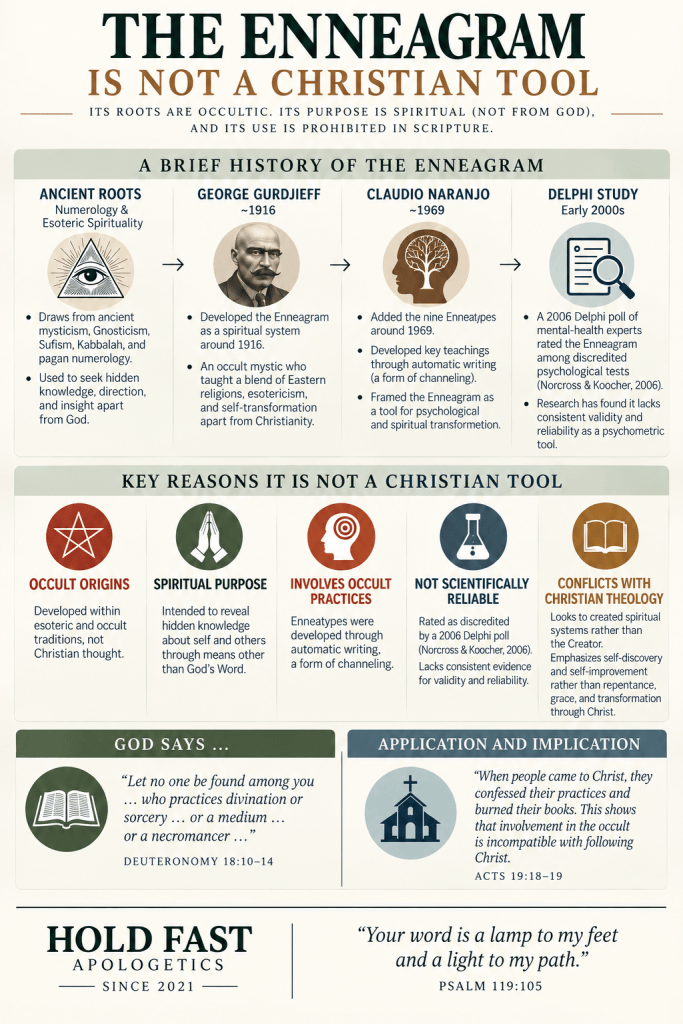
Should Christians Use the Enneagram? From a biblical perspective: No.
The Enneagram is not merely a symbol or neutral tool—it is presented as a system for understanding ourselves and others. Its historical roots are based in the occult, and its purpose is esoteric. Scripture gives us a clear boundary regarding how God views the occult and lovingly directs us to seek spiritual guidance from Him (Scripture and prayer), not other spiritual sources—always for our good.
So the question isn’t simply, “Does this seem helpful?” but, “Is this true?”
From a scientific perspective: No.
The Enneagram has not been established as a scientifically valid personality assessment. In a 2006 Delphi survey of psychologists, the Enneagram was among the methods rated as discredited, while subsequent systematic research has continued to find mixed evidence for its reliability and validity.
Why does this matter?
What we believe about ourselves shapes how we live—and what we believe about others shapes how we love them. The labels we accept can become the lens through which we interpret our behavior, our relationships, and even what we believe we are capable of changing.
So the question isn’t simply, “Does this help me understand myself?” but, “Is what I’m trusting to define me actually true?” Before we look to a personality system, a label, or even our own feelings for guidance, we should ask: Who has the authority to tell me who I am? Because whatever we depend on for identity and direction will ultimately lead us.
 Hold Fast Apologetics