The following is an excerpt from Stephen J. Wellum’s It Is Finished (Union Publishing, 2025), chapter 3, “The Saviour Who Meets Our Need,” pp. 30–34.
“The following is an excerpt from Stephen J. Wellum’s It Is Finished (Union Publishing, 2025), chapter 3, “The Saviour Who Meets Our Need,” pp. 30–34.
First, the words of Genesis 3:15 indicate that the coming Saviour must be truly human, since he comes from the woman. Because by his perfect obedience he will undo what Adam did, it is important that he must be human like us—and yet he is not like us, for he is a greater Adam (see Rom. 5:14; 1 Cor. 15:45, 47).
This truth is further underscored through successive covenants that God makes over time with Noah, Abraham, Israel, Moses, and David. Each of them picks up the ‘offspring’ promise. But as the Old Testament makes painfully clear, not one of those God makes a covenant with can save us, for they too need a Saviour. Instead, all of them point forward to someone who can do what they can’t: the sinless covenant-keeper who will love God perfectly, obeying all God’s commands and satisfying God’s righteous demand against us.
This truth is especially evident in the covenant of God with David. The Davidic covenant is the epitome of the Old Testament covenants, for it brings the previous ones to a climax in King David himself. The Davidic covenant consists of God’s promises about the establishment of David’s house forever (2 Sam. 7:12–16) and is notably characterised by the ‘Father-son’ relationship between God and the king (v. 14; Psalm 2). Significantly, this Father-son relationship links the Davidic covenant back to the previous covenants (for example, Adam, Abraham, and Israel) as well as forwards to Jesus, who is David’s greater Son.
Previously, the language of ‘son’ was applied to the nation of Israel (Exod. 4:22–23), but now it is applied to the individual king as the representative of that nation. As king, David represents both God’s rule to the people and the people themselves as a whole (2 Sam. 7:18–29). The Davidic king also fulfils the role of Adam, since it is through him that God’s rule is effected on earth (v. 19). At the centre of God’s redemptive plan is the restoration of humanity’s role in creation by the provision of a human ‘offspring.’ By the time we get to David, God is teaching us that it is specifically through the Davidic king that creation will be restored—a truth strongly emphasised in the Psalms and the writings of the prophets (e.g., Psalm 2, 72, 110; Isa. 9:6–7 and chapter 11).
However, a problem remains. All the Davidic kings disobey, just like Adam did, yet God’s promise of a Saviour depends on them. God will surely keep his promise to provide the king who will bring salvation, won’t he? But among the kings, there is not even one faithful and obedient son/king who can save us.
What mere human can rise to this level? After all, only God can forgive sin, bring his kingdom to this world, and usher in a new creation. Only a Saviour who is truly God would ever be in a position to achieve this.
This leads us to the message of the biblical prophets, who unveil the second truth: this coming Saviour must also be truly God. How so? The prophets announce that God will keep his promise to save us by his provision of a faithful king who is also a priest (Psalm 110; Isa. 9:6–7). In this human king-priest, a new and everlasting covenant will commence, resulting in God’s saving reign in this world, the permanent forgiveness of our sin (Jer. 31:34), and the inauguration of a new creation (Isa. 65:17).
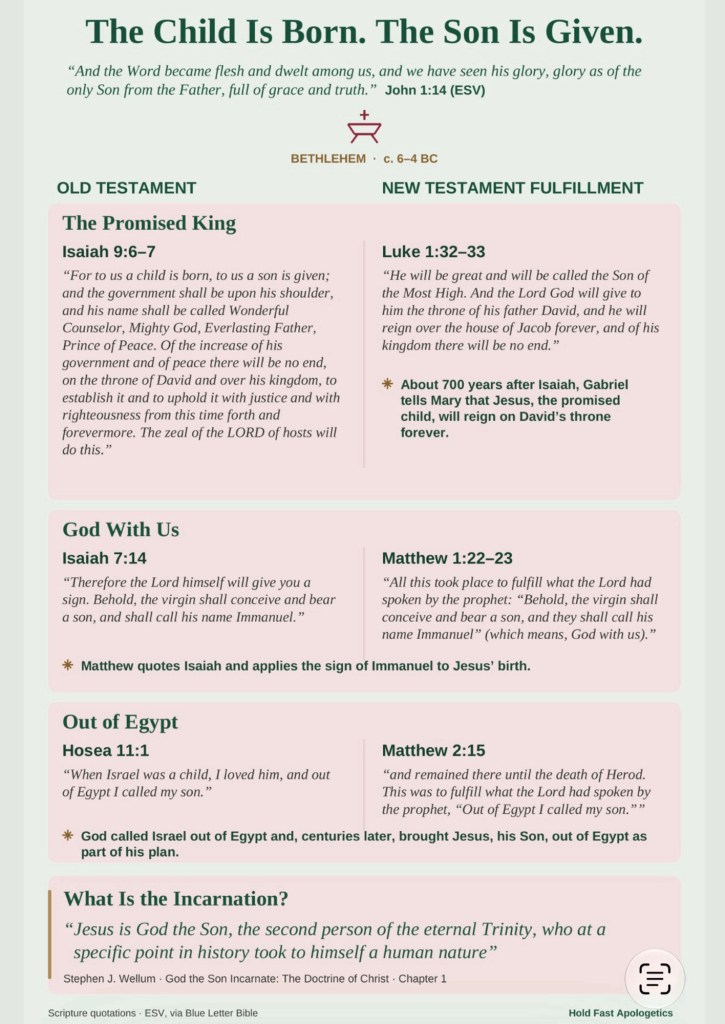
The prophets teach that the future king-priest will be both a human and a divine “Son.” Isaiah pictures this well. The future human king will sit on David’s throne (Isa. 9:7), but he will also bear the names of God: ‘Wonderful Counselor, Mighty God, Everlasting Father, Prince of Peace’ (v. 6). This king, though another David (Isa. 11:1), is also David’s Lord, who shares God’s rule (Ps. 110:1). He is the mediator of a new covenant, that is, the one who acts on our behalf, who does not only the acts of God, but also dies in our place for our sin (Isa. 53:11).
It is through him alone that forgiveness comes (Jer. 31:34). In him, Old Testament hope and expectation are now joined: God will save us through his provision of a king/son-priest—one who is truly human and truly God.”

