
Here are the main points of this clip:
✔️Jesus was a Jew.
“The book of the genealogy of Jesus Christ, the son of David, the son of Abraham.
2 Abraham was the father of Isaac, and Isaac the father of Jacob, and Jacob the father of Judah and his brothers, 3 and Judah the father of Perez and Zerah by Tamar, and Perez the father of Hezron, and Hezron the father of Ram,[a] 4 and Ram the father of Amminadab, and Amminadab the father of Nahshon, and Nahshon the father of Salmon, 5 and Salmon the father of Boaz by Rahab, and Boaz the father of Obed by Ruth, and Obed the father of Jesse, 6 and Jesse the father of David the king.
And David was the father of Solomon by the wife of Uriah, 7 and Solomon the father of Rehoboam, and Rehoboam the father of Abijah, and Abijah the father of Asaph,[b] 8 and Asaph the father of Jehoshaphat, and Jehoshaphat the father of Joram, and Joram the father of Uzziah, 9 and Uzziah the father of Jotham, and Jotham the father of Ahaz, and Ahaz the father of Hezekiah, 10 and Hezekiah the father of Manasseh, and Manasseh the father of Amos,[c] and Amos the father of Josiah, 11 and Josiah the father of Jechoniah and his brothers, at the time of the deportation to Babylon.
12 And after the deportation to Babylon: Jechoniah was the father of Shealtiel,[d] and Shealtiel the father of Zerubbabel, 13 and Zerubbabel the father of Abiud, and Abiud the father of Eliakim, and Eliakim the father of Azor, 14 and Azor the father of Zadok, and Zadok the father of Achim, and Achim the father of Eliud, 15 and Eliud the father of Eleazar, and Eleazar the father of Matthan, and Matthan the father of Jacob, 16 and Jacob the father of Joseph the husband of Mary, of whom Jesus was born, who is called Christ.”
(Matthew 1:1-16)
✔️Jesus was/is the Jewish Messiah who fulfilled hundreds of Old Testament prophecies (Lk 24:44-48; 1 Cor 15).
Per historian Justo L. Gonzalez, “The early Christians did not believe that they were following a new religion (worldview). They were Jews, and their main difference with the rest of Judaism was that they were convinced that the Messiah (Christ) had come, whereas other Jews continued awaiting his advent.” (Story of Christianity, Vol. 1, 41.)
✔️Jesus read the Hebrew Scriptures (Old Testament Scripture: See Luke 4).
“And he came to Nazareth, where he had been brought up. And as was his custom, he went to the synagogue on the Sabbath day, and he stood up to read. 17 And the scroll of the prophet Isaiah was given to him. He unrolled the scroll and found the place where it was written,
18 ‘The Spirit of the Lord is upon me,
because he has anointed me
to proclaim good news to the poor.
He has sent me to proclaim liberty to the captives
and recovering of sight to the blind,
to set at liberty those who are oppressed,
19 to proclaim the year of the Lord’s favor.’
20 And he rolled up the scroll and gave it back to the attendant and sat down. And the eyes of all in the synagogue were fixed on him. 21 And he began to say to them, ‘Today this Scripture has been fulfilled in your hearing.’”
(Luke 4:16-21)
Here is a Google Document with samples of Jesus quoting the Hebrew Scriptures: https://docs.google.com/document/d/1yMAZVwnkcYpzLUzpegNL-iNrwl5N5wwGSb-ABE742RY/edit?usp=sharing
✔️Initially derogatory in nature, the term “Christian” was applied to Jesus’s followers by the citizens of Antioch after Jesus’s crucifixion (Acts 11:26).
“So Barnabas went to Tarsus to look for Saul, 26 and when he had found him, he brought him to Antioch. For a whole year they met with the church and taught a great many people. And in Antioch the disciples were first called Christians.” (Acts 11:25-26)
“But let none of you suffer as a murderer or a thief or an evildoer or as a meddler. 16 Yet if anyone suffers as a Christian, let him not be ashamed, but let him glorify God in that name. 17 For it is time for judgment to begin at the household of God; and if it begins with us, what will be the outcome for those who do not obey the gospel of God?” (1 Peter 4:15-17)
✔️The Council of Nicaea in AD 325 recognized the Scriptures to be God’s authoritative word (recognized vs declared).
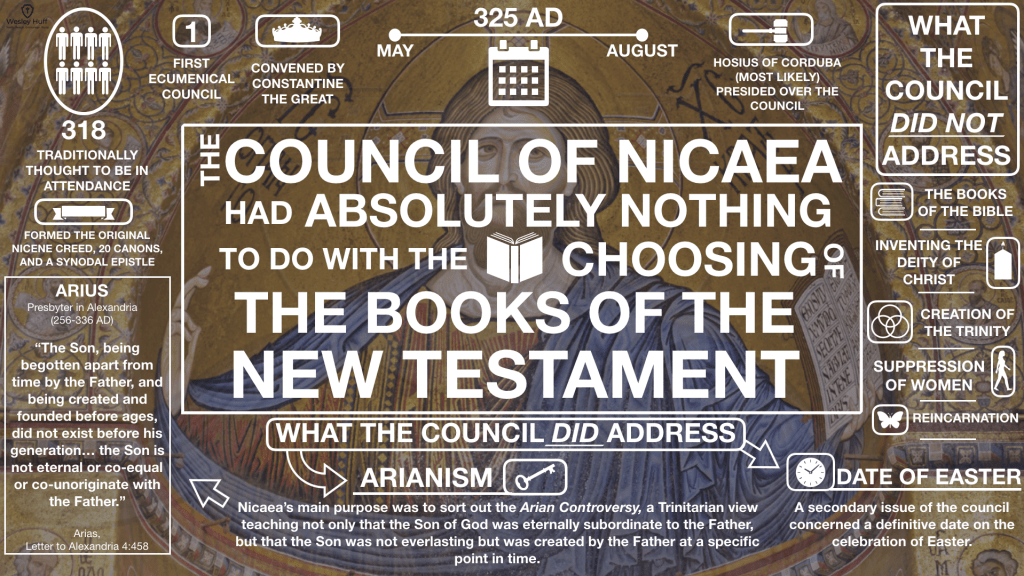
Wes Huff: “The first Council of Nicaea, which took place between May and August in 325 AD in what is now İznik, Turkey, was an ecumenical council called to deal with a specific theological problem. Its purpose was to sort out the Arian Controversy––a Trinitarian heresy being promoted by a presbyter in North Africa named Arius, teaching not only that the Son of God was eternally subordinate to the Father, but that the Son was not everlasting but created by God the Father at a specific point in time. Arius, in his letter to Alexandria, wrote that: “The Son, being begotten apart from time by the Father, and being created and founded before ages, did not exist before his generation… the Son is not eternal or co-equal or co-unoriginate with the Father” (Letter to Alexandria 4:458).
The end result of the assembly was what is now known as the Nicene Creed, along with twenty canon decrees and a synod epistle that went along with the creedal statement. Within all of these documents, Nicaea quotes the New Testament books as authoritative and acknowledged the supremacy and jurisdiction they held. All 318 members (even the unorthodox ones as far as we can tall) recognized the rule scripture possessed already, they did not invent the status it held. The twenty-seven books of the New Testament were being read, studied, preached, and declared as God’s holy Word hundreds of years before anyone at Nicaea was even born.
There is no evidence from any of the documents that came out of Nicaea nor from the testimony of witnesses and members who were there (Eusebius, Athanasius, or Eustathius, for example) that any part of the council had anything to do with choosing or establishing the canon of Scripture. So where did this idea originate from? Well, there are two possible sources where the myth could have originated and taken on a life of its own.” (full article)
Friends, the above (bolded) statements are truth claims that need to be examined. Either they are objectively true (historically verifiable) or they are not. Why wouldn’t we test them?
“Christianity, if false, is of no importance, and if true, of infinite importance, the only thing it cannot be is moderately important.” – C.S. Lewis

