A former Speech and Language Pathologist for nearly 20 years, I began educating our 3 children full-time in 2015 and have cherished every gifted moment (even the challenges). But what is interwoven into all aspects of daily life (as a wife, via motherhood, teaching, friendship, fitness, etc.) is Christian Apologetics (1 Peter 3:15)… which is why this blog exists.
The Enneagram was created by George I. Gurdjieff in 1916 for the purpose of gleaning knowledge from the Cosmos as well as for creating “sacred dances” (using an occult number wrapped around the shape: 142587).
Divination is the act of seeking information from any spiritual sources other than God, which is prohibited by God (Deut 18; Galatians 5). And therefore, this man-made tool is not spiritually neutral. Nor is it “redeemable.”
Does God redeem Diviners? Yes! But not the act of divination.
✔️Is it ancient?
The shape (1916; Gurdjieff) and it’s accompanying “types” (1969-1971; Claudio Naranjo) are not ancient. However, the worldview behind its formation is incredibly ancient (Panentheism mixed with Gnosticism).
It needs to be shared that neither Panentheism nor Gnosticism are compatible with Christianity. In fact, both John and Paul were countering Gnosticism in the 1st century (John 1; Colossians 2).
As Marcia has wisely shared in other interviews, “The Enneagram is not like meat sacrificed to idols. The Enneagram is the idol itself.”
For a comprehensive overview of the important details shared above, please check-out Don & Joy Veinot’s and Marcia Montenegro’s book, Richard Rohr and the Enneagram Secret! It’s an essential resource pertaining to Enneagram research!
Lastly, Midwest Christian Outreach has both produced and compiled an incredible playlist of educational videos anyone can watch while walking on a treadmill, making dinner, folding laundry dry, or flying on a plane. If reading isn’t your preferred way of gleaning information, these videos are invaluable!
“The bigger question is, ‘Why does the Enneagram seem so wonderful to some people if it’s not actually accurate?’”
Dr. Jay Medenwaldt
Preface: This post is not an endorsement of the #Enneagram, but is instead highlighting Dr. Medenwaldt’s important work. This clip is a must watch (12m)!
Per the TEDx video description:
“The Enneagram is common in society as a tool to better understand ourselves and others. Many people use it to determine compatibility or learn more about their personality type. However, this test can sometimes do more harm than help to our personal lives. It allows people to make instant judgments about people they just met or justify dislike of certain personality types.
This talk shows the psychology of the Enneagram, and how stories surrounding the it can reduce people to a number, and perpetuate harmful ideas that lead to negative consequences among family, friends, and society as a whole.
Dr. Jay Medenwaldt is currently an assistant professor of psychology at Northwestern College, IA. He served in the Air Force as a behavioral scientist for nine years before earning a PhD in social psychology and an MDiv in apologetics, ethics, and biblical studies. His research and ministry work focus on how psychological factors affect religious beliefs. His forthcoming book examines the enneagram through the lens of science and Christian theology.
This talk was given at a TEDx event using the TED conference format but independently organized by a local community.”
Friends, the hope God provides is real. So real that we can gaze at the historical reality of the cross (AD 30 or 33) and daily consider the significance of the empty tomb.
And while the library of documents we call the Bible (66 books written over 1,500yrs by 40+ people from different regions) are reliable resources, many hearts are astounded to consider that information also exists about Jesus outside of the Bible! (1)
A few examples of these non-Christian, historical sources are Flavius Josephus (Jewish historian), Suetonius (Roman historian), the Talmud (a text of Rabbinic Judaism), and Cornelius Tacitus (Roman historian and senator). And what do they show us?
✔️Jesus was a real man, ✔️he was crucified on a Roman cross, and ✔️produced an empty tomb. Not to mention ✔️had numerous followers who were martyred for what they earnestly believed. These facts are undisputed by the vast majority of modern day scholars (non-Christian, included).
To add, Dr. Craig Hazen from Biola explains that other worldviews and religions acknowledge Jesus’s existence: “In Hinduism, Jesus emerges in some Hindus’ minds as one of the greatest teachers ever to walk the earth. In Buddhism, if not an incarnation of the Buddha, Jesus certainly is a great Bodhisattva who leads people to the precipice of enlightenment. In Islam, Jesus is a greater prophet than Mohammad, was born of a virgin, is remembered as a miracle worker, and holds the scales of justice at the end of time.” (2)
As Cold Case Detective and Apologist J Warner Wallace explains, “Jesus doesn’t matter because He influenced the world. Jesus influenced the world because He matters…Jesus is who He said he was: God incarnate.“ (3)
You might not need to do research, or desire extra evidence, but maybe your son or daughter might have questions. Or, possibly your neighbor. Questions are good! Please welcome them. Not having answers readily available doesn’t mean they don’t exist. (4)
This video featuring Drs Gary Habermas (Liberty University), Darrell Bock (Dallas Theological Seminary), and Mikel Del Rosario (Moody Bible) will encourage you immensely! (5)
“Brethren, let us cut out of our sermons everything that takes men’s minds away from the cross.
One look at Jesus is better than the most attentive gazing at our gems of speech.
Christ must ever be in the foreground, and our sermons must point to him, or they will do more harm than good. We must preach Christ crucified, and set him forth like the sun in the heavens…
I gather that there is no such thing as a progressive word of the cross, but that the gospel is the same gospel today as it was when Paul in the beginning proclaimed it…
God had but one Son…and he sent him here below to take our nature, that, being found in fashion as a man, he might die on our behalf, made sin for us that we might be made the righteousness of God in him.
‘God so loved the world, that he gave his only begotten Son, that whosoever believeth in him might not perish, but have everlasting life’ [Jn 3:16]. The word of the cross is, ‘God is love’; he willeth not the death of the sinner, but that he turn unto him and live…
Psalm 22, written by King David nearly 1,000 years before Jesus’s crucifixion in AD 30 or 33, was penned 300 years before crucifixion was even invented! And Isaiah 53 (The Suffering Servant) was drafted 700 years beforehand!
Why does this matter?
How could we recognize our Savior without evidence to back up His claims (Mt 11:3-6; Jn 20:30; Lk 24:44-48)? After all, anyone can claim to be the Messiah/Christ. We would need instructions (ie, signposts directing us) as to be absolutely confident.
God, in His goodness, intentionally worked in real time and history to provide these details (more than 300 prophecies). And Jesus fulfilled them all! Psalm 22 and Isaiah 53 both demonstrate God’s faithfulness so vividly! I genuinely hope this encourages anyone needing it today. God is so good!
After his bodily resurrection:
“Then he [Jesus] said to them, ‘These are my words that I spoke to you while I was still with you, that everything written about me in the Law of Moses and the Prophets and the Psalms must be fulfilled.’ Then he opened their minds to understand the Scriptures, and said to them, ‘Thus it is written, that the Christ should suffer and on the third day rise from the dead, and that repentance for the forgiveness of sins should be proclaimed in his name to all nations, beginning from Jerusalem.’” Luke 24:44-47 📕
🎞️ Lee Strobel examines the mathematical miracle of Jesus’s fulfillment of prophecy (2m): https://tinyurl.com/msev37zs
Even John the Baptist, whom Jesus said, “among those born of women no one greater than John the Baptist has appeared,” proclaimed that he was not the Christ (Matthew 11:11; Jn 1:19-20).
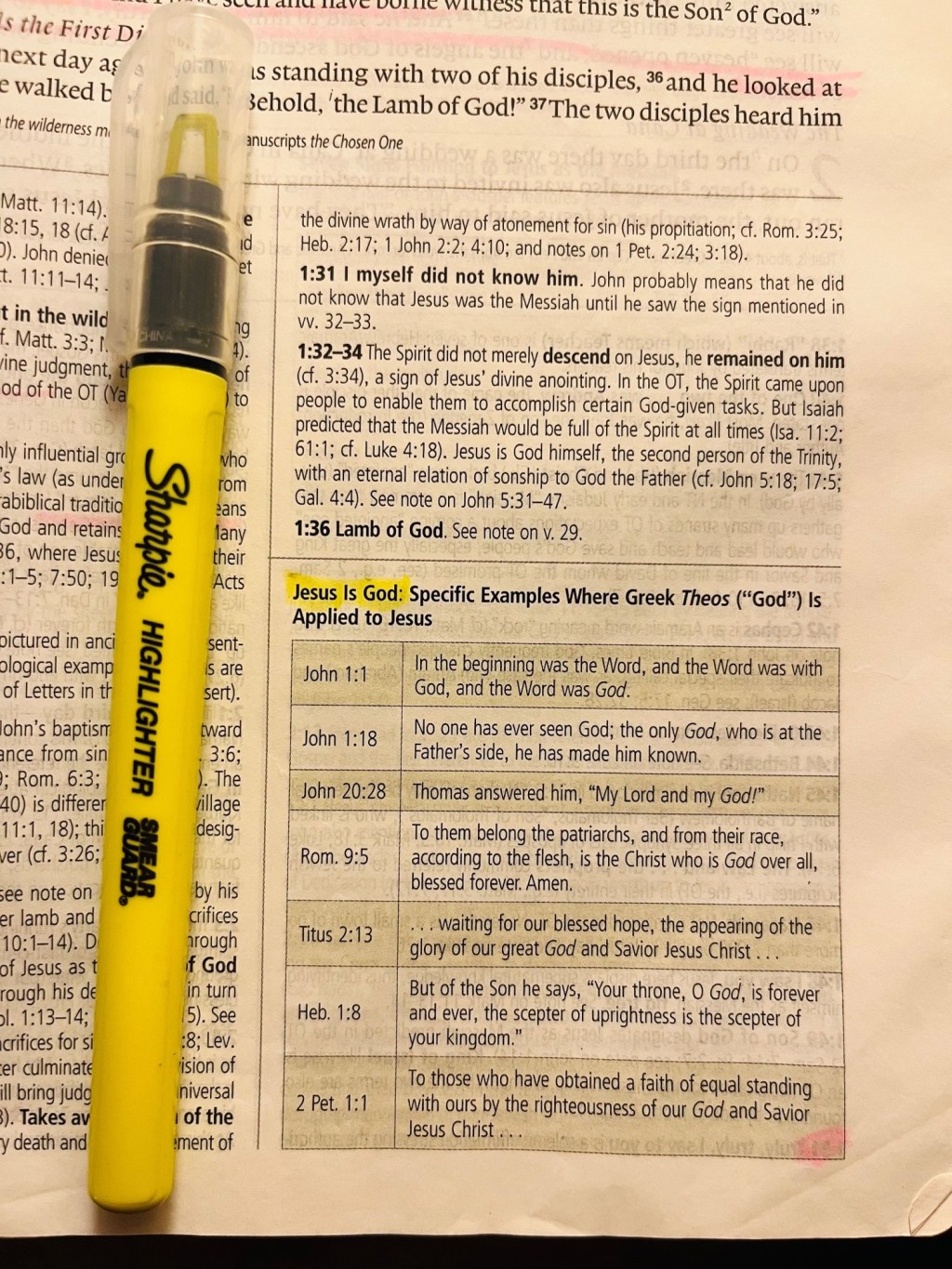
The scriptures demonstrate that Jesus was/is both fully God, and fully human. Why is this so important?
Seminary professor and author articulates the importance of acknowledging Jesus’s humanity and divinity with one succinct statement:
“He suffered as God because only God had the power to save; He suffered as man because only man owed the debt.”
As GoodFriday draws near, think upon the immense love of God which stepped into our place, adding upon Himself humanity, and doing what we are unable to do: save ourselves. Only Jesus is the long-awaited Messiah (Christ). And only God is God.
Dr. James White, author of “The Forgotten Trinity as well as director of Alpha and Omega Ministries, explains that “The doctrine of the Trinity is simply that there is one eternal being of God – indivisible, infinite. This one being of God is shared by three co-equal, co-eternal persons, the Father, the Son, and the Spirit.”
White goes on to say that “there is one eternal, infinite being of God, shared fully and completely by three persons, Father, Son and Spirit. One what, three who’s.”
“One what, three who’s.”
Dr. James White
Dr. White cautions us not to combine any of the three Persons of the Godhead: “We are not saying that the Father is the Son, or the Son the Spirit, or the Spirit the Father. It is very common for people to misunderstand the doctrine as to mean that we are saying Jesus is the Father. The doctrine of the Trinity does not in any way say this!”
More from White:
“The three Biblical doctrines that flow directly into the river that is the Trinity are as follows:
1) There is one and only one God, eternal, immutable.
2) There are three eternal Persons described in Scripture – the Father, the Son, and the Spirit. These Persons are never identified with one another – that is, they are carefully differentiated as Persons.
3) The Father, the Son, and the Spirit, are identified as being fully deity—that is, the Bible teaches the Deity of Christ and the Deity of the Holy Spirit.”
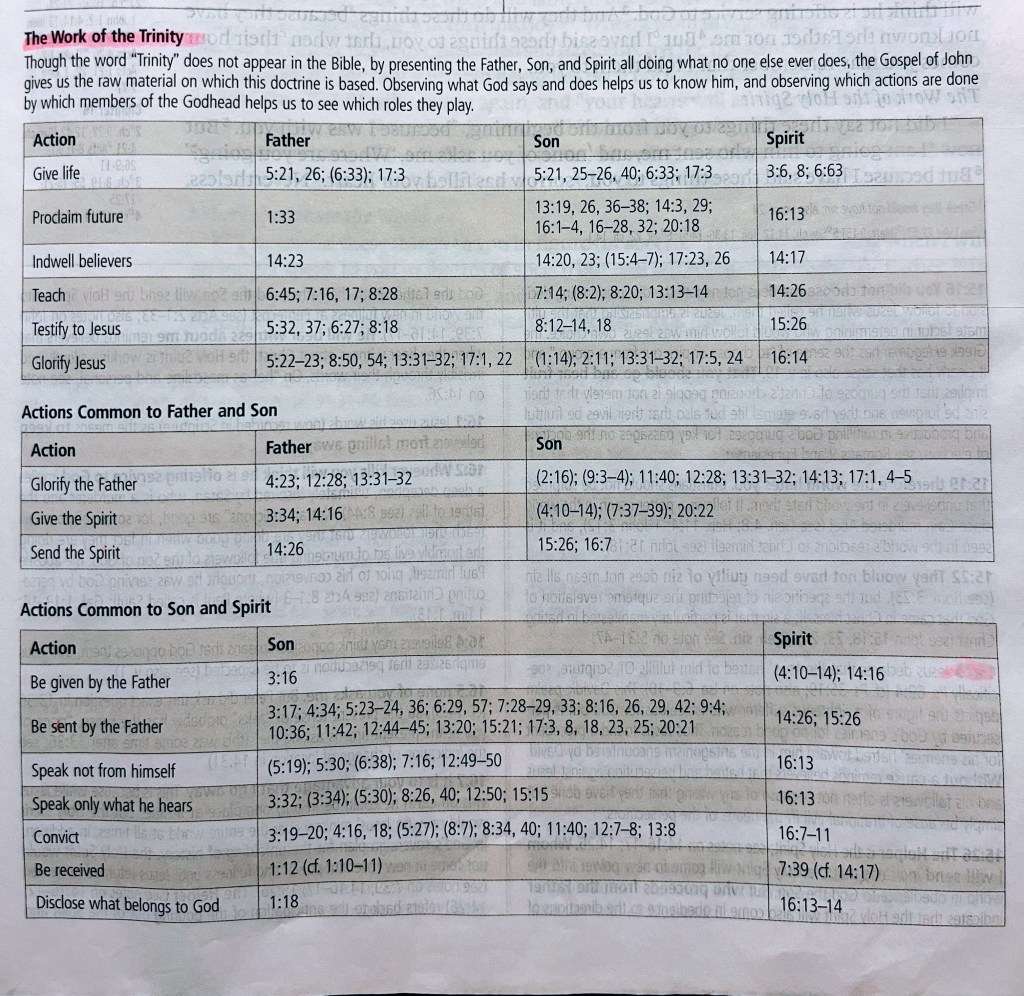
The chart below, from the ESV Study Bible; John 15; p.2055), shows us “which actions are done by which members of the Godhead helps us to see which roles they play.”
Seminary professor and author, Dr. Douglas Groothuis:
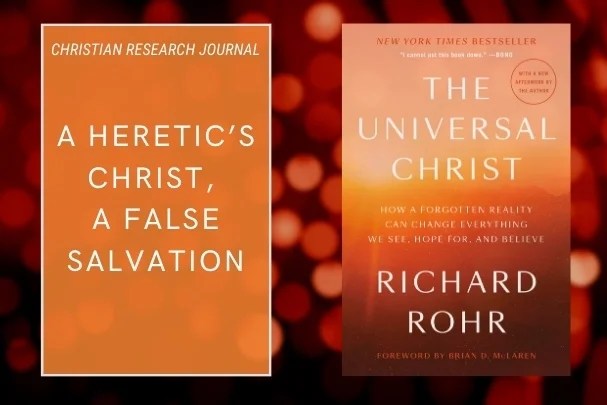
“Not all who speak of ‘Christ’ mean the Jesus Christ of Scripture, the true Lord and Savior of the universe. Jesus Himself warned us of imposters who would rise after His departure. ‘At that time if anyone says to you, ‘Look, here is the Messiah!’ or, ‘There he is!’ do not believe it” (Matthew 24:23; see also 1 John 4:1–6; 2 Corinthians 11:14–15). Not everyone who uses Christian terminology uses the Bible as their dictionary for meaning. Jesus further warned of those who nullified Scripture by their preference for merely human opinions (Matthew 15:1–7; see also Colossians 2:8). Rohr has a perverse skill of twisting Scripture to fit his unbiblical worldview (2 Peter 3:16).”
If you work in formal church ministry and know of anyone immersed in the Enneagram, please be aware that Richard Rohr has personally mentored the 3 most popular enneagram authors: Heuertz, Cron, and Stabile. Beth McCord admits on her webpage (Your Enneagram Coach) that she began her Enneagram journey by “devouring” Rohr’s Enneagram book.
🎤To demonstrate the gravity of this situation, here is a quote by Fr. Rohr via his webpage:
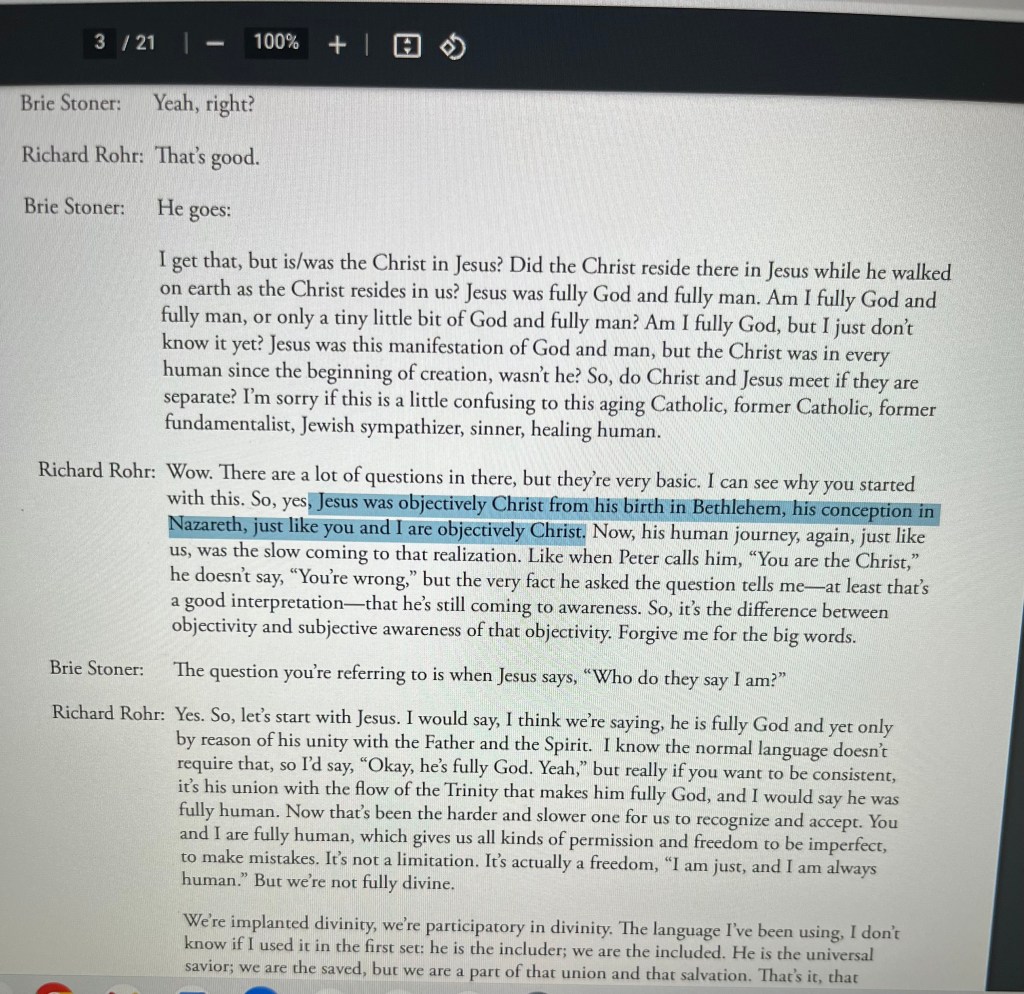
“Jesus was objectively Christ from his birth in Bethlehem, his conception in Nazareth, just like you and I are objectively Christ. Now, his human journey, again, just like us, was the slow coming to that realization.”(1)🚩
Fr Richard Rohr
A self-professed Panentheist who teaches Perennial Wisdom, Rohr advocates both a “different Jesus” and a “different gospel” (2 Cor 11: 4). And he is just passing along the message of the original Enneagram architect (Gurdjieff; 1916).
Friends, attempting to remove Rohr from Enneagram programming is likened to neglecting to thank your foreign language instructor for teaching you Spanish, English, or French. You’re still speaking the language, regardless of whether you mention their name.
An example of Rohr’s theology is shared here (screenshot), from an interview with Richard Rohr in 2019. It is located on his CAC website.
The highlighted portion is where Rohr expounds upon his teaching of what he calls the “True/Authentic Self,” which in Rohr’s theology is “the Christ.” He teaches that we all are the Christ just as Jesus was the Christ. This is more akin to Gnosticism,🚩 not Christianity.
This terminology is important to recognize; especially since some enneagram proponents are attempting to remove Rohr from their scripture-laden version of the Enneagram. Those who either revere Rohr or are mentored by him (Cron, Stabile, Heuertz, McCord, etc.) are still very influential.
By God’s grace alone, through His work on our behalf, diviners and adulterers are saved! However, divination and adultery are not redeemable. God redeems His creation, not the practices which harm it and are contrary to His character.
With this in view, Enneagram is not spiritually neutral. It is not redeemable.
Let’s rest in the work Jesus did for us! Let’s run to God’s word, not to pragmatism (perceived helplessness). Friends, God is faithful to help us!
“Beware of false prophets, who come to you in sheep’s clothing but inwardly are ravenous wolves.” (- Jesus; Matthew 7:15)📕
“I appeal to you, brothers, to watch out for those who cause divisions and create obstacles contrary to the doctrine that you have been taught; avoid them.” (Romans 16:17)📕
“For such men are false apostles, deceitful workmen, disguising themselves as apostles of Christ. And no wonder, for even Satan disguises himself as an angel of light. So it is no surprise if his servants, also, disguise themselves as servants of righteousness. Their end will correspond to their deeds.” (2 Cor 11:13-15)📕
The Enneagram: Discernment of the Spirits (Introduction); 2 hours
Before reading this post, please know that Rohr does NOT hold to the core Christian teachings as detailed in Scripture regarding God’s nature, Jesus as God the Son, sin, and salvation. While he quotes Scripture and uses Christian verbiage, these terms are defined differently by Rohr. For more information about Rohr, please watch this video by Seminary Professor and Author, Dr. Douglas Groothuis (here).🚩
IN HIS OWN WORDS:
Richard Rohr, a Franciscan Friar who views Jesus and Christ as two separate beings, is the most prominent figure associated with the Enneagram. He is highly revered by Suzanne Stabile, Ian Cron, Christopher Heuertz, Beth McCord, and others for his teaching and mentorship.
With this in view, what does Rohr have to say about this “tool” which has been embraced to readily by numerous churches?
🔍Does he affirm the Enneagram as a scientifically verified system?
🎞️(1:40m)No. ”Scientifically, we can’t prove it.”
🔍Does he have definitive evidence for any “Christian” ties to the Enneagram?
Here’s what Rohr admits:
🎞️(6:04) “In my opinion… I can’t prove all of this, but it’s the only links in the chain we can rediscover…(6:16) Then it got lost in his Latin texts and no one bothered with it. But anyway, we’ve got it back.”
🎞️(2:52) Rohr claims that it got rediscovered by “good Jesuits,” and thereby brought back to the West in the early 70’s.
Who were these Jesuits?
Per American Jesuit Priest and Professor, Mitch Pacwa, the Enneagram made its way to Loyola in Detroit through another Jesuit Priest, Bob Ochs, S.J. after he learned it from Chilean Psychiatrist, Claudio Naranjo, in 1970. Naranjo learned about the Enneagram through Oscar Ichazo, and Ichazo utilized the shape after following the teachings of George Gurdjieff (designed the enneagram shape in 1916). No types were added until Claudio Naranjo.(1) It should be noted that Pacwa was trained by Ochs.
If restaurants & grocery stores recall food for the possibility of food poisoning, why don’t Christian publishers humbly recall books they’ve printed which promote poisonous teaching contrary to historic, biblical Christianity?
📙For example, why would two respected Christian publishing companies (Zondervan and IVP) choose to print literature promoting verifiably non-Christian programming? Given that it would be wrong to presume motives, let’s tackle the toxic facts about the Enneagram with the hope that our friends will recognize the real concerns (even though they are overlooked by these publishers).
First of all—Rohr, Stabile, Heuertz, McCord, and others have made the claims that the Enneagram is both Christian and Ancient (*Cron acknowledges a concerning past exists for the enneagram but promotes it via pragmatism).
Is this true? Is the Enneagram both Christian and Ancient? Upon examining these assertions, we find the following information to be historically reliable:
✔️The Enneagram shape was created around 1916 by esoteric teacher George Gurdjieff as a way to get information from the Universe. 🔍1916 debunks ancient attestation. 🔍The view that God is contained within the universe as an impersonal “force” or “flow” is more in-line with Gnosticism and pantheism (not Christianity).
Christianity acknowledges only one God, who is the good and personal Creator of the universe. And while God sustains the universe (Hebrews 1:1-4), He is not contained within it, nor subject to change by it. God is self-sufficient (Isaiah 46:9; Acts 17:24-30) as well as unchanging (immutable: Malachi 3:6 Ja 1:17). 🔍Divination, seeking guidance from spirits, is forbidden in Christianity (Deut 18).
✔️The personality types were added by Chilean New Age Psychiatrist, Claudio Naranjo, around 1969.
✔️Naranjo confessed in the interview shared above that he derived the Enneatypes predominantly via spirit contact (automatic writing/divination). Automatic writing asserts that a spirit moves a person’s hand when writing. This is opposed to how the Holy Spirit helped the biblical writers pen the Scriptures (2 Peter 1:20-21)—given the Holy Spirit engages their minds, not by-passing their minds.
✔️Richard Rohr claims that Jesus and the Christ are two separate entities. 🔍”Christ” is Greek for “Messiah.” Per Christianity, Jesus is the promised Messiah who makes atonement for the sins of the world (Is 53; 1 Cor 25; 2 Cor 5; 1 Jn 2, 5).
✔️Rohr also claims that “Christ” was first incarnated into creation at the Big Bang. 🔍Christianity claims that Jesus is the word which was in the beginning with God and is God, and the one who created the universe (Jn 1:1-18; Col 1:16; 1 Cor 8:6). The first incarnation was Jesus putting on humanity around 5 BC (Is 7:14; Jn 1:24; Gal 4:4).
✔️Rohr claims everyone and everything is “in Christ” due to his belief that the Christ entity incarnated into all creation at the Big Bang. The “True Self,” “Authentic Self,” and “Divine Self” terminology stems from this view of oneism (Pantheism and Panentheism), NOT Christianity. 🔍Christianity claims we all fall short of the glory of God because of sin (Isaiah 59:2; Ro 3:23; 6:23; 5:12). This is our “old self” (Eph 4). 🔍Christianity claims that our salvation can only come from our Creator (Eph 2). 🔍Christianity claims Jesus came to take our sins upon Himself as an act of love. God did what only God could do, on our behalf (1 Pe 2:24; 2 Cor 5).
“Beloved, do not believe every spirit, but test the spirits to see whether they are from God, for many false prophets have gone out into the world. 2 By this you know the Spirit of God: every spirit that confesses that Jesus Christ has come in the flesh is from God, 3 and every spirit that does not confess Jesus is not from God. This is the spirit of the antichrist, which you heard was coming and now is in the world already.”
1 John 4:1-3
Conclusion:
-The New Age presents a different Jesus and a different gospel (2 Cor 11:4). -The Enneagram was birthed from the New Age in the 20th century. -Slapping Scripture upon this shape does not change its identity…no more than “standing in a garage makes one a car” (Chesterton).
Friends, let’s genuinely pray for these publishers. It’s too important not to!
13 minutes with Alisa Childers and Marcia Montenegro




 Hold Fast Apologetics