
Made popular by Christian Apologist Dr. David Wood, the Islamic Dilemma is a logical argument revealing how the Quran openly “affirms the inspiration, preservation, and authority of the Jewish and Christian Scriptures (the Torah and the Gospel).” [1]
The Islamic Dilemma exposes Allah’s command, through the Quran, for Christians to judge the Quran by the Torah and the Gospel. In other words, the “previous Scriptures” are to be the straightedge.
Therefore, the Christian Scriptures are to judge the Quran, then the Quran is false (because the Quran contradicts the Gospel on fundamental events and doctrine). But if the Torah and the Gospel have been corrupted, then the Quran is still false (because it promises the preservation of the Christian Scriptures).
It should also be noted, as Islam claims, that the Quran was “revealed” to Muhammad between AD 610 and AD 632. If Allah is all-knowing and all-powerful, he would have known about any corruption that might have occurred with the biblical scriptures (Torah and the Gospels) and would not have made these commands.
“So let the people of the Gospel judge by what Allah has revealed in it. And those who do not judge by what Allah has revealed are ˹truly˺ the rebellious.” Quran 5:47
Additional resources below.
The Words of the Quran (and the Dilemma)
The Muslim Scriptures (Quran) “affirm the inspiration, preservation, and authority of the Christian scriptures (including the Torah and the Gospel).” [4] | The Dilemma: A. If the Torah and the Gospel are true (inspired and authoritative), then the Quran is false. B. If the Torah and the Gospel are false (Allah did not preserve them), then the Quran is false. |
| “Recite what has been revealed to you from the Book of your Lord. None can change His Words, nor can you find any refuge besides Him.” Quran 18:27 | The Quran promises the preservation of the Christian Scriptures, but if the Christian Scriptures have been corrupted, then Allah’s words can be changed, making the Quran false. But if Allah did preserve the Bible, then the Quran is still false because it contradicts the Bible. |
| “Those who follow the Messenger, the unlettered prophet, whom they find written in what they have of the Torah and the Gospel, who enjoins upon them what is right and forbids them what is wrong and makes lawful for them the good things and prohibits for them the evil and relieves them of their burden and the shackles which were upon them. So they who have believed in him, honored him, supported him and followed the light which was sent down with him – it is those who will be the successful.” Quran 7:157 | Allah commands that the “people of the Book” (Christians) should live by their book and judge the Quran by their Scriptures (Old and New Testaments). The Christian Scriptures differ from the Quran on essential doctrines (per Dr. David Wood): God is a Trinity (Matthew 28:18-20). The Son entered creation as Jesus of Nazareth (John 1:1-4). Jesus died on the cross for sins (Mark 10:32-34, 45). Jesus rose from the dead (Luke 24; 1 Cor 15). Therefore, the Quran is false. |
| “So let the people of the Gospel judge by what Allah has revealed in it. And those who do not judge by what Allah has revealed are ˹truly˺ the rebellious.” Quran 5:47 | |
| “Say, ˹O Prophet,˺ ‘O People of the Book! You have nothing to stand on unless you observe the Torah, the Gospel, and what has been revealed to you from your Lord.’ And your Lord’s revelation to you ˹O Prophet˺ will only cause many of them to increase in wickedness and disbelief. So do not grieve for the people who disbelieve. (Al-Ma’idah 5:68)” Quran 5:68 | |
| “And when you come across those who ridicule Our revelations, do not sit with them unless they engage in a different topic. Should Satan make you forget, then once you remember, do not ˹continue to˺ sit with the wrongdoing people.” Quran 6:68 | |
| “He has revealed to you ˹O Prophet˺ the Book in truth, confirming what came before it, as He revealed the Torah and the Gospel previously, as a guide for people, and ˹also˺ revealed the Standard ˹to distinguish between right and wrong˺. Surely those who reject Allah’s revelations will suffer a severe torment. For Allah is Almighty, capable of punishment.” Quran 3:3-4 | |
| “If you ˹O Prophet˺ are in doubt about ˹these stories˺ that We have revealed to you, then ask those who read the Scripture before you. The truth has certainly come to you from your Lord, so do not be one of those who doubt,” Quran 10:94 | |
| “And let the people of the Gospel judge by what God sent down therein; and whoso judges not by what God has sent down: it is they who are the perfidious. So let the people of the Gospel judge by what Allah has revealed in it. And those who do not judge by what Allah has revealed are ˹truly˺ the rebellious. We have revealed to you ˹O Prophet˺ this Book with the truth, as a confirmation of previous Scriptures and a supreme authority on them. So judge between them by what Allah has revealed, and do not follow their desires over the truth that has come to you. To each of you We have ordained a code of law and a way of life. If Allah had willed, He would have made you one community, but His Will is to test you with what He has given ˹each of˺ you. So compete with one another in doing good. To Allah you will all return, then He will inform you ˹of the truth˺ regarding your differences.” Surah 5:47-49 |
Why is this important?
Every person has a view of the world (a worldview) that answers the major questions we all have: Who are we? How did we get here? What is our purpose? Why are we and this world so broken and yet so beautiful at the same time? From where did love come? How can the broken be made right? Nancy Pearcey, in her book Total Truth, explains that a worldview is like a “mental map that tells us how to navigate the world effectively (p.23). Pearcey contends that the biblical worldview (Christianity) best accounts for the truth of “total reality” and provides a “perspective for interpreting every subject matter” (p. 34).
“I am not a Christian because it works for me. I had a life prior to Christianity that seemed to be working just fine. And my life as a Christian hasn’t always been that easy.
I am a Christian because it’s true.
I’m a Christian because I want to live in a way that reflects the truth.
I’m a Christian because my high regard for truth gives me no alternative.”
J. Waner Wallace (quote source)
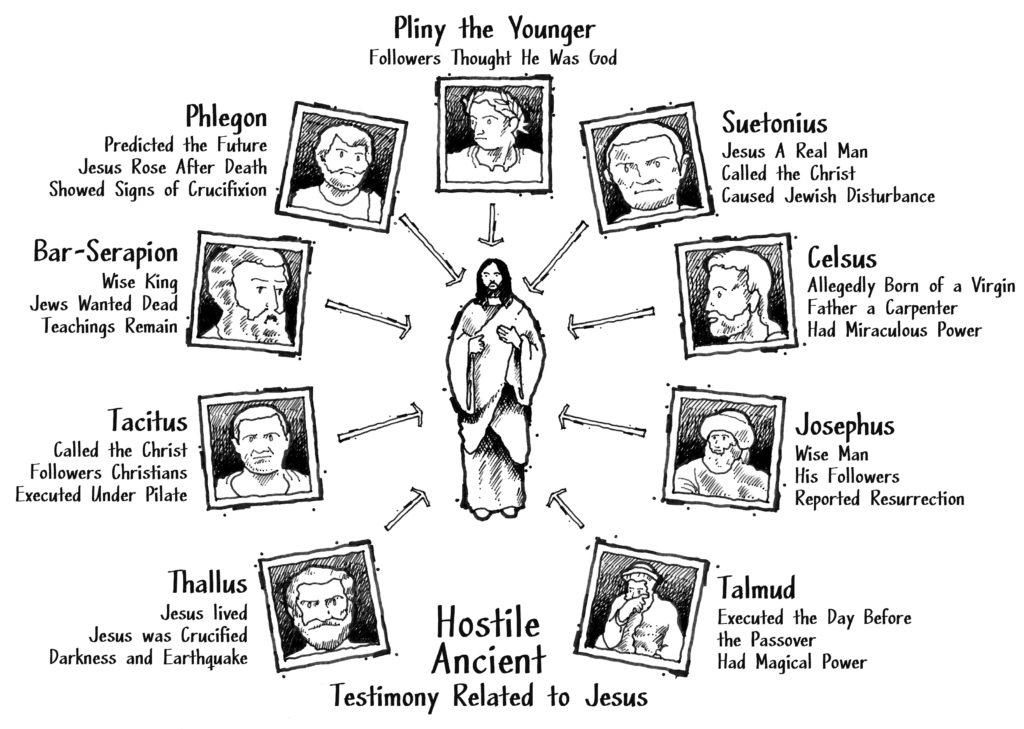
Nearly every major worldview (religion) today acknowledges that Jesus was a real man who performed wondrous deeds, was a good and wise teacher, and was crucified upon a Roman cross around AD 30 or 33. And while Islam denies that Jesus died on the Roman cross (Quran 4:157-158), the historical evidence says otherwise. The combined written testimonies of both Christian eyewitnesses (New Testament writers) and non-Christian historians (eg, Josephus, Pliny the Younger, Mara Bar Sarapion, Livy, and Tacitus) record this event as factual.
“Beloved, do not believe every spirit, but test the spirits to see whether they are from God, for many false prophets have gone out into the world. 2 By this you know the Spirit of God: every spirit that confesses that Jesus Christ has come in the flesh is from God, 3 and every spirit that does not confess Jesus is not from God. This is the spirit of the antichrist, which you heard was coming and now is in the world already.” (1 John 4: 1-3)
When someone tests the claims of Christianity, he or she has the option to trust those claims or not. However, upon examining those assertions, one thing is for certain: wishful thinking is no longer viable. The crucifixion either happened or it didn’t. And the bodily resurrection either occurred or it didn’t. Jesus either claimed to be God, or he didn’t. To not examine these assertions thoughtfully and responsibly is to build one’s home out of the wood of apathy, with its foundation on the shifting sands of relativism.
“but test everything; hold fast what is good.” (1 Thessalonians 5:21)
The Three Major Monotheistic Worldviews
| Christianity | Islam | Judaism | |
| Date Founded | AD 30 or 33 | AD 610 | 2000 BC |
| Sacred Writings | Old and New Testament Scriptures (The Bible) | Qur’an, Hadith | Torah, Tan’akh, Midrash |
| Worldview | Monotheistic Genesis 1:1; Deuteronomy 6:4-5; Isaiah 45:5; 1 Corinthians 8:6 | Monotheistic Surah Al-Ma’idah 5:73; Quran 21:22 | Monotheistic Genesis 1:1; Deuteronomy 6:4-5; Isaiah 45:5 |
| God | Yahweh (Trinity: Father, Son, & Holy Spirit) | Allah | Yahweh |
| View of Jesus | ✔️The promised Messiah (fulfilling > 300 Old Testament prophecies); ✔️God (A); ✔️Died for the sins of humanity on a Roman cross in AD 30 or 33; ✔️Born of a virgin; ✔️Creator; ✔️Judge | ✔️Prophet (A); ✔️Born of a virgin (B); ✔️Did not die on a cross (C); ✔️Judge (D); ✔️Just a man (E); *It should be noted that “the Ebionites were not dominant followers of Jesus nor were they proto-Muslims.” (F) | ✔️False Messiah (A); ✔️Just a man (B); ✔️Crucified by Pontius Pilate (C). |
| View of Salvation | Faith in Jesus (his work on our behalf); Grace alone. Ephesians 2:1-10; Romans 10: 9-10 | Man is born good; Good deeds must outweigh the bad deeds. | .Follow the law; Day of Atonement. |
What is the Gospel (Good News) of God
Christianity holds fast to a monotheistic worldview. This means that Christians view God as the one and only God: There is no other being like Him (Isaiah 45:5; Isaiah 46:9). Only God is the eternal, infinite, Holy, transcendent, uncreated Creator of everything (Genesis 1; Psalm 24; John 1:1-14; Colossians 1:15-20). This means that humanity is not God, nor can man ever become God. God alone is God for eternity. And humans stay humans, forever.
God is one essence or Being (what), and three coequal, coeternal Persons (who).
Christianity teaches the biblical view that God alone is self-sufficient. In other words, God is perfect, lacking nothing (Exodus 3:14; Isaiah 40:28; Isaiah 46:9; Romans 11:33. Therefore, if God were only the Father (one Person), he would need to create humanity to know love. This would demonstrate a lack within him. He would be imperfect. Wes Huff explains that “The Father has been loving the Son in the power of the Holy Spirit forever. God does not need to create to experience anything. [Instead,] creation is an outpouring of his love.” (source)
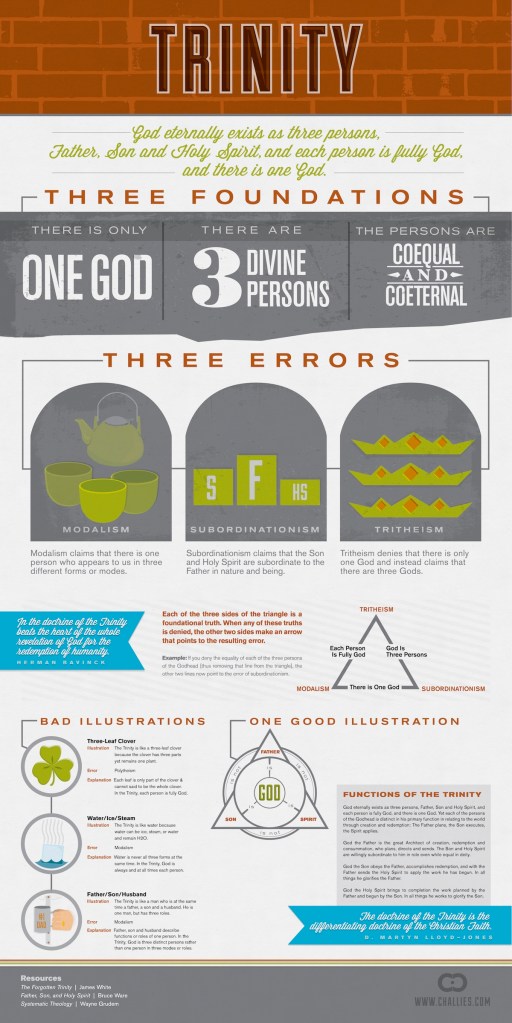
“In eternity past, the Father loved the Son and the Son loved the Father. Love is bound up in the very nature of God.” D.A. Carson (source)
This is why God, as a Trinity, best explains why God is Love (1 John 4). Even though the word Trinity is not found in the Bible, Scripture (both the Old and New Testaments) confirms the concept. God the Father, God the Son, and God the Holy Spirit have been loving one another from Eternity past. There is no lack of love (holiness, goodness, etc.) in the Godhead. There is no need to create anything to love because God is already Love. God’s love stands in stark contrast to our frail and self-focused affections. Instead, God’s love always has another’s best interest in mind. Viewing God as a Trinity, God is one essence (what) and three coequal, coeternal Persons (who), has been an essential teaching of Christianity from the very beginning.
“Go therefore and make disciples of all nations, baptizing them in the name of the Father and of the Son and of the Holy Spirit,” Jesus (Matthew 28:19)
“For to us a child is born, to us a son is given; and the government shall be upon his shoulder, and his name shall be called Wonderful Counselor, Mighty God, Everlasting Father, Prince of Peace.” (Isaiah 9:6)
“And when Jesus saw their faith, he said to the paralytic, ‘Son, your sins are forgiven.’ 6 Now some of the scribes were sitting there, questioning in their hearts, 7 ‘Why does this man speak like that? He is blaspheming! Who can forgive sins but God alone?’” (Mark 2:5-7)
“In the beginning was the Word, and the Word was with God, and the Word was God. He was with God in the beginning. All things were created through him, and apart from him not one thing was created that has been created. He was in the world, and the world was created through him, and yet the world did not recognize him. He came to his own, and his own people did not receive him. But to all who did receive him, *he gave* them the right to be children of God, to those who believe in his name, who were born, not of natural descent, or of the will of the flesh, or of the will of man, but of God. The Word became flesh and dwelt among us. We observed his glory, the glory as the one and only Son from the Father, full of grace and truth.” (John 1:1-14)
“No one has ever seen God; God the only Son, who is at the Father’s side, he has made him known” (John 1:18)
And while God does not need anything (even us), he created us for his good and perfect purposes. Per GotQuestions.org, “Being created for God’s pleasure does not mean humanity was made to entertain God or provide Him with amusement. God is a creative Being, and it gives Him pleasure to create. God is a personal Being, and it gives Him pleasure to have other beings He can have a genuine relationship with.” (source)
“For by him all things were created, in heaven and on earth, visible and invisible, whether thrones or dominions or rulers or authorities — all things were created through him and for him.” (Colossians 1:16)
The Bible tells us that God created humanity in his image (Genesis 1:27), which does not imply that humanity is like God in our being (ontology). Instead, it refers to our God-given design for communication (with him), creativity (stewarding the resources given to us), relationship (resembling what God has as a Trinity), and the ability to love. God has given humanity the gift of Free Will so that love would be possible. Without the choice to love, love would not be an option.
Another important note to make is this: God is good, and therefore everything God creates is good. Genesis 1 attests to the goodness of God’s design! God made humanity with a body and a soul. Therefore, humanity is not just a soul, but both body and soul. And both have a good design because God made both (Genesis 1:26-27). This biblical perspective of God’s design of humanity differs drastically from the Docetic (Gnostic) perspective, drastically!
“Docestism is the viewpoint that our bodies are bad because the material world is bad or evil. “The word Docetism comes from the Greek dokein, which meant ‘to seem’; according to Docetism, Jesus Christ only seemed to have a human body like ours.” [14] This view finds it illogical for a infinte, holy God to wear a finite, sin-riddled humanity. Islam, Gnosticism, Perennial Wisdom, and the New Age Spirituality would agree with the Docetic interpretation of Jesus’s life, claiming that he could not have been God incarnate. Nor could a prophet from God die such a humiliating death (upon a Roman cross).
“For the word of the cross is folly to those who are perishing, but to us who are being saved it is the power of God. 19 For it is written,
‘I will destroy the wisdom of the wise,
and the discernment of the discerning I will thwart.’”
Christian apologist GodLogic (Avery) dialogued with a Muslim via a livestream on YouTube about the essential doctrine of God’s incarnation (as Jesus of Nazareth). GodLogic helped this young man to understand that Christians recognize that humanity is a creation of God, and that no human can become God (as opposed to Mormonism and the New Age). Christians do not believe that we are divine. However, we do hold fast to the biblical teaching that God can become a man (see Isaiah 9:6 & Philippians 2). GL pointed to a teaching in the Quran, where Allah (believed by Muslims to be the infinite, uncreated Creator) chooses to protect creation by veiling himself in light (a creation). [15]
GodLogic, both respectfully and patiently, built a bridge with the Muslim caller, finding mutual agreement that God, being infinite and mighty, lovingly veiled himself with creation. For the Muslim, Allah chooses to withhold his glory (without losing his glory or might) with a created thing: light. For the Christian, we recognize Jesus as remaining the infinite, glorious God of the Universe, all the while adding upon himself a human nature. Jesus was fully God and fully human. To reiterate, Jesus did not become God nor was merely an enlightened man. Jesus was God incarnate. That is why Philippians 2:6-11 was an early creed of Christians (recorded in Paul’s letter to the Philippian church in AD 61-61).
“who (Jesus), existing in the form of God,
did not consider equality with God
as something to be exploited.
7 Instead he emptied himself
by assuming the form of a servant,
taking on the likeness of humanity.
And when he had come as a man,
8 he humbled himself by becoming obedient
to the point of death—
even to death on a cross.
9 For this reason God highly exalted him
and gave him the name
that is above every name,
10 so that at the name of Jesus
every knee will bow—
in heaven and on earth
and under the earth—
11 and every tongue will confess
that Jesus Christ is Lord,
to the glory of God the Father.”
(Philippians 2:6-11)
What does it mean to be made in the Image of God, and how does this relate to the Gospel of God? Dr. David Wood unpacks what it means to be made in the image of God. This is an excellent resource!
“So God created man in his own image,
in the image of God he created him;
male and female he created them.” (Genesis 1:27)
We are created by a good God. All that God does is good. This means that our design is good (Genesis 1 and 2). Included in this design is our ability to choose. We are moral creatures. We have the God-given ability to choose either God’s way (his word/character) or our own way. In other words, can either follow God’s heart and do what is best for us, or follow our own hearts and do what seems right! Or as Frank Sinatra sang, “I’ll do it my way!”
Choosing our own way is straying from what is good and right. Therefore, forging our own path is choosing what is wrong and evil, for it goes against God’s guidance. When our first parents (Adam and Eve) chose to follow their own hearts instead of God’s heart, they essentially chose to pilot a good design with a less capable pilot. Because of this choice, we all have inherited a broken lens through which to operate what God has given us. Friends, we broke the world. We are the only ones to blame, not God.
“It’s your sins that have cut you off from God. Because of your sins, he has turned away and will not listen anymore.”(Isaiah 59:2)
“All we like sheep have gone astray; we have turned—every one—to his own way; and the Lord has laid on him the iniquity of us all.” (Isaiah 53:6)
What then? Are we Jews any better off? No, not at all. For we have already charged that all, both Jews and Greeks, are under sin, 10 as it is written:
(D)“None is righteous, no, not one;
11 no one understands;
no one seeks for God.
(Romans 3:9-11)
“for all have sinned and fall short of the glory of God,” (Romans 3:23)
“Therefore, just as sin came into the world through one man, and death through sin, and so death spread to all men because all sinned.” (Romans 5:12
But in his immense (charitable and steadfast) love for us, He did not leave us in this death-bound state. God had a plan. A plan set forth by the Father, the Son, and the Holy Spirit in eternity past. A boots-on-the-ground mission of God for humanity, carried out in real time and space. A plan that could not be thwarted.
Friends, Jesus demonstrated in real time and space who He was (and still is). God’s love came down and put upon Himself a human nature to fulfill His promise: rescuing humanity (Ge 3:15; Jn 2:12; 3:26). This is captured vividly in Mark’s letter. Remaining fully God, fully veiled in a human nature, Jesus fulfilled the Law of God perfectly on our behalf. Going to the cross, Jesus paid the debt you and I owe, and raising bodily in a transformed body, Jesus made a way back to God which only God could make. Jesus’s work on our behalf saves us. As pastor and author Michael Horton articulates, “He suffered as God because only God had the power to save; He suffered as man because only man owed the debt.” You see, Jesus is not a mere model of faith for Christians… Jesus is the object of our faith.
“I will put enmity between you and the woman,
and between your offspring and her offspring;
he shall bruise your head,
and you shall bruise his heel.” (Genesis 3:15)
“Surely he has borne our griefs
and carried our sorrows;
yet we esteemed him stricken,
smitten by God, and afflicted.
5 But he was pierced for our transgressions;
he was crushed for our iniquities;
upon him was the chastisement that brought us peace,
and with his wounds we are healed.
6 All we like sheep have gone astray;
we have turned—every one—to his own way;
and the Lord has laid on him
the iniquity of us all.” (Isaiah 53:4-6)
“but God shows his love for us in that while we were still sinners, Christ died for us.“ (Romans 5:8)
“He committed no sin, neither was deceit found in his mouth. 23 When he was reviled, he did not revile in return; when he suffered, he did not threaten, but continued entrusting himself to him who judges justly. 24 He himself bore our sins in his body on the tree, that we might die to sin and live to righteousness. By his wounds you have been healed. 25 For you were straying like sheep, but have now returned to the Shepherd and Overseer of your souls.” (1 Peter 2:22-25)
God’s plan of salvation for humanity was not just for those living in the first century, but it is for all of humanity. Every human needs to be saved from his or her sin. This plan was retroactive for those living before God’s incarnation as well as for those who would come afterwards. It’s for this very reason that God both planned and superintended the construction of the Bible so that we can all know his plan of salvation.
“ Then he (Jesus) said to them, ‘These are my words that I spoke to you while I was still with you, that everything written about me in the Law of Moses and the Prophets and the Psalms must be fulfilled.’ 45 Then he opened their minds to understand the Scriptures, 46 and said to them, ‘Thus it is written, that the Christ should suffer and on the third day rise from the dead, 47 and that repentance for the forgiveness of sins should be proclaimed in his name to all nations, beginning from Jerusalem. 48 You are witnesses of these things. 49 And behold, I am sending the promise of my Father upon you. But stay in the city until you are clothed with power from on high.‘” (Luke 24:44-49)
“Inasmuch as many have undertaken to compile a narrative of the things that have been accomplished among us, 2 just as those who from the beginning were eyewitnesses and ministers of the word have delivered them to us, 3 it seemed good to me also, having followed all things closely for some time past, to write an orderly account for you, most excellent Theophilus, 4 that you may have certainty concerning the things you have been taught.” (Luke 1:1-4)
The Bible is a codex of 66 books penned by more than 40 writers on 3 different continents (Africa, Europe, and Asia), in 3 different languages (Hebrew, Aramaic, and Greek), with a steadfast message testifying to God as the One True God who is faithful to save. Per John Wenham, from his book Christ and the Bible, “To him (Jesus), what Scripture says, God says” (p. 17).
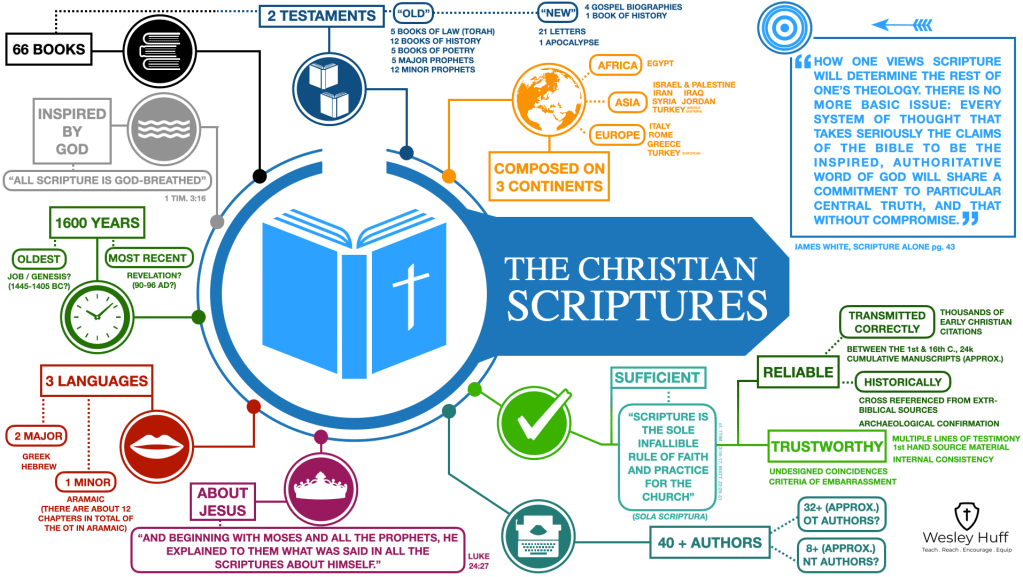
“Then the Lord said to Moses, ‘Write this as a memorial in a book and recite it in the ears of Joshua, that I will utterly blot out the memory of Amalek from under heaven.’” Exodus 17:14
“But the Helper, the Holy Spirit, whom the Father will send in my name, he will teach you all things and bring to your remembrance all that I have said to you.” John 14:26
“I do not ask for these only, but also for those who will believe in me through their word, ” John 17:20
The late Voddie Baucham described the Bible in this way: “I choose to believe the Bible because it’s a reliable collection of historical documents written by eyewitnesses, during the lifetime of other eyewitnesses…who report supernatural events that took place in fulfillment of specific prophecies, and claim their writings are divine rather than human in origin” (here is the quote source).
“For whatever was written in former days was written for our instruction, that through endurance and through the encouragement of the Scriptures we might have hope.” (Romans 15:4)
“For we did not follow cleverly devised myths when we made known to you the power and coming of our Lord Jesus Christ, but we were eyewitnesses of his majesty. 17 For when he received honor and glory from God the Father, and the voice was borne to him by the Majestic Glory, “This is my beloved Son, with whom I am well pleased,” 18 we ourselves heard this very voice borne from heaven, for we were with him on the holy mountain. 19 And we have the prophetic word more fully confirmed, to which you will do well to pay attention as to a lamp shining in a dark place, until the day dawns and the morning star rises in your hearts, 20 knowing this first of all, that no prophecy of Scripture comes from someone’s own interpretation. 21 For no prophecy was ever produced by the will of man, but men spoke from God as they were carried along by the Holy Spirit.” (2 Peter 1:16-21)
“But as for you, continue in what you have learned and have firmly believed, knowing from whom you learned it 15 and how from childhood you have been acquainted with the sacred writings, which are able to make you wise for salvation through faith in Christ Jesus. 16 All Scripture is breathed out by God and profitable for teaching, for reproof, for correction, and for training in righteousness, 17 that the man of God may be complete, equipped for every good work.” (2 Timothy 3:14-17)
Where did Christianity get its name?
Per historian Justo L. Gonzalez, “The early Christians did not believe that they were following a new religion (worldview). They were Jews, and their main difference with the rest of Judaism was that they were convinced that the Messiah (Christ) had come, whereas other Jews continued awaiting his advent.” (p. 41) [2] Nancy Pearcey says it this way in her book Finding Truth, “The Christian message does not begin with ‘accept Christ as your Savior’; it begins with ‘in the beginning God created the heavens and the earth’” (p.45).
Initially, the Romans viewed early Christians as a variant sect of Judaism. That is, until people from outside of Judaism became followers of Jesus as well. The title “Christian” was given to them by authorities in Antioch to designate them as a group (Acts 11:26; 1 Peter 4:16).
Early Christians believed that Jesus had fulfilled the prophecies about the Messiah in the Old Testament. The works Jesus had performed, and the worship he had received, made it clear to these early Christians that Jesus was who he claimed to be: God incarnate.
Do we have the original message?
One objection cited by numerous Muslim apologists (regarding the Islamic Dilemma) is that Allah was speaking about the inspiration, preservation, and authority of the original Torah and Gospel. It’s their belief that what we have today is not the original but is instead a corrupted version.
So how do we know that what we have today matches the original?
To know if we have an accurate message in our Bibles today, we need to examine if the copies were early, plentiful (for cross-checking and comparing), and consistent (or were they altered after the originals). It’s also important to address the role of the Council of Nicaea (AD 325) in church history and whether this council had any say in what books were inspired (authoritative).
Early
What did the earliest followers of Jesus teach? This is crucial! This is what the Islamic Dilemma is addressing. In order to do this with integrity, let’s go to the Gospel letter thought to be the earliest of the four gospel accounts by numerous scholars — Mark. The Gospel of Mark was recorded with “internal and external data pointing to Rome as the place of composition around the mid-to-late 50’s.”[3] And while Mark was not an eyewitness to Jesus’s earthly ministry, he wrote Peter’s testimony with care and urgency.
Jesus’s crucifixion most likely occurred in A.D. 30 or 33; therefore, the documentation provided by Mark is approximately 20 years later. This is incredible news when referring to ancient documents! For example, the first written copy of Caesar’s Gallic Wars appeared approximately 950 years later, with the first extant copy of Tacitus’s Annals showing up 1,000 years afterwards! [4]
“Famous British manuscript expert Sir Frederick Kenyon summed up the matter well when he declared that: ‘The interval between the dates of original composition and the earliest extant evidence becomes so small as to be in fact negligible, and the last foundation for any doubt that the Scriptures have come down substantially as they were written has now been removed. Both the authenticity and the general integrity of the books of the New Testament may be regarded as finally established‘ (Kenyon, The Bible and Archaeology, 288).” Norman Geisler (source)
Given that Mark’s letter was Peter’s eyewitness account of Jesus’ teachings and miracles, we would expect the earliest eyewitness report to boldly acknowledge Jesus’s self-proclamations to be the long-awaited Messiah (God the Son, incarnate). And if we take time to actually study Mark for ourselves, we would find Jesus demonstrating his identity as God incarnate in nearly every single chapter of Mark! We just need to read the texts versus readily believing every online pundit (this includes me).
It should also be noted that both Paul and Peter were martyred at the hands of Nero in the mid to late 60s AD. This means that every letter written by these two men was within 20-35 years after the crucifixion and bodily resurrection of Jesus (250-300 years before the council of Nicaea). Here is a powerful example of how the events recounted by Peter in Mark’s letter parallel those of Psalm 22.
Mark 15
“And when the sixth hour had come, there was darkness over the whole land until the ninth hour. 34 And at the ninth hour Jesus cried with a loud voice, ‘Eloi, Eloi, lema sabachthani?’ which means, ‘My God, my God, why have you forsaken me?’ 35 And some of the bystanders hearing it said, ‘Behold, he is calling Elijah.’ 36 And someone ran and filled a sponge with sour wine, put it on a reed and gave it to him to drink, saying, ‘Wait, let us see whether Elijah will come to take him down.’ 37 And Jesus uttered a loud cry and breathed his last. 38 And the curtain of the temple was torn in two, from top to bottom. 39 And when the centurion, who stood facing him, saw that in this way he breathed his last, he said, ‘Truly this man was the Son of God!’” (Mark 15)
“Then he said to them, ‘These are my words that I spoke to you while I was still with you, that everything written about me in the Law of Moses and the Prophets and the Psalms must be fulfilled.’ 45 Then he opened their minds to understand the Scriptures, 46 and said to them, ‘Thus it is written, that the Christ should suffer and on the third day rise from the dead, 47 and that repentance for the forgiveness of sins should be proclaimed in his name to all nations, beginning from Jerusalem. 48 You are witnesses of these things. 49 And behold, I am sending the promise of my Father upon you. But stay in the city until you are clothed with power from on high.’” (Luke 24:44-49)
Psalm 22
“My God, my God, why have you forsaken me?
Why are you so far from saving me, from the words of my groaning?
2 O my God, I cry by day, but you do not answer,
and by night, but I find no rest.
3 Yet you are holy,
enthroned on the praises of Israel.
4 In you our fathers trusted;
they trusted, and you delivered them.
5 To you they cried and were rescued;
in you they trusted and were not put to shame.
6 But I am a worm and not a man,
scorned by mankind and despised by the people.
7 All who see me mock me;
they make mouths at me; they wag their heads;
8 “He trusts in the Lord; let him deliver him;
let him rescue him, for he delights in him!”
9 Yet you are he who took me from the womb;
you made me trust you at my mother’s breasts.
10 On you was I cast from my birth,
and from my mother’s womb you have been my God.
11 Be not far from me,
for trouble is near,
and there is none to help.
12 Many bulls encompass me;
strong bulls of Bashan surround me;
13 they open wide their mouths at me,
like a ravening and roaring lion.
14 I am poured out like water,
and all my bones are out of joint;
my heart is like wax;
it is melted within my breast;
15 my strength is dried up like a potsherd,
and my tongue sticks to my jaws;
you lay me in the dust of death.
16 For dogs encompass me;
a company of evildoers encircles me;
they have pierced my hands and feet—
17 I can count all my bones—
they stare and gloat over me;
18 they divide my garments among them,
and for my clothing they cast lots.
19 But you, O Lord, do not be far off!
O you my help, come quickly to my aid!
20 Deliver my soul from the sword,
my precious life from the power of the dog!
21 Save me from the mouth of the lion!
You have rescued me from the horns of the wild oxen!
22 I will tell of your name to my brothers;
in the midst of the congregation I will praise you:
23 You who fear the Lord, praise him!
All you offspring of Jacob, glorify him,
and stand in awe of him, all you offspring of Israel!
24 For he has not despised or abhorred
the affliction of the afflicted,
and he has not hidden his face from him,
but has heard, when he cried to him.
25 From you comes my praise in the great congregation;
my vows I will perform before those who fear him.
26 The afflicted shall eat and be satisfied;
those who seek him shall praise the Lord!
May your hearts live forever!
27 All the ends of the earth shall remember
and turn to the Lord,
and all the families of the nations
shall worship before you.
28 For kingship belongs to the Lord,
and he rules over the nations.
29 All the prosperous of the earth eat and worship;
before him shall bow all who go down to the dust,
even the one who could not keep himself alive.
30 Posterity shall serve him;
it shall be told of the Lord to the coming generation;
31 they shall come and proclaim his righteousness to a people yet unborn,
that he has done it.”
But even before Mark’s letter was a creed which was sung by Christians, soon after Jesus’s crucifixion and bodily resurrection. Paul knew of this creed. He later penned this creed of the early church into his first letter to the church in Corinth (mid-50’s AD), a decade before his martyrdom by Nero (AD 64).
“For I delivered to you as of first importance what I also received: that Christ died for our sins in accordance with the Scriptures, 4 that he was buried, that he was raised on the third day in accordance with the Scriptures, 5 and that he appeared to Cephas, then to the twelve. 6 Then he appeared to more than five hundred brothers at one time, most of whom are still alive, though some have fallen asleep. 7 Then he appeared to James, then to all the apostles. 8 Last of all, as to one untimely born, he appeared also to me.” (1 Corinthians 15:3-8)
Even atheist New Testament scholars agree that this creed was remarkably early! Friends, this was nearly 300 years before the Council of Nicaea. [5]
“Gerd Lüdemann: An atheistic NT professor at Göttingen, Lüdemann dates the elements in the tradition to the first two years after the crucifixion of Jesus, as mentioned in various sources. You can find his arguments in The Resurrection of Jesus: History, Experience, Theology (Fortress, 1994)’ [6]
What does this teachable song (creed) communicate?
✔️Jesus of Nazareth was a real man (Jewish).
✔️Jesus died for our sins.
✔️Jesus’s life, death, and bodily resurrection were promised in the Hebrew Scriptures (Old Testament).
✔️Jesus appeared bodily to Peter, James, the Disciples, and 500+ people (at one time). These were eyewitnesses available for fact-checking.
✔️This creed was proclaimed, sung, & written down very early — within months of Jesus’s bodily resurrection in either AD 30 or 33. It existed before Paul’s conversion.
Plentiful
Not only are the New Testament documents early, but they are also plentiful!! Per Andreas Köstenberger and Michael Kruger in their book The Heresy of Orthodoxy, “By contrast, the New Testament manuscripts stand out as entirely unique in this regard. Although the exact count is always changing, currently we possess over 5,500 manuscripts (in whole or in part) of the New Testament in Greek alone. No other document of antiquity even comes close. Moreover, we possess thousands more manuscripts in other languages” (pgs 207-208). As Dr. Daniel Wallace often recounts, “We have an embarrassment of riches” when it comes to the number of copies we’ve been given!
Having numerous copies affords us the ability to compare and contrast the documents with one another. With thousands of copies at hand, we are thereby able to locate spelling differences as well as scrutinize whether doctrinal changes have been made. And while textual critics have identified more than 400,000 differences among the 5,500 Greek manuscripts, 99% of these differences (“variants”) were attributed to spelling differences. The conclusion: no significant doctrinal differences exist! This is preservation!!
Regarding preservation versus corruption, someone (monk, scribe, etc) would have had to change hundreds of copies of manuscripts in Greek, Coptic, Latin, and other languages, all the while keeping it all secret. This is implausible.
Consistent
So far, we have pointed out the early nature of the New Testament documents and the abundance of copies available to us today (by the sovereignty of God). Due to the plentiful nature of the manuscripts, we can compare and contrast them with academic scrutiny for any doctrinal changes. We can then conclude that the message we have today is consistent with the earliest manuscripts, pointing to the preservation of the Gospels.
“New Testament textual transmission didn’t happen in a single line of succession but rather in multiple streams, with many people making many copies, creating a wealth of manuscript data.” Wes Huff (source)
The reality is that our current Bibles are constructed (except for the New World Translation and the Passion Translation) from the earliest copies of both the Old and New Testament documents (not from the most recent). With this in view, how then do we address the TikTok apologists who fervently and confidently look to the Council of Nicaea to discredit the Bible’s authority and preservation?
The Council of Nicaea
Is it historically accurate to assert that a fourth-century church council was responsible for creating the biblical canon? Let’s take a look an objective look at history and assess this popular claim!
“There is no historical basis for the idea that Nicaea established the canon and created the Bible.” Dr. John M. Meade (source)
When looking into the reliability of ancient documents, Wes Huff has become a trusted resource! In his article, What Happened at the Council of Nicaea, Huff explains, “One of the main characters in the Da Vinci Code, Leigh Teabing, states at one point that, “Constantine commissioned and financed a new Bible, which omitted those gospels that spoke of Christ’s human traits and embellished those gospels that made him godlike” (Brown, 325). These sorts of ideas didn’t start with Dan Brown; the story in one form or another has been floating around for decades and even centuries before any such works of popular fiction.” [8]
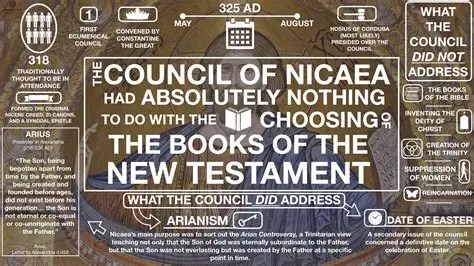
John M. Meade, the director of the Text and Canon Institute, speaks to the “works of popular fiction” as mentioned by Wes Huff: “Voltaire earlier mentions that Constantine convened the council. At Nicaea, then, the fathers distinguished the canonical from the apocryphal books by prayer and a miracle. The publication of Pappus’s 1601 edition of Synodicon Vetus—and the subsequent citing of the miracle at Nicaea, especially by Voltaire in his Dictionary—appears to be the reason Dan Brown could narrate the events so colorfully and why many others continue to perpetuate this legend.” [9]
So what exactly happened at the Council of Nicaea in AD 325?
Per ancient documents specialist Wes Huff, “The first Council of Nicaea, which took place between May and August in 325 AD in what is now İznik, Turkey, was an ecumenical council called to deal with a specific theological problem. Its purpose was to sort out the Arian Controversy – a Trinitarian heresy being promoted by a presbyter in North Africa named Arius, teaching not only that the Son of God was eternally subordinate to the Father, but that the Son was not everlasting but created by God the Father at a specific point in time. Arius, in his letter to Alexandria, wrote that: “The Son, being begotten apart from time by the Father, and being created and founded before ages, did not exist before his generation… the Son is not eternal or co-equal or co-unoriginate with the Father” (Letter to Alexandria 4:458). [8]
Neither the Roman Emperor Constantine nor the bishops present at the Council of Nicaea created the biblical canon we have today. Instead, the bishops simply acknowledged the biblical canon, utilizing those books already recognized as authoritative as their standard (canon) for determining what Jesus taught about his identity (divinity).
Christian apologist and author Michael Kruger puts it this way, “The bottom line is that the earliest Christians didn’t really have to ‘choose’ the four gospels from among all the others. Rather the four canonical gospels were simply the ones that had been there from the very beginning. The early church didn’t pick the gospels, but inherited them.” [12] Oh, and the council also discussed the date of Easter. But there is no mention of these men creating the concept of the Trinity, the divinity of Jesus, or the canon of Scriptures.
🚨Something to consider: If Allah revealed His Word (Quran) to Muhammad between AD 610 and AD 632, as Muslims purport, then he should have known about the Council of Nicaea, because it took place three hundred years prior. Therefore, if he had known of any corruption, he would not have encouraged Muhammad to seek out the “previous Scriptures” for wisdom. Again, something to chew upon.
Christian Attestation (1st and 2nd centuries) Prior to Nicaea
Christian apologist Tim Barnett explains that “Many people think Emperor Constantine invented the deity of Christ in the fourth century, but a look at quotes from the early church fathers shows this is an egregious misrepresentation of the facts. In my mentoring letter this month, I offered a short list of quotations to demonstrate that the early church believed Jesus is God. Now I’d like to make the argument even stronger by offering thirty-six quotations from nine different early church fathers. All of these quotations predate the Council of Nicea.” [10]
Here are 3 quotes from Barnett’s article:
“Polycarp (AD 69-155) was the bishop at the church in Smyrna. Irenaeus tells us Polycarp was a disciple of John the Apostle. In his Letter to the Philippians he says,
‘Now may the God and Father of our Lord Jesus Christ, and the eternal high priest himself, the Son of God Jesus Christ, build you up in faith and truth…and to us with you, and to all those under heaven who will yet believe in our Lord and God Jesus Christ and in his Father who raised him from the dead.’”1
“Justin Martyr (AD 100-165) was an Christian apologist of the second century.
‘And that Christ being Lord, and God the Son of God, and appearing formerly in power as Man, and Angel, and in the glory of fire as at the bush, so also was manifested at the judgment executed on Sodom, has been demonstrated fully by what has been said.’”
“Irenaeus of Lyons (AD 130-202) was bishop of Lugdunum in Gaul, which is now Lyons, France. Irenaeus was born in Smyrna in Asia Minor, where he studied under bishop Polycarp, who in turn had been a disciple of John the Apostle.
‘For I have shown from the Scriptures, that no one of the sons of Adam is as to everything, and absolutely, called God, or named Lord. But that He is Himself in His own right, beyond all men who ever lived, God, and Lord, and King Eternal, and the Incarnate Word, proclaimed by all the prophets, the apostles, and by the Spirit Himself, may be seen by all who have attained to even a small portion of the truth. Now, the Scriptures would not have testified these things of Him, if, like others, He had been a mere man…. He is the holy Lord, the Wonderful, the Counselor, the Beautiful in appearance, and the Mighty God, coming on the clouds as the Judge of all men;—all these things did the Scriptures prophesy of Him.’”
As these quotes vividly demonstrate, two hundred years before the Council of Nicaea, Jesus was worshipped as God. What is equally critical to acknowledge is that these men quoted the New Testament Scriptures in their writings (again, well before the Council of Nicaea)! For example, Polycarp, who was a disciple of John, quoted 17 of the 27 NT letters in his cover letter to the Philippian church! These men knew that God’s inspired word was given by God through men to men, relayed through eyewitness accounts, not speculations and myths.
“We ourselves heard this very voice borne from heaven, for we were with him on the holy mountain. 19 And we have the prophetic word more fully confirmed, to which you will do well to pay attention as to a lamp shining in a dark place, until the day dawns and the morning star rises in your hearts, 20 knowing this first of all, that no prophecy of Scripture comes from someone’s own interpretation. 21 For no prophecy was ever produced by the will of man, but men spoke from God as they were carried along by the Holy Spirit.” (2 Peter 1:18-21)
Why are the Gnostic Gospels excluded?
Why weren’t the Gnostic gospels grafted into the biblical canon? The reasons for this are rational: 1) The Gnostic gospels were written inthe 2nd century, well after the eyewitnesses were gone (no one to fact-check their stories), and 2) the content of these books did not match the teachings of Jesus (as documented by his Disciples/eyewitnesses).
Michael Kruger holds no punches in describing Gnosticism as “a heretical version of Christianity.” [11] The Gnostic gospels promulgated a flawed and warped spin of Christianity, which counters biblical Christianity on fundamental matters: Jesus’s divinity, Jesus’s incarnation, and Jesus’s resurrection. Wes Huff elaborates:
“Historical Christianity pretty clearly states that salvation is something outside of you that’s imparted to you by the finished work of Christ on the cross, but in Gnosticism, salvation is something that’s inside of you, and you realize it by understanding and knowing the secret knowledge that not only is Jesus divine, but you’re divine, and you can unlock that divinity.
So, a lot of the Gnostic gospels are nonsensical, and nonsensical on purpose. And they’re nonsensical on purpose because the idea is, if you understand them, then it’s because you understand the secret knowledge. If you don’t understand them, it’s because you don’t understand the secret knowledge. Sometimes you’ll read through these, and you’ll think, ‘What on earth is being talked about?’ That’s almost on purpose because they’re not meant to be understood. They’re not meant to be clear.
Let me just look at a section from the Gospel of Mary Magdalene for you to illustrate this.
‘The first is darkness. The second, desire. Then, ignorance, fear of death, power of the flesh, foolish reason, and self-righteous materialism. These are the powers of anger and doubt. And ask, ‘From where did you come, killer of men? Where are you heading, slayer of space?’ My soul replied, ‘What bound me is dead. That enveloped me has been vanquished. My desires are over, and ignorance is no more. In this life, I was freed from the world and the chains of forgetfulness. From now on, I will rest in the eternal now, for this age, this Aeon, and its stillness.’ Mary fell silent, for this was the truth Jesus had revealed.’” [13]
So why were the Gnostic Gospels excluded from the biblical canon (well before the Council of Nicaea)? I’ll humbly allow F.F. Bruce to answer this: “The Gnostic schools lost because they deserved to lose” (Canon of Scripture, 277) [11] Mic drop.
In conclusion, the New Testament Scriptures were written early, their paper trail is abundant, and their preservation is verified historically! By God’s sovereign design, we have God’s authoritative words to humanity, preserved and kept for us. Friends, you can trust them!
The grass withers, the flower fades, but the word of our God will stand forever.” (Isaiah 40:8)
Additional Resouces
Essentials of Christianity
What Christians Should Know about Islam
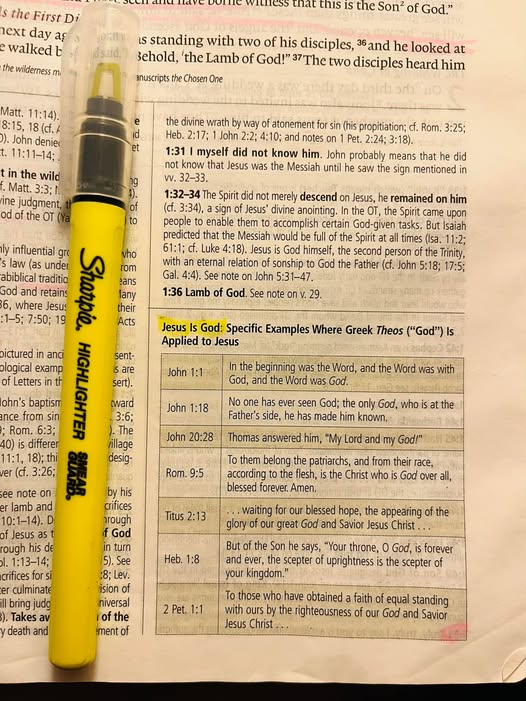
Jesus is God
“The truth is, the witness of the New Testament, with regard to Jesus as the object of faith, is an absolutely unitary witness. The thing is rooted far too deep in the records of primitive Christianity ever to be removed by any critical process. The Jesus spoken of in the New Testament was no mere teacher of righteousness, no mere pioneer in a new type of religious life, but One who was regarded, and regarded Himself, as the Saviour whom men could trust.”
J. Gresham Machen; Christianity & Liberalism, p. 73.
“Relating to Jesus as God is also crucial to the message we take to the rest of the world. We must know whom we represent if we are to represent him faithfully. Our Christian walk, witness, and worship all must reflect a sound understanding of the identity of our Lord Jesus Christ.”
Robert M. Bowman [7]
Jesus Outside of the Bible
And even if someone were to ignore the eyewitness accounts recorded within the New Testament, regarding Jesus and the early church, there would still exist a “robust description of Jesus and his followers from ancient, non-Christian voices (ninety-two historical figures).” Jesus was a real man who claimed to be God through his forgiving of sins, his accepting worship, and fulfillment of prophecy (hundreds of Old Testament prophecies). [5]
The Bible is Trustworthy
Early Christian and Non-Christian: Jesus Received & Accepted Worshipped
The Council of Nicaea in AD 325
Bibliography
- Dr. David Wood: The Quran, the Bible, and the Islamic Dilemma (David Wood).
- The Story of Christianity, Vol. 1: The Early Church to the Dawn of the Reformation https://a.co/d/cJrFWCm
- ESV Study Bible https://a.co/d/9leS2aa
- The Biographical Test Updated, by Dr. Clay Jones: https://tinyurl.com/3sh2m243
- Dr. Gary Habermas; The Early Creeds: https://youtu.be/gisWsQGiV5c?si=yI1pqeulHtg7DDAx.in/gbPB6SzV and Trustworthy, a book by Dr. Ben Shaw.
- Patton, Michael. n.d. “How We Know 1 Corinthians 15:3-7 is a Very Early Creed.” Parchment and Pen. https://credohouse.org/blog/how-we-know-1-corinthians-153-7-is-a-very-early-creed
- Putting Jesus in His Place: The Case for the Deity of Christ https://a.co/d/i9AGhNH (p.20-23)
- Wes Huff: What Happened at the Council of Nicaea? — Wesley Huff
- John M. Meade: Did Nicaea Really Create the Bible?
- Tim Barnett: Nine Early Church Fathers Who Taught Jesus Is God
- Michael Kruger: Was Gnosticism Tolerant and Inclusive? Debunking Some Myths about “Alternative” Christianities – Canon Fodder
- Michael Kruger: Apocryphal Gospels, Conspiracy Theories, and the Mainstream Media – Canon Fodder
- Wes Huff and Tim Barnett: Why Are the Gnostic Gospels Left Out of the Bible?
- What is Docetism? | GotQuestions.org
- Quran Tafsir Surah Al-An’am – 103 – Quran.com
 Hold Fast Apologetics