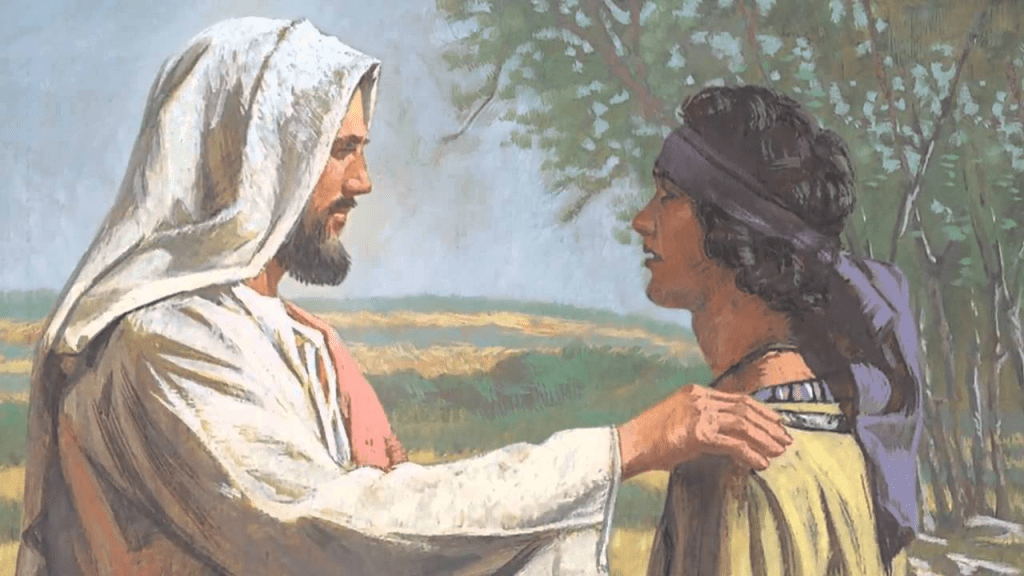
“And as he was setting out on his journey, a man ran up and knelt before him and asked him, ‘Good Teacher, what must I do to inherit eternal life?’ 18 And Jesus said to him, ‘Why do you call me good? No one is good except God alone. 19 You know the commandments: ‘Do not murder, Do not commit adultery, Do not steal, Do not bear false witness, Do not defraud, Honor your father and mother.’ 20 And he said to him, ‘Teacher, all these I have kept from my youth.’ 21 And Jesus, looking at him, loved him, and said to him, ‘You lack one thing: go, sell all that you have and give to the poor, and you will have treasure in heaven; and come, follow me.’ 22 Disheartened by the saying, he went away sorrowful, for he had great possessions.
23 And Jesus looked around and said to his disciples, ‘How difficult it will be for those who have wealth to enter the kingdom of God!’ 24 And the disciples were amazed at his words. But Jesus said to them again, ‘Children, how difficult it is to enter the kingdom of God! 25 It is easier for a camel to go through the eye of a needle than for a rich person to enter the kingdom of God.’ 26 And they were exceedingly astonished, and said to him, “Then who can be saved?’ 27 Jesus looked at them and said, “With man it is impossible, but not with God. For all things are possible with God.’ 28 Peter began to say to him, ‘See, we have left everything and followed you.” 29 Jesus said, ‘Truly, I say to you, there is no one who has left house or brothers or sisters or mother or father or children or lands, for my sake and for the gospel, 30 who will not receive a hundredfold now in this time, houses and brothers and sisters and mothers and children and lands, with persecutions, and in the age to come eternal life. 31 But many who are first will be last, and the last first.’” (Mark 10:17-31)
(For an in-depth study of Mark, consider watching Mike Winger’s videos here)
Numerous scholars date the Gospel of Mark to around AD 55, with its intended recipients being Gentile Christians in Rome. Mark’s letter documents Peter’s eyewitness account of Jesus’s earthly ministry, with notable succinctness (a thematic description of events, as opposed to chronological) and urgency. Mark’s urgency to record these historical events points to their inherent significance to the reader; especially, when Christians were being persecuted and martyred in and around Rome (which increased with Nero, AD 64). And Mark showcases this urgency, immediately! In the very first sentence of this letter, Mark makes haste to recognize Jesus as the Messiah, God incarnate, as demonstrated by the Hebrew Scriptures:
“The beginning of the gospel of Jesus Christ, the Son of God.
2 As it is written in Isaiah the prophet,”
‘Behold, I send my messenger before your face,
who will prepare your way,
3 the voice of one crying in the wilderness:
‘Prepare the way of the Lord,
make his paths straight,’”
Not only does Mark vividly illustrate the crucial role of the Old Testament in describing the promised Messiah, but he also documents the remarkable self-claims of Jesus pertaining to his identity. Therefore, when the rich young ruler calls Jesus a “good teacher” (Mark 10), Jesus wastes no time highlighting the fundamental assertion the young man is making about Jesus:
- Jesus is good.
- Only God is good.
- Therefore, Jesus is God.
“‘Good Teacher, what must I do to inherit eternal life?’ 18 And Jesus said to him, ‘Why do you call me good? No one is good except God alone.’”
Mark 10: 17-18
Christian apologist and YouTuber (Testify), Erik Manning, recognizes that Jesus was bringing the Shema (Deut 6:4) to the forefront by pointing out that “there is only one source of true goodness,” God alone. God is one, and only God is good.
Hear, O Israel: The LORD our God, the LORD is one. You shall love the LORD your God with all your heart and with all your soul and with all your might. And these words that I command you today shall be on your heart. You shall teach them diligently to your children, and shall talk of them when you sit in your house, and when you walk by the way, and when you lie down, and when you rise. You shall bind them as a sign on your hand, and they shall be as frontlets between your eyes. You shall write them on the doorposts of your house and on your gates. (Deuteronomy 6:4)
Manning also makes it clear that Jesus did not say that he was not good. Therefore, Jesus did not rebuke the young man, nor did Jesus deny that the richer young ruler’s assertion was true. Jesus simply (and lovingly) helped this man process through the title he was assigning to Jesus.
Immediately following Jesus’s initial question, “Why do you call me good? No one is good except God alone,” Jesus answers the young man’s heartfelt query of what he is lacking for salvation. Friends, please slow down and catch the imperative implications of Jesus’s response:
“You know the commandments: ‘Do not murder, Do not commit adultery, Do not steal, Do not bear false witness, Do not defraud, Honor your father and mother.’ 20 And he said to him, ‘Teacher, all these I have kept from my youth.’
“And Jesus, looking at him, loved him, and said to him, ‘You lack one thing: go, sell all that you have and give to the poor, and you will have treasure in heaven; and come, follow me’” (Mark 10).
In the video shared above, Erik Manning draws our attention to the fact that Jesus, intentionally places his own commands alongside the Ten Commandments (God’s commands). Again, do not miss the significance of Jesus’ message here: Jesus’s words are given equal weight and authority as the Ten Commandments! Therefore, obeying Jesus is obeying God. Following Jesus’s commands is following God’s commands. If salvation belongs to God alone (which it does), then salvation belongs to Jesus.
So, what does this have to do with us two thousand years later?
Even though Mark’s letter wasn’t written to us (because we were not alive then), God intended that we read it too (John 17:20). You see, God is good and He wants to be known. Therefore, God makes the important things easy for us to understand. As others have said, “The main things the plain things.” God, in His goodness, wants us all to know Him. And He wants us to know His faithful plan to save humanity, as documented in the Scriptures.
“The Holy Spirit, therefore, has generously planned Holy Scripture in such a way that in the easier passages He relieves our hunger; in the more obscure He drives away our pride. Practically nothing is dug out from those obscure texts which is discovered to be said very plainly in another place.” Augustine, On Christian Doctrine, II. 6
Mark makes it abundantly clear that Jesus recognized who he was. The Creator of the universe, the designer of our cells, and the engineer behind the honeybee’s waggle dance (Genesis 1:1; John 1:1-14; Colossians 1:15-20), put upon himself a human nature. Friends, God came down! Let that blow your mind!
Jesus is both fully human (see Philippians 2) and fully God. Jesus is of the same substance as the Father (homoousios). He is not only the Judge of our souls (John 5:22-23), but he is also the one who saves us! You see, Jesus is more than a mere model of faith…someone who gets us, or someone we emulate. Jesus is God incarnate! He is the object of our faith. Jesus received worship for a reason (Matthew 8:2; 21:9, 17).
 Hold Fast Apologetics