Hold Fast Apologetics

What Does Scripture Say?

  • Hebrews 1

    Who inspired Hebrews? Simply and confidently stated: God. This might sound obvious, but nevertheless it’s important that I share that “inspired” does not refer to God supplanting the author’s mind (as what happens in the New Age when writers “dictate” what fallen angels speak), but instead indicates that the author pens what God has taught…as God renews our minds to Truth.

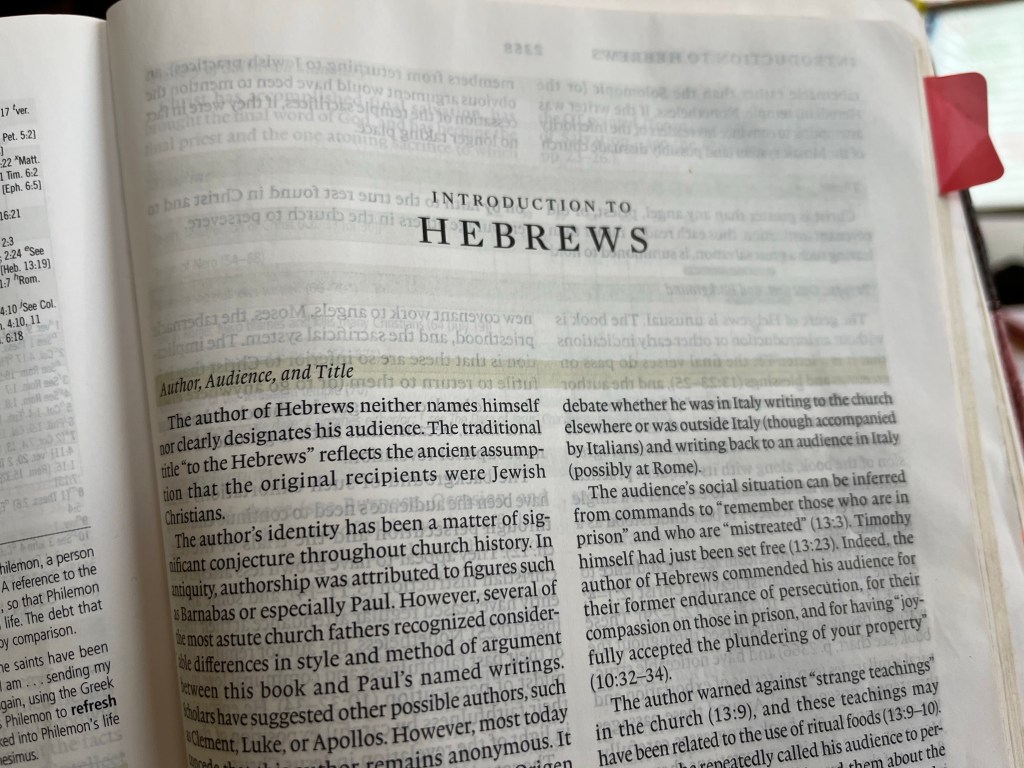
    The author of Hebrews would have been documenting to Jewish Christians what the scriptures affirmed about Jesus as the Messiah. Now, when discussing who wrote and/or authored Hebrews…that detail does not have 100% agreement. Was the author Paul, Barnabas, Apollos, or Clement? The text doesn’t explicitly say…but evidence demonstrates that Hebrews was most likely written prior to the destruction of the temple in Jerusalem (A.D. 60-70). This narrows the authorship quite a bit. Below you will find the entire chapter of Hebrews 1 (NET) along with a 27-minute video featuring New Testament scholar and seminary professor, Dr. David Allen Black, speaking to the authorship of Hebrews. I pray that the “living and active words” you read below…the words God has provided us, will lead you to rest in Him today. He is the only true God. The God of our hope and salvation. Blessings!

    27 minutes with Dr. David Alan Black and The Ten Minute Bible Hour

    Introduction: God Has Spoken Fully and Finally in His Son

    1 After God spoke long ago[a] in various portions[b] and in various ways[c] to our ancestors[d] through the prophets, in these last days he has spoken to us in a son,[e] whom he appointed heir of all things, and through whom he created the world.[f] The Son is[g]the radiance of his glory and the representation of his essence, and he sustains all things by his powerful word,[h] and so when he had accomplished cleansing for sins, he sat down at the right hand of the Majesty on high.[i] Thus he became[j] so far better than the angels as[k] he has inherited a name superior to theirs.

    The Son Is Superior to Angels

    For to which of the angels did God[l] ever say, “You are my son! Today I have fathered you”?[m] And in another place[n] he says,[o] “Iwill be his father and he will be my son.”[p]But when he again brings[q] his firstborn into the world, he says, “Let all the angels of God worship him![r] And he says[s] of the angels, “He makes[t] his angels winds[u] and his ministers a flame of fire,”[v] but of[w]the Son he says,[x]

    Your throne, O God, is forever and ever,[y]
    and a righteous scepter[z] is the scepter of your kingdom.
    You have loved righteousness and hated lawlessness.
    So God, your God, has anointed you over your companions[aa] with the oil of rejoicing.”[ab]

    10 And,

    You founded the earth in the beginning, Lord,[ac]
    and the heavens are the works of your hands.
    11 They will perish, but you continue.
    And they will all grow old like a garment,
    12 and like a robe you will fold them up
    and like a garment[ad] they will be changed,
    but you are the same and your years will never run out.”[ae]

    13 But to which of the angels[af] has he ever said, “Sit at my right hand until I make your enemies a footstool for your feet”?[ag]14 Are they not all ministering spirits, sent out to serve those[ah] who will inherit salvation?

    Footnotes

    1. Hebrews 1:1 tn Or “spoke formerly.”
    2. Hebrews 1:1 tn Or “parts.” The idea is that God’s previous revelation came in many parts and was therefore fragmentary or partial (L&N 63.19), in comparison with the final and complete revelation contained in God’s Son. However, some interpret πολυμερῶς (polumerōs) in Heb 1:1 to mean “on many different occasions” and would thus translate “many times” (L&N 67.11). This is the option followed by the NIV “at many times and in various ways.” Finally, this word is also understood to refer to the different manners in which something may be done, and would then be translated “in many different ways” (L&N 89.81). In this last case, the two words πολυμερῶς and πολυτρόπως (polutropōs) mutually reinforce one another (“in many and various ways,” NRSV).
    3. Hebrews 1:1 tn These two phrases are emphasized in Greek by being placed at the beginning of the sentence and by alliteration.
    4. Hebrews 1:1 tn Grk “to the fathers.”
    5. Hebrews 1:2 tn The Greek puts an emphasis on the quality of God’s final revelation. As such, it is more than an indefinite notion (“a son”) though less than a definite one (“the son”), for this final revelation is not just through any son of God, nor is the emphasis specifically on the person himself. Rather, the focus here is on the nature of the vehicle of God’s revelation: He is no mere spokesman (or prophet) for God, nor is he merely a heavenly messenger (or angel); instead, this final revelation comes through one who is intimately acquainted with the heavenly Father in a way that only a family member could be. There is, however, no exact equivalent in English (“in son” is hardly good English style).sn The phrase in a sonis the fulcrum of Heb 1:1-4. It concludes the contrast of God’s old and new revelation and introduces a series of seven descriptions of the Son. These descriptions show why he is the ultimate revelation of God.
    6. Hebrews 1:2 tn Grk “the ages.” The temporal (ages) came to be used of the spatial (what exists in those time periods). See Heb 11:3 for the same usage.
    7. Hebrews 1:3 tn Grk “who being…and sustaining.” Heb 1:1-4 form one skillfully composed sentence in Greek, but it must be broken into shorter segments to correspond to contemporary English usage, which does not allow for sentences of this length and complexity.
    8. Hebrews 1:3 tn Grk “by the word of his power.”
    9. Hebrews 1:3 sn An allusion to Ps 110:1, quoted often in Hebrews.
    10. Hebrews 1:4 tn Grk “having become.” This is part of the same sentence that extends from v. 1 through v. 4 in the Greek text.
    11. Hebrews 1:4 tn Most modern English translations attempt to make the comparison somewhat smoother by treating “name” as if it were the subject of the second element: “as the name he has inherited is superior to theirs” (cf. NAB, NIV, NRSV, CEV). However, the Son is the subject of both the first and second elements: “he became so far better”; “he has inherited a name.” The present translation maintains this parallelism even though it results in a somewhat more awkward rendering.sn This comparison is somewhat awkward to express in English, but it reflects an important element in the argument of Hebrews: the superiority of Jesus Christ.
    12. Hebrews 1:5 tn Grk “he”; the referent (God) has been specified in the translation for clarity.
    13. Hebrews 1:5 tn Grk “I have begotten you.”sn A quotation from Ps 2:7.
    14. Hebrews 1:5 tn Grk “And again,” quoting another OT passage.
    15. Hebrews 1:5 tn The words “he says” are not in the Greek text but are supplied to make a complete English sentence. In the Greek text this is a continuation of the previous sentence, but English does not normally employ such long and complex sentences.
    16. Hebrews 1:5 tn Grk “I will be a father to him and he will be a son to me.”sn A quotation from 2 Sam 7:14 (cf. 1 Chr 17:13).
    17. Hebrews 1:6 tn Or “And again when he brings.” The translation adopted in the text looks forward to Christ’s second coming to earth. Some take “again” to introduce the quotation (as in 1:5) and understand this as Christ’s first coming, but this view does not fit well with Heb 2:7. Others understand it as his exaltation/ascension to heaven, but this takes the phrase “into the world” in an unlikely way.
    18. Hebrews 1:6 sn A quotation combining themes from Deut 32:43 and Ps 97:7.
    19. Hebrews 1:7 sn The Greek correlative conjunctions μέν and δέ (men and de) emphasize the contrastive parallelism of vs. 7 (what God says about the angels) over against vv. 8-9 and vv. 10-12 (what God says about the son).
    20. Hebrews 1:7 tn Grk “He who makes.”
    21. Hebrews 1:7 tn Or “spirits” (so KJV, NKJV). The Greek word πνεῦμα (pneuma) can mean either “wind” or “spirit” depending on the context. Since the context here concerns the superiority of the Son to the angels, many interpreters and most modern English translations see the present verse emphasizing the transitory or ephemeral nature of God’s other servants, the angels, and thus underscoring their inferiority to the Son.
    22. Hebrews 1:7 sn A quotation from Ps 104:4.
    23. Hebrews 1:8 tn Or “to.”
    24. Hebrews 1:8 tn The verb “he says” (λέγει, legei) is implied from the λέγει of v. 7.
    25. Hebrews 1:8 tn Or possibly, “Your throne is God forever and ever.” This translation is quite doubtful, however, since (1) in the context the Son is being contrasted to the angels and is presented as far better than they. The imagery of God being the Son’s throne would seem to be of God being his authority. If so, in what sense could this notbe said of the angels? In what sense is the Son thus contrasted with the angels? (2) The μέν…δέ (mende) construction that connects v. 7 with v. 8 clearly lays out this contrast: “On the one hand, he says of the angels…on the other hand, he says of the Son.” Thus, although it is grammatically possible that θεός (theos) in v. 8 should be taken as a predicate nominative, the context and the correlative conjunctions are decidedly against it. Hebrews 1:8 is thus a strong affirmation of the deity of Christ.
    26. Hebrews 1:8 tn Grk “the righteous scepter,” but used generically.
    27. Hebrews 1:9 sn God…has anointed you over your companions. God’s anointing gives the son a superior position and authority over his fellows.
    28. Hebrews 1:9 sn A quotation from Ps 45:6-7.
    29. Hebrews 1:10 sn You founded the earthyour years will never run out. In its original setting Ps 102:25-27 refers to the work of God in creation, but here in Hebrews 1:10-12 the writer employs it in reference to Christ, the Lord, making a strong argument for the essential deity of the Son.
    30. Hebrews 1:12 tc The words “like a garment” (ὡς ἱμάτιον, hōs himation) are found in excellent and early mss (P46 א A B D* 1739) though absent in a majority of witnesses (D1Ψ 0243 0278 33 1881 M lat sy bo). Although it is possible that longer reading was produced by overzealous scribes who wanted to underscore the frailty of creation, it is much more likely that the shorter reading was produced by scribes who wanted to conform the wording to that of Ps 102:26 (101:27 LXX), which here lacks the second “like a garment.” Both external and internal considerations decidedly favor the longer reading, and point to the author of Hebrews as the one underscoring the difference between the Son and creation.snThe phrase like a garment here is not part of the original OT text (see tc note above); for this reason it has been printed in normal type.
    31. Hebrews 1:12 sn A quotation from Ps 102:25-27.
    32. Hebrews 1:13 sn The parallel phrases to which of the angels in vv. 5 and 13 show the unity of this series of quotations (vv. 5-14) in revealing the superiority of the Son over angels (v. 4).
    33. Hebrews 1:13 sn A quotation from Ps 110:1.
    34. Hebrews 1:14 tn Grk “sent for service for the sake of those.”

  • Romans 15 and Psalm 18

    Hi, Friends! Below you will find Romans 15 and Psalm 18 (Ps 18 was quoted by Paul within his letter to the Church in Rome) as provided by BibleGateway. The New English Translation (NET) was utilized as to share ample footnotes for study. God is so good, Sisters…and His Word is True! It’s my prayer that these “living and active” words fill your heart and mind today as He carries you through all that comes. Blessings!

    57-minute introduction to Romans by Professor Walt Russell from Biola University.

    Romans 15

    15 But we who are strong ought to bear with the failings of the weak, and not just please ourselves.[a] 2 Let each of us please his neighbor for his good to build him up. 3 For even Christ did not please himself, but just as it is written, “The insults of those who insult you have fallen on me.”[b] 4 For everything that was written in former times was written for our instruction, so that through endurance and through encouragement of the scriptures we may have hope. 5 Now may the God of endurance and comfort give you unity with one another[c] in accordance with Christ Jesus, 6 so that together you may with one voice glorify the God and Father of our Lord Jesus Christ.

    Exhortation to Mutual Acceptance

    7 Receive one another, then, just as Christ also received you, to God’s glory. 8 For I tell you that Christ has become a servant of the circumcised[d] on behalf of God’s truth to confirm the promises made to the fathers,[e]9 and thus the Gentiles glorify God for his mercy.[f] As it is written, “Because of this I will confess you among the Gentiles, and I will sing praises to your name.”[g] 10 And again it says: “Rejoice, O Gentiles, with his people.”[h] 11 And again, “Praise the Lord all you Gentiles, and let all the peoples praise him.”[i] 12 And again Isaiah says, “The root of Jesse will come, and the one who rises to rule over the Gentiles, in him will the Gentiles hope.”[j] 13 Now may the God of hope fill you with all joy and peace as you believe in him,[k] so that you may abound in hope by the power of the Holy Spirit.

    Paul’s Motivation for Writing the Letter

    14 But I myself am fully convinced about you, my brothers and sisters,[l] that you yourselves are full of goodness, filled with all knowledge, and able to instruct one another. 15 But I have written more boldly to you on some points so as to remind you, because of the grace given to me by God 16 to be a minister of Christ Jesus to the Gentiles. I serve[m] the gospel of God[n] like a priest, so that the Gentiles may become an acceptable offering,[o] sanctified by the Holy Spirit.

    17 So I boast[p] in Christ Jesus about the things that pertain to God. 18 For I will not dare to speak of anything except what Christ has accomplished through me in order to bring about the obedience[q] of the Gentiles, by word and deed, 19 in the power of signs and wonders, in the power of the Spirit of God. So from Jerusalem even as far as Illyricum I have fully preached the gospel of Christ. 20 And in this way I desire to preach where Christ has not been named, so as not to build on another person’s foundation, 21 but as it is written: “Those who were not told about him will see, and those who have not heard will understand.”[r]

    Paul’s Intention of Visiting the Romans

    22 This is the reason I was often hindered from coming to you. 23 But now there is nothing more to keep me[s] in these regions, and I have for many years desired[t] to come to you 24 when I go to Spain. For I hope to visit you when I pass through and that you will help me[u] on my journey there, after I have enjoyed your company for a while.

    25 But now I go to Jerusalem to minister to the saints. 26 For Macedonia and Achaia are pleased to make some contribution for the poor among the saints in Jerusalem. 27 For they were pleased to do this, and indeed they are indebted to the Jerusalem saints.[v] For if the Gentiles have shared in their spiritual things, they are obligated also to minister to them in material things. 28 Therefore after I have completed this and have safely delivered this bounty to them,[w] I will set out for Spain by way of you, 29 and I know that when I come to you I will come in the fullness of Christ’s blessing.

    30 Now I urge you, brothers and sisters,[x]through our Lord Jesus Christ and through the love of the Spirit, to join fervently with me in prayer to God on my behalf. 31 Pray[y] that I may be rescued from those who are disobedient in Judea and that my ministry in Jerusalem may be acceptable to the saints, 32 so that by God’s will I may come to you with joy and be refreshed in your company. 33 Now may the God of peace be with all of you. Amen.[z]

    Footnotes

    1. Romans 15:1 tn Grk “and not please ourselves.” NT Greek negatives used in contrast like this are often not absolute, but relative: “not so much one as the other.”
    2. Romans 15:3 sn A quotation from Ps 69:9.
    3. Romans 15:5 tn Grk “grant you to think the same among one another.”
    4. Romans 15:8 tn Grk “of the circumcision”; that is, the Jews.
    5. Romans 15:8 tn Or “to the patriarchs.”
    6. Romans 15:9 tn There are two major syntactical alternatives which are both awkward: (1) One could make “glorify” dependent on “Christ has become a minister” and coordinate with “to confirm” and the result would be rendered “Christ has become a minister of circumcision to confirm the promises…and so that the Gentiles might glorify God.” (2) One could make “glorify” dependent on “I tell you” and coordinate with “Christ has become a minister” and the result would be rendered “I tell you that Christ has become a minister of circumcision…and that the Gentiles glorify God.” The second rendering is preferred.
    7. Romans 15:9 sn A quotation from Ps 18:49.
    8. Romans 15:10 sn A quotation from Deut 32:43.
    9. Romans 15:11 sn A quotation from Ps 117:1.
    10. Romans 15:12 sn A quotation from Isa 11:10.
    11. Romans 15:13 tn Grk “in the believing” or “as [you] believe,” with the object “him” supplied from the context. The referent could be God (15:13a) or Christ (15:12).
    12. Romans 15:14 tn Grk “brothers.” See note on the phrase “brothers and sisters” in 1:13.
    13. Romans 15:16 tn Grk “serving.” This is a continuation of the previous sentence in the Greek text, but in keeping with contemporary English style, a new sentence was started here in the translation.
    14. Romans 15:16 tn The genitive in the phrase τὸ εὐαγγέλιον τοῦ θεοῦ (to euangelion tou theou, “the gospel of God”) could be translated as either a subjective genitive (“the gospel which God brings”) or an objective genitive (“the gospel about God”). Either is grammatically possible. This is possibly an instance of a plenary genitive (see ExSyn 119-21; M. Zerwick, Biblical Greek, §§36-39). If so, an interplay between the two concepts is intended: The gospel which God brings is in fact the gospel about himself.
    15. Romans 15:16 tn Grk “so that the offering of the Gentiles may become acceptable.” This could be understood to refer to an offering belonging to the Gentiles (a possessive genitive) or made by the Gentiles (subjective genitive), but more likely the phrase should be understood as an appositive genitive, with the Gentiles themselves consisting of the offering (so J. D. G. Dunn, Romans [WBC 38], 2:860). The latter view is reflected in the translation “so that the Gentiles may become an acceptable offering.”
    16. Romans 15:17 tc ‡ After οὖν (oun), several significant Alexandrian and Western mss (B C D F G 81 365) have τήν (tēn). The article is lacking in א A Ψ 33 1175 1241 1505 1739 1881 M however. P46 supplies a relative pronoun and has a different reading entirely (“which I have [as a] boast”). Articles were frequently introduced to clarify the meaning of the text. In this instance, since the word modified (καύχησιν, kauchēsin) is third declension, a visual oversight (resulting in omission) is less likely. Hence, the shorter reading is probably earlier. The difference in translation between these first two options is negligible (“I have the boast” or “I have a boast”). NA28 puts the article in brackets, indicating some doubt as to its authenticity.tn Grk “Therefore I have a boast.”
    17. Romans 15:18 tn Grk “unto obedience.”
    18. Romans 15:21 sn A quotation from Isa 52:15.
    19. Romans 15:23 tn Grk “now no longer having a place…I have.”
    20. Romans 15:23 tn Grk “but having a desire…for many years.”
    21. Romans 15:24 tn Grk “and to be helped by you.” The passive construction was changed to an active one in the translation.
    22. Romans 15:27 tn Grk “to them”; the referent (the Jerusalem saints) has been specified in the translation for clarity.
    23. Romans 15:28 tn Grk “have sealed this fruit to them.”
    24. Romans 15:30 tn Grk “brothers.” See note on the phrase “brothers and sisters” in 1:13.
    25. Romans 15:31 tn Verses 30-31 form one long sentence in the Greek but have been divided into two distinct sentences for clarity in English.
    26. Romans 15:33 tc Some mss lack the word “Amen” here, one of them (P46) also inserting 16:25-27 at this point. See the tcnote at 16:25 for more information.

    Psalm 18

    Psalm 18[a]

    For the music director, by the Lord’s servant David, who sang[b] to the Lord the words of this song when[c] the Lordrescued him from the power[d] of all his enemies, including Saul.[e]

    18 He said:[f]
    “I love[g] you, Lord, my source of strength![h]
    2 The Lord is my high ridge,[i] my stronghold,[j] my deliverer.
    My God is my rocky summit where[k] I take shelter,[l]
    my shield, the horn that saves me,[m]and my refuge.[n]
    3 I called[o] to the Lord, who is worthy of praise,[p]
    and I was delivered from my enemies.
    4 The waves[q] of death engulfed me,
    the currents[r] of chaos[s] overwhelmed me.[t]
    5 The ropes of Sheol tightened around me,[u]
    the snares of death trapped me.[v]
    6 In my distress I called to the Lord;
    I cried out to my God.[w]
    From his heavenly temple[x] he heard my voice;
    he listened to my cry for help.[y]
    7 The earth heaved and shook.[z]
    The roots of the mountains[aa]trembled;[ab]
    they heaved because he was angry.
    8 Smoke ascended from[ac] his nose;[ad]
    fire devoured as it came from his mouth.[ae]
    He hurled down fiery coals.[af]
    9 He made the sky sink[ag] as he descended;
    a thick cloud was under his feet.
    10 He mounted[ah] a winged angel[ai] and flew;
    he glided[aj] on the wings of the wind.[ak]
    11 He shrouded himself in darkness,[al]
    in thick rain clouds.[am]
    12 From the brightness in front of him came
    hail and fiery coals.[an]
    13 The Lord thundered[ao] in[ap] the sky;
    the Most High[aq] shouted.[ar]
    14 He shot his[as] arrows and scattered them,[at]
    many lightning bolts[au] and routed them.[av]
    15 The depths[aw] of the sea[ax] were exposed;
    the inner regions[ay] of the world were uncovered
    by[az] your battle cry,[ba] Lord,
    by the powerful breath from your nose.[bb]
    16 He reached down[bc] from above and took hold of me;
    he pulled me from the surging water.[bd]
    17 He rescued me from my strong enemy,[be]
    from those who hate me,
    for they were too strong for me.
    18 They confronted[bf] me in my day of calamity,
    but the Lord helped me.[bg]
    19 He brought me out into a wide open place;
    he delivered me because he was pleased with me.[bh]
    20 The Lord repaid[bi] me for my godly deeds;[bj]
    he rewarded[bk] my blameless behavior.[bl]
    21 For I have obeyed the Lord’s commands;[bm]
    I have not rebelled against my God.[bn]
    22 For I am aware of all his regulations,[bo]
    and I do not reject his rules.[bp]
    23 I was innocent before him,
    and kept myself from sinning.[bq]
    24 The Lord rewarded me for my godly deeds;[br]
    he took notice of my blameless behavior.[bs]
    25 You prove to be loyal[bt] to one who is faithful;[bu]
    you prove to be trustworthy[bv] to one who is innocent.[bw]
    26 You prove to be reliable[bx] to one who is blameless,
    but you prove to be deceptive[by] to one who is perverse.[bz]
    27 For you deliver oppressed[ca] people,
    but you bring down those who have a proud look.[cb]
    28 Indeed,[cc] you light my lamp, Lord.[cd]
    My God[ce] illuminates the darkness around me.[cf]
    29 Indeed,[cg] with your help[ch] I can charge against[ci] an army;[cj]
    by my God’s power[ck] I can jump over a wall.[cl]
    30 The one true God acts in a faithful manner;[cm]
    the Lord’s promise[cn] is reliable.[co]
    He is a shield to all who take shelter[cp]in him.
    31 Indeed,[cq] who is God besides the Lord?
    Who is a protector[cr] besides our God?[cs]
    32 The one true God[ct] gives[cu] me strength;[cv]
    he removes[cw] the obstacles in my way.[cx]
    33 He gives me the agility of a deer;[cy]
    he enables me to negotiate the rugged terrain.[cz]
    34 He trains my hands for battle;[da]
    my arms can bend even the strongest bow.[db]
    35 You give me your protective shield;[dc]
    your right hand supports me.[dd]
    Your willingness to help[de] enables me to prevail.[df]
    36 You widen my path;[dg]
    my feet[dh] do not slip.
    37 I chase my enemies and catch[di] them;
    I do not turn back until I wipe them out.
    38 I beat them[dj] to death;[dk]
    they fall at my feet.[dl]
    39 You give me strength[dm] for battle;
    you make my foes kneel before me.[dn]
    40 You make my enemies retreat;[do]
    I destroy those who hate me.[dp]
    41 They cry out, but there is no one to help them;[dq]
    they cry out to the Lord,[dr] but he does not answer them.
    42 I grind them as fine windblown dust;[ds]
    I beat them underfoot[dt] like clay[du] in the streets.
    43 You rescue me from a hostile army.[dv]
    You make me[dw] a leader of nations;
    people over whom I had no authority are now my subjects.[dx]
    44 When they hear of my exploits, they submit to me.[dy]
    Foreigners are powerless[dz] before me.
    45 Foreigners lose their courage;[ea]
    they shake with fear[eb] as they leave[ec] their strongholds.[ed]
    46 The Lord is alive![ee]
    My Protector[ef] is praiseworthy.[eg]
    The God who delivers me[eh] is exalted as king.[ei]
    47 The one true God[ej] completely vindicates me;[ek]
    he makes nations submit to me.[el]
    48 He delivers me[em] from my enemies.
    You snatch me away[en] from those who attack me;[eo]
    you rescue me from violent men.
    49 So I will give you thanks before the nations,[ep] O Lord.
    I will sing praises to you.[eq]
    50 He[er] gives his king magnificent victories;[es]
    he is faithful[et] to his chosen ruler,[eu]
    to David and his descendants[ev]forever.”[ew]

  • Remember the Gospel

    For I am not ashamed of the gospel, for it is God’s power for salvation to everyone who believes, to the Jew first and also to the Greek. For the righteousness of God is revealed in the gospel from faith to faith, just as it is written, “The righteous by faith will live.”

    Romans 1:16-17
    4 minutes with Voddie Baucham

    1 Corinthians 15

    Christ’s Resurrection

    15 Now I want to make clear for you,[a]brothers and sisters,[b] the gospel that I preached to you, that you received and on which you stand, 2 and by which you are being saved, if you hold firmly to the message I preached to you—unless you believed in vain. 3 For I passed on to you as of first importance[c] what I also received—that Christ died for our sins according to the scriptures, 4 and that he was buried, and that he was raised[d] on the third day according to the scriptures, 5 and that he appeared to Cephas,[e] then to the twelve. 6 Then he appeared to more than 500 of the brothers and sisters[f] at one time, most of whom are still alive,[g]though some have fallen asleep.[h] 7 Then he appeared to James, then to all the apostles. 8 Last of all, as though to one born at the wrong time,[i] he appeared to me also. 9 For I am the least of the apostles, unworthy to be called an apostle, because I persecuted the church of God. 10 But by the grace of God I am what I am, and his grace to me has not been in vain. In fact, I worked harder than all of them—yet not I, but the grace of God with me. 11 Whether then it was I or they, this is the way we preach and this is the way you believed.

    No Resurrection?

    12 Now if Christ is being preached as raised from the dead,[j] how can some of you say there is no resurrection of the dead? 13 But if there is no resurrection of the dead, then not even Christ has been raised. 14 And if Christ has not been raised, then our preaching is futile and your faith is empty. 15 Also, we are found to be false witnesses about God, because we have testified against God that he raised Christ from the dead, when in reality he did not raise him, if indeed the dead are not raised. 16 For if the dead are not raised, then not even Christ has been raised. 17 And if Christ has not been raised, your faith is useless; you are still in your sins. 18 Furthermore, those who have fallen asleep[k] in Christ have also perished. 19 For if only in this life we have hope in Christ, we should be pitied more than anyone.

    20 But now Christ has been raised from the dead, the firstfruits of those who have fallen asleep. 21 For since death came through a man,[l] the resurrection of the dead also came through a man.[m] 22 For just as in Adam all die, so also in Christ all will be made alive. 23 But each in his own order: Christ, the firstfruits; then when Christ comes, those who belong to him.[n] 24 Then[o] comes the end,[p] when he hands over the kingdom to God the Father, when he has brought to an end all rule and all authority and power. 25 For he must reign until he has put all his enemies under his feet. 26 The last enemy to be eliminated is death. 27 For he has put everything in subjection under his feet.[q] But when it says “everything” has been put in subjection, it is clear that this does not include the one who put everything in subjection to him. 28 And when all things are subjected to him, then the Son himself will be subjected to the one who subjected everything to him, so that God may be all in all.

    29 Otherwise, what will those do who are baptized for the dead?[r] If the dead are not raised at all, then why are they baptized for them? 30 Why too are we in danger every hour? 31 Every day I am in danger of death! This is as sure as[s] my boasting in you,[t]which I have in Christ Jesus our Lord. 32 If from a human point of view I fought with wild beasts at Ephesus, what did it benefit me? If the dead are not raised, let us eat and drink, for tomorrow we die.[u] 33 Do not be deceived: “Bad company corrupts good morals.”[v]34 Sober up as you should, and stop sinning! For some have no knowledge of God—I say this to your shame!

    The Resurrection Body

    35 But someone will say, “How are the dead raised? With what kind of body will they come?” 36 Fool! What you sow will not come to life unless it dies. 37 And what you sow is not the body that is to be, but a bare seed[w]—perhaps of wheat or something else. 38 But God gives it a body just as he planned, and to each of the seeds a body of its own. 39 All flesh is not the same: People have one flesh, animals have another, birds and fish another.[x]40 And there are heavenly bodies and earthly bodies. The glory of the heavenly body is one sort and the earthly another. 41 There is one glory of the sun, and another glory of the moon and another glory of the stars, for star differs from star in glory.

    42 It is the same with the resurrection of the dead. What is sown is perishable, what is raised is imperishable.[y] 43 It is sown in dishonor, it is raised in glory; it is sown in weakness, it is raised in power; 44 it is sown a natural body, it is raised a spiritual body. If there is a natural body, there is also a spiritual body. 45 So also it is written, “The first man, Adam, became a living person”;[z] the last Adam became a life-giving spirit. 46 However, the spiritual did not come first, but the natural, and then the spiritual. 47 The first man is from the earth, made of dust; the second man is from heaven. 48 Like the one made of dust, so too are those made of dust, and like the one from heaven, so too those who are heavenly. 49 And just as we have borne the image of the man of dust, let us also bear[aa] the image of the man of heaven.

    50 Now this is what I am saying, brothers and sisters:[ab] Flesh and blood cannot inherit the kingdom of God, nor does the perishable inherit the imperishable. 51 Listen,[ac] I will tell you a mystery: We will not all sleep,[ad] but we will all be changed— 52 in a moment, in the blinking[ae] of an eye, at the last trumpet. For the trumpet will sound, and the dead will be raised imperishable, and we will be changed. 53 For this perishable body must put on the imperishable, and this mortal body must put on immortality. 54 Now when this perishable puts on the imperishable, and this mortal puts on immortality, then the saying that is written will happen,

    Death has been swallowed up in victory.”[af]
    55 Where, O death, is your victory?
    Where, O death, is your sting?[ag]

    56 The sting of death is sin, and the power of sin is the law. 57 But thanks be to God, who gives us the victory through our Lord Jesus Christ! 58 So then, dear brothers and sisters,[ah] be firm. Do not be moved! Always be outstanding in the work of the Lord, knowing that your labor is not in vain in the Lord.

    Footnotes
    1. 1 Corinthians 15:1 tn Grk “Now I make known to you.”
    2. 1 Corinthians 15:1 tn Grk “brothers.” See note on the phrase “brothers and sisters” in 1:10.
    3. 1 Corinthians 15:3 tn Grk “among (the) first things.”
    4. 1 Corinthians 15:4 tn Grk “he has been raised/is raised,” using a Greek tense that points to the present effect of the act of raising him. But in English idiom the temporal phrase “on the third day” requires a different translation of the verb.
    5. 1 Corinthians 15:5 sn Cephas. This individual is generally identified with the Apostle Peter (L&N 93.211). Both the Aramaic name “Cephas” and the Greek name “Peter” are related to words in each language which mean “rock.”
    6. 1 Corinthians 15:6 tn Grk “brothers.” See note on the phrase “brothers and sisters” in 1:10.
    7. 1 Corinthians 15:6 tn Grk “most of whom remain until now.”
    8. 1 Corinthians 15:6 tn The verb κοιμάω(koimaō) literally means “sleep,” but it is often used in the Bible as a euphemism for death when speaking of believers. This metaphorical usage by its very nature emphasizes the hope of resurrection: Believers will one day “wake up” out of death. Here the term refers to death, but “sleep” was used in the translation to emphasize the metaphorical, rhetorical usage of the term.
    9. 1 Corinthians 15:8 sn One born at the wrong time. The Greek word used here (ἔκτρωμα, ektrōma) refers to a premature birth, a miscarriage, or an aborted child. Paul uses it as a powerful figure of the unexpected, abnormal nature of his apostolic call.
    10. 1 Corinthians 15:12 tn Grk “that he has been raised from the dead.”
    11. 1 Corinthians 15:18 tn See the note on the word “asleep” in 15:6. This term is also used in v. 20.
    12. 1 Corinthians 15:21 tn Or “through a human being” (a reference to Adam).
    13. 1 Corinthians 15:21 tn Or “through a human being” (a reference to Jesus Christ).
    14. 1 Corinthians 15:23 tn Grk “then those who belong to Christ, at his coming.”
    15. 1 Corinthians 15:24 tn This is a continuation of the previous sentence in the Greek text. Because of the length and complexity of the Greek sentence, a new sentence was started here in the translation.
    16. 1 Corinthians 15:24 tn Grk “then the end” or “then (is) the end.” Paul explains how the “end” relates to resurrection in vv. 25-28.
    17. 1 Corinthians 15:27 sn A quotation from Ps 8:6.
    18. 1 Corinthians 15:29 sn Many suggestions have been offered for the puzzling expression baptized for the dead. There are up to 200 different explanations for the passage; a summary is given by K. C. Thompson, “I Corinthians 15, 29 and Baptism for the Dead,” Studia Evangelica2.1 (TU 87), 647-59. The most likely interpretation is that some Corinthians had undergone baptism to bear witness to the faith of fellow believers who had died without experiencing that rite themselves. Paul’s reference to the practice here is neither a recommendation nor a condemnation. He simply uses it as evidence from the lives of the Corinthians themselves to bolster his larger argument, begun in 15:12, that resurrection from the dead is a present reality in Christ and a future reality for them. Whatever they may have proclaimed, the Corinthians’ actions demonstrated that they had hope for a bodily resurrection.
    19. 1 Corinthians 15:31 tn Or, more literally, “I swear by the boasting in you.”
    20. 1 Corinthians 15:31 tc ‡ Although the witnesses for the shorter reading (P46 D F G Ψ 075 0243 1739 1881 M) are not as strong as for the addition of ἀδελφοί (adelphoi, “brothers”) at this juncture (א A B K P 33 81 104 365 1175 2464 lat sy co), it is difficult to find a reason why scribes would either intentionally or unintentionally drop the address here. Thus, the shorter reading is slightly preferred.
    21. 1 Corinthians 15:32 sn An allusion to Isa 22:13; 56:12.
    22. 1 Corinthians 15:33 sn A quotation from the poet Menander, Thais 218, which Paul uses in a proverbial sense.
    23. 1 Corinthians 15:37 tn Grk “and what you sow, you do not sow the body that will be, but a bare seed.”
    24. 1 Corinthians 15:39 tn Grk “all flesh is not the same flesh, but there is one (flesh) of people, but another flesh of animals and another flesh of birds and another of fish.”
    25. 1 Corinthians 15:42 tn Grk “it is sown in corruption, it is raised in incorruption.” The “it” refers to the body, as v. 44 shows.
    26. 1 Corinthians 15:45 tn Grk “living soul”; a quotation from Gen 2:7.
    27. 1 Corinthians 15:49 tc ‡ A few significant witnesses have the future indicative φορέσομεν (phoresomen, “we will bear”; B I 6 630 1881 al sa) instead of the aorist subjunctive φορέσωμεν (phoresōmen, “let us bear”; P46 א A C D F G Ψ 075 0243 33 1739 M latt bo). If the original reading is the future tense, then “we will bear” would be a guarantee that believers would be like Jesus (and unlike Adam) in the resurrection. If the aorist subjunctive is original, then “let us bear” would be a command to show forth the image of Jesus, i.e., to live as citizens of the kingdom that believers will one day inherit. The future indicative is not widespread geographically. At the same time, it fits the context well: Not only are there indicatives in this section (especially vv. 42-49), but the conjunction καί (kai) introducing the comparative καθώς (kathōs) seems best to connect to the preceding by furthering the same argument (what is, not what ought to be). For this reason, though, the future indicative could be a reading thus motivated by an early scribe. In light of the extremely weighty evidence for the aorist subjunctive, it is probably best to regard the aorist subjunctive as autographic. This connects well with v. 50, for there Paul makes a pronouncement that seems to presuppose some sort of exhortation. G. D. Fee (First Corinthians [NICNT], 795) argues for the originality of the subjunctive, stating that “it is nearly impossible to account for anyone’s having changed a clearly understandable future to the hortatory subjunctive so early and so often that it made its way into every textual history as the predominant reading.” The subjunctive makes a great deal of sense in view of the occasion of 1 Corinthians. Paul wrote to combat an over-realized eschatology in which some of the Corinthians evidently believed they were experiencing all the benefits of the resurrection body in the present, and thus that their behavior did not matter. If the subjunctive is the correct reading, it seems Paul makes two points: (1) that the resurrection is a bodily one, as distinct from an out-of-body experience, and (2) that one’s behavior in the interim does make a difference (see 15:32-34, 58).
    28. 1 Corinthians 15:50 tn Grk “brothers.” See note on the phrase “brothers and sisters” in 1:10.
    29. 1 Corinthians 15:51 tn Grk “Behold.”
    30. 1 Corinthians 15:51 tc The manuscripts are grouped into four basic readings here: (1) אC 0243* 33 1739 have “we all will sleep, but we will not all be changed” (πάντες κοιμηθησόμεθα, οὐ πάντες δὲ ἀλλαγησόμεθα); (2) P46 Ac (F G) have “we will not all sleep, but we will not all be changed” (πάντες οὐ κοιμηθησόμεθα, οὐ πάντες δὲ ἀλλαγησόμεθα); (3) D* lat Tert Ambst Spec read “we will all rise, but we will not all be changed.” (4) The wording πάντες οὐ κοιμηθησόμεθα, πάντες δὲ ἀλλαγησόμεθα (“we will not all sleep, but we will all be changed”) is found in B D2 Ψ075 0243c 1881 M sy co. How shall we interpret such data? In light of the fact that Paul and his generation did in fact die, early scribes may have felt some embarrassment over the bald statement, “We will not all sleep” (πάντες οὐ κοιμηθησόμεθα). This could account for the first variant. Although the second variant could be viewed as a conflation of (1) and (4) (so TCGNT 502; G. D. Fee, First Corinthians [NICNT], 796), it could also have arisen consciously, to guard against the notion that all whom Paul was addressing should regard themselves as true believers. The third variant, prominent in the Western witnesses, may have arisen to counter those who would deny the final resurrection (so TCGNT 502). In any event, since the fourth reading has the best credentials externally and best explains the rise of the others it should be adopted as the authentic wording here.tn See the note on the word “asleep” in 15:6.
    31. 1 Corinthians 15:52 tn The Greek word ῥιπή(rhipē) refers to a very rapid movement (BDAG 906 s.v.). This has traditionally been translated as “twinkling,” which implies an exceedingly fast—almost instantaneous—movement of the eyes, but this could be confusing to the modern reader since twinkling in modern English often suggests a faint, flashing light. In conjunction with the genitive ὀφθαλμοῦ (ophthalmou, “of an eye”), “blinking” is the best English equivalent (see, e.g., L&N 16.5), although it does not convey the exact speed implicit in the Greek term.
    32. 1 Corinthians 15:54 sn A quotation from Isa 25:8.
    33. 1 Corinthians 15:55 sn A quotation from Hos 13:14.
    34. 1 Corinthians 15:58 tn Grk “brothers.” See note on the phrase “brothers and sisters” in 1:10.

    However, I consider my life worth nothing to me; my only aim is to finish the race and complete the task the Lord Jesus has given me—the task of testifying to the good news of God’s grace.

    Acts 20:24
    46 minutes with Gary Habermas, Darrell Bock, and Mikel Del Rosario
  • 2 Corinthians 4

    Inspired by God, Paul wrote this second letter to the Corinthian Church around AD 55 or 56…only 20-26 years after Jesus’s crucifixion and resurrection.

    ✏️ Matthew Henry’s Commentary on 2 Corinthians 4

    2 Corinthians 4

    The Light of the Gospel

    4 Therefore, having this ministry by the mercy of God, we do not lose heart. 2 But we have renounced disgraceful, underhanded ways. We refuse to practice cunning or to tamper with God’s word, but by the open statement of the truth we would commend ourselves to everyone’s conscience in the sight of God. 3 And even if our gospel is veiled, it is veiled to those who are perishing. 4 In their case the god of this world has blinded the minds of the unbelievers, to keep them from seeing the light of the gospel of the glory of Christ, who is the image of God. 5 For what we proclaim is not ourselves, but Jesus Christ as Lord, with ourselves as your servants for Jesus’ sake. 6 For God, who said, “Let light shine out of darkness,” has shone in our hearts to give the light of the knowledge of the glory of God in the face of Jesus Christ.

    Treasure in Jars of Clay

    7 But we have this treasure in jars of clay, to show that the surpassing power belongs to God and not to us. 8 We are afflicted in every way, but not crushed; perplexed, but not driven to despair; 9 persecuted, but not forsaken; struck down, but not destroyed; 10 always carrying in the body the death of Jesus, so that the life of Jesus may also be manifested in our bodies. 11 For we who live are always being given over to death for Jesus’ sake, so that the life of Jesus also may be manifested in our mortal flesh. 12 So death is at work in us, but life in you.

    13 Since we have the same spirit of faith according to what has been written, “I believed, and so I spoke,” we also believe, and so we also speak, 14 knowing that He who raised the Lord Jesus will raise us also with Jesus and bring us with you into His presence.15 For it is all for your sake, so that as grace extends to more and more people it may increase thanksgiving, to the glory of God.

    16 So we do not lose heart. Though our outer self is wasting away, our inner self is being renewed day by day. 17 For this light momentary affliction is preparing for us an eternal weight of glory beyond all comparison,18 as we look not to the things that are seen but to the things that are unseen. For the things that are seen are transient, but the things that are unseen are eternal.

    What is the Gospel?

    20 minutes
    8 minutes
    75 minutes
  • Are You Weary? Don’t Give Up…

    Friends, when hardships come (and they will), let’s not give up! But when I say, “not give up”…I’m not referring to us being stronger and more self-sufficient! That’s the opposite of what I’m exhorting here. Self-reliance is often the shovel which digs our pits!

    On the contrary, we need to abandon the authority we arrogantly (and often naively) assign to ourselves. The “I’ve got this” banter we used to claim was the cry of that dead person we used to be…Not who we are anymore! In Christ, we are brand new creations! (2 Cor 5:17) And even our new identity is a gift from God! “For by grace you are saved through faith, and this is not from yourselves, it is the gift of God; it is not from works, so that no one can boast.” (Eph 2:8-9)

    Sisters, let’s lay every circumstance down at the cross and leave it there. And when temptation calls us to pick it back up,…PRAY! Sing a hymn of praise to God in that moment! Not an ode that magnifies your own strength and perseverance, but words which glorify God, alone! Friends, God’s got this! He loves us more than anyone ever could…plus, He’s God! We should trust Him!

    1 I waited patiently for the Lord;
    he turned to me and heard my cry.
    2 He lifted me out of the slimy pit,
    out of the mud and mire;
    he set my feet on a rock
    and gave me a firm place to stand.
    3 He put a new song in my mouth,
    a hymn of praise to our God.
    Many will see and fear the Lord
    and put their trust in him.

    Psalm 40:1-3

    “Come to me, all you who are weary and burdened, and I will give you rest. Take my yoke on you and learn from me, because I am gentle and humble in heart, and you will find rest for your souls.”

    Matthew‬ ‭11:28-29‬ ‭

    In His strength and for His glory (Soli Deo Gloria)!

    Love,

    Mer

    The Gospel

    4 minutes with Voddie Baucham
    15 minutes with Steven Bancarz
  • Biblical Sexuality

    The following 2-hour video entitled, “There’s No Such Thing as a Gay Person,” features an in-depth discussion of Biblical Sexuality by Rosaria Butterfield, Christopher Yuan, and Becket Cook.

    Friends, the good news of belonging to Jesus is not a popular one. It is in complete opposition to the predominantly self-focused message of our culture at-large. The Freudian doctrine which has saturated our screens and textbooks for decades, crowns emotion as our king. And if we serve them faithfully, we can be healthy and fulfilled. “Follow your heart!” “Come on! You deserve this!” According to God’s Word (The Bible), however, our identity isn’t defined by our feelings, nor is it tied to our temptations! No amount of self-betterment or self-focus can obtain the peace and hope found in Christ alone. He is our only hope!

    Becket, Rosaria, and Christopher are going to share this exact sentiment in the clip below. But as you watch, please open-up your Bible at the same time…Remembering to always test what you hear alongside/against God’s Word. I pray this video and the resources that accompany encourage you immensely! Much love, Meridith

    “The cross does not make an ally with the sin it crushes.”

    Rosaria Butterfield
    120 minutes

    Testimonials by Butterfield, Cook, and Yuan

    Disclaimer: I have not read these yet…but share them based upon the recommendations of folks I respect. They are on my list!

    Scripture Referencing “Identity”

    Verses supplied by OpenBible:

    Genesis 1:27 So God created man in his own image, in the image of God he created him; male and female he created them.

    2 Corinthians 5:17 ESV / 488 helpful votes

    Therefore, if anyone is in Christ, he is a new creation. The old has passed away; behold, the new has come.

    1 Peter 2:9 ESV / 434 helpful votes

    But you are a chosen race, a royal priesthood, a holy nation, a people for his own possession, that you may proclaim the excellencies of him who called you out of darkness into his marvelous light.

    Jeremiah 1:5 ESV / 388 helpful votes

    “Before I formed you in the womb I knew you, and before you were born I consecrated you; I appointed you a prophet to the nations.”

    Galatians 2:20 ESV / 367 helpful votes

    I have been crucified with Christ. It is no longer I who live, but Christ who lives in me. And the life I now live in the flesh I live by faith in the Son of God, who loved me and gave himself for me.

    Jeremiah 29:11 ESV / 332 helpful votes

    For I know the plans I have for you, declares the Lord, plans for welfare and not for evil, to give you a future and a hope.

    Ephesians 2:10 ESV / 320 helpful votes

    For we are his workmanship, created in Christ Jesus for good works, which God prepared beforehand, that we should walk in them.

    1 Corinthians 12:27 ESV / 301 helpful votes

    Now you are the body of Christ and individually members of it.

    John 15:15 ESV / 264 helpful votes

    No longer do I call you servants, for the servant does not know what his master is doing; but I have called you friends, for all that I have heard from my Father I have made known to you.

    1 John 3:1-3 ESV / 244 helpful votes

    See what kind of love the Father has given to us, that we should be called children of God; and so we are. The reason why the world does not know us is that it did not know him. Beloved, we are God’s children now, and what we will be has not yet appeared; but we know that when he appears we shall be like him, because we shall see him as he is. And everyone who thus hopes in him purifies himself as he is pure.

    1 Corinthians 6:19-20 ESV / 240 helpful votes

    Or do you not know that your body is a temple of the Holy Spirit within you, whom you have from God? You are not your own, for you were bought with a price. So glorify God in your body.

    Colossians 3:1-4 ESV / 211 helpful votes

    If then you have been raised with Christ, seek the things that are above, where Christ is, seated at the right hand of God. Set your minds on things that are above, not on things that are on earth. For you have died, and your life is hidden with Christ in God. When Christ who is your life appears, then you also will appear with him in glory.

    Ephesians 4:22-24 ESV / 182 helpful votes

    To put off your old self, which belongs to your former manner of life and is corrupt through deceitful desires, and to be renewed in the spirit of your minds, and to put on the new self, created after the likeness of God in true righteousness and holiness.

    Galatians 3:27-29 ESV / 179 helpful votes

    For as many of you as were baptized into Christ have put on Christ. There is neither Jew nor Greek, there is neither slave nor free, there is no male and female, for you are all one in Christ Jesus. And if you are Christ’s, then you are Abraham’s offspring, heirs according to promise.

    Psalm 139:14 ESV / 171 helpful votes

    I praise you, for I am fearfully and wonderfully made. Wonderful are your works; my soul knows it very well.

    John 15:5 ESV / 170 helpful votes

    I am the vine; you are the branches. Whoever abides in me and I in him, he it is that bears much fruit, for apart from me you can do nothing.

    John 1:12 ESV / 165 helpful votes

    But to all who did receive him, who believed in his name, he gave the right to become children of God,

    Luke 9:23-27 ESV / 154 helpful votes

    And he said to all, “If anyone would come after me, let him deny himself and take up his cross daily and follow me. For whoever would save his life will lose it, but whoever loses his life for my sake will save it. For what does it profit a man if he gains the whole world and loses or forfeits himself? For whoever is ashamed of me and of my words, of him will the Son of Man be ashamed when he comes in his glory and the glory of the Father and of the holy angels. But I tell you truly, there are some standing here who will not taste death until they see the kingdom of God.”

    Isaiah 43:1 ESV / 148 helpful votes

    But now thus says the Lord, he who created you, O Jacob, he who formed you, O Israel: “Fear not, for I have redeemed you; I have called you by name, you are mine.

    Romans 8:14-15 ESV / 130 helpful votes

    For all who are led by the Spirit of God are sons of God. For you did not receive the spirit of slavery to fall back into fear, but you have received the Spirit of adoption as sons, by whom we cry, “Abba! Father!”

    Romans 8:1 ESV / 104 helpful votes

    There is therefore now no condemnation for those who are in Christ Jesus.

    Ephesians 4:24 ESV / 102 helpful votes

    And to put on the new self, created after the likeness of God in true righteousness and holiness.

    Colossians 3:3 ESV / 99 helpful votes

    For you have died, and your life is hidden with Christ in God.

    Ephesians 2:6 ESV / 97 helpful votes

    And raised us up with him and seated us with him in the heavenly places in Christ Jesus,

    Ephesians 1:4 ESV / 97 helpful votes

    Even as he chose us in him before the foundation of the world, that we should be holy and blameless before him. In love

    Psalm 139:1-24 ESV / 97 helpful votes

    To the choirmaster. A Psalm of David. O Lord, you have searched me and known me! You know when I sit down and when I rise up; you discern my thoughts from afar. You search out my path and my lying down and are acquainted with all my ways. Even before a word is on my tongue, behold, O Lord, you know it altogether. You hem me in, behind and before, and lay your hand upon me. …

    Colossians 3:12 ESV / 94 helpful votes

    Put on then, as God’s chosen ones, holy and beloved, compassionate hearts, kindness, humility, meekness, and patience,

    Romans 6:6 ESV / 94 helpful votes

    We know that our old self was crucified with him in order that the body of sin might be brought to nothing, so that we would no longer be enslaved to sin.

    Romans 8:17 ESV / 91 helpful votes

    And if children, then heirs—heirs of God and fellow heirs with Christ, provided we suffer with him in order that we may also be glorified with him.

    1 Samuel 16:7 ESV / 89 helpful votes

    But the Lord said to Samuel, “Do not look on his appearance or on the height of his stature, because I have rejected him. For the Lordsees not as man sees: man looks on the outward appearance, but the Lord looks on the heart.”

    Galatians 3:26 ESV / 88 helpful votes

    For in Christ Jesus you are all sons of God, through faith.

    Philippians 3:20 ESV / 85 helpful votes

    But our citizenship is in heaven, and from it we await a Savior, the Lord Jesus Christ,

    John 15:16 ESV / 84 helpful votes

    You did not choose me, but I chose you and appointed you that you should go and bear fruit and that your fruit should abide, so that whatever you ask the Father in my name, he may give it to you.

    Psalm 100:3 ESV / 84 helpful votes

    Know that the Lord, he is God! It is he who made us, and we are his; we are his people, and the sheep of his pasture.

    Colossians 1:27 ESV / 79 helpful votes

    To them God chose to make known how great among the Gentiles are the riches of the glory of this mystery, which is Christ in you, the hope of glory.

    Ephesians 2:19 ESV / 77 helpful votes

    So then you are no longer strangers and aliens, but you are fellow citizens with the saints and members of the household of God,

    Romans 8:15 ESV / 74 helpful votes

    For you did not receive the spirit of slavery to fall back into fear, but you have received the Spirit of adoption as sons, by whom we cry, “Abba! Father!”

    John 3:16 ESV / 73 helpful votes

    “For God so loved the world, that he gave his only Son, that whoever believes in him should not perish but have eternal life.

    Isaiah 49:16 ESV / 73 helpful votes

    Behold, I have engraved you on the palms of my hands; your walls are continually before me.

    Ephesians 1:7 ESV / 72 helpful votes

    In him we have redemption through his blood, the forgiveness of our trespasses, according to the riches of his grace,

    1 Corinthians 6:17 ESV / 72 helpful votes

    But he who is joined to the Lord becomes one spirit with him.

    Colossians 2:10 ESV / 68 helpful votes

    And you have been filled in him, who is the head of all rule and authority.

    Ephesians 5:8 ESV / 65 helpful votes

    For at one time you were darkness, but now you are light in the Lord. Walk as children of light

    Ephesians 1:5 ESV / 63 helpful votes

    He predestined us for adoption as sons through Jesus Christ, according to the purpose of his will,

    Colossians 3:1-3 ESV / 61 helpful votes

    If then you have been raised with Christ, seek the things that are above, where Christ is, seated at the right hand of God. Set your minds on things that are above, not on things that are on earth. For you have died, and your life is hidden with Christ in God.

    Colossians 2:9-10 ESV / 61 helpful votes

    For in him the whole fullness of deity dwells bodily, and you have been filled in him, who is the head of all rule and authority.

    Ephesians 2:8 ESV / 57 helpful votes

    For by grace you have been saved through faith. And this is not your own doing; it is the gift of God,

    Ephesians 1:3 ESV / 57 helpful votes

    Blessed be the God and Father of our Lord Jesus Christ, who has blessed us in Christ with every spiritual blessing in the heavenly places,

    1 John 3:1-2 ESV / 56 helpful votes

    See what kind of love the Father has given to us, that we should be called children of God; and so we are. The reason why the world does not know us is that it did not know him. Beloved, we are God’s children now, and what we will be has not yet appeared; but we know that when he appears we shall be like him, because we shall see him as he is.

    Galatians 3:28 ESV / 56 helpful votes

    There is neither Jew nor Greek, there is neither slave nor free, there is no male and female, for you are all one in Christ Jesus.

    Philippians 4:19 ESV / 55 helpful votes

    And my God will supply every need of yours according to his riches in glory in Christ Jesus.

    Galatians 3:27-28 ESV / 55 helpful votes

    For as many of you as were baptized into Christ have put on Christ. There is neither Jew nor Greek, there is neither slave nor free, there is no male and female, for you are all one in Christ Jesus.

    Ephesians 1:11 ESV / 54 helpful votes

    In him we have obtained an inheritance, having been predestined according to the purpose of him who works all things according to the counsel of his will,

    Romans 5:1 ESV / 54 helpful votes

    Therefore, since we have been justified by faith, we have peace with God through our Lord Jesus Christ.

    1 Peter 2:1-12 ESV / 53 helpful votes

    So put away all malice and all deceit and hypocrisy and envy and all slander. Like newborn infants, long for the pure spiritual milk, that by it you may grow up into salvation— if indeed you have tasted that the Lord is good. As you come to him, a living stone rejected by men but in the sight of God chosen and precious, you yourselves like living stones are being built up as a spiritual house, to be a holy priesthood, to offer spiritual sacrifices acceptable to God through Jesus Christ. …

    Isaiah 64:8 ESV / 53 helpful votes

    But now, O Lord, you are our Father; we are the clay, and you are our potter; we are all the work of your hand.

    1 Samuel 12:22 ESV / 53 helpful votes

    For the Lord will not forsake his people, for his great name’s sake, because it has pleased the Lord to make you a people for himself.

    Ephesians 2:13 ESV / 52 helpful votes

    But now in Christ Jesus you who once were far off have been brought near by the blood of Christ.

    Ephesians 1:13 ESV / 50 helpful votes

    In him you also, when you heard the word of truth, the gospel of your salvation, and believed in him, were sealed with the promised Holy Spirit,

    1 Corinthians 1:30 ESV / 50 helpful votes

    And because of him you are in Christ Jesus, who became to us wisdom from God, righteousness and sanctification and redemption,

    Revelation 2:17 ESV / 49 helpful votes

    He who has an ear, let him hear what the Spirit says to the churches. To the one who conquers I will give some of the hidden manna, and I will give him a white stone, with a new name written on the stone that no one knows except the one who receives it.’

    1 John 3:1 ESV / 49 helpful votes

    See what kind of love the Father has given to us, that we should be called children of God; and so we are. The reason why the world does not know us is that it did not know him.

    Ephesians 2:4-5 ESV / 49 helpful votes

    But God, being rich in mercy, because of the great love with which he loved us, even when we were dead in our trespasses, made us alive together with Christ—by grace you have been saved—

    1 Peter 3:15 ESV / 48 helpful votes

    But in your hearts honor Christ the Lord as holy, always being prepared to make a defense to anyone who asks you for a reason for the hope that is in you; yet do it with gentleness and respect,

    2 Corinthians 5:20 ESV / 46 helpful votes

    Therefore, we are ambassadors for Christ, God making his appeal through us. We implore you on behalf of Christ, be reconciled to God.

    Romans 5:17 ESV / 46 helpful votes

    For if, because of one man’s trespass, death reigned through that one man, much more will those who receive the abundance of grace and the free gift of righteousness reign in life through the one man Jesus Christ.

    Psalm 23:1-6 ESV / 46 helpful votes

    A Psalm of David. The Lord is my shepherd; I shall not want. He makes me lie down in green pastures. He leads me beside still waters. He restores my soul. He leads me in paths of righteousness for his name’s sake. Even though I walk through the valley of the shadow of death, I will fear no evil, for you are with me; your rod and your staff, they comfort me. You prepare a table before me in the presence of my enemies; you anoint my head with oil; my cup overflows. …

    Matthew 5:48 ESV / 45 helpful votes

    You therefore must be perfect, as your heavenly Father is perfect.

    Ephesians 3:14-15 ESV / 41 helpful votes

    For this reason I bow my knees before the Father, from whom every family in heaven and on earth is named,

    2 Corinthians 1:21-22 ESV / 41 helpful votes

    And it is God who establishes us with you in Christ, and has anointed us, and who has also put his seal on us and given us his Spirit in our hearts as a guarantee.

    1 Peter 3:3-7 ESV / 38 helpful votes

    Do not let your adorning be external—the braiding of hair and the putting on of gold jewelry, or the clothing you wear— but let your adorning be the hidden person of the heart with the imperishable beauty of a gentle and quiet spirit, which in God’s sight is very precious. For this is how the holy women who hoped in God used to adorn themselves, by submitting to their own husbands, as Sarah obeyed Abraham, calling him lord. And you are her children, if you do good and do not fear anything that is frightening. Likewise, husbands, live with your wives in an understanding way, showing honor to the woman as the weaker vessel, since they are heirs with you of the grace of life, so that your prayers may not be hindered.

    Matthew 6:26 ESV / 38 helpful votes

    Look at the birds of the air: they neither sow nor reap nor gather into barns, and yet your heavenly Father feeds them. Are you not of more value than they?

    Colossians 3:23 ESV / 36 helpful votes

    Whatever you do, work heartily, as for the Lord and not for men,

    Romans 8:37 ESV / 35 helpful votes

    No, in all these things we are more than conquerors through him who loved us.

    Psalm 139:1 ESV / 35 helpful votes

    To the choirmaster. A Psalm of David. O Lord, you have searched me and known me!

    2 Timothy 3:16 ESV / 34 helpful votes

    All Scripture is breathed out by God and profitable for teaching, for reproof, for correction, and for training in righteousness,

    2 Timothy 1:7 ESV / 30 helpful votes

    For God gave us a spirit not of fear but of power and love and self-control.

    Acts 17:10-11 ESV / 29 helpful votes

    The brothers immediately sent Paul and Silas away by night to Berea, and when they arrived they went into the Jewish synagogue. Now these Jews were more noble than those in Thessalonica; they received the word with all eagerness, examining the Scriptures daily to see if these things were so.

    Ephesians 1:5-8 ESV / 27 helpful votes

    He predestined us for adoption as sons through Jesus Christ, according to the purpose of his will, to the praise of his glorious grace, with which he has blessed us in the Beloved. In him we have redemption through his blood, the forgiveness of our trespasses, according to the riches of his grace, which he lavished upon us, in all wisdom and insight

    Psalm 95:6-7 ESV / 27 Oh come, let us worship and bow down; let us kneel before the Lord, our Maker! For he is our God, and we are the people of his pasture, and the sheep of his hand. Today, if you hear his voice,

    Colossians 2:7 Rooted and built up in him and established in the faith, just as you were taught, abounding in thanksgiving.

    1 Corinthians 6:20 ESV / 2For you were bought with a price. So glorify God in your body.

    Romans 8:16-17 The Spirit himself bears witness with our spirit that we are children of God, and if children, then heirs—heirs of God and fellow heirs with Christ, provided we suffer with him in order that we may also be glorified with him.

    Romans 8:28 And we know that for those who love God all things work together for good, for those who are called according to his purpose.

    Psalm 103:15-17 As for man, his days are like grass; he flourishes like a flower of the field; for the wind passes over it, and it is gone, and its place knows it no more. But the steadfast love of the Lord is from everlasting to everlasting on those who fear him, and his righteousness to children’s children

    Additional Resources

    Scripture references regarding homosexuality (click here).

    40 minutes
    65 minutes
    65 minutes
    C. S. Lewis and The Four Loves
    C.S. Lewis’s “The Four Loves:” Agapē Love – 27 minutes
    C.S. Lewis: Eros love – 36 minutes
    C.S. Lewis: Philia love – 30 minutes
    C.S. Lewis: Storge – 27 minutes
  • Proverbs 1

    The following chapter from God’s Word can be found at BibleGateway.com. The NET translation (New English Translation) was utilized here as to provide ample footnotes. Friends, let’s keep opening our Bibles and trusting God’s lead. Only God is God…let’s trust and obey. Soli Deo Gloria, Meridith

    Introduction to the Book

    1 The proverbs[a] of Solomon,[b] son of David, king of Israel:
    To[c] learn[d] wisdom[e] and moral instruction,[f]
    to discern[g] wise counsel.[h]
    To receive[i] moral instruction[j] in skillful living,[k]
    with[l] righteousness,[m] justice,[n] and equity.[o]
    To impart[p] shrewdness[q] to the morally naive,[r]
    a discerning[s] plan[t] to the young person.[u]
    (Let the wise also[v] hear[w] and gain[x]instruction,
    and let the discerning[y] acquire guidance![z])
    To discern[aa] the meaning of[ab] a proverb and a parable,[ac]
    the sayings of the wise[ad] and their riddles.[ae]

    Introduction to the Theme of the Book

    Fearing the Lord[af] is the beginning[ag]of discernment,[ah]
    but[ai] fools[aj] have despised[ak]wisdom and moral instruction.[al]
    Listen,[am] my child,[an] to the instruction[ao] from[ap] your father,
    and do not forsake the teaching[aq]from[ar] your mother.
    For they will be like[as] an elegant[at]garland[au] on[av] your head,
    and like[aw] pendants[ax] around[ay] your neck.

    Admonition to Avoid Easy but Unjust Riches

    10 My child, if sinners[az] try to entice[ba]you,
    do not consent![bb]
    11 If they say, “Come with us!
    We will[bc] lie in wait[bd] to shed blood;[be]
    we will ambush[bf] an innocent person[bg] capriciously.[bh]
    12 We will swallow them alive[bi] like Sheol,[bj]
    those full of vigor[bk] like those going down to the Pit.
    13 We will seize[bl] all kinds of precious wealth;[bm]
    we will fill our houses with plunder.[bn]
    14 Join with us![bo]
    We will all share[bp] equally in what we steal.”[bq]
    15 My child, do not go down[br] their way,[bs]
    withhold yourself[bt] from their path;[bu]
    16 for they[bv] are eager[bw] to inflict harm,[bx]
    and they hasten[by] to shed blood.[bz]
    17 Surely it is futile to spread[ca] a net
    in plain sight of[cb] any bird,[cc]
    18 but these men lie in wait for their own blood,[cd]
    they ambush their own lives![ce]
    19 Such[cf] are the ways[cg] of all who gain profit unjustly;[ch]
    it[ci] takes away the life[cj] of those who obtain it![ck]

    Warning Against Disregarding Wisdom

    20 Wisdom[cl] calls out[cm] in the street,
    she shouts loudly[cn] in the plazas;[co]
    21 at the head of the noisy streets[cp] she calls,
    in the entrances of the gates in the city[cq] she utters her words:[cr]
    22 “How long will you simpletons[cs] love naiveté?[ct]
    How long[cu] have mockers[cv]delighted in[cw] mockery?[cx]
    And how long[cy] will fools[cz] hate knowledge?
    23 You should respond to[da] my rebuke.[db]
    Then[dc] I would pour out[dd] my thoughts[de] to you;
    I would make[df] my words known to you.
    24 However,[dg] because[dh] I called but you refused to listen,[di]
    because[dj] I stretched out my hand[dk]but no one was paying attention,[dl]
    25 and you neglected[dm] all my advice,
    and did not comply[dn] with my rebuke,
    26 so[do] I myself will laugh[dp] when disaster strikes you,[dq]
    I will mock when what you dread[dr]comes,
    27 when what you dread[ds] comes like a whirlwind,[dt]
    and disaster strikes you[du] like a devastating storm,[dv]
    when distressing trouble[dw] comes on you.
    28 Then they will call to me, but I will not answer;
    they will diligently seek[dx] me, but they will not find me.
    29 Because[dy] they hated moral knowledge,[dz]
    and did not choose to fear the Lord,[ea]
    30 they did not comply with my advice,
    they spurned[eb] all my rebuke.
    31 Therefore[ec] they will eat from the fruit[ed] of their way,[ee]
    and they will be stuffed full[ef] of their own counsel.
    32 For the waywardness[eg] of the
    simpletons will kill[eh] them,
    and the careless ease[ei] of fools will destroy them.
    33 But the one who listens[ej] to me will live in security,[ek]
    and will be at ease[el] from the dread of harm.”

    Footnotes

    1. Proverbs 1:1 tn The noun מָשָׁל (mashal) can mean an object lesson based on or using a comparison or analogy. It may be a short pithy statement (Ezek 16:44), object lesson drawn from experience (Ps 78:2-6), saying or by-word (Deut 28:37), or an oracle of future blessing (Ezek 21:1-5). Here it means an object lesson setting out courses of action. It helps one choose the course of action to follow or avoid.
    2. Proverbs 1:1 sn The phrase “The Proverbs of Solomon” is a title for the entire book. The title does not mean that Solomon authored or collected all the proverbs in this book. Some sections are collections from different authors: the sayings of the wise (22:17-24:22), more sayings of the wise (24:23-34), the words of Agur (Prov 30:1-33) and Lemuel (Prov 31:1-9). The title does not imply that the book was in its final canonical form in the days of Solomon; the men of Hezekiah added a collection of Solomonic proverbs to the existing form of the book (25:1-29:27). The original collection of Solomonic proverbs appears to be the collection of short pithy sayings in 10:1-22:16, and the title might have originally introduced only these. There is question whether chapters 1-9 were part of the original form of the book in the days of Solomon because they do not fit under the title; they are not “proverbs” per se(sentence sayings) but introductory admonitions (longer wisdom speeches). Chapters 1-9 could have been written by Solomon and perhaps added later by someone else. Or they could have been written by someone else and added later in the days of Hezekiah.
    3. Proverbs 1:2 tn The infinitive construct with ל (lamed) here designates purpose. This is the first of five purpose clauses in the opening section (1:2a, 2b, 3a, 4a, 6a). These closely related clauses reveal the purpose of the collection of proverbs in general.
    4. Proverbs 1:2 tn As a stative verb יָדַע (yadaʿ) can mean “to know” or, as here, “to come to know,” or “to become wise in” (BDB 394). This term refers to experiential knowledge, not just cognitive knowledge; it includes the intellectual assimilation and practical use of what is acquired.
    5. Proverbs 1:2 sn The noun “wisdom” (חָכְמָה, khokhmah) could be nuanced “moral skill.” It refers to “skill” that produces something of value. It is used in reference to the skill of seamen (Ps 107:27), abilities of weavers (Exod 35:26), capabilities of administrators (1 Kgs 3:28), or skill of craftsmen (Exod 31:6). In the realm of moral living, it refers to skill in living—one lives life with moral skill so that something of lasting value is produced from one’s life. Deut 4:6 refers to the statutes and laws given by God as Israel’s wisdom.
    6. Proverbs 1:2 tn Heb “instruction.” The noun מוּסָר (musar) has a three-fold range of meaning: (1) physical or parental: “discipline; chastisement” (2) verbal: “warning; exhortation” and (3) moral: “training; instruction” (BDB 416; HALOT557). Throughout the Book of Proverbs the term includes moral training and instruction which may go hand in hand with either of the first two areas of meaning. The “parental” discipline may also be chastisement from God. Four times (1:2, 7; 15:33; 23:23) the term is paired with חָכְמָה(khokhmah, “wisdom, moral skill”).
    7. Proverbs 1:2 tn The infinitive construct with ל (lamed) here designates a second purpose of the book: to compare and to make proper evaluation of the sayings of the wise. The term בִין (bin, “to discern”) refers to the ability to make distinctions between things, to understand, or to consider (HALOT 122).
    8. Proverbs 1:2 tn Heb “words of discernment.” The noun בִּינָה (binah, “discernment”) functions as an attributive genitive: “discerning words” or “wise sayings” (so NLT). This noun is a cognate accusative of the infinitive of the same root לְהָבִין (lehavin, “to discern”). The phrase “to discern words of discernment” refers to understanding words that give insight, or wise sayings, such as in Proverbs.
    9. Proverbs 1:3 tn The infinitive construct with ל (lamed) here designates a further purpose of the book: This focuses on the purpose of the book from the perspective of the student/disciple. The verb לָקַח(laqakh, “receive”) here means to acquire something. It is parallel to the verb “treasure up” in 2:1.
    10. Proverbs 1:3 tn Heb “instruction.” See note on the same term in 1:2.
    11. Proverbs 1:3 tn Heb “prudence.” The Hiphil infinitive absolute הַשְׂכֵּל (haskel, “of prudence”) functions as a genitive of content (“about prudence”) or of result, (“leading to prudence”). The basic meaning of שָׂכַל is “to be prudent” or “be successful” (cf. BDB 968; HALOT 1328). In the Hiphil it means “to act in a prudent way,” “to have insight (leading to prudent behavior),” to “have success (resulting from prudence)”, or “to dispense prudence” (i.e., instruct in wisdom). Elsewhere, the term describes the prudent actions of Abigail in contrast to her foolish husband Nabal (1 Sam 25).
    12. Proverbs 1:3 tn Heb “righteousness and justice and equity.” The three nouns that follow “instruction in prudence (or skillful living)” are adverbial accusatives of manner, describing the ways in which prudent living should be manifested: “withrighteousness, justice, and equity.” The term “with” does not appear in the Hebrew text, but is implied by the syntax and inserted for clarity.
    13. Proverbs 1:3 sn The word “righteousness” (צֶדֶק, tsedeq) describes conduct that conforms to a standard. Elsewhere it is used in a concrete sense to refer to commercial weights and measures that conform to a standard (Deut 25:15). In the moral realm it refers to “righteous” conduct that conforms to God’s law.
    14. Proverbs 1:3 tn Heb “and justice.” The Hebrew conjunction “and” is omitted in the translation for the sake of English style.snThe noun מִשְׁפָּט (mishpat, “justice, judgment”) refers especially to legal matters in court whether the legal case, precedent, or judicial decision (e.g. 1 Kgs 3:28). But it also refers broadly to the concept of justice. Part of learning prudence is to make decisions that are just and right.
    15. Proverbs 1:3 sn The Hebrew noun translated “equity” comes from the root יָשָׁר(yashar) which has the basic idea of “upright, straight, right.” It refers to activity that is morally upright and straight, that is, on the proper moral path. Elsewhere it is used in a concrete sense to describe cows walking straight down a path without turning right or left (1 Sam 6:12). Wisdom literature often uses the motif of the straight path to describe a morally “straight” life.
    16. Proverbs 1:4 tn Heb “to give.” The infinitive construct with ל (lamed) here introduces the fourth purpose of the book, now from the perspective of the teacher. It is what the wise instructor, or sage, wants to impart to the naive youths.
    17. Proverbs 1:4 tn The noun עָרְמָה (ʿormah) “prudence, shrewdness, craftiness” (BDB 791 s.v.) or “cleverness” (HALOT 886 s.v. 1) refers to a shrewd plan of action, viewed positively or negatively. It is used negatively of planned deception (Josh 9:4) and premeditated murder (Exod 21:14). The related adjective described the serpent as “shrewd, crafty, cunning” (Gen 3:1); it describes cunning plans (Job 5:12) and deception (Job 15:5). The related verb describes a wicked concocted plan (Ps 83:4). The term is used positively of a morally prudent lifestyle (Prov 8:5, 12; 15:5; 19:25). There is no virtue for simpletons to be unaware in this world; they need to be wise as serpents. Proverbs provide a morally shrewd plan for life.
    18. Proverbs 1:4 tn Heb “the naive” or “simpleton.” The substantival adjective פֶּתִי(peti) means “simple; open-minded” in the sense of being open and easily influenced by either wisdom or folly (BDB 834 s.v.; HALOT 989 s.v. I פֶּתִי). The simpleton is easily enticed and misled (Prov 1:32; 7:7; 9:6; 22:3; 27:12); believes everything, including bad counsel (Prov 14:15); lacks moral prudence (Prov 8:5; 19:25); needs discernment (Prov 21:11); but is capable of learning (Prov 9:4, 16). The related verb means “to be wide open; open-minded; enticed, deceived” (BDB 834). The term describes one easily persuaded and gullible, open to any influence, good or bad (cf. NLT “the simpleminded”). This is the “wide-eyed youth” who is headed for trouble unless he listens to the counsel of wisdom.
    19. Proverbs 1:4 tn Heb “knowledge and purpose.” The noun דַּעַת (daʿat, “knowledge”) may be nuanced “discernment” here (HALOT 229 s.v. I דַּעַת4). The nouns דַּעַת וּמְזִמָּה (daʿat umezimmah, “discernment and purpose”) form a hendiadys (two nouns joined with vav to describe the same thing). The first noun functions adjectivally and the second functions as a noun: “discerning plan.” This parallels “a shrewd plan for the morally naive” or “a discerning plan for the young person.”
    20. Proverbs 1:4 tn The noun מְזִמָּה (mezimmah) may mean (1) “plan” or (2) “discretion” (BDB 273 s.v.; HALOT 566 s.v.). It describes the ability to make plans or formulate the best course of action for gaining a goal (C. H. Toy, Proverbs [ICC], 7). The related verb זָמַם (zamam) means “to plan; to devise” (BDB 273 s.v.; HALOT 272 s.v. I זמם; e.g., Gen 11:6). Here the nouns “knowledge and plan” (דַּעַת וּמְזִמָּה, daʿat umezimmah) form a hendiadys: knowledge of how to form and carry out a morally wise plan for life.
    21. Proverbs 1:4 tn Heb “young man” or “youth.” The term sometimes applies to an assistant, or servant, or someone in training for a higher position.sn As this second clause does not begin with “and” in Hebrew, it may be understood as an expansion what it means to impart shrewdness.
    22. Proverbs 1:5 tn The term “also” does not appear in the Hebrew text, but is supplied in the translation since the audience has shifted from the young and inexperienced to those already having some wisdom. As such v. 5 functions as a parenthesis in the purpose statements of 1:1-7. The book is not just for beginners; even the wise can become wiser.
    23. Proverbs 1:5 tn The verb יִשְׁמַע (yishmaʿ) functions as a jussive (rather than a imperfect, “he will hear”) as supported in conjunction with the following jussive וְיוֹסֶף(veyosef, “Let him add” or “so that he may add”).
    24. Proverbs 1:5 tn Heb “add.” Or “increase” in insight. The Hiphil verb וְיוֹסֶף (veyosef) is a jussive rather than an imperfect as the final short vowel (segol) and accent on the first syllable shows (BDB 415 s.v. יָסַף Hiph).
    25. Proverbs 1:5 tn The Niphal substantival participle נָבוֹן (navon, “discerning”), rather than the noun, is used to describe a person who is habitually characterized by discernment. 1:5 forms a striking contrast to 1:4—there was the simpleton and the youth, here the wise and discerning. Both need this book.
    26. Proverbs 1:5 tn The noun תַּחְבֻּלָה(takhbulah, “direction; counsel”) refers to moral guidance (BDB 287 s.v.). It is related to חֹבֵל (khovel, “sailor”), חִבֵּל (khibbel, “mast”) and חֶבֶל (khevel, “rope; cord”), so BDB suggests it originally meant directing a ship by pulling ropes on the mast. It is used in a concrete sense of God directing the path of clouds (Job 37:12) and in a figurative sense of moral guidance (Prov 11:14; 20:18; 24:6). Here it refers to the ability to steer a right course through life (A. Cohen, Proverbs, 2).
    27. Proverbs 1:6 tn The infinitive construct with ל (lamed) means “to discern” and introduces the fifth purpose of the book. It focuses on the benefits of proverbs from the perspective of the reader. By studying proverbs the reader will discern the hermeneutical key to understanding more and more proverbs.
    28. Proverbs 1:6 tn The phrase “the meaning of” does not appear in the Hebrew text, but is implied; it is supplied in the translation for the sake of clarity.
    29. Proverbs 1:6 tn The noun מְלִיצָה (melitsah) means “allusive expression; enigma” in general, and “proverb, parable” in particular (BDB 539; HALOT 590). The related noun מֵלִיץ (melits) means “interpreter” (Gen 42:23). The related Arabic root means “to turn aside,” so this Hebrew term might refer to a saying that has a “hidden meaning” to its words; see H. N. Richardson, “Some Notes on לִיץ and Its Derivatives,” VT 5 (1955): 163-79.
    30. Proverbs 1:6 tn This line functions in apposition to the preceding, further explaining the phrase “a proverb and a parable.”
    31. Proverbs 1:6 tn The noun חִידָה (khidah, “riddle”) designates enigmatic sayings whose meaning is obscure or hidden, such as a riddle (Num 12:8; Judg 14:12, 19), allegory (Ezek 17:2), perplexing moral problem (Pss 49:5; 78:2), perplexing question (1 Kgs 10:1 = 2 Chr 9:1) or ambiguous saying (Dan 8:23); see BDB 295 s.v. and HALOT 309 s.v. If this is related to Arabic hada (“to turn aside, avoid”), it refers to sayings whose meanings are obscure. The sayings of the wise often take the form of riddles that must be discerned.
    32. Proverbs 1:7 tn Heb “fear of the Lord.” In this expression (יִרְאַת יְהוָה, yirʾat yehvah) “the Lord” functions as an objective genitive. He is the object of fear and wonder. The term יִרְאָה(yirʾah) comes from the root יָרֵא (yareʾ), the common root for fear in the OT which has a basic three-fold range of meanings: (1) “be in dread or terror” (Deut 1:29; Jonah 1:10), (2) “to stand in awe” (1 Kgs 3:28), (3) “to revere; to respect” (Lev 19:3). With the Lord as the object, it captures the tension of shrinking back in fear and drawing close in awe and adoration. Both categories of meaning appear in Exod 20:20 (where the Lorddescended upon Sinai amidst geophysical convulsions). Moses encouraged the Israelites to not be afraid of God striking them dead for no reason (“Do not fear!”) but informed the people that the Lordrevealed himself in such a terrifying manner to scare them from sinning (“God has come only to test you and to put the fear of him in you so that you do not sin”). The fear of the Lord is expressed in reverential submission to his will—the characteristic of true worship. The fear of the Lord is the foundation for wisdom (9:10) and the discipline leading to wisdom (15:33). It is expressed in hatred of evil (8:13) and avoidance of sin (16:6), and so results in prolonged life (10:27; 19:23).
    33. Proverbs 1:7 tn The noun רֵאשִׁית (reʾshit) has a two-fold range of meaning (BDB 912 s.v.): (1) “beginning” = first step in a course of action (e.g., Ps 111:10; Prov 17:14; Mic 1:13) or (2) “chief thing” as the principal aspect of something (e.g., Prov 4:7). So fearing the Lord is either (1) the first step in acquiring moral knowledge or (2) the most important aspect of moral knowledge. The first option is preferred because 1:2-6focuses on the acquisition of wisdom.
    34. Proverbs 1:7 tn Heb “knowledge.” The noun דָּעַת (daʿat, “knowledge”) refers to experiential knowledge, not just cognitive knowledge, including the intellectual assimilation and practical application (BDB 394). It is also used in v. 4 with the nuance “discernment” and the variation of this motto in Prov 9:10 substitutes חָכְמָה(khokhmah, “wisdom, moral skill”) at this point.
    35. Proverbs 1:7 tn The conjunction “but” does not appear in the Hebrew text, but is implied by the antithetical parallelism. It is supplied in the translation for clarity. Note, however that the Hebrew word order is “wisdom and instruction—fools have despised.” Without a conjunction the clash or contrast is held poetically until the end.
    36. Proverbs 1:7 tn The term אֱוִיל (ʾevil, “fool”) refers to a person characterized by moral folly (BDB 17 s.v.). Fools lack understanding (10:21), do not store up knowledge (10:14), fail to attain wisdom (24:7), and refuse correction (15:5; 27:22). They are arrogant (26:5), talk loosely (14:3) and are contentious (20:3). They might have mental intelligence but they are morally foolish. In sum, they are stubborn and “thick-brained” (J. H. Greenstone, Proverbs, 6).
    37. Proverbs 1:7 tn The verb בָּזָה (bazah, “despise”) means to treat things of value with contempt, as if they were worthless (BDB 102 s.v.). The classic example is Esau who despised his birthright and sold it for lentil stew (Gen 25:34). The perfect verb places the life that fools have lived in contrast with the beginning of moral knowledge. Here is the way of wisdom; fools have gone a different way. Now by implication—what is your choice? The translation of the perfect verb depends on whether the verb’s root is stative or dynamic. Stative verbs (verbs that describe a state) may be present time in the perfect and so can have gnomic force (cf. KJV, NASB, ESV, NIV). Dynamic verbs (verbs that describe actions) in the Hebrew perfect form are past or perfective. They may describe a past action which is prototypical of ongoing behavior. This type of root does not have a morphological test to distinguish if it is stative or dynamic. But the meaning “to treat with” despite suggests that it is dynamic, making the perfective translation “have despised” preferred.
    38. Proverbs 1:7 sn Heb “wisdom and instruction fools have despised.” Placing “wisdom and moral instruction” first makes this the focus. The reader is not asked to think primarily about the nature of fools but about the choice regarding wisdom. The pair of terms echoes v. 2a, perhaps forming an inclusio.
    39. Proverbs 1:8 tn The imperative שְׁמַע(shemaʿ, “Listen!”) forms an urgent exhortation which expects immediate compliance with parental instruction.
    40. Proverbs 1:8 tn Heb “my son.” It is likely that collections of proverbs grew up in the royal courts and were designed for the training of the youthful prince. But once the collection was included in the canon, the term “son” would be expanded to mean a disciple, for all the people were to learn wisdom when young. It would not be limited to sons alone but would include daughters—as the expression “the children of (בְּנֵי, bene) Israel” (including males and females) clearly shows. Several passages in the Mishnah and Talmud record instructions to teach daughters the Mosaic law so that they will be righteous and avoid sin as well. The translation “my child,” although not entirely satisfactory, will be used here.
    41. Proverbs 1:8 tn Heb “training” or “discipline.” See note on 1:2.
    42. Proverbs 1:8 tn Heb “of.” The noun אָבִיךָ(ʾavikha, “of your father”) may be classified as a genitive of source.
    43. Proverbs 1:8 tn Heb “instruction.” In Proverbs the noun תּוֹרָה (torah) often means “instruction” or “moral direction” rather than “law” (BDB 435 s.v. 1.a). It is related to יָרָה (yarah, “to point [or, show] the way” in the Hiphil (BDB 435). Instruction attempts to point a person in the right direction (e.g., Gen 46:28).
    44. Proverbs 1:8 tn Heb “of.” The noun אִמֶּךָ(ʾimmekha, “of your mother”) may be classified as a genitive of source.
    45. Proverbs 1:9 tn The comparative “like” does not appear in the Hebrew text, but is implied by the metaphor; it is supplied in the translation for the sake of clarity.
    46. Proverbs 1:9 tn Heb “a garland of grace.” The word חֵן (khen, “grace”) refers to qualities that make a person pleasant and agreeable, e.g., a gracious and charming person (BDB 336 s.v.). The metaphor compares the teachings that produce these qualities to an attractive wreath.
    47. Proverbs 1:9 tn The noun לִוְיַה (livyah, “wreath; garland”) refers to a headdress and appears only twice in the OT (Prov 1:9; 4:9; BDB 531 s.v.; HALOT 524 s.v.).
    48. Proverbs 1:9 tn Heb “for.”
    49. Proverbs 1:9 tn The comparative “like” does not appear in the Hebrew text, but is implied by the metaphor; it is supplied in the translation for the sake of clarity.
    50. Proverbs 1:9 tn Cf. KJV, ASV “chains”; NIV “a chain”; but this English term could suggest a prisoner’s chain to the modern reader rather than adornment.
    51. Proverbs 1:9 tn Heb “for.”
    52. Proverbs 1:10 tn The term חַטָּא (khattaʾ) is the common word for “sinner” in the OT. Because the related verb is used once of sling throwers who miss the mark (Judg 20:16), the idea of sin is often explained as “missing the moral mark” (BDB 306-8 s.v.). But the term should not be restricted to simply falling short of the moral ideal. Its basic meaning is to do wrongly. For a slinger or an archer that would mean missing the mark, but in the arena of morality and relationships, behaving wrongly refers to committing an offense or sinning, doing what is wrong. Here it involves the conscious intent to harm, referring to a gang of robbers.
    53. Proverbs 1:10 tn The Piel stem of the verb פָּתָה (patah) means “to persuade, entice” (BDB 834 s.v. פָּתָה 1; see, e.g., Judg 14:15; 16:5; Prov 16:29; Hos 2:16). In this context, the imperfect form יְפַתּוּךָ (yefattukha) considers the process of offering persuasion rather than the result of someone being persuaded and may be nuanced modally: “(If) they attempt to persuade you.”
    54. Proverbs 1:10 tc The MT reads the root אָבָה(ʾavah, “to be willing; to consent”). Some medieval Hebrew mss read the root בּוֹא(boʾ, “to go”): “do not go with them.” The majority of Hebrew mss and the versions support the MT reading, which is the less common word and so the more likely original reading.
    55. Proverbs 1:11 tn The cohortative verb (נֶאֶרְבָה; neʾerevah) could indicate exhortation (“Let us lie in wait!”), resolve (“We will lie in wait!”), or purpose (“so that we may lie in wait”). Regardless of classification the verse indicates both invitation and intention.
    56. Proverbs 1:11 tn The verb אָרַב (ʾarav, “to lie in wait”) is used for planning murder (Deut 19:11), kidnapping (Judg 21:20), or seduction (Prov 23:28).
    57. Proverbs 1:11 tn Heb “for blood.” The term דָּם (dam, “blood”) functions as a metonymy of effect for “blood shed violently” through murder (HALOT 224 s.v. 4).
    58. Proverbs 1:11 tn Heb “lie in hiding.”
    59. Proverbs 1:11 tn The term “innocent” (נָקִי, naqi) intimates that the person to be attacked is harmless.
    60. Proverbs 1:11 tn Heb “without cause” (so KJV, NASB); NCV “just for fun.” The term חִנָּם (khinnam, “without cause”) emphasizes that the planned attack is completely unwarranted.
    61. Proverbs 1:12 tn Heb “life.” The noun חַיִּים(khayyim, “life”) functions as an adverbial accusative of manner: “alive.” The noun is a plural of state, where the plural morpheme is used for the abstract concept (“life” not “lives”).
    62. Proverbs 1:12 tn The noun שְׁאוֹל (sheʾol) can mean (1) “death,” cf. NCV; (2) “the grave,” cf. KJV, NIV, NLT (3) “Sheol” as the realm of departed spirits, cf. NAB “the nether world,” and (4) “extreme danger.” Here it is parallel to the noun בוֹר (vor, “the Pit”) so it is the grave or more likely “Sheol” (cf. ASV, NRSV). Elsewhere Sheol is personified as having an insatiable appetite and swallowing people alive as they descend to their death (e.g., Num 16:30, 33; Isa 5:14; Hab 2:5). The grave is often personified similarly in ancient Near Eastern literature, e.g., in Ugaritic mythological texts Mot (= “death”) is referred to as “the great swallower.”
    63. Proverbs 1:12 tn Heb “and whole.” The vav(ו) is asseverative or appositional (“even”); it is omitted in the translation for the sake of style and smoothness. The substantival adjective תָּמִים (tamim, “whole; perfect; blameless”) is an adverbial accusative describing the condition and state of the object. Used in parallel to חַיִּים (khayyim, “alive”), it must mean “full of health” (BDB 1071 s.v. תָּמִים 2). These cutthroats want to murder people who are full of vigor.
    64. Proverbs 1:13 tn Heb “find.” The use of the verb מָצָא (matsaʾ, “to find”) is deliberate understatement to rhetorically down-play the heinous act of thievery.
    65. Proverbs 1:13 tn Heb “all wealth of preciousness.”
    66. Proverbs 1:13 tn The noun שָׁלָל (shalal, “plunder”) functions as an adverbial accusative of material: “with plunder.” This term is normally used for the spoils of war (e.g., Deut 20:14; Josh 7:21; Judg 8:24, 25; 1 Sam 30:20) but here refers to “stolen goods” (so NCV, CEV; e.g., Isa 10:2; Prov 16:19; BDB 1022 s.v. 3). The enticement was to join a criminal gang and adopt a life of crime to enjoy ill-gotten gain (A. Cohen, Proverbs, 4). Cf. NAB, NRSV “booty”; TEV “loot.”
    67. Proverbs 1:14 tn Heb “Throw in your lot with us.” This is a figurative expression (hypocatastasis) urging the naive to join their life of crime and divide their loot equally. The noun גּוֹרָל (goral, “lot”) can refer to (1) a lot thrown for decision-making processes, e.g., choosing the scapegoat (Lev 16:8), discovering a guilty party (Jonah 1:7) or allocating property (Josh 18:6); (2) an allotted portion (Josh 15:1) or (3) allotted fate or future destiny (Prov 1:14; Dan 12:13; see BDB 174 s.v.). Here the criminals urged the lad to share their life. The verb תַּפִּיל (tappil) is an imperfect of injunction: “Throw in…!” but might also be an imperfect of permission: “you may throw.” It functions metonymically as an invitation to join their life of crime: “share with us” (BDB 658 s.v. 3).
    68. Proverbs 1:14 tn Heb “there will be to all of us.”
    69. Proverbs 1:14 tn Heb “one purse” (so KJV, NAB, NRSV). The term כִּיס (kis, “purse; bag”) is a synecdoche of container (= purse) for contents (= stolen goods). The adjective אֶחָד (ʾekhad, “one”) indicates that the thieves promised to share equally in what they had stolen.
    70. Proverbs 1:15 tn Heb “do not walk.”
    71. Proverbs 1:15 tn Heb “in the way with them.”
    72. Proverbs 1:15 tn Heb “your foot.” The term “foot” (רֶגֶל, regel) is a synecdoche of part (= your foot) for the whole person (= yourself).
    73. Proverbs 1:15 sn The word “path” (נְתִיבָה, netivah) like the word “way” (דֶּרֶךְ, derekh) is used as an idiom (developed from a hypocatastasis), meaning “conduct, course of life.”
    74. Proverbs 1:16 tn Heb “their feet.” The term “feet” is a synecdoche of the part (= their feet) for the whole person (= they), stressing the eagerness of the robbers.
    75. Proverbs 1:16 tn Heb “run.” The verb רוּץ(ruts, “run”) functions here as a metonymy of association, meaning “to be eager” to do something (BDB 930 s.v.).
    76. Proverbs 1:16 tn Heb “to harm.” The noun רַע (raʿ) has a four-fold range of meanings: (1) “pain, harm” (Prov 3:30), (2) “calamity, disaster” (13:21), (3) “distress, misery” (14:32) and (4) “moral evil” (8:13; see BDB 948-49 s.v.). The parallelism with “swift to shed blood” suggests it means “to inflict harm, injury.”
    77. Proverbs 1:16 tn The imperfect tense verbs may be classified as habitual or progressive imperfects describing their ongoing continual activity.
    78. Proverbs 1:16 tc The BHS editors suggest deleting this entire verse from MT because it does not appear in several versions (Codex B of the LXX, Coptic, Arabic) and is similar to Isa 59:7a. It is possible that it was a scribal gloss (intentional addition) copied into the margin from Isaiah. But this does not adequately explain the differences. It does fit the context well enough to be original.
    79. Proverbs 1:17 tn Heb “for the net to be spread out.” The Pual participle of זָרָה(zarah) means “to be spread” (HALOT 280 s.v. I זרה pu.1). The subject of this verbal use of the participle is the noun הָרָשֶׁת(harashet, “the net”). It is futile for the net to be spread out in plain view of birds.
    80. Proverbs 1:17 tn Heb “in the eyes of.”snThis means either: (1) Spreading a net in view of birds is futile because birds will avoid the trap, but the wicked are so blind that they fail to see danger; or (2) it does not matter if a net is spread because birds are so hungry they will eat anyway and be trapped; the wicked act in a similar way.
    81. Proverbs 1:17 tn Heb “all of the possessors of wings.”
    82. Proverbs 1:18 sn They think that they are going to shed innocent blood, but in their blindness they do not realize that it is their own blood they shed. Their greed will lead to their destruction. This is an example of ironic poetic justice. They do not intend to destroy themselves, but this is what they accomplish.
    83. Proverbs 1:18 tn Heb “their own souls.” The term נֶפֶשׁ (nefesh, “soul”) is used as a metonymy (= soul) of association (= life). The noun נֶפֶשׁ often refers to physical “life” (Exod 21:23; Num 17:3; Judg 5:18; Prov 12:10; BDB 659 s.v. 3.c).
    84. Proverbs 1:19 tn The exclamation כֵּן (ken, “so; thus; such”) marks a conclusion (BDB 485 s.v.). It draws a comparison between the destruction of the wicked in v. 18 and the concluding statement in v. 19.
    85. Proverbs 1:19 tc The MT reads אָרְחוֹת(ʾorkhot, “paths; ways” as a figure for mode of life): “so are the ways [or, paths] of all who gain profit unjustly.” The BHS editors suggest emending the text to אַחֲרִית(ʾakharit, “end” as figure for their fate) by simple metathesis between ח (khet) and ר(resh) and by orthographic confusion between י (yod) and ו (vav), both common scribal errors: “so is the fate of all who gain profit unjustly.” The external evidence supports MT, which is also the more difficult reading. It adequately fits the context which uses “way” and “path” imagery throughout 1:10-19.
    86. Proverbs 1:19 tn Heb “those who unjustly gain unjust gain.” The participle בֹּצֵעַ(botseaʿ, “those who unjustly gain”) is followed by the cognate accusative of the same root בָּצַע (batsaʿ, “unjust gain”) to underscore the idea that they gained their wealth through heinous criminal activity. snThe verb followed by the cognate noun usually means seeking gain in an unjust way (1 Sam 8:3), or for selfish purposes (Gen 37:26), or gaining by violence. The word may have the sense of covetousness.
    87. Proverbs 1:19 tn The subject of the verb is the noun בָּצַע (batsaʿ, “unjust gain”), which is also the referent of the third person masculine singular suffix on בְּעָלָיו (beʿalav, “its owners”). Greed takes away the life of those who live by greed (e.g., 15:27; 26:27). See G. R. Driver, “Problems in the Hebrew Text of Proverbs,” Bib 32 (1951): 173-74.
    88. Proverbs 1:19 tn The term נֶפֶשׁ (nefesh, “soul”) is used as a metonymy (= soul) of association (= life). The noun נֶפֶשׁ often refers to physical “life” (Exod 21:23; Num 17:3; Judg 5:18; Prov 12:10; BDB 659 s.v. 3.c).
    89. Proverbs 1:19 tn Heb “its owners.”
    90. Proverbs 1:20 tn The noun חָכְמָה(khokhmah, “wisdom”) is the abstract feminine plural form. It probably functions as a plural of intensity, stressing the all-embracing, elevated wisdom (W. McKane, Proverbs [OTL], 272). As in 8:1-9:11, Wisdom is personified as a righteous woman in 1:20-33.
    91. Proverbs 1:20 sn The verb רָנַן (ranan, “to cry out, give a ringing cry”) always expresses excitement, whether of joyful praise or sorrowful lament (BDB 943 s.v.). Here it is an excited summons.
    92. Proverbs 1:20 tn Heb “she gives her voice.” The expression means to shout loudly (BDB 679 s.v. נָתַן Qal 1.x, HALOT 735 s.v. נָתַן Qal 12).
    93. Proverbs 1:20 sn The word רְחֹבוֹת (rekhovot, “plazas”) refers to the wide plazas or broad open spaces near the gate where all the people assembled. The personification of wisdom as a woman crying out in this place would be a vivid picture of the public appeal to all who pass by.
    94. Proverbs 1:21 tc MT reads הֹמִיּוֹת (homiyyot, “noisy streets”; Qal participle feminine plural from הָמָה [hamah], “to murmur; to roar”), referring to the busy, bustling place where the street branches off from the gate complex. The LXX reads τειχέων (teicheōn) which reflects חֹמוֹת (khomot), “walls” (feminine plural noun from חוֹמָה [khomah], “wall”): “She proclaims on the summits of the walls.” MT is preferred because it is the more difficult form. The LXX textual error was caused by simple omission of י (yod). In addition, the LXX expands the verse to read, “she sits at the gates of the princes, at the gates of the city she boldly says.” The shorter MT reading is preferred.
    95. Proverbs 1:21 sn The phrase “in the city” further defines the area of the entrance just inside the gate complex, the business area. In an ancient Near Eastern city, business dealings and judicial proceedings would both take place in this area.
    96. Proverbs 1:21 tn Heb “she speaks her words.”
    97. Proverbs 1:22 tn Wisdom addresses three types of people: simpletons (פְּתָיִם, petayim), scoffers (לֵצִים, letsim) and fools (כְּסִילִים, kesilim). For the term “simpleton” see note on 1:4. Each of these three types of people is satisfied with the life being led and will not listen to reason. See J. A. Emerton, “A Note on the Hebrew Text of Proverbs 1:22-23, ” JTS 19 (1968): 609-14.
    98. Proverbs 1:22 tn Heb “simplicity” (so KJV, NASB); NAB “inanity.” The noun פֶּתִי (peti) means “simplicity; lack of wisdom” (BDB 834 s.v.; HALOT 989 s.v. II פֶּתִי). It is related to the term פְּתָיִם (petayim) “simpletons” and so forms a striking wordplay. This lack of wisdom and moral simplicity is inherent in the character of the naive person.
    99. Proverbs 1:22 tn The words “how long” appear in the first line of the verse and are understood by implication in each line. English style requires repeating the question words because of the changing of the tense of the verbs in the three lines.
    100. Proverbs 1:22 sn The term לֵצִים (letsim, “scoffers; mockers”) comes from the root לִיץ (lits, “to scorn; to mock; to speak indirectly” (BDB 539 s.v. לִיץ). They are cynical and defiant freethinkers who ridicule the righteous and all for which they stand (e.g., Ps 1:1).
    101. Proverbs 1:22 tn The Hebrew verb (חָמַד, khamad) is often translated in the future tense to match the other verbs in the verse. But “will love” and “will hate” are both imperfect forms of stative verbs which must be future. In contrast, the verb “to take pleasure; to delight” (חָמַד, khamad) is in the perfect conjugation and is morphologically dynamic (as indicated by its imperfect form ‏יַחְמֹד, yakhmod). Therefore it is past or perfective. By switching the time frame, the rebuke embedded in the question looks forward and back, both at what should not continue and what should not have been done.
    102. Proverbs 1:22 tn Heb “for themselves.” The ethical dative לָהֶם (lahem, “for themselves”) is normally untranslated. It is a rhetorical device emphasizing that they take delight in mockery for their own self-interests.
    103. Proverbs 1:22 tn The words “how long” appear in the first line of the verse and are understood by implication in each line. English style requires repeating the question words because of the changing of the tense of the verbs in the three lines.
    104. Proverbs 1:22 sn The term “fool” (כְּסִיל, kesil) refers to the morally insensitive dullard (BDB 493 s.v.).
    105. Proverbs 1:23 tn The form of the verb יָשׁוּבוּ(yashuvu) is an imperfect from שׁוּב (shuv, “to return”). The translation depends on how it works with the preposition ל (lamed). Most frequently lamed means “to, toward.” But it can also mean “from” (HALOT 508 s.v. 5). If it means “to,” it says “you return to my rebuke” which is contrary to the context. Some translations (ESV, NIV) add “if” to make sense of the context. Others (NASB, NRSV, KJV) translate as an imperative, e.g. “turn to,” though they probably understood it as a jussive in meaning. If the preposition means “from” here, then it probably continues the series of questions in v. 22, “How long will you turn away from my rebuke?” Compare also Roland Murphy, Proverbs (WBC), 8, 10. While the precise formulation is in question, the rhetorical force is not. The translation is faithful to the rhetorical force of the clause.
    106. Proverbs 1:23 sn The noun תּוֹכַחַת(tokhakhat, “rebuke”) is used in all kinds of disputes including rebuking, arguing, reasoning, admonishing, and chiding. The term is broad enough to include here warning and rebuke. Cf. KJV, NAB, NRSV “reproof”; TEV “when I reprimand you”; CEV “correct you.”
    107. Proverbs 1:23 tn Heb “Behold!”
    108. Proverbs 1:23 tn The Hiphil cohortative of נָבַע (navaʿ, “to pour out”) describes the speaker’s resolution to pour out wisdom on those who respond.
    109. Proverbs 1:23 tn Heb “my spirit.” The term “spirit” (רוּחַ, ruakh) functions as a metonymy (= spirit) of association (= thoughts), as indicated by the parallelism with “my words” (דְּבָרַי, devaray). The noun רוּחַ (ruakh, “spirit”) can have a cognitive nuance, e.g., “spirit of wisdom” (Exod 28:3; Deut 34:9). It is used metonymically for “words” (Job 20:3) and “mind” (Isa 40:13; Ezek 11:5; 20:32; 1 Chr 28:12; see BDB 925 s.v. רוּחַ 6). The “spirit of wisdom” produces skill and capacity necessary for success (Isa 11:2; John 7:37-39).
    110. Proverbs 1:23 tn Here too the form is the cohortative, stressing the resolution of wisdom to reveal herself to the one who responds.
    111. Proverbs 1:24 tn The term “however” does not appear in the Hebrew text, but is implied by the contrast between the offer in 1:23 and the accusation in 1:24-25. It is supplied in the translation for the sake of clarity.
    112. Proverbs 1:24 tn The particle יַעַן (yaʿan, “because”) introduces a causal clause which forms part of an extended protasis; the apodosis is 1:26.
    113. Proverbs 1:24 tn The phrase “to listen” does not appear in the Hebrew but is supplied in the translation for the sake of clarity.
    114. Proverbs 1:24 tn The term “because” does not appear in this line but is implied by the parallelism; it is supplied in the translation for clarity and smoothness.
    115. Proverbs 1:24 sn This expression is a metonymy of adjunct; it is a gesture that goes with the appeal for some to approach.
    116. Proverbs 1:24 tn The participle expresses the circumstances while she stretched out her hand.
    117. Proverbs 1:25 tn The verb III פָּרַע (paraʿ) means “to let go; to let alone” (BDB 828 s.v.). It can refer to unkempt hair of the head (Lev 10:6) or lack of moral restraint: “to let things run free” (Exod 32:25; Prov 28:19). Here it means “to avoid, neglect” the offer of wisdom (BDB 829 s.v. 2). As a preterite, or vayyiqtol, this verb continues the response of the naive and the fools from the previous verse. The structure of 1:24-25 is: “Because I did X, but you did Y, and [because] I did A, but you did B and C, and D.” Verse 25 has the “and C and D” portions.
    118. Proverbs 1:25 tn The verbs in this series are a participle, a preterite/vayyiqtol, and finally a perfect. “Neglected” is a preterite (matching the preterite “refused” in 1:24) giving the contrasting response to what Lady Wisdom did. “Did not comply” is a Hebrew perfect in order to expand on what “neglected” means, rather than give an additional response as another preterite would imply. For the word “comply, consent,” see 1:20.
    119. Proverbs 1:26 tn The conclusion or apodosis is now introduced.
    120. Proverbs 1:26 sn Laughing at the consequences of the fool’s rejection of wisdom does not convey hardness against the fool; it reveals the folly of rejecting wisdom (e.g., Ps 2:4). It vindicates wisdom and the appropriateness of the disaster (D. Kidner, Proverbs [TOTC], 60).
    121. Proverbs 1:26 tn Heb “at your disaster.” The second person masculine plural suffix is either (1) a genitive of worth: “the disaster due you” or (2) an objective genitive: “disaster strikes you.” The term “disaster” (אֵיד, ʾed) often refers to final life-ending calamity (Prov 6:15; 24:22; BDB 15 s.v. 3). The preposition ב (bet) focuses upon time here.
    122. Proverbs 1:26 tn Heb “your dread” (so NASB); KJV “your fear”; NRSV “panic.” The second person masculine plural suffix is a subjective genitive: “that which you dread.”
    123. Proverbs 1:27 tn Heb “your dread.” See note on 1:26.
    124. Proverbs 1:27 sn The term “whirlwind” (NAB, NIV, NRSV; cf. TEV, NLT “storm”) refers to a devastating storm and is related to the verb שׁוֹא (shoʾ, “to crash into ruins”; see BDB 996 s.v. שׁוֹאָה). Disaster will come swiftly and crush them like a devastating whirlwind.
    125. Proverbs 1:27 tn Heb “your disaster.” The second person masculine plural suffix is an objective genitive: “disaster strikes you.”
    126. Proverbs 1:27 tn Heb “like a storm.” The noun סוּפָה (sufah, “storm”) is often used in similes to describe sudden devastation (Isa 5:28; Hos 8:7; Amos 1:14).
    127. Proverbs 1:27 tn Heb “distress and trouble.” The nouns “distress and trouble” mean almost the same thing so they may form a hendiadys. The two similar sounding terms צוּקָה (tsuqah) and צָרָה (tsarah) also form a wordplay (paronomasia) which also links them together.
    128. Proverbs 1:28 tn Heb “look to.” The verb שָׁחַר (shakhar, “to look”) is used figuratively of intensely looking (i.e., seeking) for deliverance out of trouble (W. L. Holladay, Concise Hebrew and Aramaic Lexicon, 366); cf. NLT “anxiously search for.” It is used elsewhere in parallelism with בָּקַשׁ(baqash, “to seek rescue”; Hos 5:15). It does not mean “to seek early” (cf. KJV) as is popularly taught due to etymological connections with the noun שַׁחַר (shakhar, “dawn”; so BDB 1007 s.v. שָׁחַר).
    129. Proverbs 1:29 sn The causal particle תַּחַת כִּי(takhat ki, “for the reason that”) explains why Lady Wisdom will not respond to their calls in the future. Their past refusal to listen means she will not listen and they will have to bear the consequences of their choices. The content repeats the previous accusation in verse 22 of hating moral knowledge. And the two halves of verse 29echo the two parts of 1:7a, emphasizing how completely they have missed the mark.
    130. Proverbs 1:29 tn Heb “knowledge.” The noun דָעַת (daʿat, “knowledge”) refers to moral knowledge. See note on 1:7.
    131. Proverbs 1:29 tn Heb “the fear of the Lord.” The noun is an objective genitive; the Lord is to be the object of fear. See note on 1:7.
    132. Proverbs 1:30 tn The verb “spurned” (נָאַץ, naʾats) is parallel to “comply, accede to, be willing” (e.g., 1:10). This is how the morally stubborn fool acts (e.g., 15:5).
    133. Proverbs 1:31 tn The vav (ו) prefixed to the verb וְיֹאכְלוּ (veyoʾkhelu) functions in a consecutive logical sense: “therefore.”
    134. Proverbs 1:31 sn The expression “eat the fruit of” is a figurative expression (hypocatastasis) that compares the consequences of sin to agricultural growth that culminates in produce. They will suffer the consequences of their sinful actions, that is, they will “reap” what they “sow.”
    135. Proverbs 1:31 sn The words “way” (דֶּרֶךְ, derekh) and “counsel” (מוֹעֵצָה, moʿetsah) stand in strong contrast to the instruction of wisdom which gave counsel and rebuke to encourage a better way. They will bear the consequences of the course they follow and the advice they take (for that wrong advice, e.g., Ps 1:1).
    136. Proverbs 1:31 tn Heb “to eat to one’s fill.” The verb שָׂבֵעַ (saveaʿ) means (1) positive: “to eat one’s fill” so that one’s appetite is satisfied and (2) negative: “to eat in excess” as a glutton to the point of sickness and revulsion (BDB 959 s.v.). Fools will not only “eat” the fruit of their own way (v. 31a), they will be force-fed this revolting “menu” which will make them want to vomit (v. 31b) and eventually kill them (v. 32).
    137. Proverbs 1:32 tn Heb “turning away” (so KJV). The term מְשׁוּבַת (meshuvat, “turning away”) refers to moral defection and apostasy (BDB 1000 s.v.; cf. ASV “backsliding”). The noun מְשׁוּבַת (“turning away”) which appears at the end of Wisdom’s speech in 1:32 is from the same root as the verb תָּשׁוּבוּ (tashuvu, “turn!”) which appears at the beginning of this speech in 1:23. This repetition of the root שׁוּב (shuv, “to turn”) creates a wordplay: Because fools refuse to “turn to” wisdom (1:23), they will be destroyed by their “turning away” from wisdom (1:32). The wordplay highlights the poetic justice of their judgment. But here they have never embraced the teaching in the first place; so it means turning from the advice as opposed to turning to it.
    138. Proverbs 1:32 sn The Hebrew verb “to kill” (הָרַג, harag) is the end of the naive who refuse to change. The word is broad enough to include murder, massacre, killing in battle, and execution. Here it is judicial execution by God, using their own foolish choices as the means to ruin.
    139. Proverbs 1:32 tn Heb “complacency” (so NASB, NIV, NRSV, NLT); NAB “smugness.” The noun שַׁלְוַה (shalvah) means (1) positively: “quietness; peace; ease” and (2) negatively: “self-sufficiency; complacency; careless security” (BDB 1017 s.v.), which is the sense here. It is “repose gained by ignoring or neglecting the serious responsibilities of life” (C. H. Toy, Proverbs[ICC], 29).
    140. Proverbs 1:33 tn The participle is used substantivally here: “whoever listens” will enjoy the benefits of the instruction.
    141. Proverbs 1:33 tn The noun בֶּטַח (betakh, “security”) functions as an adverbial accusative of manner: “in security.” The phrase refers to living in a permanent settled condition without fear of danger (e.g., Deut 33:12; Ps 16:9). It is the antithesis of the dread of disaster facing the fool and the simple.
    142. Proverbs 1:33 tn The verb שַׁאֲנַן (shaʾanan) is a Palel perfect of שָׁאַן (shaʾan) which means “to be at ease; to rest securely” (BDB 983 s.v. שָׁאַן). Elsewhere it parallels the verb “to be undisturbed” (Jer 30:10), so it means “to rest undisturbed and quiet.” The combination of ו (vav) plus perfect continues the framework of the verb preceding it, in this case the imperfect.
  • Homeschooling Without the Enneagram

    #repost #homeschool #examine #enneagram

    Origins of the Enneagram. < 10 minutes

    “As Christians, it is important to investigate any new practice or teaching prior to use, and the Enneagram is no different.

    Dr. Christopher Berg

    Are you a homeschooling parent who is hearing about the Enneagram from women you respect and admire? You’re certainly not alone! My family and I have been homeschooling for nearly 8 years…and while we haven’t met anyone who utilizes the enneagram for homeschooling purposes, dear friends have assured me that it’s practically everywhere. But before you jump-in and embrace this programming as it’s currently marketed (a personality tool), please consider taking a few hours to thoughtfully examine the information shared below. It will be worth it!

    Let’s get started…

    Contrary to claims made by Enneagram proponents Cron, Stabile, Rohr, and Heuertz, the Enneagram does not have ancient roots, nor is it Christian. Far from it, actually! The diagram itself was constructed by a mystic named George Gurdjieff in the early 1900s, and the types attached were assigned in the late 1960s. How did Claudio Naranjo produce these numbers/types/traits? Naranjo confesses via the video below that he derived each trait predominately through Automatic Writing. This means that Naranjo received the enneatypes via channeling Spirit Guides. These spirits do not have God’s interests in mind, nor what is best in terms of our salvation, healing, and/or growth. (Col 2:8; 1 Tim 4:1) For Christian’s Answers for the New Age, please check-out Marcia Montenegro’s research here.

    With all of this in view, the promotion of the Enneagram as Christian is misleading and deceptive. The ancient wisdom advertised by the authors above (and others) is not Biblical wisdom, but is instead a pragmatic syncretism of various spiritual doctrines pointing heavily to a Gnostic worldview. Ladies, when an author takes scripture out of context and then slaps it upon a New Age tool, it does not make it Christian. No more than, per G.K. Chesterton, “standing in a garage makes someone a car.” This is important!

    Please take this hypothetical situation into account: What if someone brought these tarot cards to your son or daughter at school, quoted some Bible verses, and then proclaimed that God would speak through them? Would you approve? This example might seem drastically different from the Enneagram, but it isn’t. The genetic fallacy doesn’t work regarding this tool.


    If the occult origin of the Ennegram isn’t enough to deter you, what about the lack of psychological reliability and validity attached to the Enneatypes? Here is one study:

    Link to research: https://www.tandfonline.com/doi/full/10.1080/15374416.2014.895941

    For more information regarding the psychometric underpinnings of the Enneagram, please view Jay Medenwaldt’s research (videos are included below). When we combine Jay’s findings with Claudio Naranjo’s confession, we arrive at the same conclusion held by Theology Mom, Krista Bontrager:

    “In sum, I think the best we can say is that the Enneagram is unsubstantiated pseudo-science. At worst, it might be a demonically inspired framework.”

    Krista Bontrager, Explosion of the Enneagram Among Evangelicals

    Concisely stated, the Enneagram was birthed by New Age practices and philosophy, is promoted in churches by means of Pragmatism (“whatever works”), and is considered pseudoscience when examined scientifically. Sisters, the New Age Movement is not anything new. It’s an age old belief that humanity is equal with God and that knowing our god-ness is whet the journey is all about. To the New Age thinker, Jesus was a highly evolved human, created as we are, but not Lord (as Jesus claimed). In the New Age, looking inward for spiritual guidance is how someone matures (“Enlightenment”). Gals, this isn’t Biblical. Looking inward only gets our minds set upon ourselves…our own reasonings and emotional perspectives. And ladies, that matters immensely! For what we focus upon often consumes us, and what consumes us, ultimately leads us. And what leads us, inevitably rules our hearts. Whether it’s a personality type, an academic degree, or the amount of likes we receive on Instagram,…what we admire most essentially sits on the throne of our hearts.

    Please pray about this for a moment. What consumes your thoughts and guides your steps? Are you defined it a number, or are you trusting what God’s Word (Scripture) says? You see, it all comes down to Jesus, and who He claimed to be. And who He claimed to be affects how we see the Bible. Please keep reading…as this is at the heart of the matter.

    C.S. Lewis in his book, Mere Christianity, articulates it in this way, “I am trying here to prevent anyone saying the really foolish thing that people often say about Him [that is, Christ]: ‘I’m ready to accept Jesus as a great moral teacher, but I don’t accept His claim to be God.’ That is the one thing we must not say. A man who was merely a man and said the sort of things Jesus said would not be a great moral teacher. He would either be a lunatic–on a level with the man who says he is a poached egg–or else he would be the Devil of Hell. You must make your choice. Either this man was, and is, the Son of God: or else a madman or something worse…. You can shut Him up for a fool, you can spit at Him and kill Him as a demon; or you can fall at His feet and call Him Lord and God. But let us not come up with any patronising nonsense about His being a great human teacher. He has not left that open to us. He did not intend to.”

    Friends, Jesus was a real man who was crucified on a Roman cross and had an empty tomb. More than 500 eyewitnesses saw his resurrected body…several of whom were martyred for what they fervently believed they saw! Ladies, Jesus was not a created being but preeminent and before all things. He is Lord! We need to take this seriously.

    Now, that we’ve acknowledged Jesus’s claims, how does His Lordship affect how we view the Bible? Jesus said that the Old Testament scriptures point to Him, (John 5:39) and the Apostle John called Jesus the Word of God. (John 1:1-18) Gals, Jesus valued God’s Words and so should we! And what we learn through reading the scriptures is that belonging to God is a gift God provides freely through the cross and resurrection of Jesus. When you put your complete trust in Christ, you not only acknowledge that He is God, but you choose His Lordship over your own pursuit of lordship. You exchange a self-focused life for a “mind set upon things above where God is.” (Colossians 3)

    You see, your new identity in Christ isn’t earned nor is it discovered through a number. Who someone is, is 100% received through the Grace God gives. It’s a gift! You were once a slaved to sin with a heart bent toward self, but after submitting it all at the cross, you were set free! Free to know God! You are a brand new creation in Jesus because of His work on the cross (John 1:12). Look to Him alone (in prayer) Sister, and put your full trust in His words (Scripture)! We have a sin problem and the only way back to God is through the Gospel God gives. God’s got this!

    “I have been crucified with Christ. It is no longer I who live, but Christ who lives in me. And the life I now live in the flesh I live by faith in the Son of God, who loved me and gave Himself for me.”

    Galatians 2:20

    His,
    Meridith

    Check-out Apologetics for Children

    60 minutes

    History, Biblical Perspectives, and Psychometrics

    Origins, designed purpose, and current usage explained. 56 minutes with Alisa Childers and Marcia Montenegro
    Nearly 2 hours of remarkable information pertaining to the Enneagram: It’s origin, history, current usage, the Genetic Fallacy, Richard Rohr, and much more. Apologia Studios hosts Marcia Montenegro.
    60 minutes with Sean McDowell and Chris Berg
    Pragmatism on display…Todd Wilson and Marcia Montenegro debate regarding the Enneagram.
    A 60 minute comprehensive interview w/ Jay Medenwaldt – the science behind the Enneagram, as well as why it is so popular.

    More Christian Resources

    Alisa Childers and Steven Bancarz provide an in-depth (Biblical) look at Richard Rohr’s ”Universal Christ.” This video places Rohr’s theology alongside/against Scripture, thereby revealing major concerns! 🚩 Mr. Rohr promotes the Enneagram heavily… Another legitimate reason to avoid it!
    The video bookmarks for Alisa and Steven’s interview regarding, Richard Rohr’s ”Universal Christ”
    Incredibly comprehensive and respectful!

    Scripture References

    Deuteronomy‬ ‭18:9-14 “When you come into the land that the Lord your God is giving you, you shall not learn to follow the abominable practices of those nations. There shall not be found among you anyone who burns his son or his daughter as an offering, anyone who practices divination or tells fortunes or interprets omens, or a sorcerer or a charmer or a medium or a necromancer or one who inquires of the dead, for whoever does these things is an abomination to the Lord. And because of these abominations the Lord your God is driving them out before you. You shall be blameless before the Lord your God, for these nations, which you are about to dispossess, listen to fortune-tellers and to diviners. But as for you, the Lord your God has not allowed you to do this.”

    Acts‬ ‭19:18-20‬ “Also many of those who were now believers came, confessing and divulging their practices. And a number of those who had practiced magic arts brought their books together and burned them in the sight of all. And they counted the value of them and found it came to fifty thousand pieces of silver. So the word of the Lord continued to increase and prevail mightily.” *Post Resurrection

    Colossians 2:6-8 “Therefore, as you received Christ Jesus the Lord, so walk in him, rooted and built up in him and established in the faith, just as you were taught, abounding in thanksgiving. See to it that no one takes you captive by philosophy and empty deceit, according to human tradition, according to the elemental spirits of the world, and not according to Christ (Jesus).” *Paul may have been addressing Gnosticism here.

    2 Corinthians‬ ‭11:13-15‬ ‭“For such men are false apostles, deceitful workmen, disguising themselves as apostles of Christ. And no wonder, for even Satan disguises himself as an angel of light. So it is no surprise if his servants, also, disguise themselves as servants of righteousness. Their end will correspond to their deeds.” *Test every message alongside Scripture.

    Matthew 24:24 “Then if anyone says to you, ‘Look, here is the Christ!’ or ‘There he is!’ do not believe it. For false christs and false prophets will arise and perform great signs and wonders, so as to lead astray, if possible, even the elect…” *Jesus speaking

    Jeremiah 14:14 “And the Lord said to me: “The prophets are prophesying lies in my name. I did not send them, nor did I command them or speak to them. They are prophesying to you a lying vision, worthless divination, and the deceit of their own minds.”

    1 Corinthians 15 “Now I would remind you, brothers, of the gospel I preached to you, which you received, in which you stand,2 and by which you are being saved, if you hold fast to the word I preached to you—unless you believed in vain. 3 For I delivered to you as of first importance what I also received: that Christ died for our sins in accordance with the Scriptures,4 that he was buried, that he was raised on the third day in accordance with the Scriptures,5 and that he appeared to Cephas, then to the twelve. 6 Then he appeared to more than five hundred brothers at one time, most of whom are still alive, though some have fallen asleep.7 Then he appeared to James, then to all the apostles. 8 Last of all, as to one untimely born, he appeared also to me…”

    Galatians 2:20 “I have been crucified with Christ. It is no longer I who live, but Christ who lives in me. And the life I now live in the flesh I live by faith in the Son of God, who loved me and gave himself for me.”

    1 John 4:1-3 “Beloved, do not believe every spirit, but test the spirits to see whether they are from God, for many false prophets have gone out into the world. By this you know the Spirit of God: every spirit that confesses that Jesus Christ has come in the flesh is from God, and every spirit that does not confess Jesus is not from God. This is the spirit of the antichrist, which you heard was coming and now is in the world already.”

    Hebrews 1:1-2 ”Long ago, at many times and in many ways, God spoke to our fathers by the prophets, but in these last days he has spoken to us by his Son, whom he appointed the heir of all things, through whom also he created the world.”

    James‬ ‭1:5 “If any of you lacks wisdom, let him ask God, who gives generously to all without reproach, and it will be given him.”

    2 Timothy 3:16 “All Scripture is breathed out by God and profitable for teaching, for reproof, for correction, and for training in righteousness,”

    Colossians‬ ‭3:1-3‬ “If then you have been raised with Christ, seek the things that are above, where Christ is, seated at the right hand of God. Set your minds on things that are above, not on things that are on earth. For you have died, and your life is hidden with Christ in God.”

    John 14:6 Jesus said to him, “I am the way, and the truth, and the life. No one comes to the Father except through me.

    Matthew 24:24 “For false christs and false prophets will arise and perform great signs and wonders, so as to lead astray, if possible, even the elect.”

    Ephesians 5:11 “Take no part in the unfruitful works of darkness, but instead expose them.”

    2 Timothy 3:2 “For people will be lovers of self, lovers of money, proud, arrogant, abusive, disobedient to their parents, ungrateful, unholy,”

    1 Thessalonians 5:21-22 “But test everything; hold fast what is good. Abstain from every form of evil.”

    Proverbs 3:5-7 “5 Trust in the Lord with all your heart, and do not lean on your own understanding. In all your ways acknowledge Him, and He will make straight your paths. Be not wise in your own eyes; fear the Lord, and turn away from evil.

    Colossians 2:8 “See to it that no one takes you captive by philosophy and empty deceit, according to human tradition, according to the elemental spirits of the world, and not according to Christ.”

    Peter 1:20-21 “But know this first of all, that no prophecy of Scripture is a matter of one’s own interpretation, for no prophecy was ever made by an act of human will, but men moved by the Holy Spirit spoke from God.”

    1 Peter‬ ‭1:10-12 “Concerning this salvation, the prophets who prophesied about the grace that was to be yours searched and inquired carefully, inquiring what person or time the Spirit of Christ in them was indicating when he predicted the sufferings of Christ and the subsequent glories. It was revealed to them that they were serving not themselves but you, in the things that have now been announced to you through those who preached the good news to you by the Holy Spirit sent from heaven, things into which angels long to look.

    Ephesians 2:1-10 “And you were dead in the trespasses and sins in which you once walked, following the course of this world, following the prince of the power of the air, the spirit that is now at work in the sons of disobedience— among whom we all once lived in the passions of our flesh, carrying out the desires of the body and the mind, and were by nature children of wrath, like the rest of mankind. But God, being rich in mercy, because of the great love with which he loved us, even when we were dead in our trespasses, made us alive together with Christ—by grace you have been saved— and raised us up with him and seated us with him in the heavenly places in Christ Jesus, so that in the coming ages he might show the immeasurable riches of his grace in kindness toward us in Christ Jesus. For by grace you have been saved through faith. And this is not your own doing; it is the gift of God, not a result of works, so that no one may boast. For we are his workmanship, created in Christ Jesus for good works, which God prepared beforehand, that we should walk in them.”

    Hosea‬ ‭4:1-3, 5-6‬ ‭ “Hear the word of the Lord, O children of Israel, for the Lord has a controversy with the inhabitants of the land. There is no faithfulness or steadfast love, and no knowledge of God in the land; there is swearing, lying, murder, stealing, and committing adultery; they break all bounds, and bloodshed follows bloodshed. Therefore the land mourns, and all who dwell in it languish, and also the beasts of the field and the birds of the heavens, and even the fish of the sea are taken away. You shall stumble by day; the prophet also shall stumble with you by night; and I will destroy your mother. My people are destroyed for lack of knowledge; because you have rejected knowledge, I reject you from being a priest to me. And since you have forgotten the law of your God, I also will forget your children.”

    Who is Jesus?

    6 minutes
    18 minutes (Trinity)
    44 minutes
    10 minutes with Nabeel

    What is the Gospel?

    2 minutes with Greg Koukl
    20 minutes with David Wood – Made in the Image of God

    Trust the Bible

    3 minutes with Mike Winger. “Test everything by Scripture.”
    57 minutes with Voddie Baucham
    130 minutes with Dan Wallace

    Essential Christian Doctrine

    60 minutes with Alisa and Krista
    18 minutes with Nabeel Qureshi
    35 minutes with Lee Strobel

    Evidence for the Resurrection

    46 minutes with Gary Habermas, Darrell Bock, and Mikel Del Rosario
    40 minutes with Mary Jo Sharp
  • Scripture about Motherhood

    Soli Deo Gloria – To God alone be the glory! ♥️

    Proverbs 31:25-30
    Strength and dignity are her clothing, and she laughs at the time to come. She opens her mouth with wisdom, and the teaching of kindness is on her tongue. She looks well to the ways of her household and does not eat the bread of idleness. Her children rise up and call her blessed; her husband also, and he praises her: “Many women have done excellently, but you surpass them all.” …

    Proverbs 22:6
    Train up a child in the way he should go; even when he is old he will not depart from it.

    Psalm 127:3
    Behold, children are a heritage from the Lord, the fruit of the womb a reward.

    Isaiah 66:13
    As one whom his mother comforts, so I will comfort you; you shall be comforted in Jerusalem.

    Isaiah 49:15
    “Can a woman forget her nursing child, that she should have no compassion on the son of her womb? Even these may forget, yet I will not forget you.

    Proverbs 23:22-25
    Listen to your father who gave you life, and do not despise your mother when she is old. Buy truth, and do not sell it; buy wisdom, instruction, and understanding. The father of the righteous will greatly rejoice; he who fathers a wise son will be glad in him. Let your father and mother be glad; let her who bore you rejoice.

    1 Corinthians 13:4-7
    Love is patient and kind; love does not envy or boast; it is not arrogant or rude. It does not insist on its own way; it is not irritable or resentful; it does not rejoice at wrongdoing, but rejoices with the truth. Love bears all things, believes all things, hopes all things, endures all things.

    2 Timothy 1:5
    I am reminded of your sincere faith, a faith that dwelt first in your grandmother Lois and your mother Eunice and now, I am sure, dwells in you as well.

    Leviticus 19:3
    Every one of you shall revere his mother and his father, and you shall keep my Sabbaths: I am the Lord your God.

    Psalm 139:13
    For you formed my inward parts; you knitted me together in my mother’s womb.

    Proverbs 1:8-9
    Hear, my son, your father’s instruction, and forsake not your mother’s teaching, for they are a graceful garland for your head and pendants for your neck.

    Proverbs 31:28
    Her children rise up and call her blessed; her husband also, and he praises her:

    Ephesians 6:1-3
    Children, obey your parents in the Lord, for this is right. “Honor your father and mother” (this is the first commandment with a promise), “that it may go well with you and that you may live long in the land.”

    2 Kings 4:30
    Then the mother of the child said, “As the Lord lives and as you yourself live, I will not leave you.” So he arose and followed her.

    Proverbs 17:6
    Grandchildren are the crown of the aged, and the glory of children is their fathers.

    Psalm 113:9
    He gives the barren woman a home, making her the joyous mother of children. Praise the Lord!

    Luke 1:46-48
    And Mary said, “My soul magnifies the Lord, and my spirit rejoices in God my Savior, for he has looked on the humble estate of his servant. For behold, from now on all generations will call me blessed;

    Proverbs 31:10-12
    An excellent wife who can find? She is far more precious than jewels. The heart of her husband trusts in her, and he will have no lack of gain. She does him good, and not harm, all the days of her life.

    Luke 2:51
    And he went down with them and came to Nazareth and was submissive to them. And his mother treasured up all these things in her heart.

    Titus 2:3-5
    Older women likewise are to be reverent in behavior, not slanderers or slaves to much wine. They are to teach what is good, and so train the young women to love their husbands and children, to be self-controlled, pure, working at home, kind, and submissive to their own husbands, that the word of God may not be reviled.

    Proverbs 14:1
    The wisest of women builds her house, but folly with her own hands tears it down.

    Deuteronomy 6:6-7
    And these words that I command you today shall be on your heart. You shall teach them diligently to your children, and shall talk of them when you sit in your house, and when you walk by the way, and when you lie down, and when you rise.

    1 Peter 3:4
    But let your adorning be the hidden person of the heart with the imperishable beauty of a gentle and quiet spirit, which in God’s sight is very precious.

    Proverbs 31:25
    Strength and dignity are her clothing, and she laughs at the time to come.

    Proverbs 15:20
    A wise son makes a glad father, but a foolish man despises his mother.

    Proverbs 23:22
    Listen to your father who gave you life, and do not despise your mother when she is old.

    Matthew 10:37
    Whoever loves father or mother more than me is not worthy of me, and whoever loves son or daughter more than me is not worthy of me.

    Proverbs 6:20-22
    My son, keep your father’s commandment, and forsake not your mother’s teaching. Bind them on your heart always; tie them around your neck. When you walk, they will lead you; when you lie down, they will watch over you; and when you awake, they will talk with you.

    Psalm 127:3-5
    Behold, children are a heritage from the Lord, the fruit of the womb a reward. Like arrows in the hand of a warrior are the children of one’s youth. Blessed is the man who fills his quiver with them! He shall not be put to shame when he speaks with his enemies in the gate.

    1 Timothy 5:2
    Older women as mothers, younger women as sisters, in all purity.

    Proverbs 6:20-21
    My son, keep your father’s commandment, and forsake not your mother’s teaching. Bind them on your heart always; tie them around your neck.

    1 Timothy 5:1-2
    Do not rebuke an older man but encourage him as you would a father, younger men as brothers, older women as mothers, younger women as sisters, in all purity.

    Galatians 5:22
    But the fruit of the Spirit is love, joy, peace, patience, kindness, goodness, faithfulness,

    Matthew 19:19
    Honor your father and mother, and, You shall love your neighbor as yourself.”

    3 John 1:4
    I have no greater joy than to hear that my children are walking in the truth.

    1 Samuel 1:26-28
    And she said, “Oh, my lord! As you live, my lord, I am the woman who was standing here in your presence, praying to the Lord. For this child I prayed, and the Lord has granted me my petition that I made to him. Therefore I have lent him to the Lord. As long as he lives, he is lent to the Lord.” And he worshiped the Lord there.

    Proverbs 31:26
    She opens her mouth with wisdom, and the teaching of kindness is on her tongue.

    Ephesians 4:32
    Be kind to one another, tenderhearted, forgiving one another, as God in Christ forgave you.

    Joshua 24:15
    And if it is evil in your eyes to serve the Lord, choose this day whom you will serve, whether the gods your fathers served in the region beyond the River, or the gods of the Amorites in whose land you dwell. But as for me and my house, we will serve the Lord.”

    Deuteronomy 4:9
    “Only take care, and keep your soul diligently, lest you forget the things that your eyes have seen, and lest they depart from your heart all the days of your life. Make them known to your children and your children’s children—

    Philippians 4:8
    Finally, brothers, whatever is true, whatever is honorable, whatever is just, whatever is pure, whatever is lovely, whatever is commendable, if there is any excellence, if there is anything worthy of praise, think about these things.

    Proverbs 19:14
    House and wealth are inherited from fathers, but a prudent wife is from the Lord.

    Proverbs 31:31
    Give her of the fruit of her hands, and let her works praise her in the gates.

    Galatians 5:22-23
    But the fruit of the Spirit is love, joy, peace, patience, kindness, goodness, faithfulness, gentleness, self-control; against such things there is no law.

    1 Corinthians 13:13
    So now faith, hope, and love abide, these three; but the greatest of these is love.

    Proverbs 31:10-31
    An excellent wife who can find? She is far more precious than jewels. The heart of her husband trusts in her, and he will have no lack of gain. She does him good, and not harm, all the days of her life. She seeks wool and flax, and works with willing hands. She is like the ships of the merchant; she brings her food from afar. …

    Titus 2:4-5
    And so train the young women to love their husbands and children, to be self-controlled, pure, working at home, kind, and submissive to their own husbands, that the word of God may not be reviled.

    Titus 2:1-15
    But as for you, teach what accords with sound doctrine. Older men are to be sober-minded, dignified, self-controlled, sound in faith, in love, and in steadfastness. Older women likewise are to be reverent in behavior, not slanderers or slaves to much wine. They are to teach what is good, and so train the young women to love their husbands and children, to be self-controlled, pure, working at home, kind, and submissive to their own husbands, that the word of God may not be reviled. …

    Titus 2:4
    And so train the young women to love their husbands and children,

    Jeremiah 1:5
    “Before I formed you in the womb I knew you, and before you were born I consecrated you; I appointed you a prophet to the nations.”

    Genesis 3:20
    The man called his wife’s name Eve, because she was the mother of all living.

    “Eve in Exile” by Rebekah Merkle

    2 minutes

    Our Hope: The Gospel

    3 minutes with Greg Koukl
  • The Creator and His Creation

    Below you will find an article written by Luke Wayne from Christian Apologetics and Research Ministry (CARM) along with links and videos as additional resources regarding this important topic. With increased spiritual syncretism occurring in our churches through teachings accompanying the enneagram, we are needing all-the-more to be in prayer for our churches as well as to be ready to share God’s Word…with gentleness and respect. (Deut 18; Jer 10:2-3; 1 Pe 3:15)

    The predominant terms that will be both discussed and defined Biblically in this post are Pantheism, Panentheism, and God’s Omnipresence. Friends, please grab your Bible and examine the content provided here alongside God’s Word for yourself…We should get into the habit of do so daily. In God’s grace alone, and for His glory alone. Blessings!

    3 minutes

    Is God distinct from creation?

    by Luke Wayne | Mar 8, 2017 | God, Questions

    God is distinct from His creation. God is above and beyond all the finite things He has made, and while God may choose to interact with and even fellowship with His creation, the things God brought into existence do not share in His divine essence or Being.

    In most forms of Hinduism, the universe is considered to be a manifestation of the divine essence and thus to, in one sense or another, be a part of or an expression of “God.” Similar ideas have become increasingly popular in the west in the last few centuries, such as pantheism (the belief that “God” and the material universe are synonymous) and panentheism (the belief that, while God transcends creation, the created universe exists in God and is a part of God’s being). In each of these ideas, the distinction between God and creation is blurred or outright denied. At best, the “God” of these systems is distinct from the world the way that I am distinct from my own lungs or heart. My heart may not exhaust all that I am, but it shares in my existence and is an essential part of my very being.

    The God of the Bible, however, is not like this at all. God exists wholly apart from His creation. He does not need the universe, and the universe is not part of His being or nature. God created all things outside Himself rather than merely emanating them out from His own essence. God is not the universe, and the universe is not part of God.

    From Beginning to End

    The creation account in Genesis 1:1-2:24 is clearly a description of God creating, forming, and fashioning a universe entirely distinct from Himself. God does not “become,” “emanate,” or otherwise extend His own being into any of the things formed. God creates. He commands, and things come into being. He makes man in His image, but not after His kind or out of His substance. He forms man from the dirt and brings him to life as a separate and distinct living thing. From the opening words of the Bible, we are immediately confronted with the fact that God is separate from and superior to the things He has made. Indeed, our worship of God is rooted, in part, in the fact that He is our distinct creator and sustainer. He is a God utterly outside ourselves to whom we owe our finite existence.

    “Let them praise the name of the Lord, For He commanded and they were created. He has also established them forever and ever; He has made a decree which will not pass away,” (Psalm 148:5-6).

    “For the Lord is a great God And a great King above all gods, In whose hand are the depths of the earth, The peaks of the mountains are His also. The sea is His, for it was He who made it, And His hands formed the dry land. Come, let us worship and bow down, Let us kneel before the Lord our Maker. For He is our God, And we are the people of His pasture and the sheep of His hand,” (Psalm 95:3-7).

    The grandeur of God is magnified in the very fact that He cannot be identified with any other existing thing:

    “‘To whom then will you liken Me That I would be his equal?’ says the Holy One. Lift up your eyes on high And see who has created these stars, The One who leads forth their host by number, He calls them all by name; Because of the greatness of His might and the strength of His power, Not one of them is missing,” (Isaiah 40:25-26).

    The last book of the Bible, like the first, confronts us with the fact that God is not His creation, and His creation owes Him worship and sole allegiance:

    “And every created thing which is in heaven and on the earth and under the earth and on the sea, and all things in them, I heard saying, ‘To Him who sits on the throne, and to the Lamb, be blessing and honor and glory and dominion forever and ever,’” (Revelation 5:13).

    From beginning to end, the Bible presents us with a God who is distinct from creation and makes that central to our relationship to Him. This is not a tertiary fact, but rather a foundational biblical truth.

    Jehovah Among the Gods

    That God is entirely distinct from His creation and utterly unlike anything He has made is perhaps the central reason why images of God are forbidden throughout Scripture and why idolatry is such a grave sin. For example, when the apostle Paul traveled to Athens, “his spirit was being provoked within him as he was observing the city full of idols,” (Acts 17:16). He confronted the pagan worshipers, proclaiming to them:

    “The God who made the world and all things in it, since He is Lord of heaven and earth, does not dwell in temples made with hands; nor is He served by human hands, as though He needed anything since He Himself gives to all people life and breath and all things,” (Acts 17:24-25).

    Temples do not share in God’s essence, and He does not dwell in them. God is not His creation, His existence does not depend on His creation, and He is far above and beyond the things He has made. This is what made idolatry so foolish. Now, some will point out that Paul goes on to quote Epimenides, saying “in Him, we live and move and exist,” (Acts 17:28) and will claim that this points to a shared existence or essence between God and men. That is not Paul’s point at all, however. Not only has Paul just affirmed, as we have seen, that God is a distinct creator that does not depend on or dwell within creation, but when we look at the context, Paul’s argument from the pagan poets is nothing remotely pantheistic:

    “For in Him we live and move and exist, as even some of your own poets have said, ‘For we also are His children.’ Being then the children of God, we ought not to think that the Divine Nature is like gold or silver or stone, an image formed by the art and thought of man. Therefore having overlooked the times of ignorance, God is now declaring to men that all people everywhere should repent,” (Acts 17:28-30).

    Paul’s point is that even pagan writers acknowledge that God formed us, so why should we think that God could be like something we ourselves can form? These statements, in fact, outright deny that God shares in the essence of material things like gold or stone, and thus point to the distinction between God and creation rather than any unity between the two. The very thing that the Greeks were being called to repent of was worshipping created things as if they were God when they are not.

    “For they exchanged the truth of God for a lie, and worshiped and served the creature rather than the Creator, who is blessed forever. Amen,” (Romans 1:25).

    The earliest Christian writers argued in this same vein, pointing out the foolishness of thinking that any or all created things could be God and emphasizing the necessary distinction. For example, one of the earliest works of Christian apologetics says to the Greek pagan reader:

    “Do you accept the vain and silly doctrines of those who are deemed, trustworthy philosophers? Of whom some said that fire was God, calling that God to which they themselves were by and by to come; and some water; and others some other of the elements formed by God. But if any one of these theories is worthy of approbation, every one of the rest of created things might also be declared to be God. But such declarations are simply the startling and erroneous utterances of deceivers,” (Epistle to Diognetus, Chapter 8).

    There is no room in Christian thought for a divine universe or a God who shares His own existence or essence with creation.

    Omnipresence Isn’t Pantheism

    It is also common to see people argue that passages which claim that God is present everywhere at once or that He isn’t bound by time, space, or location somehow prove God’s oneness with the created universe. He is everywhere, it is presumed He must also be everything. This doesn’t logically follow at all. Just because I am present at my house doesn’t mean that I am at my house. Just because I am in my office doesn’t mean that I am my office. To be at, with, in, or among something is not the same is to be that thing. Further, these verses actually assume God’s distinction from creation. For example:

    “Where can I go from Your Spirit? Or where can I flee from Your presence? If I ascend to heaven, You are there; If I make my bed in Sheol, behold, You are there. If I take the wings of the dawn, If I dwell in the remotest part of the sea, Even there Your hand will lead me, And Your right hand will lay hold of me. If I say, ‘Surely the darkness will overwhelm me, And the light around me will be night,’ Even the darkness is not dark to You, And the night is as bright as the day. Darkness and light are alike to You,” (Psalm 139:7-12).

    This passage certainly claims that the vast presence of God is not bound by location and that one cannot escape His presence. The Psalmist goes on in the very next lines, however, to clearly describe himself as a creation distinct from God:

    “For You formed my inward parts; You wove me in my mother’s womb. I will give thanks to You, for I am fearfully and wonderfully made; Wonderful are Your works, And my soul knows it very well. My frame was not hidden from You, When I was made in secret, And skillfully wrought in the depths of the earth; Your eyes have seen my unformed substance; And in Your book were all written The days that were ordained for me, When as yet there was not one of them,” (Psalm 139:13-16).

    Likewise with other Omnipresence passages. Jeremiah wrote:

    “‘Can a man hide himself in hiding places So I do not see him?’ declares the Lord. ‘Do I not fill the heavens and the earth?’ declares the Lord,” (Jeremiah 23:24).

    This passage, again, shows that man cannot hide from God. It does not, however, say that a man cannot escape God because that man actually is God or is a part of God. Indeed, the assumption of a man trying to hide from God is that God is a separate thing from which the man seeks to hide, and the passage does not contend with that assumption at all. Instead, the passage simply says that God is so vast that there is nowhere man can go to escape Him. Similarly, we see passages related to the temple:

    “Thus says the Lord, ‘Heaven is My throne and the earth is My footstool. Where then is a house you could build for Me? And where is a place that I may rest?’” (Isaiah 66:1).

    “But will God indeed dwell on the earth? Behold, heaven and the highest heaven cannot contain You, how much less this house which I have built!” (1 Kings 8:27).

    These passages speak of God’s immense grandeur, but they are not the kind of thing someone would write who believed that the Temple was just as much a part of God as anything else. Heaven is God’s throne; it is not God Himself. The earth is God’s footstool, not part of His body. The Temple’s smallness is compared to God’s vastness, but no unity between the two in essence or being is implied. God is magnified above creation here, not merged with it.

    Conclusion: God is distinct from creation

    The Bible everywhere distinguishes God from His creation and nowhere implies any union or blurring of the two. The view that God and the universe are in any sense the same being is idolatry from which God calls men to repent. This is not a small difference between Christianity and Hinduism or other pantheistic faiths. It is an absolutely foundational matter. It is a Gospel issue.

    Additional Resources

    Bible verses regarding God’s Omnipresence via OpenBible ✏️

    Alisa Childers and Marcia Montenegro, 60 minutes
    Dr. Norman Geisler, 2 minutes
    80 minutes
    60 minutes
    Alisa Childers and Steven Bancarz examine Richard Rohr’s Universal Christ alongside the Bible, 3h 12m
    60 minutes
  • “He is Risen!”

    Matthew 28:1-20 (NET)

    The following chapter from Matthew was provided by www.Biblegateway.com. The New English Translation was chosen as to supply notes from the translators.

    The Resurrection

    28 Now after the Sabbath, at dawn on the first day of the week, Mary Magdalene and the other Mary went to look at the tomb. 2 Suddenly there was a severe earthquake, for an angel of the Lord[a] descending from heaven came and rolled away the stone and sat on it. 3 His[b] appearance was like lightning, and his clothes were white as snow. 4 The[c]guards were shaken and became like dead men because they were so afraid of him. 5 But the angel said[d] to the women, “Do not be afraid; I know[e] that you are looking for Jesus, who was crucified.[f] 6 He is not here, for he has been raised,[g] just as he said. Come and see the place where he[h] was lying. 7 Then go quickly and tell his disciples, ‘He has been raised from the dead. He[i] is going ahead of you into Galilee. You will see him there.’ Listen, I have told you!” 8 So[j] they left the tomb quickly, with fear and great joy, and ran to tell his disciples. 9 But[k] Jesus met them, saying, “Greetings!” They[l] came to him, held on to his feet and worshiped him. 10 Then Jesus said to them, “Do not be afraid. Go and tell my brothers to go to Galilee. They will see me there.”

    The Guards’ Report

    11 While[m] they were going, some[n] of the guard went into the city and told the chief priests everything that had happened. 12 After[o] they had assembled with the elders and formed a plan, they gave a large sum of money to the soldiers, 13 telling them, “You are to say, ‘His disciples came at night and stole his body[p] while we were asleep.’ 14 If[q] this matter is heard before the governor,[r] we will satisfy him[s] and keep you out of trouble.”[t] 15 So they took the money and did as they were instructed. And this story is told among the Jews to this day.[u]

    The Great Commission

    16 So[v] the eleven disciples went to Galilee to the mountain Jesus had designated. 17 When[w] they saw him, they worshiped him,[x]but some doubted.[y] 18 Then Jesus came up and said to them,[z]All authority in heaven and on earth has been given to me. 19 Therefore go[aa] and make disciples of all nations, baptizing them in the name of the Father and the Son and the Holy Spirit,[ab] 20 teaching them to obey everything I have commanded you. And remember,[ac] I am with you[ad] always, to the end of the age.”[ae]

    Footnotes

    1. Matthew 28:2 tn Or “the angel of the Lord.” See the note on the word “Lord” in 1:20.
    2. Matthew 28:3 tn Here δέ (de) has not been translated.
    3. Matthew 28:4 tn Here δέ (de) has not been translated.
    4. Matthew 28:5 tn Grk “But answering, the angel said.” This is somewhat redundant in English and has been simplified in the translation.
    5. Matthew 28:5 tn Grk “for I know.”
    6. Matthew 28:5 sn See the note on crucified in 20:19.
    7. Matthew 28:6 tn The verb here is passive (ἠγέρθη, ēgerthē). This “divine passive” (see ExSyn 437-38) points to the fact that Jesus was raised by God.
    8. Matthew 28:6 tc Expansions on the text, especially when the Lord is the subject, are a common scribal activity. In this instance, since the subject is embedded in the verb, three major variants have emerged to make the subject explicit: ὁ κύριος (ho kurios, “the Lord”; A C D L W Γ 0148 ƒ1,13 565 579 700 1241 M lat), τὸ σῶμα τοῦ κυρίου (to sōma tou kuriou, “the body of the Lord”; 1424), and ὁ ᾿Ιησοῦς (ho Iēsous, “Jesus”; Φ). The reading with no explicit subject, however, is superior on both internal and external grounds, being supported by א B Θ 33 892* co.
    9. Matthew 28:7 tn Grk “And behold he.” The Greek word ἰδού (idou) has not been translated because it has no exact English equivalent here, but adds interest and emphasis (BDAG 468 s.v. 1).
    10. Matthew 28:8 tn Here καί (kai) has been translated as “so” to indicate the implied result of the angel’s instructions to tell the disciples.
    11. Matthew 28:9 tn Grk “And behold.” Here καί (kai) has been translated as “but” to indicate that the return of the women from the tomb was interrupted by this appearance of Jesus. The Greek word ἰδού(idou) has not been translated because it has no exact English equivalent here, but adds interest and emphasis (BDAG 468 s.v. 1).
    12. Matthew 28:9 tn Here δέ (de) has not been translated.
    13. Matthew 28:11 tn Here δέ (de) has not been translated.
    14. Matthew 28:11 tn Grk “behold, some of the guard.” The Greek word ἰδού (idou) has not been translated because it has no exact English equivalent here, but adds interest and emphasis (BDAG 468 s.v. 1).
    15. Matthew 28:12 tn Here καί(kai) has not been translated.
    16. Matthew 28:13 tn Grk “him.”
    17. Matthew 28:14 tn Here καί(kai) has not been translated.
    18. Matthew 28:14 tn Here ἐπί(epi) followed by the genitive = “before,” especially in the language of lawsuits (BDAG 363 s.v. 3).
    19. Matthew 28:14 tc ‡ αὐτόν(auton, “him”) is found after πείσομεν (peisomen, “we will satisfy”) in the majority of witnesses, though it seems to be motivated by a need for clarification and cannot therefore easily explain the rise of the shorter reading (which is found in א B Θ 33 pc). Nevertheless, English style requires the pronoun. NA28includes the word in brackets, indicating doubts as to its authenticity.
    20. Matthew 28:14 tn Grk “and make you free from care” = “we will keep you out of trouble.”
    21. Matthew 28:15 tc ‡ The word ἡμέρας (hēmeras, “day”) is found after σήμερον (sēmeron, “today, this [day]”) in some early and significant witnesses (B D L Θ lat, as well as other versions and fathers), but may be added for emphasis (cf. Acts 20:26; 27:33; Rom 11:8; 2 Cor 3:14). But since the idiom with “day” is unquestionably found only in Paul’s speeches in Acts or his letters, intrinsic evidence is against the addition. The shorter reading (found in א A W 0148vid ƒ1,13 33 565 579 700 1241 1424 M) is thus preferred. NA28 includes the word in brackets, indicating reservations about its authenticity. Whether authentic or not, the translation is not affected.
    22. Matthew 28:16 tn Here δέ (de) has been translated as “so” to indicate the implied result of Jesus’ instructions in v. 10.
    23. Matthew 28:17 tn Here καί(kai) has not been translated.
    24. Matthew 28:17 tn The word “him” is not in the Greek text, but is implied. Direct objects were frequently omitted in Greek when clear from the context.
    25. Matthew 28:17 tn The Greek text reads here οἱ δὲ ἐδίστασαν (hoi de edistasan). Some scholars argue that the article is functioning like a personal pronoun, thus “theydoubted” (e.g., D. A. Hagner, Matthew [WBC], 2:884). If so, then all the disciples would be in view. The translation of the text takes οἱ as an alternative pronoun which has a partitive notion (i.e., some of the disciples doubted, but not all). The difficulty with the personal pronoun view is that there are no examples of it in Matthew in which the same subject immediately precedes with its own verb (as would be the case in “they worshiped…they doubted”). Such, in fact, would be quite awkward, for the article would be unnecessary since the pronominal referent is already embedded in the verb. The only reason for the article here would be to distinguish the subject in some way; but if the same subject is in view, no distinction is being made.
    26. Matthew 28:18 tn Grk “coming, Jesus spoke to them, saying.” The participle λέγων (legōn, “saying”) is redundant in contemporary English and has not been translated. Here καί(kai) has been translated as “then” to indicate the implied sequence of events within the narrative.
    27. Matthew 28:19 tn “Go…baptize…teach” are participles modifying the imperative verb “make disciples.” According to ExSyn 645 the first participle (πορευθέντες, poreuthentes, “Go”) fits the typical structural pattern for the attendant circumstance participle (aorist participle preceding aorist main verb, with the mood of the main verb usually imperative or indicative) and thus picks up the mood (imperative in this case) from the main verb (μαθητεύσατε, mathēteusate, “make disciples”). This means that semantically the action of “going” is commanded, just as “making disciples” is. As for the two participles that follow the main verb (βαπτίζοντες, baptizontes, “baptizing”; and διδάσκοντες, didaskontes, “teaching”), these do not fit the normal pattern for attendant circumstance participles, since they are present participles and follow the aorist main verb. However, some interpreters do see them as carrying additional imperative force in context. Others regard them as means, manner, or even result.
    28. Matthew 28:19 tc Although some scholars have denied that the trinitarian baptismal formula in the Great Commission was a part of the autographic text of Matthew, there is no ms support for their contention. F. C. Conybeare, “The Eusebian Form of the Text of Mt. 28:19, ” ZNW 2 (1901): 275-88, based his view on a faulty reading of Eusebius’ quotations of this text. The shorter reading has also been accepted, on other grounds, by a few other scholars. For discussion (and refutation of the conjecture that removes this baptismal formula), see B. J. Hubbard, The Matthean Redaction of a Primitive Apostolic Commissioning(SBLDS 19), 163-64, 167-75; and Jane Schaberg, The Father, the Son, and the Holy Spirit (SBLDS 61), 27-29.
    29. Matthew 28:20 tn The Greek word ἰδού (idou) has been translated here as “remember” (BDAG 468 s.v. 1.c).
    30. Matthew 28:20 sn I am with you. Matthew’s Gospel begins with the prophecy that the Savior’s name would be “Emmanuel, that is, ‘God withus,’” (1:23, in which the author has linked Isa 7:14 and 8:8, 10together) and it ends with Jesus’ promise to be with his disciples forever. The Gospel of Matthew thus forms an inclusio about Jesus in his relationship to his people that suggests his deity.
    31. Matthew 28:20 tc Most mss(Ac Γ Δ Θ ƒ13 565 579 700 12411424 M it sy) have ἀμήν (amēn, “amen”) at the end of v. 20. Such a conclusion is routinely added by scribes to NT books because a few of these books originally had such an ending (cf. Rom 16:27; Gal 6:18; Jude 25). A majority of Greek witnesses have the concluding ἀμήν in every NT book except Acts, James, and 3 John (and even in these books, ἀμήν is found in some witnesses). It is thus a predictable variant. Further, no good reason exists for the omission of the particle in significant and early witnesses such as א A* B D W ƒ133 al lat sa.
  • It All Hinges Upon Jesus’s Resurrection

    As Sunday rapidly approaches, please consider examining the claims Jesus made about Himself. Friends, if His resurrection didn’t happen, Christianity isn’t a viable worldview…it would be futile and misleading. Christianity’s existence hinges entirely on Jesus’s resurrection. (1 Corinthians 15)

    As you research, you will find approximately 130 attestations, both Christian and non-Christian (Greco-Roman, Syrian, and Jewish), referencing Jesus outside of the New Testament. A few examples of these historical sources are Flavius Josephus, Suetonius, and Cornelius Tacitus. And what do they show us? Jesus was a real man, he was crucified on a Roman cross, and produced an empty tomb. Not to mention had numerous followers who were martyred for what they earnestly believed. These facts are undesputed by the vast majority of modern day scholars (non-Christian, included).

    “Jesus’ death by crucifixion under Pontius Pilate is as sure as anything historical can ever be. For if no follower of Jesus had written anything for one hundred years after his crucifixition, we would still know about him from two authors not among his supporters. Their names are Flavius Josephus and Cornelius Tacitus.”

    – John Dominic Crossan

    Friends, pour out your heart as you investigate…every hurt, every doubt, and every concern. Genuinely look into Jesus’s claims. Why not? C.S. Lewis articulated it well, “Christianity, if false, is of no importance, and if true, of infinite importance. The only thing it cannot be is moderately important.”

    His,

    Meridith

    C.S. Lewis addresses Jesus’s Claims

    I am trying here to prevent anyone saying the really foolish thing that people often say about Him [that is, Christ]: ‘I’m ready to accept Jesus as a great moral teacher, but I don’t accept His claim to be God.’ That is the one thing we must not say. A man who was merely a man and said the sort of things Jesus said would not be a great moral teacher. He would either be a lunatic–on a level with the man who says he is a poached egg–or else he would be the Devil of Hell. You must make your choice. Either this man was, and is, the Son of God: or else a madman or something worse…. You can shut Him up for a fool, you can spit at Him and kill Him as a demon; or you can fall at His feet and call Him Lord and God. But let us not come up with any patronising nonsense about His being a great human teacher. He has not left that open to us. He did not intend to.”

    –C.S. Lewis in Mere Christianity

    What is the Gospel?

    Sources

    “Evidence For Jesus‘s Empty Tomb” by Dr’s Gary Habermas, Darrell Bock, and Mikel Del Rosario (55 minutes)

    Jesus’s Resurrection, Historical and Evidential, presented by Nabeel Qureshi (55 minutes)

    “Jesus Outside of the Bible” by Mikel Del Rosario (45 minutes)

    “Cold Case Christianity” by Detective J. Warner Wallace (60 minutes)
    “Who is Jesus?” by Impact 360 Institute (6 minutes)

    ✏️ “Is There Any Evidence For Jesus Outside The Bible?” written by J. Warner Wallace

    ✏️ “9 HISTORICAL FACTS ABOUT JESUS’ BROTHER JAMES THAT PROVIDE EVIDENCE FOR CHRISTIANITY” by Erik Manning

    ✏️ “What Convinced James His Brother Was God” by Robby Lashua

    1 Corinthians 15

    Now I want to make clear for you, brothers and sisters, the gospel that I preached to you, that you received and on which you stand, 2 and by which you are being saved, if you hold firmly to the message I preached to you—unless you believed in vain. 3 For I passed on to you as of first importance[c]what I also received—that Christ died for our sins according to the scriptures, 4 and that he was buried, and that he was raised on the third day according to the scriptures, 5 and that he appeared to Cephas, then to the twelve. 6 Then he appeared to more than 500 of the brothers and sisters at one time, most of whom are still alive, though some have fallen asleep. 7 Then he appeared to James, then to all the apostles. 8 Last of all, as though to one born at the wrong time, he appeared to me also. 9 For I am the least of the apostles, unworthy to be called an apostle, because I persecuted the church of God. 10 But by the grace of God I am what I am, and his grace to me has not been in vain. In fact, I worked harder than all of them—yet not I, but the grace of God with me. 11 Whether then it was I or they, this is the way we preach and this is the way you believed.

    No Resurrection?

    12 Now if Christ is being preached as raised from the dead, how can some of you say there is no resurrection of the dead? 13 But if there is no resurrection of the dead, then not even Christ has been raised. 14 And if Christ has not been raised, then our preaching is futile and your faith is empty. 15 Also, we are found to be false witnesses about God, because we have testified against God that he raised Christ from the dead, when in reality he did not raise him, if indeed the dead are not raised. 16 For if the dead are not raised, then not even Christ has been raised. 17 And if Christ has not been raised, your faith is useless; you are still in your sins. 18 Furthermore, those who have fallen asleep[k] in Christ have also perished. 19 For if only in this life we have hope in Christ, we should be pitied more than anyone.

    20 But now Christ has been raised from the dead, the firstfruits of those who have fallen asleep. 21 For since death came through a man,[l] the resurrection of the dead also came through a man. 22 For just as in Adam all die, so also in Christ all will be made alive. 23 But each in his own order: Christ, the firstfruits; then when Christ comes, those who belong to him. 24 Then comes the end, when he hands over the kingdom to God the Father, when he has brought to an end all rule and all authority and power. 25 For he must reign until he has put all his enemies under his feet. 26 The last enemy to be eliminated is death. 27 For he has put everything in subjection under his feet. But when it says “everything” has been put in subjection, it is clear that this does not include the one who put everything in subjection to him. 28 And when all things are subjected to him, then the Son himself will be subjected to the one who subjected everything to him, so that God may be all in all.

    29 Otherwise, what will those do who are baptized for the dead? If the dead are not raised at all, then why are they baptized for them? 30 Why too are we in danger every hour? 31 Every day I am in danger of death! This is as sure as my boasting in you, which I have in Christ Jesus our Lord. 32 If from a human point of view I fought with wild beasts at Ephesus, what did it benefit me? If the dead are not raised, let us eat and drink, for tomorrow we die. 33 Do not be deceived: “Bad company corrupts good morals.”[v]34 Sober up as you should, and stop sinning! For some have no knowledge of God—I say this to your shame!

    The Resurrection Body

    35 But someone will say, “How are the dead raised? With what kind of body will they come?” 36 Fool! What you sow will not come to life unless it dies. 37 And what you sow is not the body that is to be, but a bare seed—perhaps of wheat or something else. 38 But God gives it a body just as he planned, and to each of the seeds a body of its own. 39 All flesh is not the same: People have one flesh, animals have another, birds and fish another. 40 And there are heavenly bodies and earthly bodies. The glory of the heavenly body is one sort and the earthly another. 41 There is one glory of the sun, and another glory of the moon and another glory of the stars, for star differs from star in glory.

    42 It is the same with the resurrection of the dead. What is sown is perishable, what is raised is imperishable. 43 It is sown in dishonor, it is raised in glory; it is sown in weakness, it is raised in power; 44 it is sown a natural body, it is raised a spiritual body. If there is a natural body, there is also a spiritual body. 45 So also it is written, “The first man, Adam, became a living person”; the last Adam became a life-giving spirit. 46 However, the spiritual did not come first, but the natural, and then the spiritual. 47 The first man is from the earth, made of dust; the second man is from heaven. 48 Like the one made of dust, so too are those made of dust, and like the one from heaven, so too those who are heavenly. 49 And just as we have borne the image of the man of dust, let us also bear the image of the man of heaven.

    50 Now this is what I am saying, brothers and sisters: Flesh and blood cannot inherit the kingdom of God, nor does the perishable inherit the imperishable. 51 Listen, I will tell you a mystery: We will not all sleep, but we will all be changed— 52 in a moment, in the blinking[ae] of an eye, at the last trumpet. For the trumpet will sound, and the dead will be raised imperishable, and we will be changed. 53 For this perishable body must put on the imperishable, and this mortal body must put on immortality. 54 Now when this perishable puts on the imperishable, and this mortal puts on immortality, then the saying that is written will happen,

    Death has been swallowed up in victory.”
    55 Where, O death, is your victory?
    Where, O death, is your sting?

    56 The sting of death is sin, and the power of sin is the law. 57 But thanks be to God, who gives us the victory through our Lord Jesus Christ! 58 So then, dear brothers and sisters, be firm. Do not be moved! Always be outstanding in the work of the Lord, knowing that your labor is not in vain in the Lord.

    www.BibleGateway.com