Hold Fast Apologetics

What Does Scripture Say?

  • Thankful on Thanksgiving 🍁

    “Whatever is good and perfect is a gift coming down to us from God our Father, who created all the lights in the heavens. He never changes or casts a shifting shadow.”

    James 1:17

    Friend, there is so much God has given us. The air we breathe, the food we eat, the people we meet, and His Word written down for us! But of all the gifts God provides, we can be the most grateful (365 days a year) for the the Gospel.

    The Gospel is God’s rescue plan for you and for me from sin, shame, and self-reliance. Jesus lovingly bore the source of our brokenness (sin) upon those wooden beams as to free us…and to heal us. Jesus made a way to God that only He could make. The Gospel is a gift that we need to remember when the “hard” comes our way each day. And oftentimes, Thanksgiving can be difficult…Especially when missing a loved-one.

    No matter what may come today or tomorrow, we can rejoice heartily that the wisdom and strength that Jesus supplies will guide and sustain you through every situation- especially the hardships. So, even if you find yourself hurting this Thanksgiving, I pray that the Good News of His faithful presence with us through the cross brings immense joy. A joy that encourages your heart, knowing that you are not alone.

    Friend, He is with you, and more than enough for you.

    Happy Thanksgiving to you!

    Love,

    Mer

    Scriptures about Thankfulness

    Colossians 4:2 “Devote yourselves to prayer, being watchful and thankful.”

    Colossians 2:6-7 “Therefore, as you received Christ Jesus the Lord, so walk in Him, rooted and built up in Him and established in the faith, just as you were taught, abounding in thanksgiving.”

    1 Thessalonians 5:16-18 “Rejoice always, pray continually, give thanks in all circumstances; for this is God’s will for you in Christ Jesus.”

    Colossians 3:15 “Let the peace of Christ rule in your hearts, since as members of one body you were called to peace. And be thankful.”

    Colossians 3:17 “And whatever you do, whether in word or deed, do it all in the name of the Lord Jesus, giving thanks to God the Father through Him

    Ephesians 2:8 “For it is by grace you have been saved, through faith—and this is not from yourselves, it is the gift of God—”

    James 1:17 “Every good and perfect gift is from above, coming down from the Father of the heavenly lights, who does not change like shifting shadows”

    John 3:16 “For God so loved the world that He gave His one and only Son, that whoever believes in Him shall not perish but have eternal life.”

    Philippians 1:6 “And I am sure of this, that He who began a good work in you will bring it to completion at the day of Jesus Christ”

    Philippians 4:6 “Do not be anxious about anything, but in every situation, by prayer and petition, with thanksgiving, present your requests to God”

    Psalm 40:1-4 ” I waited patiently for the LORD; He turned to me and heard my cry. 2 He lifted me out of the slimy pit, out of the mud and mire; He set my feet on a rock and gave me a firm place to stand. 3 He put a new song in my mouth, a hymn of praise to our God. Many will see and fear the LORD and put their trust in Him. 4 Blessed is the one who trusts in the LORD, who does not look to the proud, to those who turn aside to false gods.”

    Psalm 28:7 “The LORD is my strength and my shield; my heart trusts in Him, and He helps me. My heart leaps for joy, and with my song I praise Him.”

    Psalm 121 “I lift up my eyes to the hills. From where does my help come? 2 My help comes from the LORD, who made heaven and earth. 3 He will not let your foot be moved; he who keeps you will not slumber. 4 Behold, He who keeps Israel will neither slumber nor sleep. 5 The LORD is your keeper; the LORD is your shade on your right hand. 6 The sun shall not strike you by day, nor the moon by night. 7 The LORD will keep you from all evil; he will keep your life. 8 The LORD will keep your going out and your coming in from this time forth and forevermore.”

    Psalm 100:4 “Enter His gates with thanksgiving and His courts with praise; give thanks to Him and praise His name.”

    1 Chronicles 16:34 “Give thanks to the LORD, for He is good; His love endures forever.”

    Romans 6:23 “For the wages of sin is death, but the gift of God is eternal life in Christ Jesus our Lord”

    Psalm 95:2-3 “Let us come before Him with thanksgiving and extol Him with music and song.  For the LORD is the great God, the great King above all gods”

    Hebrews 12:28-29 “Therefore, since we are receiving a kingdom that cannot be shaken, let us be thankful, and so worship God acceptably with reverence and awe, for our ‘God is a consuming fire.’”

    1 Timothy 4:4-5 “For everything God created is good, and nothing is to be rejected if it is received with thanksgiving, because it is consecrated by the word of God and prayer.”

    Romans 12:1-2 “Therefore, I urge you, brothers and sisters, in view of God’s mercy, to offer your bodies as a living sacrifice, holy and pleasing to God—this is your true and proper worship.  Do not conform to the pattern of this world, but be transformed by the renewing of your mind. Then you will be able to test and approve what God’s will is—His good, pleasing and perfect will. For by the grace given me I say to every one of you: Do not think of yourself more highly than you ought, but rather think of yourself with sober judgment, in accordance with the faith God has distributed to each of you.”

    Psalm 46:10 “…be still and know I am God…”

    2 Corinthians 4:15-16 ” All this is for your benefit, so that the grace that is reaching more and more people may cause thanksgiving to overflow to the glory of God. Therefore we do not lose heart. Though outwardly we are wasting away, yet inwardly we are being renewed day by day.”

    Matthew 11:28 “Come to Me, all who labor and are heavy laden, and I will give you rest.”

    1 Thessalonians 2:13 “And we also thank God continually because, when you received the word of God, which you heard from us, you accepted it not as a human word, but as it actually is, the word of God, which is indeed at work in you who believe.”

    2 Timothy 1:7 “For God gave us a spirit not of fear but of power and love and self-control.”

    2 Corinthians 9:11-12 “You will be enriched in every way so that you can be generous on every occasion, and through us your generosity will result in thanksgiving to God. This service that you perform is not only supplying the needs of the Lord’s people but is also overflowing in many expressions of thanks to God.”

    Psalm 118:1-18 “1 Give thanks to the LORD, for He is good; his love endures forever. 2 Let Israel say: “His love endures forever.” 3 Let the house of Aaron say: “His love endures forever.” 4 Let those who fear the LORD say: “His love endures forever.” 5 When hard pressed, I cried to the LORD; he brought me into a spacious place. 6 The LORD is with me; I will not be afraid. What can mere mortals do to me? 7 The LORD is with me; he is my helper. I look in triumph on my enemies. 8 It is better to take refuge in the LORD than to trust in humans. 9 It is better to take refuge in the LORD than to trust in princes. 10 All the nations surrounded me, but in the name of the LORD I cut them down. 11 They surrounded me on every side, but in the name of the LORD I cut them down. 12 They swarmed around me like bees, but they were consumed as quickly as burning thorns; in the name of the LORD I cut them down. 13 I was pushed back and about to fall, but the LORD helped me. 14 The LORD is my strength and my defense ; he has become my salvation. 15 Shouts of joy and victory resound in the tents of the righteous: “The LORD’s right hand has done mighty things! 16 The LORD’s right hand is lifted high; the LORD’s right hand has done mighty things!” 17 I will not die but live, and will proclaim what the LORD has done. 18 The LORD has chastened me severely, but he has not given me over to death.”

    Ephesians 5:20 “Giving thanks always and for everything to God the Father in the name of our Lord Jesus Christ,”

    psalm 107:8-9 “Let them thank the Lord for his steadfast love, for his wondrous works to the children of man! For he satisfies the longing soul, and the hungry soul he fills with good things.”

    Ephesians 1:16 “I do not cease to give thanks for you, remembering you in my prayers,”

    Philippians 1:3 “I thank my God in all my remembrance of you,”

    2 Thessalonians 1:3 “We ought always to give thanks to God for you, brothers, as is right, because your faith is growing abundantly, and the love of every one of you for one another is increasing.”

    Revelation 7:12 “Saying, ‘Amen! Blessing and glory and wisdom and thanksgiving and honor and power and might be to our God forever and ever! Amen.’”

    Jonah 2:9 “But I with the voice of thanksgiving will sacrifice to You; what I have vowed I will pay. Salvation belongs to the Lord!”

    2 Corinthians 2:14 “But I with the voice of thanksgiving will sacrifice to You; what I have vowed I will pay. Salvation belongs to the Lord!”

    Hebrews 13:6 So we can confidently say, “The Lord is my helper; I will not fear; what can man do to me?”

    1 Timothy 1:12 “I thank Him who has given me strength, Christ Jesus our Lord, because He judged me faithful, appointing me to his service,”

    Thankful for Jesus

    6 minutes
    12 minutes w/ Nabeel Qureshi regarding The Trinity
    44 minutes w/ Mikel Del Rosario

    Thankful for the Gospel

    8 minutes w/ Jeff Durbin
    20 minutes w/ David Wood

    Thankful for the Resurrection

    45 minutes w/ Mary Jo Sharp
    3 minutes w/ Lee Strobel
    Gary Habermas
    Thankful for the Bible
    60 minutes w/ Voddie Baucham
    90 minutes w/ Wes Huff

  • This article was written for Women in Apologetics in September of 2022

    “For if while we were enemies we were reconciled to God by the death of his Son, how much more, now that we are reconciled, shall we be saved by his life” Romans 5:10

    Intentional

    The plan to both reconcile and save humanity was a Trinitarian decision from the very beginning. (Ge 3:15; Gal 4:4-7) Jesus, God the Son, the author of life (John 1:1; Acts 3:15; Heb 12:2), and the suffering servant foretold in Isaiah 53, sacrificed his perfect life willingly on our behalf. This was not “cosmic child abuse” as some have suggested, this was Jesus’s will. As Alan Shlemon explains, “Jesus went to the cross because he had full knowledge of His identity, His mission, and the importance of His work…”

    “Jesus said, ‘I am the good shepherd. The good shepherd lays down his life for the sheep (John 10:11), and again, ‘I lay down My life so that I may take it again.’ Indeed, Jesus clarifies who is in charge of His destiny: ‘No one has taken [My life] away from Me, but I lay it down on My own initiative’ (Jn 10:18). Jesus’s crucifixion was His mission, and He was in full control. “Or do you not think that I cannot appeal to My Father and He will at once put at My disposal more than 12 legions of angels?” (Mt 26:53) – Shlemon adds, “Despite His access to divine and heavenly powers, Jesus willingly pursued His mission to get arrested, crucified, and rise again because He knew this was the preconceived plan of the Godhead” (Is 53; Jn 1:29; 1 Jn 2:2). Jesus wasn’t a created being subjected to cross without any say in the matter. Quite the opposite! As demonstrated by Greg Koukl, Jesus “is the judge Himself suffering, the One who determines the punishment takes it, the One who passes judgement receives it. It is Jesus, the incarnate God” who willingly fulfills the perfect plan of God (Jn 1:1,14). And this trinitarian plan concerning the cross is the central message the Bible.

    Necessary

    “These are My words that I spoke to you while I was still with you, that everything written about Me in the Law of Moses and the Prophets and the Psalms MUST be fulfilled…Thus it is written, that the Christ should suffer and on the Third day rise from the dead, and that repentance for the forgiveness of sins should be proclaimed to all nations, beginning with Jerusalem” (Luke 24:44-47). Jesus made it clear on numerous occasions that it was necessary for the Christ to suffer, to die, and then to be raised (Luke 24:26; Mk 8:31, 9:31; Mt 16:21, 17:23), and that this was written of in the Scriptures (Ps 22; Is 53).

    When it was night of the Passover, Jesus and some of His disciples went to a place called, Gethsemane, where Jesus prayed to His Father, “My Father, if possible, let this cup pass from me! Yet not what I will, but what you will.” Matthew records Jesus asking for another way. But as we see from the events that follow, Jesus not only willingly submits His humanness to the plan, but He also demonstrates that suffering was necessary (Jesus 14:6; John 10).

    Jesus also identifies with the “Righteous Servant” of Isaiah 53. Composed 700 years earlier by the prophet, Isaiah (“Yahweh is Salvation”), this “golden passional of the Old Testament” (Polycarp), was written “beneath the cross upon Golgotha” (Franz Delitzsch ). John confirms in his gospel account that, “Isaiah said these things because he saw Christ’s glory, and spoke about Him” (John 12:38-41). Jesus was a man despised, intimate with pain and suffering (53:3). He was innocent, yet we judged Him as a guilty sinner (53:4). He was pierced, crushed, and punished for our disobedient ways (53:5), and all of our iniquities were laid upon Him (53:6). Jesus was “cut off from the land of the living”(53:8), buried in a rich man’s tomb (Is 53:9; Mt 28) and did not remain dead (53:10).

    The gruesome reality of the cross demonstrates both the severity of sin and the mercy of our just God. Hebrews 9:22 says that “without the shedding of blood there is no forgiveness of sins.” But God, “for our sake He made Him to be (carry our) sin who knew no sin, so that in Him we might become the righteousness of God” (2 Cor 5:21). And per John Stott, “for a substitute to be effective, it must be an appropriate equivalent.” God’s abundant love for humanity was demonstrated in the atoning work of Jesus Christ on our behalf. It’s only by His wounds on the cross and His resurrection from the death that we are forgiven (Is 53; 1 Co 15:17). And by this, we see that His suffering was necessary.

    Conclusion

    Friends, it should be a profound comfort that Jesus intimately understands the hardship that often results when obeying God’s will vs our own (following our hearts). Our Savior was “fully human in every way, in order that He might become a merciful and faithful high priest in service to God” on our behalf (Heb 2:17).  Jesus knew His mission. He finished the transaction willingly. He made the only way to God for humanity that only a holy God could provide (1 Co 15; Rom 3:21-25; 1 Tim 2:5-6)…even though it meant drinking the cup of suffering.

    Resources: 

    John Stott, the Cross of Christ

    The Moody Handbook of Messianic Prophecy

    Greg Koukl, Stand to Reason, Cosmic Child Abuse

    Alan Schlemon, Stand to Reason, Christ, Crucifixion, Child Abuse

    S. Michael Houdmann, Got Questions Blog

    Dr. Doug Groothuis Apologetics, second edition

    Wayne Grudem, Systematic Theology

  • Ephesians 2:2-10

    “And you were dead in the trespasses and sins in which you once walked, following the course of this world, following the prince of the power of the air, the spirit that is now at work in the sons of disobedience— among whom we all once lived in the passions of our flesh, carrying out the desires of the body and the mind, and were by nature children of wrath, like the rest of mankind. But God, being rich in mercy, because of the great love with which he loved us, even when we were dead in our trespasses, made us alive together with Christ—by grace you have been saved— and raised us up with him and seated us with him in the heavenly places in Christ Jesus, so that in the coming ages he might show the immeasurable riches of his grace in kindness toward us in Christ Jesus. 8 For by grace you have been saved through faith. And this is not your own doing; it is the gift of God, not a result of works, so that no one may boast. For we are his workmanship, created in Christ Jesus for good works, which God prepared beforehand, that we should walk in them.”

  • What is The Gospel?
    7 minutes with Jeff Durbin

    1 Corinthians 15

    Now I want to make clear for you,[a] brothers and sisters,[b] the gospel that I preached to you, that you received and on which you stand, 2 and by which you are being saved, if you hold firmly to the message I preached to you—unless you believed in vain. 3 For I passed on to you as of first importance[c] what I also received—that Christ died for our sins according to the scriptures, 4 and that he was buried, and that he was raised[d] on the third day according to the scriptures, 5 and that he appeared to Cephas,[e]then to the twelve. 6 Then he appeared to more than 500 of the brothers and sisters[f] at one time, most of whom are still alive,[g] though some have fallen asleep.[h] 7 Then he appeared to James, then to all the apostles. 8 Last of all, as though to one born at the wrong time,[i] he appeared to me also. 9 For I am the least of the apostles, unworthy to be called an apostle, because I persecuted the church of God. 10 But by the grace of God I am what I am, and his grace to me has not been in vain. In fact, I worked harder than all of them—yet not I, but the grace of God with me. 11 Whether then it was I or they, this is the way we preach and this is the way you believed.

    No Resurrection?

    12 Now if Christ is being preached as raised from the dead,[j] how can some of you say there is no resurrection of the dead? 13 But if there is no resurrection of the dead, then not even Christ has been raised. 14 And if Christ has not been raised, then our preaching is futile and your faith is empty. 15 Also, we are found to be false witnesses about God, because we have testified against God that he raised Christ from the dead, when in reality he did not raise him, if indeed the dead are not raised. 16 For if the dead are not raised, then not even Christ has been raised. 17 And if Christ has not been raised, your faith is useless; you are still in your sins. 18 Furthermore, those who have fallen asleep[k]in Christ have also perished. 19 For if only in this life we have hope in Christ, we should be pitied more than anyone.

    20 But now Christ has been raised from the dead, the firstfruits of those who have fallen asleep. 21 For since death came through a man,[l] the resurrection of the dead also came through a man.[m] 22 For just as in Adam all die, so also in Christ all will be made alive. 23 But each in his own order: Christ, the firstfruits; then when Christ comes, those who belong to him.[n]24 Then[o] comes the end,[p] when he hands over the kingdom to God the Father, when he has brought to an end all rule and all authority and power. 25 For he must reign until he has put all his enemies under his feet. 26 The last enemy to be eliminated is death. 27 For he has put everything in subjection under his feet.[q] But when it says “everything” has been put in subjection, it is clear that this does not include the one who put everything in subjection to him. 28 And when all things are subjected to him, then the Son himself will be subjected to the one who subjected everything to him, so that God may be all in all.

    29 Otherwise, what will those do who are baptized for the dead?[r] If the dead are not raised at all, then why are they baptized for them? 30 Why too are we in danger every hour? 31 Every day I am in danger of death! This is as sure as[s] my boasting in you,[t] which I have in Christ Jesus our Lord. 32 If from a human point of view I fought with wild beasts at Ephesus, what did it benefit me? If the dead are not raised, let us eat and drink, for tomorrow we die.[u] 33 Do not be deceived: “Bad company corrupts good morals.”[v] 34 Sober up as you should, and stop sinning! For some have no knowledge of God—I say this to your shame!

    The Resurrection Body

    35 But someone will say, “How are the dead raised? With what kind of body will they come?” 36 Fool! What you sow will not come to life unless it dies. 37 And what you sow is not the body that is to be, but a bare seed[w]—perhaps of wheat or something else. 38 But God gives it a body just as he planned, and to each of the seeds a body of its own. 39 All flesh is not the same: People have one flesh, animals have another, birds and fish another.[x] 40 And there are heavenly bodies and earthly bodies. The glory of the heavenly body is one sort and the earthly another. 41 There is one glory of the sun, and another glory of the moon and another glory of the stars, for star differs from star in glory.

    42 It is the same with the resurrection of the dead. What is sown is perishable, what is raised is imperishable.[y] 43 It is sown in dishonor, it is raised in glory; it is sown in weakness, it is raised in power; 44 it is sown a natural body, it is raised a spiritual body. If there is a natural body, there is also a spiritual body. 45 So also it is written, “The first man, Adam, became a living person”;[z] the last Adam became a life-giving spirit. 46 However, the spiritual did not come first, but the natural, and then the spiritual. 47 The first man is from the earth, made of dust; the second man is from heaven. 48 Like the one made of dust, so too are those made of dust, and like the one from heaven, so too those who are heavenly. 49 And just as we have borne the image of the man of dust, let us also bear[aa] the image of the man of heaven.

    50 Now this is what I am saying, brothers and sisters:[ab] Flesh and blood cannot inherit the kingdom of God, nor does the perishable inherit the imperishable. 51 Listen,[ac] I will tell you a mystery: We will not all sleep,[ad] but we will all be changed— 52 in a moment, in the blinking[ae]of an eye, at the last trumpet. For the trumpet will sound, and the dead will be raised imperishable, and we will be changed. 53 For this perishable body must put on the imperishable, and this mortal body must put on immortality. 54 Now when this perishable puts on the imperishable, and this mortal puts on immortality, then the saying that is written will happen,

    Death has been swallowed up in victory.”[af]
    55 Where, O death, is your victory?
    Where, O death, is your sting?[ag]

    56 The sting of death is sin, and the power of sin is the law. 57 But thanks be to God, who gives us the victory through our Lord Jesus Christ! 58 So then, dear brothers and sisters,[ah] be firm. Do not be moved! Always be outstanding in the work of the Lord, knowing that your labor is not in vain in the Lord.

    Footnotes
    1. 1 Corinthians 15:1 tn Grk “Now I make known to you.”
    2. 1 Corinthians 15:1 tn Grk “brothers.” See note on the phrase “brothers and sisters” in 1:10.
    3. 1 Corinthians 15:3 tn Grk “among (the) first things.”
    4. 1 Corinthians 15:4 tn Grk “he has been raised/is raised,” using a Greek tense that points to the present effect of the act of raising him. But in English idiom the temporal phrase “on the third day” requires a different translation of the verb.
    5. 1 Corinthians 15:5 sn Cephas. This individual is generally identified with the Apostle Peter (L&N 93.211). Both the Aramaic name “Cephas” and the Greek name “Peter” are related to words in each language which mean “rock.”
    6. 1 Corinthians 15:6 tn Grk “brothers.” See note on the phrase “brothers and sisters” in 1:10.
    7. 1 Corinthians 15:6 tn Grk “most of whom remain until now.”
    8. 1 Corinthians 15:6 tn The verb κοιμάω(koimaō) literally means “sleep,” but it is often used in the Bible as a euphemism for death when speaking of believers. This metaphorical usage by its very nature emphasizes the hope of resurrection: Believers will one day “wake up” out of death. Here the term refers to death, but “sleep” was used in the translation to emphasize the metaphorical, rhetorical usage of the term.
    9. 1 Corinthians 15:8 sn One born at the wrong time. The Greek word used here (ἔκτρωμα, ektrōma) refers to a premature birth, a miscarriage, or an aborted child. Paul uses it as a powerful figure of the unexpected, abnormal nature of his apostolic call.
    10. 1 Corinthians 15:12 tn Grk “that he has been raised from the dead.”
    11. 1 Corinthians 15:18 tn See the note on the word “asleep” in 15:6. This term is also used in v. 20.
    12. 1 Corinthians 15:21 tn Or “through a human being” (a reference to Adam).
    13. 1 Corinthians 15:21 tn Or “through a human being” (a reference to Jesus Christ).
    14. 1 Corinthians 15:23 tn Grk “then those who belong to Christ, at his coming.”
    15. 1 Corinthians 15:24 tn This is a continuation of the previous sentence in the Greek text. Because of the length and complexity of the Greek sentence, a new sentence was started here in the translation.
    16. 1 Corinthians 15:24 tn Grk “then the end” or “then (is) the end.” Paul explains how the “end” relates to resurrection in vv. 25-28.
    17. 1 Corinthians 15:27 sn A quotation from Ps 8:6.
    18. 1 Corinthians 15:29 sn Many suggestions have been offered for the puzzling expression baptized for the dead. There are up to 200 different explanations for the passage; a summary is given by K. C. Thompson, “I Corinthians 15, 29 and Baptism for the Dead,” Studia Evangelica 2.1 (TU 87), 647-59. The most likely interpretation is that some Corinthians had undergone baptism to bear witness to the faith of fellow believers who had died without experiencing that rite themselves. Paul’s reference to the practice here is neither a recommendation nor a condemnation. He simply uses it as evidence from the lives of the Corinthians themselves to bolster his larger argument, begun in 15:12, that resurrection from the dead is a present reality in Christ and a future reality for them. Whatever they may have proclaimed, the Corinthians’ actions demonstrated that they had hope for a bodily resurrection.
    19. 1 Corinthians 15:31 tn Or, more literally, “I swear by the boasting in you.”
    20. 1 Corinthians 15:31 tc ‡ Although the witnesses for the shorter reading (P46 D F G Ψ 075 0243 1739 1881 M) are not as strong as for the addition of ἀδελφοί (adelphoi, “brothers”) at this juncture (א A B K P 33 81 104 365 1175 2464 lat sy co), it is difficult to find a reason why scribes would either intentionally or unintentionally drop the address here. Thus, the shorter reading is slightly preferred.
    21. 1 Corinthians 15:32 sn An allusion to Isa 22:13; 56:12.
    22. 1 Corinthians 15:33 sn A quotation from the poet Menander, Thais 218, which Paul uses in a proverbial sense.
    23. 1 Corinthians 15:37 tn Grk “and what you sow, you do not sow the body that will be, but a bare seed.”
    24. 1 Corinthians 15:39 tn Grk “all flesh is not the same flesh, but there is one (flesh) of people, but another flesh of animals and another flesh of birds and another of fish.”
    25. 1 Corinthians 15:42 tn Grk “it is sown in corruption, it is raised in incorruption.” The “it” refers to the body, as v. 44 shows.
    26. 1 Corinthians 15:45 tn Grk “living soul”; a quotation from Gen 2:7.
    27. 1 Corinthians 15:49 tc ‡ A few significant witnesses have the future indicative φορέσομεν (phoresomen, “we will bear”; B I 6 630 1881 al sa) instead of the aorist subjunctive φορέσωμεν (phoresōmen, “let us bear”; P46 א A C D F G Ψ 075 0243 33 1739 Mlatt bo). If the original reading is the future tense, then “we will bear” would be a guarantee that believers would be like Jesus (and unlike Adam) in the resurrection. If the aorist subjunctive is original, then “let us bear” would be a command to show forth the image of Jesus, i.e., to live as citizens of the kingdom that believers will one day inherit. The future indicative is not widespread geographically. At the same time, it fits the context well: Not only are there indicatives in this section (especially vv. 42-49), but the conjunction καί (kai) introducing the comparative καθώς (kathōs) seems best to connect to the preceding by furthering the same argument (what is, not what ought to be). For this reason, though, the future indicative could be a reading thus motivated by an early scribe. In light of the extremely weighty evidence for the aorist subjunctive, it is probably best to regard the aorist subjunctive as autographic. This connects well with v. 50, for there Paul makes a pronouncement that seems to presuppose some sort of exhortation. G. D. Fee (First Corinthians [NICNT], 795) argues for the originality of the subjunctive, stating that “it is nearly impossible to account for anyone’s having changed a clearly understandable future to the hortatory subjunctive so early and so often that it made its way into every textual history as the predominant reading.” The subjunctive makes a great deal of sense in view of the occasion of 1 Corinthians. Paul wrote to combat an over-realized eschatology in which some of the Corinthians evidently believed they were experiencing all the benefits of the resurrection body in the present, and thus that their behavior did not matter. If the subjunctive is the correct reading, it seems Paul makes two points: (1) that the resurrection is a bodily one, as distinct from an out-of-body experience, and (2) that one’s behavior in the interim does make a difference (see 15:32-34, 58).
    28. 1 Corinthians 15:50 tn Grk “brothers.” See note on the phrase “brothers and sisters” in 1:10.
    29. 1 Corinthians 15:51 tn Grk “Behold.”
    30. 1 Corinthians 15:51 tc The manuscripts are grouped into four basic readings here: (1) א C 0243* 33 1739 have “we all will sleep, but we will not all be changed” (πάντες κοιμηθησόμεθα, οὐ πάντες δὲ ἀλλαγησόμεθα); (2) P46 Ac (F G) have “we will not all sleep, but we will not all be changed” (πάντες οὐ κοιμηθησόμεθα, οὐ πάντες δὲ ἀλλαγησόμεθα); (3) D* lat Tert Ambst Spec read “we will all rise, but we will not all be changed.” (4) The wording πάντες οὐ κοιμηθησόμεθα, πάντες δὲ ἀλλαγησόμεθα(“we will not all sleep, but we will all be changed”) is found in B D2 Ψ 075 0243c 1881 M sy co. How shall we interpret such data? In light of the fact that Paul and his generation did in fact die, early scribes may have felt some embarrassment over the bald statement, “We will not all sleep” (πάντες οὐ κοιμηθησόμεθα). This could account for the first variant. Although the second variant could be viewed as a conflation of (1) and (4) (so TCGNT 502; G. D. Fee, First Corinthians[NICNT], 796), it could also have arisen consciously, to guard against the notion that all whom Paul was addressing should regard themselves as true believers. The third variant, prominent in the Western witnesses, may have arisen to counter those who would deny the final resurrection (so TCGNT 502). In any event, since the fourth reading has the best credentials externally and best explains the rise of the others it should be adopted as the authentic wording here.tn See the note on the word “asleep” in 15:6.
    31. 1 Corinthians 15:52 tn The Greek word ῥιπή(rhipē) refers to a very rapid movement (BDAG 906 s.v.). This has traditionally been translated as “twinkling,” which implies an exceedingly fast—almost instantaneous—movement of the eyes, but this could be confusing to the modern reader since twinkling in modern English often suggests a faint, flashing light. In conjunction with the genitive ὀφθαλμοῦ (ophthalmou, “of an eye”), “blinking” is the best English equivalent (see, e.g., L&N 16.5), although it does not convey the exact speed implicit in the Greek term.
    32. 1 Corinthians 15:54 sn A quotation from Isa 25:8.
    33. 1 Corinthians 15:55 sn A quotation from Hos 13:14.
    34. 1 Corinthians 15:58 tn Grk “brothers.” See note on the phrase “brothers and sisters” in 1:10.

    The American Gospel Documentaries

    Trailer for Documentary 1
    Documentary 1, 60-minute version
    Trailer of Documentary 2.
  • Psalm 46: What Does it Mean to “Be Still?”

    “Be still and know that I am God.” What does God mean when asking us to, “Be still?” To take God at His Word is imperative! When we open the Bible, we shouldn’t take single verses out of their context and then read into the Bible what isn’t being said,…nor adding to it any way! Psalm 46 is an example of this type of misuse (“proof-texting”). To be still does not mean to wait in silence, detached, looking for enlightenment. When reading Psalm 46 in it’s entirety, we recognize that God is reminding us that He alone is God. He’s calling us to trust and obey Him,…to stop striving.

    “Be still, and know that I am God.” Hold off your hands, ye enemies! Sit down and wait in patience, ye believers! Acknowledge that Jehovah is God, ye who feel the terrors of his wrath! Adore him, and him only, ye who partake in the protections of his grace. Since none can worthily proclaim his nature, let “expressive silence muse his praise.” The boasts of the ungodly and the timorous forebodings of the saints should certainly be hushed by a sight of what the Lord has done in past ages.”

    Spurgeon, Psalm 46:10

    Psalm 46

    God is our strong refuge;[c]
    he is truly our helper in times of trouble.[d]
    For this reason we do not fear[e] when the earth shakes,[f]
    and the mountains tumble into the depths of the sea,[g]
    when its waves[h] crash[i] and foam,
    and the mountains shake[j] before the surging sea.[k] (Selah)
    The river’s channels bring joy to the city of God,[l]
    the special, holy dwelling place of[m] the Most High.[n]
    God lives within it,[o] it cannot be moved.[p]
    God rescues it[q] at the break of dawn.[r]
    Nations are in uproar, kingdoms are overthrown.[s]
    God[t] gives a shout,[u] the earth dissolves.[v]
    The Lord of Heaven’s Armies is on our side.[w]
    The God of Jacob[x] is our stronghold.[y](Selah)
    Come, Witness the exploits[z] of the Lord,
    who brings devastation to the earth.[aa]
    He brings an end to wars throughout the earth.[ab]
    He shatters[ac] the bow and breaks[ad]the spear;
    he burns[ae] the shields with fire.[af]
    10 He says,[ag] “Stop your striving and recognize[ah] that I am God.
    I will be exalted[ai] over[aj] the nations! I will be exalted over[ak] the earth!”
    11 The Lord of Heaven’s Armies is on our side![al]
    The God of Jacob[am] is our stronghold![an] (Selah)

    Footnotes

    1. Psalm 46:1 sn Psalm 46. In this so-called “Song Of Zion” God’s people confidently affirm that they are secure because the great warrior-king dwells within Jerusalem and protects it from the nations that cause such chaos in the earth. A refrain (vv. 7, 11) concludes the song’s two major sections.
    2. Psalm 46:1 sn The meaning of the Hebrew term עֲלָמוֹת (‘alamot, alamoth, which means “young women”) is uncertain; perhaps it refers to a particular style of music. Cf. 1 Chr 15:20.
    3. Psalm 46:1 tn Heb “our refuge and strength,” which is probably a hendiadys meaning “our strong refuge” (see Ps 71:7). Another option is to translate, “our refuge and source of strength.”
    4. Psalm 46:1 tn Heb “a helper in times of trouble he is found [to be] greatly.” The perfect verbal form has a generalizing function here. The adverb מְאֹד (meʾod, “greatly”) has an emphasizing function.
    5. Psalm 46:2 tn The imperfect is taken in a generalizing sense (cf. NEB) because the situation described in vv. 2-3 is understood as symbolizing typical world conditions. In this case the imperfect draws attention to the typical nature of the response. The covenant community characteristically responds with confidence, not fear. Another option is to take the situation described as purely hypothetical. In this case one might translate, “We will not fear, even though the earth should shake” (cf. NIV, NRSV).
    6. Psalm 46:2 tn The Hiphil infinitival form is normally taken to mean “when [the earth] is altered,” being derived from מוּר (mur, “to change”). In this case the Hiphil would be intransitive, as in Ps 15:4. HALOT 560 s.v. II מור emends the form to a Niphal and derives it from a homonymic root מוּר attested in Arabic with the meaning “shake.”
    7. Psalm 46:2 tn Heb “heart of the seas.” The plural may be used for emphasis, pointing to the deepest sea. Note that the next verse uses a singular pronoun (“its waters,” “its swelling”) in referring back to the plural noun.
    8. Psalm 46:3 tn Heb “its waters.”
    9. Psalm 46:3 tn Or “roar.”
    10. Psalm 46:3 tn The three imperfect verbal forms in v. 3 draw attention to the characteristic nature of the activity described.
    11. Psalm 46:3 tn Heb “at its swelling.” The Hebrew word often means “pride.” If the sea is symbolic of hostile nations, then this may be a case of double entendre. The surging, swelling sea symbolizes the proud, hostile nations. On the surface the psalmist appears to be depicting a major natural catastrophe, perhaps a tidal wave. If so, then the situation would be hypothetical. However, the repetition of the verbs הָמָה (hamah, “crash; roar,” v. 3) and מוֹט (mot, “shake,” v. 2) in v. 6, where nations/kingdoms “roar” and “shake,” suggests that the language of vv. 2-3 is symbolic and depicts the upheaval that characterizes relationships between the nations of the earth. As some nations (symbolized by the surging, chaotic waters) show hostility, others (symbolized by the mountains) come crashing down to destruction. The surging waters are symbolic of chaotic forces in other poetic texts (see, for example, Isa 17:12; Jer 51:42) and mountains can symbolize strong kingdoms (see, for example, Jer 51:25).
    12. Psalm 46:4 tn Heb “A river, its channels cause the city of God to be glad.”sn The city of God is Jerusalem (see Pss 48:1-2; 87:2-3). The river’s “channels” are probably irrigation ditches vital to growing crops. Some relate the imagery to the “waters of Shiloah” (see Isa 8:6), which flowed from the Gihon spring to the pool of Siloam. In Isa 8:6-8 these waters are contrasted with the flood waters symbolizing Assyria. Even if this is the reality behind the imagery, the picture of a river flowing through Jerusalem is idealized and exaggerated. The river and irrigation ditches symbolize the peace and prosperity that the Lord provides for Jerusalem, in contrast to the havoc produced by the turbulent waters (symbolic of the nations) outside the city. Some see here an adaptation of Canaanite (or, more specifically, Jebusite) mythical traditions of rivers/springs flowing from the high god El’s dwelling place. The Songs of Zion do utilize such imagery at times (see Ps 48:2). The image of a river flowing through Zion may have inspired prophetic visions of an eschatological river flowing from the temple (see Ezek 47:1-12; Joel 3:18).
    13. Psalm 46:4 tn Heb “the holy [place] of the dwelling places of.” The adjective “holy” is used here in a substantival manner and placed in construct with the following noun (see GKC 428 §132.c). Origen’s transliterated text assumes the reading קֹדֶשׁ (qodesh, “holiness; holy place”), while the LXX assumes a Piel verbal form קִדֵּשׁ (qiddesh, “makes holy”) and takes the following form as “his dwelling place.” The plural form מִשְׁכְּנֵי(mishkene, “dwelling places of”) is probably a plural of degree, emphasizing the special character of this dwelling place. See GKC 397 §124.b. The form stands as an appositional genitive in relation to the preceding construct noun.
    14. Psalm 46:4 sn The divine title “Most High” (עֶלְיוֹן, ʿelyon) pictures God as the exalted ruler of the universe who vindicates the innocent and judges the wicked. See especially Pss 7:17; 9:2; 18:13; 21:7; 47:2.
    15. Psalm 46:5 tn Heb “God [is] within her.” The feminine singular pronoun refers to the city mentioned in v. 4.
    16. Psalm 46:5 tn Another option is to translate the imperfect verbal form as future, “it will not be moved.” Even if one chooses this option, the future tense must be understood in a generalizing sense. The verb מוֹט (mot) is used in v. 2 of the mountains “tumbling” into the seas and in v. 6 of nations being “overthrown.” By way of contrast, Jerusalem, God’s dwelling place, is secure and immune from such turmoil and destruction.
    17. Psalm 46:5 tn Or “helps her.” The imperfect draws attention to the generalizing character of the statement.
    18. Psalm 46:5 tn Heb “at the turning of morning.” (For other uses of the expression see Exod 14:27 and Judg 19:26).sn At the break of dawn. The “morning” is viewed metaphorically as a time of deliverance and vindication after the dark “night” of trouble (see Ps 30:5; Isa 17:14). There may be an allusion here to Exod 14:27 (where the Lord destroyed the Egyptians at the “break of dawn”) or, more likely, to the miraculous deliverance of Jerusalem from the Assyrian siege, when the people discovered the dead bodies of the Assyrian army in the morning (Isa 37:36).
    19. Psalm 46:6 tn Heb “nations roar, kingdoms shake.” The Hebrew verb הָמָה (hamah, “roar, be in uproar”) is used in v. 3 of the waves crashing, while the verb מוֹט (mot, “overthrown”) is used in v. 2 of mountains tumbling into the sea (see also v. 5, where the psalm affirms that Jerusalem “cannot be moved”). The repetition of the verbs suggests that the language of vv. 2-3 is symbolic and depicts the upheaval that characterizes relationships between the nations of the earth. As some nations (symbolized by the surging, chaotic waters) show hostility, others (symbolized by the mountains) come crashing down to destruction. The surging waters are symbolic of chaotic forces in other poetic texts (see, for example, Isa 17:12; Jer 51:42) and mountains can symbolize strong kingdoms (see, for example, Jer 51:25).
    20. Psalm 46:6 tn Heb “He.” God is the obvious referent here (see v. 5), and has been specified in the translation for clarity.
    21. Psalm 46:6 tn Heb “offers his voice.” In theophanic texts the phrase refers to God’s thunderous shout which functions as a battle cry (see Pss 18:13; 68:33).
    22. Psalm 46:6 tn Or “melts.” See Amos 9:5. The image depicts the nation’s helplessness before Jerusalem’s defender, who annihilates their armies (see vv. 8-9). The imperfect verbal form emphasizes the characteristic nature of the action described.
    23. Psalm 46:7 tn Heb “the Lord of hosts is with us.” The title “Lord of hosts” here pictures the Lord as a mighty warrior-king who leads armies into battle (see Ps 24:10). The military imagery is further developed in vv. 8-9.
    24. Psalm 46:7 tn That is, Israel, or Judah (see Ps 20:1).
    25. Psalm 46:7 tn Heb “our elevated place” (see Pss 9:9; 18:2).
    26. Psalm 46:8 sn In this context the Lord’s exploits are military in nature (see vv. 8b-9).
    27. Psalm 46:8 tn Heb “who sets desolations in the earth” (see Isa 13:9). The active participle describes God’s characteristic activity as a warrior.
    28. Psalm 46:9 tn Heb “[the] one who causes wars to cease unto the end of the earth.” The participle continues the description begun in v. 8b and indicates that this is the Lord’s characteristic activity. Ironically, he brings peace to the earth by devastating the warlike, hostile nations (vv. 8, 9b).
    29. Psalm 46:9 tn The verb שָׁבַר (shavar, “break”) appears in the Piel here (see Ps 29:5). In the OT it occurs thirty-six times in the Piel, always with multiple objects (the object is either a collective singular or grammatically plural or dual form). The Piel may highlight the repetition of the pluralative action, or it may suggest an intensification of action, indicating repeated action comprising a whole, perhaps with the nuance “break again and again, break in pieces.” Another option is to understand the form as resultative: “make broken” (see IBHS 404-7 §24.3). The imperfect verbal form carries on and emphasizes the generalizing nature of the description.
    30. Psalm 46:9 tn The perfect verbal form with vav (ו) consecutive carries along the generalizing emphasis of the preceding imperfect.
    31. Psalm 46:9 tn The imperfect verbal form carries on and emphasizes the generalizing nature of the description.
    32. Psalm 46:9 tn Heb “wagons he burns with fire.” Some read “chariots” here (cf. NASB), but the Hebrew word refers to wagons or carts, not chariots, elsewhere in the OT. In this context, where military weapons are mentioned, it is better to revocalize the form as עֲגִלוֹת (ʿagilot, “round shields”), a word which occurs only here in the OT, but is attested in later Hebrew and Aramaic.
    33. Psalm 46:10 tn The words “he says” are supplied in the translation for clarification.
    34. Psalm 46:10 tn Heb “do nothing/be quiet (see 1 Sam 15:16) and know.” This statement may be addressed to the hostile nations, indicating they should cease their efforts to destroy God’s people, or to Judah, indicating they should rest secure in God’s protection. Since the psalm is an expression of Judah’s trust and confidence, it is more likely that the words are directed to the nations, who are actively promoting chaos and are in need of a rebuke.
    35. Psalm 46:10 tn Elsewhere in the psalms the verb רוּם (rum, “be exalted”) when used of God, refers to his exalted position as king (Pss 18:46; 99:2; 113:4; 138:6) and/or his self-revelation as king through his mighty deeds of deliverance (Pss 21:13; 57:5, 11).
    36. Psalm 46:10 tn Or “among.”
    37. Psalm 46:10 tn Or “in.”
    38. Psalm 46:11 tn Heb “the Lord of hosts is with us.” The title “Lord of hosts” here pictures the Lord as a mighty warrior-king who leads armies into battle (see Ps 24:10). The military imagery is further developed in vv. 8-9.
    39. Psalm 46:11 tn That is, Israel, or Judah (see Ps 20:1).
    40. Psalm 46:11 tn Heb “our elevated place” (see Pss 9:9; 18:2).

  • Psalm 100 and John 10

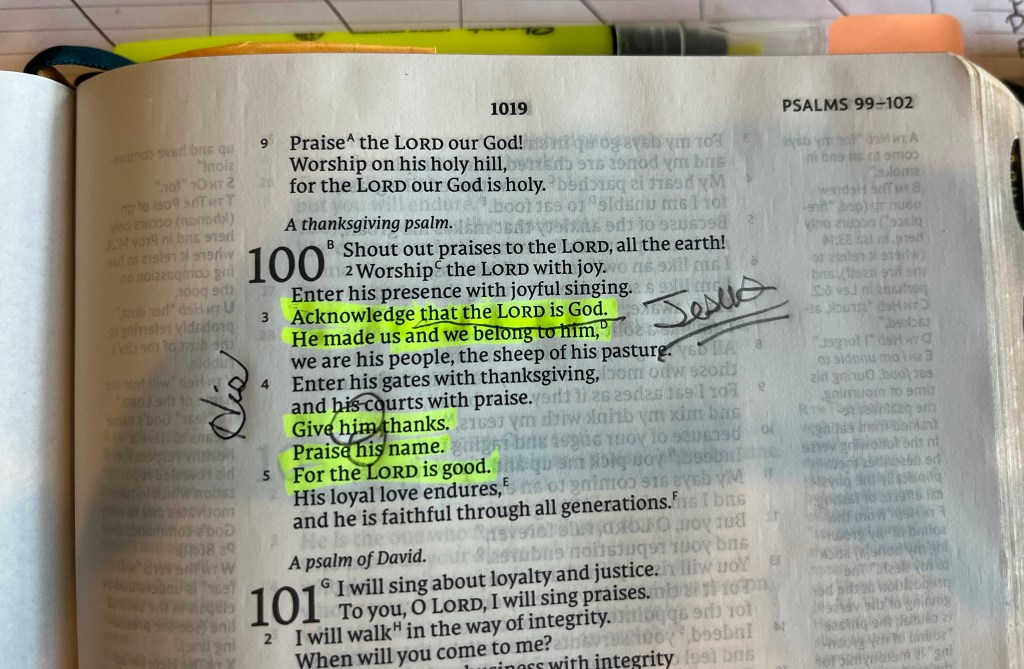
    Psalm 100

    Shout out praises to the Lord, all the earth!
    2 Worship[b] the Lord with joy.
    Enter his presence with joyful singing.
    3 Acknowledge that the Lord is God.
    He made us and we belong to him,[c]
    we are his people, the sheep of his pasture.
    4 Enter his gates with thanksgiving,
    and his courts with praise.
    Give him thanks.
    Praise his name.
    5 For the Lord is good.
    His loyal love endures,[d]
    and he is faithful through all generations.[e]

    John 10

    Jesus as the Good Shepherd

    10 “I tell you the solemn truth,[a] the one who does not enter the sheepfold[b]by the door,[c] but climbs in some other way, is a thief and a robber. The one who enters by the door is the shepherd of the sheep. The doorkeeper[d] opens the door[e] for him,[f] and the sheep hear his voice. He[g] calls his own sheep by name and leads them out.[h] When he has brought all his own sheep[i] out, he goes ahead of them, and the sheep follow him because they recognize[j] his voice. They will never follow a stranger,[k] but will run away from him, because they do not recognize[l] the stranger’s voice.”[m] Jesus told them this parable,[n] but they[o] did not understand[p] what he was saying to them.

    So Jesus said again, “I tell you the solemn truth,[q] I am the door for the sheep.[r] All who came before me were[s] thieves and robbers, but the sheep did not listen to them.[t] I am the door. If anyone enters through me, he will be saved, and will come in and go out,[u]and find pasture.[v] 10 The thief comes only to steal and kill[w] and destroy; I have come so that they may have life, and may have it abundantly.[x]

    11 “I am the good[y] shepherd. The good shepherd lays down his life[z] for the sheep. 12 The hired hand,[aa] who is not a shepherd and does not own sheep, sees the wolf coming and abandons[ab] the sheep and runs away.[ac] So the wolf attacks[ad] the sheep and scatters them. 13 Because he is a hired hand and is not concerned about the sheep,[ae] he runs away.[af]

    14 “I am the good shepherd. I[ag] know my own[ah] and my own know me— 15 just as the Father knows me and I know the Father—and I lay down my life[ai] for[aj] the sheep. 16 I have[ak] other sheep that do not come from[al] this sheepfold.[am] I must bring them too, and they will listen to my voice,[an] so that[ao] there will be one flock and[ap] one shepherd. 17 This is why the Father loves me[aq]—because I lay down my life,[ar] so that I may take it back again. 18 No one takes it away from me, but I lay it down[as] of my own free will.[at] I have the authority[au] to lay it down, and I have the authority[av] to take it back again. This commandment[aw] I received from my Father.”

    19 Another sharp division took place among the Jewish people[ax] because of these words. 20 Many of them were saying, “He is possessed by a demon and has lost his mind![ay] Why do you listen to him?” 21 Others said, “These are not the words[az] of someone possessed by a demon. A demon cannot cause the blind to see,[ba] can it?”[bb]

    Jesus at the Feast of Dedication

    22 Then came the feast of the Dedication[bc] in Jerusalem. 23 It was winter,[bd] and Jesus was walking in the temple area[be] in Solomon’s Portico.[bf]24 The Jewish leaders[bg] surrounded him and asked,[bh] “How long will you keep us in suspense?[bi] If you are the Christ,[bj]tell us plainly.”[bk] 25 Jesus replied,[bl] “I told you and you do not believe. The deeds[bm] I do in my Father’s name testify about me. 26 But you refuse to believe because you are not my sheep. 27 My sheep listen to my voice, and I know them, and they follow me. 28 I give[bn]them eternal life, and they will never perish;[bo] no one will snatch[bp] them from my hand. 29 My Father, who has given them to me, is greater than all,[bq]and no one can snatch[br] them from my Father’s hand. 30 The Father and I[bs] are one.”[bt]

    31 The Jewish leaders[bu] picked up rocks again to stone him to death. 32 Jesus said to them,[bv] “I have shown you many good deeds[bw] from the Father. For which one of them are you going to stone me?” 33 The Jewish leaders[bx] replied,[by]“We are not going to stone you for a good deed[bz] but for blasphemy,[ca]because[cb] you, a man, are claiming to be God.”[cc]

    34 Jesus answered,[cd] “Is it not written in your law, ‘I said, you are gods’?[ce] 35 If those people to whom the word of God came were called ‘gods’ (and the scripture cannot be broken),[cf] 36 do you say about the one whom the Father set apart[cg] and sent into the world, ‘You are blaspheming,’ because I said, ‘I am the Son of God’? 37 If I do not perform[ch] the deeds[ci] of my Father, do not believe me. 38 But if I do them, even if you do not believe me, believe the deeds,[cj] so that you may come to know[ck] and understand that I am in the Father and the Father is in me.” 39 Then[cl] they attempted[cm] again to seize him, but he escaped their clutches.[cn]

    40 Jesus[co] went back across the Jordan River[cp] again to the place where John[cq]had been baptizing at an earlier time,[cr]and he stayed there. 41 Many[cs] came to him and began to say, “John[ct]performed[cu] no miraculous sign, but everything John said about this man[cv]was true!” 42 And many believed in Jesus[cw] there.

    Footnotes

    1. John 10:1 tn Grk “Truly, truly, I say to you.”
    2. John 10:1 sn There was more than one type of sheepfold in use in Palestine in Jesus’ day. The one here seems to be a courtyard in front of a house (the Greek word used for the sheepfold here, αὐλή [aulē] frequently refers to a courtyard), surrounded by a stone wall (often topped with briars for protection).
    3. John 10:1 tn Or “entrance.”
    4. John 10:3 tn Or “porter” (British English).sn There have been many attempts to identify who the doorkeeper represents, none of which are convincing. More likely there are some details in this parable that are included for the sake of the story, necessary as parts of the overall picture but without symbolic significance.
    5. John 10:3 tn The words “the door” are not in the Greek text but are implied. Direct objects in Greek were often omitted when clear from the context.
    6. John 10:3 tn Grk “For this one.”
    7. John 10:3 tn Grk “And he.” Because of the difference between Greek style, which often begins sentences or clauses with “and,” and English style, which generally does not, καί (kai) has not been translated here.
    8. John 10:3 sn He calls his own sheep by name and leads them out. Some interpreters have suggested that there was more than one flock in the fold, and there would be a process of separation where each shepherd called out his own flock. This may also be suggested by the mention of a doorkeeper in v. 3 since only the larger sheepfolds would have such a guard. But the Gospel of John never mentions a distinction among the sheep in this fold; in fact (10:16) there are other sheep which are to be brought in, but they are to be one flock and one shepherd.
    9. John 10:4 tn The word “sheep” is not in the Greek text, but is implied.
    10. John 10:4 tn Grk “because they know.”
    11. John 10:5 tn Or “someone whom they do not know.”
    12. John 10:5 tn Grk “know.”
    13. John 10:5 tn Or “the voice of someone they do not know.”
    14. John 10:6 sn A parable is a fairly short narrative that has symbolic meaning. The Greek word παροιμίαν (paroimian) is used again in 16:25, 29. This term does not occur in the synoptic gospels, where παραβολή (parabolē) is used. Nevertheless it is similar, denoting a short narrative with figurative or symbolic meaning.
    15. John 10:6 tn Grk “these.”
    16. John 10:6 tn Or “comprehend.”
    17. John 10:7 tn Grk “Truly, truly, I say to you.”
    18. John 10:7 tn Or “I am the sheep’s door.”
    19. John 10:8 tn Grk “are” (present tense).
    20. John 10:8 tn Or “the sheep did not hear them.”
    21. John 10:9 tn Since the Greek phrase εἰσέρχομαι καὶ ἐξέρχομαι(eiserchomai kai exerchomai, “come in and go out”) is in some places an idiom for living or conducting oneself in relationship to some community (“to live with, to live among” [cf. Acts 1:21; see also Num 27:17; 2 Chr 1:10]), it may well be that Jesus’ words here look forward to the new covenant community of believers. Another significant NT text is Luke 9:4, where both these verbs occur in the context of the safety and security provided by a given household for the disciples. See also BDAG 294 s.v. εἰσέρχομαι1.b.β.
    22. John 10:9 sn That is, pasture land in contrast to cultivated land.
    23. John 10:10 tn That is, “to slaughter” (in reference to animals).
    24. John 10:10 tn That is, more than one would normally expect or anticipate.
    25. John 10:11 tn Or “model” (see R. E. Brown, John [AB], 1:386, who argues that “model” is a more exact translation of καλός [kalos] here).
    26. John 10:11 tn Or “The good shepherd dies willingly.”sn Jesus speaks openly of his vicarious death twice in this section (John 10:11, 15). Note the contrast: The thief takes the life of the sheep (10:10), the good shepherd lays down his own life for the sheep. Jesus is not speaking generally here, but specifically: He has his own substitutionary death on the cross in view. For a literal shepherd with a literal flock, the shepherd’s death would have spelled disaster for the sheep; in this instance it spells life for them (Compare the worthless shepherd of Zech 11:17, by contrast).
    27. John 10:12 sn Jesus contrasts the behavior of the shepherd with that of the hired hand. This is a worker who is simply paid to do a job; he has no other interest in the sheep and is certainly not about to risk his life for them. When they are threatened, he simply runs away.
    28. John 10:12 tn Grk “leaves.”
    29. John 10:12 tn Or “flees.”
    30. John 10:12 tn Or “seizes.” The more traditional rendering, “snatches,” has the idea of seizing something by force and carrying it off, which is certainly possible here. However, in the sequence in John 10:12, this action precedes the scattering of the flock of sheep, so “attacks” is preferable.
    31. John 10:13 tn Grk “does not have a care for the sheep.”
    32. John 10:13 tc The phrase “he runs away” is lacking in several significant mss (P44vid,45, 66, 75 א A*vid B D L [W] Θ 1 33 1241 al co). Most likely it was added by a later scribe to improve the readability of vv. 12-13, which is one long sentence in Greek. It has been included in the translation for the same stylistic reasons.
    33. John 10:14 tn Grk “And I.” Because of the difference between Greek style, which often begins sentences or clauses with “and,” and English style, which generally does not, καί (kai) has not been translated here.
    34. John 10:14 tn The direct object is frequently omitted in Greek and must be supplied from the context. Here it could be “sheep,” but Jesus was ultimately talking about “people.”
    35. John 10:15 tn Or “I die willingly.”
    36. John 10:15 tn Or “on behalf of” or “for the sake of.”
    37. John 10:16 tn Grk “And I have.” Because of the difference between Greek style, which often begins sentences or clauses with “and,” and English style, which generally does not, καί (kai) has not been translated here.
    38. John 10:16 tn Or “that do not belong to”; Grk “that are not of.”
    39. John 10:16 sn The statement I have other sheep that do not come from this sheepfold almost certainly refers to Gentiles. Jesus has sheep in the fold who are Jewish; there are other sheep which, while not of the same fold, belong to him also. This recalls the mission of the Son in 3:16-17, which was to save the world—not just the nation of Israel. Such an emphasis would be particularly appropriate to the author if he were writing to a non-Palestinian and primarily non-Jewish audience.
    40. John 10:16 tn Grk “they will hear my voice.”
    41. John 10:16 tn Grk “voice, and.”
    42. John 10:16 tn The word “and” is not in the Greek text, but must be supplied to conform to English style. In Greek it is an instance of asyndeton (omission of a connective), usually somewhat emphatic.
    43. John 10:17 tn Grk “Because of this the Father loves me.”
    44. John 10:17 tn Or “die willingly.”
    45. John 10:18 tn Or “give it up.”
    46. John 10:18 tn Or “of my own accord.” “Of my own free will” is given by BDAG 321 s.v. ἐμαυτοῦ c.
    47. John 10:18 tn Or “I have the right.”
    48. John 10:18 tn Or “I have the right.”
    49. John 10:18 tn Or “order.”
    50. John 10:19 tn Or perhaps “the Jewish religious leaders”; Grk “the Jews.” In NT usage the term ᾿Ιουδαῖοι (Ioudaioi) may refer to the entire Jewish people, the residents of Jerusalem and surrounding territory, the authorities in Jerusalem, or merely those who were hostile to Jesus. (For further information see R. G. Bratcher, “‘The Jews’ in the Gospel of John,” BT 26 [1975]: 401-9.) Here the phrase could be taken to refer to the Jewish religious leaders, since the Pharisees were the last to be mentioned specifically by name, in John 9:40. However, in light of the charge about demon possession, which echoes 8:48, it is more likely that Jewish people in general (perhaps in Jerusalem, if that is understood to be the setting of the incident) are in view here.
    51. John 10:20 tn Or “is insane.” To translate simply “he is mad” (so KJV, ASV, RSV; “raving mad” NIV) could give the impression that Jesus was angry, while the actual charge was madness or insanity.
    52. John 10:21 tn Or “the sayings.”
    53. John 10:21 tn Grk “open the eyes of the blind” (“opening the eyes” is an idiom referring to restoration of sight).
    54. John 10:21 tn Questions prefaced with μή () in Greek anticipate a negative answer. This can sometimes be indicated by using a “tag” at the end in English (here the tag is “can it?”).
    55. John 10:22 tn That is, Hanukkah or the ‘Festival of Lights.’ The Greek name for the feast, τὰ ἐγκαίνια (ta enkainia), literally means “renewal” and was used to translate Hanukkah which means “dedication.” The Greek noun, with its related verbs, was the standard term used in the LXX for the consecration of the altar of the Tabernacle (Num 7:10-11), the altar of the temple of Solomon (1 Kgs 8:63; 2 Chr 7:5), and the altar of the second temple (Ezra 6:16). The word is thus connected with the consecration of all the houses of God in the history of the nation of Israel.snThe feast of the Dedication (also known as Hanukkah) was a feast celebrating annually the Maccabean victories of 165-164 b.c.—when Judas Maccabeus drove out the Syrians, rebuilt the altar, and rededicated the temple on 25 Kislev (1 Macc 4:41-61). From a historical standpoint, it was the last great deliverance the Jewish people had experienced, and it came at a time when least expected. Josephus ends his account of the institution of the festival with the following statement: “And from that time to the present we observe this festival, which we call the festival of Lights, giving this name to it, I think, from the fact that the right to worship appeared to us at a time when we hardly dared hope for it” (Ant. 12.7.6 [12.325]).
    56. John 10:23 sn It was winter. The feast began on 25 Kislev, in November-December of the modern Gregorian calendar.
    57. John 10:23 tn Grk “in the temple.”
    58. John 10:23 tn Or “portico,” “colonnade”; Grk “stoa.”sn Solomons Portico was a covered walkway formed by rows of columns supporting a roof and open on the inner side facing the center of the temple complex.
    59. John 10:24 tn Or “the Jewish authorities”; Grk “the Jews.” Here the phrase refers to the Jewish leaders. The question they ask Jesus (“Are you the Christ?”) is the same one they sent and asked of John the Baptist in the desert (see John 1:19-34). See also the note on the phrase “the Jewish people” in v. 19.
    60. John 10:24 tn Grk “said to him.” This has been translated as “asked” for stylistic reasons.
    61. John 10:24 tn Grk “How long will you take away our life?” (an idiom which meant to keep one from coming to a conclusion about something). The use of the phrase τὴν ψυχὴν ἡμῶν αἴρεις(tēn psuchēn hēmōn aireis) meaning “to keep in suspense” is not well attested, although it certainly fits the context here. In modern Greek the phrase means “to annoy, bother.”
    62. John 10:24 tn Or “the Messiah” (Both Greek “Christ” and Hebrew and Aramaic “Messiah” mean “one who has been anointed”).sn See the note on Christ in 1:20.
    63. John 10:24 tn Or “publicly.”
    64. John 10:25 tn Grk “answered them.”
    65. John 10:25 tn Or “the works.”
    66. John 10:28 tn Grk “And I give.”
    67. John 10:28 tn Or “will never die” or “will never be lost.”
    68. John 10:28 tn Or “no one will seize.”
    69. John 10:29 tn Or “is superior to all.”
    70. John 10:29 tn Or “no one can seize.”
    71. John 10:30 tn Grk “I and the Father.” The order has been reversed to reflect English style.
    72. John 10:30 tn The phrase ἕν ἐσμεν(hen esmen) is a significant assertion with trinitarian implications. ἕν is neuter, not masculine, so the assertion is not that Jesus and the Father are one person, but one “thing.” Identity of the two persons is not what is asserted, but essential unity (unity of essence).
    73. John 10:31 tn Or “the Jewish authorities”; Grk “the Jews.” Here the phrase refers to the Jewish leaders. See the notes on the phrases “Jewish people” in v. 19 and “Jewish leaders” in v. 24.
    74. John 10:32 tn Grk “Jesus answered them.”
    75. John 10:32 tn Or “good works.”
    76. John 10:33 tn Or “the Jewish authorities”; Grk “the Jews.” Here again the phrase refers to the Jewish leaders. See the notes on the phrase “Jewish people” in v. 19 and “Jewish leaders” in vv. 24, 31.
    77. John 10:33 tn Grk “answered him.”
    78. John 10:33 tn Or “good work.”
    79. John 10:33 sn This is the first time the official charge of blasphemy is voiced openly in the Fourth Gospel (although it was implicit in John 8:59). Blasphemy in the NT has a somewhat broader meaning than mere utterances. It could mean to say something that dishonored God, but it could also involve claims to divine prerogatives (in this case, Jesus’ claim to oneness with the Father, v. 30). Such claims were viewed as usurping God’s majesty or honor. The remark here raised directly the issue of the identity of Jesus himself as God’s representative.
    80. John 10:33 tn Grk “and because.”
    81. John 10:33 tn Grk “you, a man, make yourself to be God.”
    82. John 10:34 tn Grk “answered them.”
    83. John 10:34 sn A quotation from Ps 82:6. Technically the Psalms are not part of the OT “law” (which usually referred to the five books of Moses), but occasionally the term “law” was applied to the entire OT, as here. The problem in this verse concerns the meaning of Jesus’ quotation from Ps 82:6. It is important to look at the OT context: The whole line reads “I say, you are gods, sons of the Most High, all of you.” Jesus will pick up on the term “sons of the Most High” in 10:36, where he refers to himself as the Son of God. The psalm was understood in rabbinic circles as an attack on unjust judges who, though they have been given the title “gods” because of their quasi-divine function of exercising judgment, are just as mortal as other men. What is the argument here? It is often thought to be as follows: If it was an OT practice to refer to men like the judges as gods, and not blasphemy, why did the Jewish authorities object when this term was applied to Jesus? This really doesn’t seem to fit the context, however, since if that were the case Jesus would not be making any claim for “divinity” for himself over and above any other human being—and therefore he would not be subject to the charge of blasphemy. Rather, this is evidently a case of arguing from the lesser to the greater, a common form of rabbinic argument. The reason the OT judges could be called gods is because they were vehicles of the word of God (cf. 10:35). But granting that premise, Jesus deserves much more than they to be called God. He is the Word incarnate, whom the Father sanctified and sent into the world to save the world (10:36). In light of the prologue to the Gospel of John, it seems this interpretation would have been most natural for the author. If it is permissible to call men “gods” because they were the vehicles of the word of God, how much more permissible is it to use the word “God” of him who is the Word of God?
    84. John 10:35 sn The parenthetical note And the scripture cannot be brokenbelongs to Jesus’ words rather than the author’s. Not only does Jesus appeal to the OT to defend himself against the charge of blasphemy, but he also adds that the scripture cannot be “broken.” In this context he does not explain precisely what is meant by “broken,” but it is not too hard to determine. Jesus’ argument depended on the exact word used in the context of Ps 82:6. If any other word for “judge” had been used in the psalm, his argument would have been meaningless. Since the scriptures do use this word in Ps 82:6, the argument is binding, because they cannot be “broken” in the sense of being shown to be in error.
    85. John 10:36 tn Or “dedicated.”
    86. John 10:37 tn Or “do.”
    87. John 10:37 tn Or “works.”
    88. John 10:38 tn Or “works.”sn Jesus says that in the final analysis, the deeds he did should indicate whether he was truly from the Father. If the authorities could not believe in him, it would be better to believe in the deeds he did than not to believe at all.
    89. John 10:38 tn Or “so that you may learn.”
    90. John 10:39 tc It is difficult to decide between ἐζήτουν οὖν (ezētoun oun, “then they were seeking”; P66 א A L W Ψ ƒ1,13 33 pm lat), ἐζήτουν δέ (ezētoun de, “now they were seeking”; P45 and a few versional witnesses), καὶ ἐζήτουν(kai ezētoun, “and they were seeking”; D), and ἐζήτουν (P75vid B Γ Θ 700 pm). Externally, the most viable readings are ἐζήτουν οὖν and ἐζήτουν. Transcriptionally, the οὖν could have dropped out via haplography since the verb ends in the same three letters. On the other hand, it is difficult to explain the readings with δέ or καί if ἐζήτουν οὖν is autographic; such readings would more likely have arisen from the simple ἐζήτουν. Intrinsically, John is fond of οὖν, using it some 200 times. Further, this Gospel begins relatively few sentences without some conjunction. The minimal support for the δέ and καί readings suggests that they arose either from the lone verb reading (which would thus be prior to their respective Vorlagen but not necessarily the earliest reading) or through carelessness on the part of the scribes. Indeed, the ancestors of P45 and D may have committed haplography, leaving later scribes in the chain to guess at the conjunction needed. In sum, the best reading appears to be ἐζήτουν οὖν.
    91. John 10:39 tn Grk “they were seeking.”
    92. John 10:39 tn Grk “he departed out of their hand.”sn It is not clear whether the authorities simply sought to “arrest” him, or were renewing their attempt to stone him (cf. John 10:31) by seizing him and taking him out to be stoned. In either event, Jesus escaped their clutches. Nor is it clear whether Jesus’ escape is to be understood as a miracle. If so, the text gives little indication and even less description. What is clear is that until his “hour” comes, Jesus is completely safe from the hands of men: His enemies are powerless to touch him until they are permitted to do so.
    93. John 10:40 tn Grk “He”; the referent (Jesus) has been specified in the translation for clarity.
    94. John 10:40 tn The word “River” is not in the Greek text but is supplied for clarity.
    95. John 10:40 sn John refers to John the Baptist.
    96. John 10:40 tn Grk “formerly.”sn This refers to the city of Bethany across the Jordan River (see John 1:28).
    97. John 10:41 tn Grk “And many.” Because of the difference between Greek style, which often begins sentences or clauses with “and,” and English style, which generally does not, καί (kai) has not been translated here.
    98. John 10:41 sn John refers to John the Baptist.
    99. John 10:41 tn Grk “did.”
    100. John 10:41 tn Grk “this one.”
    101. John 10:42 tn Grk “in him.”
  • Matthew 28

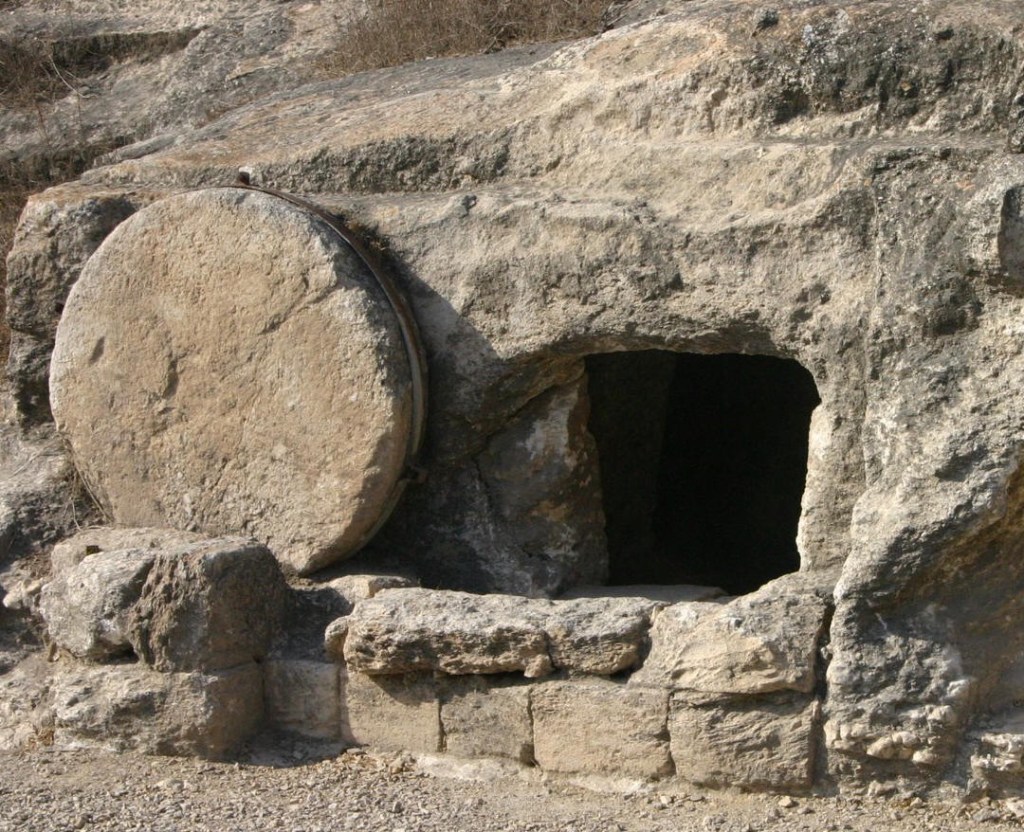
     Now after the Sabbath, at dawn on the first day of the week, Mary Magdalene and the other Mary went to look at the tomb. Suddenly there was a severe earthquake, for an angel of the Lord[a] descending from heaven came and rolled away the stone and sat on it. His[b] appearance was like lightning, and his clothes were white as snow. The[c] guards were shaken and became like dead men because they were so afraid of him. But the angel said[d] to the women, “Do not be afraid; I know[e] that you are looking for Jesus, who was crucified.[f] He is not here, for he has been raised,[g] just as he said. Come and see the place where he[h] was lying. Then go quickly and tell his disciples, ‘He has been raised from the dead. He[i] is going ahead of you into Galilee. You will see him there.’ Listen, I have told you!” So[j] they left the tomb quickly, with fear and great joy, and ran to tell his disciples. But[k] Jesus met them, saying, “Greetings!” They[l] came to him, held on to his feet and worshiped him. 10 Then Jesus said to them, “Do not be afraid. Go and tell my brothers to go to Galilee. They will see me there.”

    The Guards’ Report

    11 While[m] they were going, some[n] of the guard went into the city and told the chief priests everything that had happened. 12 After[o] they had assembled with the elders and formed a plan, they gave a large sum of money to the soldiers, 13 telling them, “You are to say, ‘His disciples came at night and stole his body[p]while we were asleep.’ 14 If[q] this matter is heard before the governor,[r] we will satisfy him[s] and keep you out of trouble.”[t] 15 So they took the money and did as they were instructed. And this story is told among the Jews to this day.[u]

    The Great Commission

    16 So[v] the eleven disciples went to Galilee to the mountain Jesus had designated. 17 When[w]they saw him, they worshiped him,[x] but some doubted.[y] 18 Then Jesus came up and said to them,[z] “All authority in heaven and on earth has been given to me. 19 Therefore go[aa] and make disciples of all nations, baptizing them in the name of the Father and the Son and the Holy Spirit,[ab] 20 teaching them to obey everything I have commanded you. And remember,[ac] I am with you[ad] always, to the end of the age.”[ae]

    Footnotes

    1. Matthew 28:2 tn Or “the angel of the Lord.” See the note on the word “Lord” in 1:20.
    2. Matthew 28:3 tn Here δέ (de) has not been translated.
    3. Matthew 28:4 tn Here δέ (de) has not been translated.
    4. Matthew 28:5 tn Grk “But answering, the angel said.” This is somewhat redundant in English and has been simplified in the translation.
    5. Matthew 28:5 tn Grk “for I know.”
    6. Matthew 28:5 sn See the note on crucified in 20:19.
    7. Matthew 28:6 tn The verb here is passive (ἠγέρθη, ēgerthē). This “divine passive” (see ExSyn 437-38) points to the fact that Jesus was raised by God.
    8. Matthew 28:6 tc Expansions on the text, especially when the Lord is the subject, are a common scribal activity. In this instance, since the subject is embedded in the verb, three major variants have emerged to make the subject explicit: ὁ κύριος (ho kurios, “the Lord”; A C D L W Γ 0148 ƒ1,13 565 579 700 1241 M lat), τὸ σῶμα τοῦ κυρίου (to sōma tou kuriou, “the body of the Lord”; 1424), and ὁ ᾿Ιησοῦς (ho Iēsous, “Jesus”; Φ). The reading with no explicit subject, however, is superior on both internal and external grounds, being supported by א B Θ 33 892* co.
    9. Matthew 28:7 tn Grk “And behold he.” The Greek word ἰδού (idou) has not been translated because it has no exact English equivalent here, but adds interest and emphasis (BDAG 468 s.v. 1).
    10. Matthew 28:8 tn Here καί (kai) has been translated as “so” to indicate the implied result of the angel’s instructions to tell the disciples.
    11. Matthew 28:9 tn Grk “And behold.” Here καί(kai) has been translated as “but” to indicate that the return of the women from the tomb was interrupted by this appearance of Jesus. The Greek word ἰδού (idou) has not been translated because it has no exact English equivalent here, but adds interest and emphasis (BDAG 468 s.v. 1).
    12. Matthew 28:9 tn Here δέ (de) has not been translated.
    13. Matthew 28:11 tn Here δέ (de) has not been translated.
    14. Matthew 28:11 tn Grk “behold, some of the guard.” The Greek word ἰδού (idou) has not been translated because it has no exact English equivalent here, but adds interest and emphasis (BDAG 468 s.v. 1).
    15. Matthew 28:12 tn Here καί (kai) has not been translated.
    16. Matthew 28:13 tn Grk “him.”
    17. Matthew 28:14 tn Here καί (kai) has not been translated.
    18. Matthew 28:14 tn Here ἐπί (epi) followed by the genitive = “before,” especially in the language of lawsuits (BDAG 363 s.v. 3).
    19. Matthew 28:14 tc ‡ αὐτόν (auton, “him”) is found after πείσομεν (peisomen, “we will satisfy”) in the majority of witnesses, though it seems to be motivated by a need for clarification and cannot therefore easily explain the rise of the shorter reading (which is found in א B Θ 33 pc). Nevertheless, English style requires the pronoun. NA28includes the word in brackets, indicating doubts as to its authenticity.
    20. Matthew 28:14 tn Grk “and make you free from care” = “we will keep you out of trouble.”
    21. Matthew 28:15 tc ‡ The word ἡμέρας(hēmeras, “day”) is found after σήμερον(sēmeron, “today, this [day]”) in some early and significant witnesses (B D L Θ lat, as well as other versions and fathers), but may be added for emphasis (cf. Acts 20:26; 27:33; Rom 11:8; 2 Cor 3:14). But since the idiom with “day” is unquestionably found only in Paul’s speeches in Acts or his letters, intrinsic evidence is against the addition. The shorter reading (found in א A W 0148vid ƒ1,13 33 565 579 700 1241 1424 M) is thus preferred. NA28includes the word in brackets, indicating reservations about its authenticity. Whether authentic or not, the translation is not affected.
    22. Matthew 28:16 tn Here δέ (de) has been translated as “so” to indicate the implied result of Jesus’ instructions in v. 10.
    23. Matthew 28:17 tn Here καί (kai) has not been translated.
    24. Matthew 28:17 tn The word “him” is not in the Greek text, but is implied. Direct objects were frequently omitted in Greek when clear from the context.
    25. Matthew 28:17 tn The Greek text reads here οἱ δὲ ἐδίστασαν (hoi de edistasan). Some scholars argue that the article is functioning like a personal pronoun, thus “they doubted” (e.g., D. A. Hagner, Matthew [WBC], 2:884). If so, then all the disciples would be in view. The translation of the text takes οἱ as an alternative pronoun which has a partitive notion (i.e., some of the disciples doubted, but not all). The difficulty with the personal pronoun view is that there are no examples of it in Matthew in which the same subject immediately precedes with its own verb (as would be the case in “they worshiped…they doubted”). Such, in fact, would be quite awkward, for the article would be unnecessary since the pronominal referent is already embedded in the verb. The only reason for the article here would be to distinguish the subject in some way; but if the same subject is in view, no distinction is being made.
    26. Matthew 28:18 tn Grk “coming, Jesus spoke to them, saying.” The participle λέγων (legōn, “saying”) is redundant in contemporary English and has not been translated. Here καί(kai) has been translated as “then” to indicate the implied sequence of events within the narrative.
    27. Matthew 28:19 tn “Go…baptize…teach” are participles modifying the imperative verb “make disciples.” According to ExSyn 645 the first participle (πορευθέντες, poreuthentes, “Go”) fits the typical structural pattern for the attendant circumstance participle (aorist participle preceding aorist main verb, with the mood of the main verb usually imperative or indicative) and thus picks up the mood (imperative in this case) from the main verb (μαθητεύσατε, mathēteusate, “make disciples”). This means that semantically the action of “going” is commanded, just as “making disciples” is. As for the two participles that follow the main verb (βαπτίζοντες, baptizontes, “baptizing”; and διδάσκοντες, didaskontes, “teaching”), these do not fit the normal pattern for attendant circumstance participles, since they are present participles and follow the aorist main verb. However, some interpreters do see them as carrying additional imperative force in context. Others regard them as means, manner, or even result.
    28. Matthew 28:19 tc Although some scholars have denied that the trinitarian baptismal formula in the Great Commission was a part of the autographic text of Matthew, there is no ms support for their contention. F. C. Conybeare, “The Eusebian Form of the Text of Mt. 28:19, ” ZNW 2 (1901): 275-88, based his view on a faulty reading of Eusebius’ quotations of this text. The shorter reading has also been accepted, on other grounds, by a few other scholars. For discussion (and refutation of the conjecture that removes this baptismal formula), see B. J. Hubbard, The Matthean Redaction of a Primitive Apostolic Commissioning (SBLDS 19), 163-64, 167-75; and Jane Schaberg, The Father, the Son, and the Holy Spirit (SBLDS 61), 27-29.
    29. Matthew 28:20 tn The Greek word ἰδού(idou) has been translated here as “remember” (BDAG 468 s.v. 1.c).
    30. Matthew 28:20 sn I am with you. Matthew’s Gospel begins with the prophecy that the Savior’s name would be “Emmanuel, that is, ‘God with us,’” (1:23, in which the author has linked Isa 7:14 and 8:8, 10 together) and it ends with Jesus’ promise to be with his disciples forever. The Gospel of Matthew thus forms an inclusio about Jesus in his relationship to his people that suggests his deity.
    31. Matthew 28:20 tc Most mss (Ac Γ Δ Θ ƒ13 565 579 700 1241 1424 M it sy) have ἀμήν (amēn, “amen”) at the end of v. 20. Such a conclusion is routinely added by scribes to NT books because a few of these books originally had such an ending (cf. Rom 16:27; Gal 6:18; Jude 25). A majority of Greek witnesses have the concluding ἀμήν in every NT book except Acts, James, and 3 John (and even in these books, ἀμήν is found in some witnesses). It is thus a predictable variant. Further, no good reason exists for the omission of the particle in significant and early witnesses such as א A* B D W ƒ1 33 al lat sa.
  • Psalm 95 and Colossians 1

    As you read the following two chapters, ask yourself the following question: “Am I challenging Jesus’s authority in my life, or am I resting in it?” When we acknowledge that only God is God, and that we are the sheep of His pasture, we sing a new song of praise! A praise that lifts His name above all others!

    Psalm 95

    Come, let us sing for joy to the Lord.
    Let us shout out praises to our Protector who delivers us.[b]
    Let us enter his presence[c] with thanksgiving.
    Let us shout out to him in celebration.[d]
    For the Lord is a great God,
    a great king who is superior to[e]all gods.
    The depths of the earth are in his hand,[f]
    and the mountain peaks belong to him.
    The sea is his, for he made it.
    His hands formed the dry land.
    Come, let us bow down and worship.[g]
    Let us kneel before the Lord, our Creator.
    For he is our God;
    we are the people of his pasture,
    the sheep he owns.[h]
    Today, if only you would obey him.[i]
    He says,[j] “Do not be stubborn like they were at Meribah,[k]
    like they were that day at Massah[l] in the wilderness,[m]
    where your ancestors challenged my authority,[n]
    and tried my patience, even though they had seen my work.
    10 For forty years I was continually disgusted[o] with that generation,
    and I said, ‘These people desire to go astray;[p]
    they do not obey my commands.’[q]
    11 So I made a vow in my anger,
    ‘They will never enter into the resting place I had set aside for them.’”[r]

    Footnotes

    1. Psalm 95:1 sn Psalm 95. The psalmist summons Israel to praise God as the creator of the world and the nation’s protector, but he also reminds the people not to rebel against God.
    2. Psalm 95:1 tn Heb “to the rocky summit of our deliverance.”
    3. Psalm 95:2 tn Heb “meet his face.”
    4. Psalm 95:2 tn Heb “with songs of joy.”
    5. Psalm 95:3 tn Heb “above.”
    6. Psalm 95:4 tn The phrase “in his hand” means within the sphere of his authority.
    7. Psalm 95:6 tn Heb “kneel down.”
    8. Psalm 95:7 tn Heb “of his hand.”
    9. Psalm 95:7 tn Heb “if only you would listen to his voice.” The Hebrew particle אִם (ʾim, “if”) and following prefixed verbal form here express a wish (cf. Ps 81:8). Note that the apodosis (the “then” clause of the conditional sentence) is suppressed.
    10. Psalm 95:8 tn The words “he says” are supplied in the translation to clarify that the following words are spoken by the Lord (see vv. 9-11).
    11. Psalm 95:8 sn The name Meribahmeans “strife.” Two separate but similar incidents at Meribah are recorded in the Pentateuch (Exod 17:1-7; Num 20:1-13, see also Pss 81:7; 106:32). In both cases the Israelites complained about lack of water and the Lord miraculously provided for them.
    12. Psalm 95:8 sn The name Massahmeans “testing.” This was another name (along with Meribah) given to the place where Israel complained following the Red Sea Crossing (see Exod 17:1-7, as well as Deut 6:16; 9:22; 33:8).
    13. Psalm 95:8 tn Heb “do not harden your heart[s] as [at] Meribah, as [in] the day of Massah in the wilderness.”
    14. Psalm 95:9 tn Heb “where your fathers tested me.”
    15. Psalm 95:10 tn The prefixed verbal form is either a preterite or an imperfect. If the latter, it emphasizes the ongoing nature of the condition in the past. The translation reflects this interpretation of the verbal form.
    16. Psalm 95:10 tn Heb “a people, wanderers of heart [are] they.”
    17. Psalm 95:10 tn Heb “and they do not know my ways.” In this context the Lord’s “ways” are his commands, viewed as a pathway from which his people, likened to wayward sheep (see v. 7), wander.
    18. Psalm 95:11 tn Heb “my resting place.” The promised land of Canaan is here viewed metaphorically as a place of rest for God’s people, who are compared to sheep (see v. 7).

    Colossians 1

    Colossians 1New English Translation

    Salutation

    1 From Paul,[a] an apostle of Christ Jesus by the will of God, and Timothy our brother, to the saints, the faithful[b]brothers and sisters[c] in Christ, at Colossae. Grace and peace to you[d] from God our Father![e]

    Paul’s Thanksgiving and Prayer for the Church

    We always[f] give thanks to God, the Father of our Lord Jesus Christ, when we pray for you, since[g] we heard about your faith in Christ Jesus and the love that you have for all the saints. Your faith and love have arisen[h] from the hope laid up[i] for you in heaven, which you have heard about in the message of truth, the gospel[j] that has come to you. Just as in the entire world this gospel[k] is bearing fruit and growing, so it has also been bearing fruit and growing[l] among you from the first day you heard it and understood the grace of God in truth. You learned the gospel[m]from Epaphras, our dear fellow slave[n]—a[o] faithful minister of Christ on our[p]behalf— who also told us of your love in the Spirit.

    Paul’s Prayer for the Growth of the Church

    For this reason we also, from the day we heard about you,[q] have not ceased praying for you and asking God[r] to fill[s]you with the knowledge of his will in all spiritual wisdom and understanding, 10 so that you may live[t] worthily of the Lord and please him in all respects[u]—bearing fruit in every good deed, growing in the knowledge of God, 11 being strengthened with all power according to his glorious might for the display of[v] all patience and steadfastness, joyfully 12 giving thanks to the Father who has qualified you to share[w] in the saints’[x]inheritance in the light. 13 He delivered us from the power of darkness and transferred us to the kingdom of the Son he loves,[y] 14 in whom we have redemption,[z] the forgiveness of sins.

    The Supremacy of Christ

    15 [aa] He is the image of the invisible God, the firstborn[ab]over all creation,[ac]
    16 for all things in heaven and on earth were created in him—all things, whether visible or invisible, whether thrones or dominions,[ad] whether principalities or powers—all things were created through him and for him.
    17 He himself is before all things and all things are held together[ae] in him.
    18 He is the head of the body, the church, as well as the beginning, the firstborn[af] from the dead, so that he himself may become first in all things.[ag]
    19 For God[ah] was pleased to have all his[ai] fullness dwell[aj] in the Son[ak]
    20 and through him to reconcile all things to himself by making peace through the blood of his cross—through him,[al] whether things on earth or things in heaven.

    Paul’s Goal in Ministry

    21 And you were at one time strangers and enemies in your[am] minds[an] as expressed through[ao] your evil deeds, 22 but now he has reconciled you[ap] by his physical body through death to present you holy, without blemish, and blameless before him— 23 if indeed you remain in the faith, established and firm,[aq] without shifting[ar] from the hope of the gospel that you heard. This gospel has also been preached in all creation under heaven, and I, Paul, have become its servant.

    24 Now I rejoice in my sufferings for you, and I fill up in my physical body—for the sake of his body, the church—what is lacking in the sufferings of Christ. 25 I became a servant of the church according to the stewardship[as] from God—given to me for you—in order to complete[at] the word of God, 26 that is, the mystery that has been kept hidden from ages and generations, but has now been revealed to his saints. 27 God wanted to make known to them the glorious[au] riches of this mystery among the Gentiles, which is Christ in you, the hope of glory. 28 We proclaim him by instructing[av] and teaching[aw] all people[ax] with all wisdom so that we may present every person mature[ay] in Christ. 29 Toward this goal[az] I also labor, struggling according to his power that powerfully[ba] works in me.

    Footnotes

    1. Colossians 1:1 tn Grk “Paul.” The word “from” is not in the Greek text, but has been supplied to indicate the sender of the letter.
    2. Colossians 1:2 tn Grk “and faithful.” The construction in Greek (as well as Paul’s style) suggests that the saints are identical to the faithful; hence, the καί (kai) is best left untranslated (cf. Eph 1:1). See ExSyn 281-82.
    3. Colossians 1:2 tn Grk “brothers,” but the Greek word may be used for “brothers and sisters” or “fellow Christians” as here (cf. BDAG 18 s.v. ἀδελφός 1, where considerable nonbiblical evidence for the plural ἀδελφοί [adelphoi] meaning “brothers and sisters” is cited).
    4. Colossians 1:2 tn Or “Grace to you and peace.”
    5. Colossians 1:2 tc Most witnesses, including some significant ones (א A C F G I [P] 075 2464 M it bo Hier), read “and the Lord Jesus Christ” at the end of this verse, no doubt to conform the wording to the typical Pauline salutation. However, excellent and early witnesses (B D K L Ψ 33 81 1175 1505 1739 1881 al sa Ambst) lack this phrase. Since the omission is inexplicable as arising from the longer reading (otherwise, these mss would surely have deleted the phrase in the rest of the corpus Paulinum), it is surely authentic.
    6. Colossians 1:3 tn The adverb πάντοτε(pantote) is understood to modify the indicative εὐχαριστοῦμεν(eucharistoumen) because it precedes περὶ ὑμῶν (peri humōn) which probably modifies the indicative and not the participle προσευχόμενοι(proseuchomenoi). But see 1:9 where the same expression occurs and περὶ ὑμῶν modifies the participle “praying” (προσευχόμενοι).
    7. Colossians 1:4 tn The adverbial participle ἀκούσαντες (akousantes) is understood to be temporal and translated with “since.” A causal idea may also be in the apostle’s mind, but the context emphasizes temporal ideas, e.g., “from the day” (v. 6).
    8. Colossians 1:5 tn Col 1:3-8 form one long sentence in the Greek text and have been divided at the end of v. 4and v. 6 and within v. 6 for clarity, in keeping with the tendency in contemporary English toward shorter sentences. Thus the phrase “Your faith and love have arisen from the hope” is literally “because of the hope.” The perfect tense “have arisen” was chosen in the English to reflect the fact that the recipients of the letter had acquired this hope at conversion in the past, but that it still remains and motivates them to trust in Christ and to love one another.
    9. Colossians 1:5 tn BDAG 113 s.v. ἀπόκειμαι 2 renders ἀποκειμένην(apokeimenēn) with the expression “reserved” in this verse.
    10. Colossians 1:5 tn The term “the gospel” (τοῦ εὐαγγελίου, tou euangeliou) is in apposition to “the word of truth” (τῷ λόγῳ τῆς ἀληθείας, tō logō tēs alētheias) as indicated in the translation.
    11. Colossians 1:6 tn Grk “just as in the entire world it is bearing fruit.” The antecedent (“the gospel”) of the implied subject (“it”) of ἐστιν (estin) has been specified in the translation for clarity.
    12. Colossians 1:6 tn Though the participles are periphrastic with the present tense verb ἐστίν (estin), the presence of the temporal indicator “from the day” in the next clause indicates that this is a present tense that reaches into the past and should be translated as “has been bearing fruit and growing.” For a discussion of this use of the present tense, see ExSyn 519-20.
    13. Colossians 1:7 tn Or “learned it.” The Greek text simply has “you learned” without the reference to “the gospel,” but “the gospel” is supplied to clarify the sense of the clause. Direct objects were frequently omitted in Greek when clear from the context.
    14. Colossians 1:7 tn The Greek word translated “fellow slave” is σύνδουλος(sundoulos); the σύν- prefix here denotes association. Though δοῦλος is normally translated “servant,” the word does not bear the connotation of a free individual serving another. BDAG notes that “‘servant’ for ‘slave’ is largely confined to Biblical transl. and early American times…in normal usage at the present time the two words are carefully distinguished” (BDAG 260 s.v.). One good translation is “bondservant” (sometimes found in the ASV for δοῦλος) in that it often indicates one who sells himself into slavery to another. But as this is archaic, few today understand its force. Also, many slaves in the Roman world became slaves through Rome’s subjugation of conquered nations, kidnapping, or by being born into slave households.
    15. Colossians 1:7 tn The Greek text has “who (ὅς, hos) is a faithful minister.” The above translation conveys the antecedent of the relative pronoun quite well and avoids the redundancy with the following substantival participle of v. 8, namely, “who told” (ὁ δηλώσας, ho dēlōsas).
    16. Colossians 1:7 tc ‡ Judging by the superior witnesses for the first person pronoun ἡμῶν (hēmōn, “us”; P46 א* A B D* F G 326* 1505) vs. the second person pronoun ὑμῶν (humōn, “you”; found in א2 C D1 Ψ 075 33 1175 17391881 2464 M lat sy co), ἡμῶν should be regarded as the initial reading. Although it is possible that ἡμῶν was an early alteration of ὑμῶν (either unintentionally, as dittography, since it comes seventeen letters after the previous ἡμῶν; or intentionally, to conform to the surrounding first person pronouns), this supposition is difficult to maintain in light of the varied and valuable witnesses for this reading. Further, the second person is both embedded in the verb ἐμάθετε(emathete) and is explicit in v. 8(ὑμῶν). Hence, the motivation to change to the first person pronoun is counterbalanced by such evidence. The second person pronoun may have been introduced unintentionally via homoioarcton with the ὑπέρ (huper) that immediately precedes it. As well, the second person reading is somewhat harder for it seems to address Epaphras’ role only in relation to Paul and his colleagues, rather than in relation to the Colossians. Nevertheless, the decision must be based ultimately on external evidence (since the internal evidence can be variously interpreted), and this strongly supports ἡμῶν.
    17. Colossians 1:9 tn Or “heard about it”; Grk “heard.” There is no direct object stated in the Greek (direct objects were frequently omitted in Greek when clear from the context). A direct object is expected by an English reader, however, so most translations supply one. Here, however, it is not entirely clear what the author “heard”: a number of translations supply “it” (so KJV, NASB, NRSV; NAB “this”), but this could refer back either to (1) “your love in the Spirit” at the end of v. 8, or (2) “your faith in Christ Jesus and the love that you have for all the saints” (v. 4). In light of this uncertainty, other translations supply “about you” (TEV, NIV, CEV, NLT). This is preferred by the present translation since, while it does not resolve the ambiguity entirely, it does make it less easy for the English reader to limit the reference only to “your love in the Spirit” at the end of v. 8.
    18. Colossians 1:9 tn The term “God” does not appear in the Greek text, but the following reference to “the knowledge of his will” makes it clear that “God” is in view as the object of the “praying and asking,” and should therefore be included in the English translation for clarity.
    19. Colossians 1:9 tn The ἵνα (hina) clause has been translated as substantival, indicating the content of the prayer and asking. The idea of purpose may also be present in this clause.
    20. Colossians 1:10 tn The infinitive περιπατῆσαι (peripatēsai, “to walk, to live, to live one’s life”) is best taken as an infinitive of purpose related to “praying” (προσευχόμενοι, proseuchomenoi) and “asking” (αἰτούμενοι, aitoumenoi) in v. 9 and is thus translated as “that you may live.”
    21. Colossians 1:10 tn BDAG 129 s.v. ἀρεσκεία states that ἀρεσκείαν(areskeian) refers to a “desire to please εἰς πᾶσαν ἀ. to please (the Lord) in all respects Col 1:10.”
    22. Colossians 1:11 tn The expression “for the display of” is an attempt to convey in English the force of the Greek preposition εἰς (eis) in this context.
    23. Colossians 1:12 tn BDAG 473 s.v. ἱκανόω states, “τινὰ εἴς τι someone for somethCol 1:12.” The point of the text is that God has qualified the saints for a “share” or “portion” in the inheritance of the saints.
    24. Colossians 1:12 tn Grk “the inheritance of the saints.” The genitive noun τῶν ἁγίων (tōn hagiōn) is a possessive genitive: “the saints’ inheritance.”
    25. Colossians 1:13 tn Here αὐτοῦ (autou) has been translated as a subjective genitive (“he loves”).
    26. Colossians 1:14 tc διὰ τοῦ αἵματοςαὐτοῦ (dia tou haimatos autou, “through his blood”) is read at this juncture by several minuscule mss(614 630 1505 2464) as well as a few, mostly secondary, versional and patristic witnesses. But the reading was prompted by the parallel in Eph 1:7where the wording is solid. If these words had been in the original of Colossians, why would scribes omit them here but not in Eph 1:7? Further, the testimony on behalf of the shorter reading is quite overwhelming: א A B C D F G Ψ 075 0150 6 33 1739 1881 Mlatt co as well as several other versions and fathers. The conviction that “through his blood” is not authentic in Col 1:14 is as strong as the conviction that these words are authentic in Eph 1:7.
    27. Colossians 1:15 sn This passage has been typeset as poetry because many scholars regard this passage as poetic or hymnic. These terms are used broadly to refer to the genre of writing, not to the content. There are two broad criteria for determining if a passage is poetic or hymnic: “(a) stylistic: a certain rhythmical lilt when the passages are read aloud, the presence of parallelismus membrorum(i.e., an arrangement into couplets), the semblance of some metre, and the presence of rhetorical devices such as alliteration, chiasmus, and antithesis; and (b) linguistic: an unusual vocabulary, particularly the presence of theological terms, which is different from the surrounding context” (P. T. O’Brien, Philippians [NIGTC], 188-89). Classifying a passage as hymnic or poetic is important because understanding this genre can provide keys to interpretation. However, not all scholars agree that the above criteria are present in this passage, so the decision to typeset it as poetry should be viewed as a tentative decision about its genre.
    28. Colossians 1:15 tn The Greek term πρωτότοκος (prōtotokos) could refer either to first in order of time, such as a first born child, or it could refer to one who is preeminent in rank. M. J. Harris, Colossians and Philemon (EGGNT), 43, expresses the meaning of the word well: “The ‘firstborn’ was either the eldest child in a family or a person of preeminent rank. The use of this term to describe the Davidic king in Ps 88:28 LXX (=Ps 89:27 EVV), ‘I will also appoint him my firstborn (πρωτότοκον), the most exalted of the kings of the earth,’ indicates that it can denote supremacy in rank as well as priority in time. But whether the πρωτό- element in the word denotes time, rank, or both, the significance of the -τοκος element as indicating birth or origin (from τίκτω, give birth to) has been virtually lost except in ref. to lit. birth.” In Col 1:15 the emphasis is on the priority of Jesus’ rank as over and above creation (cf. 1:16 and the “for” clause referring to Jesus as Creator).
    29. Colossians 1:15 tn The genitive construction πάσης κτίσεως (pasēs ktiseōs) is a genitive of subordination and is therefore translated as “over all creation.” See ExSyn 103-4.
    30. Colossians 1:16 tn BDAG 579 s.v. κυριότης 3 suggests “bearers of the ruling powers, dominions” here.
    31. Colossians 1:17 tn BDAG 973 s.v. συνίστημι B.3 suggests “continue, endure, exist, hold together” here.
    32. Colossians 1:18 tn See the note on the term “firstborn” in 1:15. Here the reference to Jesus as the “firstborn from the dead” seems to be arguing for a chronological priority, i.e., Jesus was the first to rise from the dead.
    33. Colossians 1:18 tn Grk “in order that he may become in all things, himself, first.”
    34. Colossians 1:19 tn The noun “God” does not appear in the Greek text, but the similar phrase “all the fullness of deity” in 2:9 lends credence to God as the subject of εὐδόκησεν(eudokēsen).
    35. Colossians 1:19 tn The Greek article τό(to), insofar as it relates to God, may be translated as a possessive pronoun, i.e., “his.” BDAG 404 s.v. εὐδοκέω 1 translates the phrase as “all the fullness willed to dwell in him” thus leaving the referent as impersonal. Insofar as Paul is alluding to the so-called emanations from God this is acceptable. But the fact that “the fullness” dwells in a person (i.e., “in him”) seems to argue for the translation “his fullness” where “his” refers to God.
    36. Colossians 1:19 tn The aorist verb κατοικῆσαι (katoikēsai) could be taken as an ingressive, in which case it refers to the incarnation and may be translated as “begin to dwell, to take up residence.” It is perhaps better, though, to take it as a constative aorist and simply a reference to the fact that the fullness of God dwells in Jesus Christ. This is a permanent dwelling, though, not a temporary one, as the present tense in 2:9 makes clear.
    37. Colossians 1:19 tn Grk “him”; the referent (the Son; see v. 13) has been specified in the translation for clarity.
    38. Colossians 1:20 tc The presence or absence of the second occurrence of the phrase δι᾿ αὐτοῦ (di’ autou, “through him”) is a difficult textual problem to solve. External evidence is fairly evenly divided. Many ancient and excellent witnesses lack the phrase (B D* F G I 0278 81 1175 1739 1881 2464al latt sa), but equally significant witnesses have it (P46 א A C D1 Ψ048vid 33 M al sy bo). Both readings have strong Alexandrian support, which makes the problem difficult to decide on external evidence alone. The phrase, however, has stronger evidence geographically. Internal evidence points to the inclusion of the phrase as autographic. The word immediately preceding the phrase is the masculine pronoun αὐτοῦ (autou); thus the possibility of omission through homoioteleuton in various witnesses is likely. Scribes might have deleted the phrase because of perceived redundancy or awkwardness in the sense: The shorter reading is smoother and more elegant, so scribes would be prone to correct the text in that direction. As far as style is concerned, repetition of key words and phrases for emphasis is not foreign to the corpus Paulinum (see, e.g., Rom 8:23Eph 1:132 Cor 12:7). In sum, it is easier to account for the shorter reading arising from the longer reading than vice versa, so the longer reading is more likely original, though a decision is not easy. The NA28 prints the prepositional phrase in brackets indicating some doubts as to its authenticity.
    39. Colossians 1:21 tn The article τῇ () has been translated as a possessive pronoun (ExSyn 215).
    40. Colossians 1:21 tn Although διανοία(dianoia) is singular in Greek, the previous plural noun ἐχθρούς(echthrous) indicates that all those from Colossae are in view here.
    41. Colossians 1:21 tn The dative ἐν τοῖς ἔργοις τοῖς πονηροῖς (en tois ergois tois ponērois) is taken as means, indicating the avenue through which hostility in the mind is revealed and made known.
    42. Colossians 1:22 tc Some of the better representatives of the Alexandrian and Western groups have a passive verb here instead of the active ἀποκατήλλαξεν (apokatēllaxen, “he has reconciled”): ἀποκατηλλάγητε(apokatēllagēte) in P46 B, ἀποκατήλλακται [sic] (apokatēllaktai) in 33, and ἀποκαταλλαγέντες(apokatallagentes) in D* F G. Yet the active verb is strongly supported by אA C D2 Ψ 048 075 0278 1175 1505 1739 1881 2464 M al lat sy. Internally, the passive creates an anacoluthon in that it looks back to the accusativeὑμᾶς (humas, “you”) of v. 21 and leaves the following παραστῆσαι(parastēsai) dangling (“you were reconciled…to present you”). The passive reading is certainly the harder reading. As such, it may well explain the rise of the others. At the same time, it is possible that the passive was produced by scribes who wanted some symmetry between the ποτε(pote, “at one time”) of v. 21 and the νυνὶ δέ (nuni de, “but now”) of v. 22: Since a passive periphrastic participle is used in v. 21, there may have been a temptation to produce a corresponding passive form in v. 22, so that the ὑμᾶς of v. 21 functioned as subject by way of constructio ad sensum. Since παραστῆσαι occurs ten words later, it may not have been considered in this scribal modification. Further, the Western reading (ἀποκαταλλαγέντες) hardly seems to have arisen from ἀποκατηλλάγητε(contra TCGNT 555). As difficult as this decision is, the preferred reading is the active form because it is superior externally and seems to explain the rise of all forms of the passive readings.tn The direct object is omitted in the Greek text, but it is clear from context that “you” (ὑμᾶς, humas) is implied.
    43. Colossians 1:23 tn BDAG 276 s.v. ἑδραῖος suggests “firm, steadfast.”
    44. Colossians 1:23 tn BDAG 639 s.v. μετακινέω suggests “without shifting from the hope” here.
    45. Colossians 1:25 tn BDAG 697 s.v. οἰκονομία 1.b renders the term here as “divine office.”
    46. Colossians 1:25 tn See BDAG 828 s.v. πληρόω 3. The idea here seems to be that the apostle wants to “complete the word of God” in that he wants to preach it to every person in the known world (cf. Rom 15:19). See P. T. O’Brien, Colossians, Philemon (WBC), 82.
    47. Colossians 1:27 tn The genitive noun τῆς δόξης (tēs doxēs) is an attributive genitive and has therefore been translated as “glorious riches.”
    48. Colossians 1:28 tn Or “admonishing,” or “warning.” BDAG 679 s.v. νουθετέωstates, “to counsel about avoidance or cessation of an improper course of conduct, admonish, warn, instruct.” After the participle νουθετοῦντες(nouthetountes, “instructing”) the words πάντα ἄνθρωπον (panta anthrōpon, “all men”) occur in the Greek text, but since the same phrase appears again after διδάσκοντες(didaskontes) it was omitted in translation to avoid redundancy in English.
    49. Colossians 1:28 tn The two participles “instructing” (νουθετοῦντες, nouthetountes) and “teaching” (διδάσκοντες, didaskontes) are translated as participles of means (“by”) related to the finite verb “we proclaim” (καταγγέλλομεν, katangellomen).
    50. Colossians 1:28 tn Here ἄνθρωπον(anthrōpon) is twice translated as a generic (“people” and “person”) since both men and women are clearly intended in this context.
    51. Colossians 1:28 tn Since Paul’s focus is on the present experience of the Colossians, “mature” is a better translation of τέλειον (teleion) than “perfect,” since the latter implies a future, eschatological focus.
    52. Colossians 1:29 tn The Greek phrase εἴς ὅ (eis ho, “toward which”) implies “movement toward a goal” and has been rendered by the English phrase “Toward this goal.”
    53. Colossians 1:29 tn The prepositional phrase ἐν δυνάμει (en dunamei) seems to be functioning adverbially, related to the participle, and has therefore been translated “powerfully.”
  • Jesus Outside of the Bible?

    Ladies, did you know that Jesus was mentioned outside of the Bible by Greco-Roman, Syrian, and Jewish (Non-Christian, possibly “hostile”) sources? It’s true!

    Per Dr. Gary Habermas, scholars agree that there are 130 sources, both Christian and non-Christian, referencing Jesus outside of the New Testament. These sources are only within 100-150 years of Jesus’s crucifixion and resurrection. That is incredibly early for that period of time! Please take time to both watch these videos as well as to read the article below by J Warner Wallace.

    Image: “Forensic Faith: A Homicide Detective Makes the Case for a More Reasonable, Evidential Christian Faith
    4 minutes with Dr. Gary Habermas
    44 minutes with Mikel Del Rosario
    60 minutes with J. Warner Wallace

    “Is There Any Evidence for Jesus Outside the Bible?” by J Warner Wallace

    coldcasechristianity.com/writings/is-there-any-evidence-for-jesus-outside-the-bible

    J. Warner Wallace

    By J. Warner Wallace

    October 30, 2017

    The reliable Gospel eyewitness accounts aren’t the only ancient description of Jesus. There are also non-Christian descriptions of Jesus from the late 1stto 5th Century. What do the non-Biblical accounts say about Jesus and how are we to assess them? It’s been my experience that two people can examine the same event (or even the same historical character) and disagree about what they have seen. Many years ago President John F. Kennedy was assassinated in Dallas, and the entire event was captured on video tape. There were hundreds of eyewitnesses. The tapes were watched over and over again. Yet, in the midst of such a robust eyewitness record, people still argue to this day about what they saw and what actually happened. Was it a lone shooter or an elaborate conspiracy? Something very similar occurred when the World Trade Center was attacked by terrorists. Most of us either saw the attack live on television or watched the video for months afterward. But the event is still interpreted in a variety of ways. Was this the act of international terrorists or an elaborate governmental conspiracy? Two well documented historical events with a rich set of evidences. In spite of this, both events have been interpreted in a variety of ways. It shouldn’t surprise us then to find the historical records of Jesus Christ might also experience the same type of scrutiny and diverse interpretation. Did Jesus truly live, minister, died and rise from the grave as the Gospels record or was it an elaborate conspiracy? One thing we know about the Kennedy assassination and the World Trade Center attack: regardless of interpretation, there were eyewitnesses to the events, and the events didtruly occur. In a similar manner, the ancient evidence related to Jesus reveals there wereeyewitnesses and He did exist in history. Is there any evidence for Jesus outside the Bible? Yes, and the ancient non-Christian interpretations (and critical commentaries) of the Gospel accounts serve to strengthen the core claims of the New Testament.

    Hostile Non-Biblical Pagan Accounts
    There are a number of ancient classical accounts of Jesus from pagan, non-Christian sources. These accounts are generally hostile to Christianity; some ancient authors denied the miraculous nature of Jesus and the events surrounding His life:

    Thallus (52AD)
    Thallus is perhaps the earliest secular writer to mention Jesus and he is so ancient his writings don’t even exist anymore. But Julius Africanus, writing around 221AD does quote Thallus who previously tried to explain away the darkness occurring at Jesus’ crucifixion:

    “On the whole world there pressed a most fearful darkness; and the rocks were rent by an earthquake, and many places in Judea and other districts were thrown down. This darkness Thallus, in the third book of his History, calls, as appears to me without reason, an eclipse of the sun.” (Julius Africanus, Chronography, 18:1)

    If only more of Thallus’ record could be found, we might find more confirmation of Jesus’ crucifixion. But there are some things we can conclude from this account: Jesus lived, He was crucified, and there was an earthquake and darkness at the point of His crucifixion.

    Tacitus (56-120AD)
    Cornelius Tacitus was known for his analysis and examination of historical documents and is among the most trusted of ancient historians. He was a senator under Emperor Vespasian and was also proconsul of Asia. In his “Annals’ of 116AD, he describes Emperor Nero’s response to the great fire in Rome and Nero’s claim that the Christians were to blame:

    “Consequently, to get rid of the report, Nero fastened the guilt and inflicted the most exquisite tortures on a class hated for their abominations, called Christians by the populace. Christus, from whom the name had its origin, suffered the extreme penalty during the reign of Tiberius at the hands of one of our procurators, Pontius Pilatus, and a most mischievous superstition, thus checked for the moment, again broke out not only in Judea, the first source of the evil, but even in Rome, where all things hideous and shameful from every part of the world find their centre and become popular.”

    Advertisement. Scroll to continue reading.

    In this account, Tacitus confirms several historical elements of the Biblical narrative: Jesus lived in Judea, was crucified under Pontius Pilate, and had followers who were persecuted for their faith in Christ.

    Mara Bar-Serapion (70AD)
    Sometime after 70AD, a Syrian philosopher named Mara Bar-Serapion, writing to encourage his son, compared the life and persecution of Jesus with that of other philosophers who were persecuted for their ideas. The fact Jesus is known to be a real person with this kind of influence is important. Mara Bar-Serapion refers to Jesus as the “Wise King”:

    “What benefit did the Athenians obtain by putting Socrates to death? Famine and plague came upon them as judgment for their crime. Or, the people of Samos for burning Pythagoras? In one moment their country was covered with sand. Or the Jews by murdering their wise king?…After that their kingdom was abolished. God rightly avenged these men…The wise king…Lived on in the teachings he enacted.”

    From this account, we can add to our understanding of Jesus: He was a wise and influential man who died for His beliefs. The Jewish leadership was somehow responsible for Jesus’ death. Jesus’ followers adopted His beliefs and lived their lives accordingly.

    Phlegon (80-140AD)
    In a manner similar to Thallus, Julius Africanus also mentions a historian named Phlegon who wrote a chronicle of history around 140AD. In this history, Phlegon also mentions the darkness surrounding the crucifixion in an effort to explain it:

    “Phlegon records that, in the time of Tiberius Caesar, at full moon, there was a full eclipse of the sun from the sixth to the ninth hour.” (Africanus, Chronography, 18:1)

    Phlegon is also mentioned by Origen (an early church theologian and scholar, born in Alexandria):

    “Now Phlegon, in the thirteenth or fourteenth book, I think, of his Chronicles, not only ascribed to Jesus a knowledge of future events . . . but also testified that the result corresponded to His predictions.” (Origen Against Celsus, Book 2, Chapter 14)

    Advertisement. Scroll to continue reading.

    “And with regard to the eclipse in the time of Tiberius Caesar, in whose reign Jesus appears to have been crucified, and the great earthquakes which then took place … ” (Origen Against Celsus, Book 2, Chapter 33)

    “Jesus, while alive, was of no assistance to himself, but that he arose after death, and exhibited the marks of his punishment, and showed how his hands had been pierced by nails.” (Origen Against Celsus, Book 2, Chapter 59)

    From these accounts, we can add something to our understanding: Jesus had the ability to accurately predict the future, was crucified under the reign of Tiberius Caesar and demonstrated His wounds after he was resurrected.

    Pliny the Younger (61-113AD)
    Early Christians were also described in early, non-Christian history. Pliny the Younger, in a letter to the Roman emperor Trajan, describes the lifestyles of early Christians:

    “They (the Christians) were in the habit of meeting on a certain fixed day before it was light, when they sang in alternate verses a hymn to Christ, as to a god, and bound themselves by a solemn oath, not to any wicked deeds, but never to commit any fraud, theft or adultery, never to falsify their word, nor deny a trust when they should be called upon to deliver it up; after which it was their custom to separate, and then reassemble to partake of food—but food of an ordinary and innocent kind.”

    This early description of the first Christians documents several facts: the first Christians believed Jesus was GOD, the first Christians upheld a high moral code, and these early followers met regularly to worship Jesus.

    Suetonius (69-140AD)
    Suetonius was a Roman historian and annalist of the Imperial House under the Emperor Hadrian. His writings about Christians describe their treatment under the Emperor Claudius (41-54AD):

    “Because the Jews at Rome caused constant disturbances at the instigation of Chrestus (Christ), he (Claudius) expelled them from the city (Rome).” (Life of Claudius, 25:4)

    Advertisement. Scroll to continue reading.

    This expulsion took place in 49AD, and in another work, Suetonius wrote about the fire which destroyed Rome in 64 A.D. under the reign of Nero. Nero blamed the Christians for this fire and he punished Christians severely as a result:

    “Nero inflicted punishment on the Christians, a sect given to a new and mischievous religious belief.” (Lives of the Caesars, 26.2)

    There is much we can learn from Suetonius as it is related to the life of early Christians. From this account, we know Jesus had an immediate impact on His followers: They were committed to their belief Jesus was God and withstood the torment and punishment of the Roman Empire. Jesus had a curious and immediate impact on His followers, empowering them to die courageously for what they knew to be true.

    Lucian of Samosata: (115-200 A.D.)
    Lucian was a Greek satirist who spoke sarcastically of Christ and Christians, but in the process, he did affirm they were real people and never referred to them as fictional characters:

    “The Christians, you know, worship a man to this day—the distinguished personage who introduced their novel rites, and was crucified on that account….You see, these misguided creatures start with the general conviction that they are immortal for all time, which explains the contempt of death and voluntary self-devotion which are so common among them; and then it was impressed on them by their original lawgiver that they are all brothers, from the moment that they are converted, and deny the gods of Greece, and worship the crucified sage, and live after his laws. All this they take quite on faith, with the result that they despise all worldly goods alike, regarding them merely as common property.” (Lucian, The Death of Peregrine. 11-13)

    From this account we can add to our description of Jesus: He taught about repentance and about the family of God. These teachings were quickly adopted by Jesus’ followers and exhibited to the world around them.

    Celsus (175AD)
    This is the last hostile, non-Christian account we will examine (although there are many other later accounts in history). Celsus was quite antagonistic to the claims of the Gospels, but in his criticism he unknowingly affirmed and reinforced the Biblical authors and their content. His writing is extensive and he alludes to 80 different Biblical quotes, confirming their early appearance in history. In addition, he admits the miracles of Jesus were generally believed in the early 2nd century:

    “Jesus had come from a village in Judea, and was the son of a poor Jewess who gained her living by the work of her own hands. His mother had been turned out of doors by her husband, who was a carpenter by trade, on being convicted of adultery [with a soldier named Panthéra (i.32)]. Being thus driven away by her husband, and wandering about in disgrace, she gave birth to Jesus, a bastard. Jesus, on account of his poverty, was hired out to go to Egypt. While there he acquired certain (magical) powers which Egyptians pride themselves on possessing. He returned home highly elated at possessing these powers, and on the strength of them gave himself out to be a god.”

    Advertisement. Scroll to continue reading.

    Celsus admits Jesus was reportedly born of a virgin, but then argues this could supernatural account could not be possible and offers the idea Jesus was the illegitimate son of a man named Panthera (an idea borrowed from Jews who opposed Jesus at the time). But in writing this account, Celsus does confirm several important claims: Jesus had an earthly father who was a carpenter, possessed unusual magical powers and claimed to be God.

    Hostile Non-Biblical Jewish Accounts
    In addition to classical pagan sources chronicling the life of Jesus and His followers, there are also a number of ancient hostile Jewish sources describing Jesus. These are written by Jewish theologians, historians and leaders who were definitely notsympathetic to the Christian cause. Their writings are often very harsh, critical and even demeaning to Jesus. But there is still much these writings confirm:

    Josephus (37-101AD)
    In more detail than any other non-biblical historian, Josephus writes about Jesus in his “the Antiquities of the Jews” in 93AD. Josephus was born just four years after the crucifixion. He was a consultant for Jewish rabbis at an early age, became a Galilean military commander by the age of sixteen, and he was an eyewitness to much of what he recorded in the first century A.D. Under the rule of Roman emperor Vespasian, Josephus was allowed to write a history of the Jews. This history includes three passages about Christians, one in which he describes the death of John the Baptist, one in which he mentions the execution of James (and describes him as the brother of Jesus the Christ), and a final passage which describes Jesus as a wise man and the messiah. There is much legitimate controversy about the writing of Josephus, because the first discoveries of his writings are late enough to have been re-written by Christians who were accused of making additions to the text. So to be fair, we’ll examine a scholarly reconstruction stripped of Christian embellishment:

    “Now around this time lived Jesus, a wise man. For he was a worker of amazing deeds and was a teacher of people who gladly accept the truth. He won over both many Jews and many Greeks. Pilate, when he heard him accused by the leading men among us, condemned him to the cross, (but) those who had first loved him did not cease (doing so). To this day the tribe of Christians named after him has not disappeared” (This neutral reconstruction follows closely the one proposed by John Meier, A Marginal Jew: Rethinking the Historical Jesus: The Roots of the Problem and the Person).

    Now there are many other ancient versions of Josephus’ writing which are even more explicit about the nature of Jesus’ miracles, life and his status as the Christ, but let’s take this conservative version and see what we can learn. From this text, we can conclude: Jesus lived in Palestine, was a wise man and a teacher, worked amazing deeds, was accused by the Jews, crucified under Pilate and had followers called Christians.

    Jewish Talmud (400-700AD)
    While the earliest Talmudic writings of Jewish Rabbis appear in the 5th century, the tradition of these Rabbinic authors indicates they are faithfully transmitting teachings from the early “Tannaitic” period of the 1st Century BC to the 2nd Century AD. Scholars believe there are a number of Talmudic writings referring to Jesus, and many of these writings are said to use code words to describe Jesus (such as “Balaam” or “Ben Stada” or “a certain one”). But for our purposes we’ll be very conservative and limit our examination to the passages referring to Jesus in a more direct way:

    “Jesus practiced magic and led Israel astray” (b. Sanhedrin 43a; cf. t. Shabbat 11.15; b. Shabbat 104b)

    “Rabbi Hisda (d. 309) said that Rabbi Jeremiah bar Abba said, ‘What is that which is written, ‘No evil will befall you, nor shall any plague come near your house’? (Psalm 91:10)… ‘No evil will befall you’ (means) that evil dreams and evil thoughts will not tempt you; ‘nor shall any plague come near your house’ (means) that you will not have a son or a disciple who burns his food like Jesus of Nazareth.” (b. Sanhedrin 103a; cf. b. Berakhot 17b)

    Advertisement. Scroll to continue reading.

    “Our rabbis have taught that Jesus had five disciples: Matthai, Nakai, Nezer, Buni and Todah. They brought Matthai to (to trial). He said, ‘Must Matthai be killed? For it is written, ‘When (mathai) shall I come and appear before God?’” (Psalm 92:2) They said to him, “Yes Matthai must be killed, for it is written, ‘When (mathai) he dies his name will perish’” (Psalm 41:5). They brought Nakai. He said to them, “Must Nakai be killed? For it is written, “The innocent (naqi) and the righteous will not slay’” (Exodus 23:7). They said to him, “Yes, Nakai must be kille, for it is written, ‘In secret places he slays the innocent (naqi)’” (Psalm 10:8). (b. Sanhedrin 43a; the passage continues in a similar way for Nezer, Buni and Todah)

    And this, perhaps the most famous of Talmudic passages about Jesus:

    “It was taught: On the day before the Passover they hanged Jesus. A herald went before him for forty days (proclaiming), “He will be stoned, because he practiced magic and enticed Israel to go astray. Let anyone who knows anything in his favor come forward and plead for him.” But nothing was found in his favor, and they hanged him on the day before the Passover. (b. Sanhedrin 43a)

    From just these passages mentioning Jesus by name, we can conclude the following: Jesus had magical powers, led the Jews away from their beliefs, had disciples who were martyred for their faith (one of whom was named Matthai), and was executed on the day before the Passover.

    The Toledot Yeshu (1000AD)
    The Toledot Yeshu is a medieval Jewish retelling of the life of Jesus. It is completely anti-Christian, to be sure. There are many versions of these ‘retellings’, and as part of the transmitted oral and written tradition of the Jews, we can presume their original place in antiquity, dating back to the time of Jesus’ first appearance as an influential leader who was drawing Jews away from their faith in the Law. The Toledot Yeshu contains a determined effort to explain away the miracles of Jesus and to deny the virgin birth. In some places, the text is quite vicious, but it does confirm many elements of the New Testament writings. Let’s take a look at a portion of the text (Jesus is called ‘Yehoshua’):

    “In the year 3671 (in Jewish reckonging, it being ca 90 B.C.) in the days of King Jannaeus, a great misfortune befell Israel, when there arose a certain disreputable man of the tribe of Judah, whose name was Joseph Pandera. He lived at Bethlehem, in Judah. Near his house dwelt a widow and her lovely and chaste daughter named Miriam. Miriam was betrothed to Yohanan, of the royal house of David, a man learned in the Torah and God-fearing. At the close of a certain Sabbath, Joseph Pandera, attractive and like a warrior in appearance, having gazed lustfully upon Miriam, knocked upon the door of her room and betrayed her by pretending that he was her betrothed husband, Yohanan. Even so, she was amazed at this improper conduct and submitted only against her will. Thereafter, when Yohanan came to her, Miriam expressed astonishment at behavior so foreign to his character. It was thus that they both came to know the crime of Joseph Pandera and the terrible mistake on the part of Miriam… Miriam gave birth to a son and named him Yehoshua, after her brother. This name later deteriorated to Yeshu (“Yeshu” is the Jewish “name” for Jesus. It means “May His Name Be Blotted Out”). On the eighth day he was circumcised. When he was old enough the lad was taken by Miriam to the house of study to be instructed in the Jewish tradition. One day Yeshu walked in front of the Sages with his head uncovered, showing shameful disrespect. At this, the discussion arose as to whether this behavior did not truly indicate that Yeshu was an illegitimate child and the son of a niddah. Moreover, the story tells that while the rabbis were discussing the Tractate Nezikin, he gave his own impudent interpretation of the law and in an ensuing debate he held that Moses could not be the greatest of the prophets if he had to receive counsel from Jethro. This led to further inquiry as to the antecedents of Yeshu, and it was discovered through Rabban Shimeon ben Shetah that he was the illegitimate son of Joseph Pandera. Miriam admitted it. After this became known, it was necessary for Yeshu to flee to Upper Galilee. After King Jannaeus, his wife Helene ruled over all Israel. In the Temple was to be found the Foundation Stone on which were engraven the letters of God’s Ineffable Name. Whoever learned the secret of the Name and its use would be able to do whatever he wished. Therefore, the Sages took measures so that no one should gain this knowledge. Lions of brass were bound to two iron pillars at the gate of the place of burnt offerings. Should anyone enter and learn the Name, when he left the lions would roar at him and immediately the valuable secret would be forgotten. Yeshu came and learned the letters of the Name; he wrote them upon the parchment which he placed in an open cut on his thigh and then drew the flesh over the parchment. As he left, the lions roared and he forgot the secret. But when he came to his house he reopened the cut in his flesh with a knife an lifted out the writing. Then he remembered and obtained the use of the letters. He gathered about himself three hundred and ten young men of Israel and accused those who spoke ill of his birth of being people who desired greatness and power for themselves. Yeshu proclaimed, “I am the Messiah; and concerning me Isaiah prophesied and said, ‘Behold, a virgin shall conceive, and bear a son, and shall call his name Immanuel.’” He quoted other messianic texts, insisting, “David my ancestor prophesied concerning me: ‘The Lord said to me, thou art my son, this day have I begotten thee.’” The insurgents with him replied that if Yeshu was the Messiah he should give them a convincing sign. They therefore, brought to him a lame man, who had never walked. Yeshu spoke over the man the letters of the Ineffable Name, and the leper was healed. Thereupon, they worshipped him as the Messiah, Son of the Highest. When word of these happenings came to Jerusalem, the Sanhedrin decided to bring about the capture of Yeshu. They sent messengers, Annanui and Ahaziah, who, pretending to be his disciples, said that they brought him an invitation from the leaders of Jerusalem to visit them. Yeshu consented on condition the members of the Sanhedrin receive him as a lord. He started out toward Jerusalem and, arriving at Knob, acquired an ass on which he rode into Jerusalem, as a fulfillment of the prophecy of Zechariah. The Sages bound him and led him before Queen Helene, with the accusation: “This man is a sorcerer and entices everyone.” Yeshu replied, “The prophets long ago prophesied my coming: ‘And there shall come forth a rod out of the stem of Jesse,’ and I am he; but as for them, Scripture says ‘Blessed is the man that walketh not in the counsel of the ungodly.’” Queen Helene asked the Sages: “What he says, is it in your Torah?” They replied: “It is in our Torah, but it is not applicable to him, for it is in Scripture: ‘And that prophet which shall presume to speak a word in my name, which I have not commanded him to speak or that shall speak in the name of other gods, even that prophet shall die.’ He has not fulfilled the signs and conditions of the Messiah.” Yeshu spoke up: “Madam, I am the Messiah and I revive the dead.” A dead body was brought in; he pronounced the letters of the Ineffable Name and the corpse came to life. The Queen was greatly moved and said: “This is a true sign.” She reprimanded the Sages and sent them humiliated from her presence. Yeshu’s dissident followers increased and there was controversy in Israel. Yeshu went to Upper Galilee. the Sages came before the Queen, complaining that Yeshu practiced sorcery and was leading everyone astray. Therefore she sent Annanui and Ahaziah to fetch him. The found him in Upper Galilee, proclaiming himself the Son of God. When they tried to take him there was a struggle, but Yeshu said to the men of Upper Galilee: “Wage no battle.” He would prove himself by the power which came to him from his Father in heaven. He spoke the Ineffable Name over the birds of clay and they flew into the air. He spoke the same letters over a millstone that had been placed upon the waters. He sat in it and it floated like a boat. When they saw this the people marveled. At the behest of Yeshu, the emissaries departed and reported these wonders to the Queen. She trembled with astonishment. Then the Sages selected a man named Judah Iskarioto and brought him to the Sanctuary where he learned the letters of the Ineffable Name as Yeshu had done. When Yeshu was summoned before the queen, this time there were present also the Sages and Judah Iskarioto. Yeshu said: “It is spoken of me, ‘I will ascend into heaven.’” He lifted his arms like the wings of an eagle and he flew between heaven and earth, to the amazement of everyone…Yeshu was seized. His head was covered with a garment and he was smitten with pomegranate staves; but he could do nothing, for he no longer had the Ineffable Name. Yeshu was taken prisoner to the synagogue of Tiberias, and they bound him to a pillar. To allay his thirst they gave him vinegar to drink. On his head they set a crown of thorns. There was strife and wrangling between the elders and the unrestrained followers of Yeshu, as a result of which the followers escaped with Yeshu to the region of Antioch; there Yeshu remained until the eve of the Passover. Yeshu then resolved to go the Temple to acquire again the secret of the Name. That year the Passover came on a Sabbath day. On the eve of the Passover, Yeshu, accompanied by his disciples, came to Jerusalem riding upon an ass. Many bowed down before him. He entered the Temple with his three hundred and ten followers. One of them, Judah Iskarioto apprised the Sages that Yeshu was to be found in the Temple, that the disciples had taken a vow by the Ten Commandments not to reveal his identity but that he would point him out by bowing to him. So it was done and Yeshu was seized. Asked his name, he replied to the question by several times giving the names Mattai, Nakki, Buni, Netzer, each time with a verse quoted by him and a counter-verse by the Sages. Yeshu was put to death on the sixth hour on the eve of the Passover and of the Sabbath. When they tried to hang him on a tree it broke, for when he had possessed the power he had pronounced by the Ineffable Name that no tree should hold him. He had failed to pronounce the prohibition over the carob-stalk, for it was a plant more than a tree, and on it he was hanged until the hour for afternoon prayer, for it is written in Scripture, “His body shall not remain all night upon the tree.” They buried him outside the city. On the first day of the week his bold followers came to Queen Helene with the report that he who was slain was truly the Messiah and that he was not in his grave; he had ascended to heaven as he prophesied. Diligent search was made and he was not found in the grave where he had been buried. A gardener had taken him from the grave and had brought him into his garden and buried him in the sand over which the waters flowed into the garden. Queen Helene demanded, on threat of a severe penalty, that the body of Yeshu be shown to her within a period of three days. There was a great distress. When the keeper of the garden saw Rabbi Tanhuma walking in the field and lamenting over the ultimatum of the Queen, the gardener related what he had done, in order that Yeshu’s followers should not steal the body and then claim that he had ascended into heaven. The Sages removed the body, tied it to the tail of a horse and transported it to the Queen, with the words, “This is Yeshu who is said to have ascended to heaven.” Realizing that Yeshu was a false prophet who enticed the people and led them astray, she mocked the followers but praised the Sages.

    Now in spite of the fact that the ancient Jews who wrote this did their best to argue for another interpretation of the life of Christ, they did make several claims here about Jesus. This passage, along with several others from the Toledot tradition, confirm: Jesus claimed to be the Messiah, healed the lame, said Isaiah foretold of His life, was worshipped as God, arrested by the Jews, beaten with rods, given vinegar to drink, wore a crown of thorns, rode into Jerusalem on a donkey, was betrayed by a man named Judah Iskarioto, and had followers who claimed He was resurrected and ascended, leaving an empty tomb. Many elements of the Biblical record are confirmed by these hostile accounts, in spite of the fact they deny the supernatural power of Jesus. Click To Tweet

    Let’s review what we’ve learned from hostile pagan and Jewish sources describing Jesus. We’ll do our best to discount the anti-Christian bias we see in the sources, just as we discounted the pro-Christian bias we think might exist in some versions of the writing of Josephus. Many elements of the Biblical record are confirmed by these hostile accounts, in spite of the fact they deny the supernatural power of Jesus:

    Advertisement. Scroll to continue reading.

    Jesus was born and lived in Palestine. He was born, supposedly, to a virgin and had an earthly father who was a carpenter. He was a teacher who taught that through repentance and belief, all followers would become brothers and sisters. He led the Jews away from their beliefs. He was a wise man who claimed to be God and the Messiah. He had unusual magical powers and performed miraculous deeds. He healed the lame. He accurately predicted the future. He was persecuted by the Jews for what He said, betrayed by Judah Iskarioto. He was beaten with rods, forced to drink vinegar and wear a crown of thorns. He was crucified on the eve of the Passover and this crucifixion occurred under the direction of Pontius Pilate, during the time of Tiberius. On the day of His crucifixion, the sky grew dark and there was an earthquake. Afterward, He was buried in a tomb and the tomb was later found to be empty. He appeared to His disciples resurrected from the grave and showed them His wounds. These disciples then told others Jesus was resurrected and ascended into heaven. Jesus’ disciples and followers upheld a high moral code. One of them was named Matthai. The disciples were also persecuted for their faith but were martyred without changing their claims. They met regularly to worship Jesus, even after His death.

    Not bad, given this information is coming from ancient accounts hostile to the Biblical record. While these non-Christian sources interpret the claims of Christianity differently, they affirm the initial, evidential claims of the Biblical authors (much like those who interpret the evidence related to Kennedy’s assassination and the Twin Tower attacks come to different conclusions but affirm the basic facts of the historical events). Is there any evidence for Jesus outside the Bible? Yes, and the ancient non-Christian interpretations (and critical commentaries) of the Gospel accounts serve to strengthen the core claims of the New Testament. For more on this, please refer to Forensic Faith:

    Image from Forensic Faith: A Homicide Detective Makes the Case for a More Reasonable, Evidential Christian Faith

    For more information about the reliability of the New Testament gospels and the case for Christianity, please read Cold-Case Christianity: A Homicide Detective Investigates the Claims of the Gospels. This book teaches readers ten principles of cold-case investigations and applies these strategies to investigate the claims of the gospel authors. The book is accompanied by an eight-session Cold-Case Christianity DVD Set (and Participant’s Guide

  • 1 Thessalonians 5
    1 Thessalonians 5:18

    Inspired by God, the first letter to the Thessalonians was written by Paul (possibly alongside Timothy and Silas) on or around A.D. 50. Per Dr. Gary Habermas, New Testament scholars are now attesting that 1 Thessalonians could be the earliest New Testament Epistle. The video below shows Dr. Gary Habermas explaining the importance of the Creeds in dating the books of the New Testament! Please set-apart time to watch/listen!

    45 minutes of teaching by Gary Habermas on the Creeds of the early church (Paul, Peter, etc).

    ✏️Matthew Henry’s Commentary on 1 Thessalonians 5

    1 Thessalonians 5

    The Day of the Lord

    Now concerning the times and the seasons, brothers,[a] you have no need to have anything written to you. 2 For you yourselves are fully aware that the day of the Lord will come like a thief in the night. 3 While people are saying, “There is peace and security,” then sudden destruction will come upon them as labor pains come upon a pregnant woman, and they will not escape. 4 But you are not in darkness, brothers, for that day to surprise you like a thief. 5 For you are all children[b] of light, children of the day. We are not of the night or of the darkness. 6 So then let us not sleep, as others do, but let us keep awake and be sober. 7 For those who sleep, sleep at night, and those who get drunk, are drunk at night. 8 But since we belong to the day, let us be sober, having put on the breastplate of faith and love, and for a helmet the hope of salvation. 9 For God has not destined us for wrath, but to obtain salvation through our Lord Jesus Christ, 10 who died for us so that whether we are awake or asleep we might live with him.11 Therefore encourage one another and build one another up, just as you are doing.

    Final Instructions and Benediction

    12 We ask you, brothers, to respect those who labor among you and are over you in the Lord and admonish you, 13 and to esteem them very highly in love because of their work. Be at peace among yourselves. 14 And we urge you, brothers, admonish the idle,[c] encourage the fainthearted, help the weak, be patient with them all. 15 See that no one repays anyone evil for evil, but always seek to do good to one another and to everyone.16 Rejoice always, 17 pray without ceasing, 18 give thanks in all circumstances; for this is the will of God in Christ Jesus for you.19 Do not quench the Spirit. 20 Do not despise prophecies, 21 but test everything; hold fast what is good. 22 Abstain from every form of evil.

    23 Now may the God of peace himself sanctify you completely, and may your whole spirit and soul and body be kept blameless at the coming of our Lord Jesus Christ. 24 He who calls you is faithful; he will surely do it.

    25 Brothers, pray for us.

    26 Greet all the brothers with a holy kiss.

    27 I put you under oath before the Lord to have this letter read to all the brothers.

    28 The grace of our Lord Jesus Christ be with you.

  • 1 Peter 4

    4 So, since Christ suffered[a] in the flesh, you also arm yourselves with the same attitude, because the one who has suffered in the flesh has finished with sin,[b] in that he spends the rest of his time[c] on earth concerned about the will of God and not human desires. For the time that has passed was sufficient for you to do what the non-Christians[d] desire.[e] You lived then[f] in debauchery, evil desires, drunkenness, carousing, drinking bouts,[g] and wanton idolatries.[h] So[i] they are astonished[j] when you do not rush with them into the same flood of wickedness, and they vilify you.[k] They will face a reckoning before[l] Jesus Christ[m] who stands ready to judge the living and the dead. Now it was for this very purpose[n] that the gospel was preached to those who are now dead,[o] so that though[p] they were judged in the flesh[q] by human standards[r] they may live spiritually[s] by God’s standards.[t]

    Service, Suffering, and Judgment

    For the culmination of all things is near. So be self-controlled and sober-minded for the sake of prayer.[u] Above all keep[v] your love for one another fervent,[w] because love covers a multitude of sins.[x] Show hospitality[y] to one another without complaining. 10 Just as each one has received a gift, use it to serve one another[z] as good stewards of the varied grace of God. 11 Whoever speaks, let it be with[aa]God’s words.[ab] Whoever serves, do so with the strength[ac] that God supplies, so that in everything God will be glorified through Jesus Christ. To him belong[ad] the glory and the power forever and ever. Amen.

    12 Dear friends, do not be astonished[ae] that a trial by fire is occurring among you,[af] as though something strange were happening to you. 13 But rejoice in the degree that you have shared in the sufferings of Christ, so that when his glory is revealed[ag] you may also rejoice and be glad.[ah] 14 If you are insulted for the name of Christ, you are blessed, because the Spirit of glory,[ai]who is the Spirit of God,[aj] rests[ak] on you. 15 But let none of you suffer as a murderer or thief or criminal or as a troublemaker.[al] 16 But if you suffer as a Christian,[am] do not be ashamed, but glorify[an] God that you bear such a name.[ao]17 For it is time for judgment to begin, starting with the house[ap] of God. And if it starts with us, what will be the fate[aq] of those who are disobedient to the gospel of God? 18 And if the righteous are barely saved, what will become of[ar] the ungodly and sinners?[as] 19 So then let those who suffer according to the will of God entrust their souls to a faithful Creator as they do good.[at]

    Footnotes

    1. 1 Peter 4:1 tc Most mss (א2 A P 5 33 81 436 442 1175 1611 1852 M) add ὑπὲρ ἡμῶν(huper hēmōn, “for us”); others (א* 69 1505 syp) add ὑπὲρ ὑμῶν (huper humōn, “for you”), the first hand of א also has ἀποθανόντος (apothanontos, “since he died”) instead of παθόντος (pathontos, “since he suffered”). But the reading without ὑπὲρ ἡ/ὑμῶν best explains the rise of the other readings, for not only is there confusion as to which pronoun belongs here, but the longer readings, being clarifications, are evidently scribally motivated. The shortest reading is found in significant and early witnesses (P72 B C Ψ 323 1243 1739 sa) and is strongly preferred.
    2. 1 Peter 4:1 sn Has finished with sin. The last sentence in v. 1 may refer to Christ as the one who suffered in the flesh (cf. 2:21, 23; 3:18; 4:1a) and the latter part would then mean, “he has finished dealing with sin.” But it is more likely that it refers to the Christian who suffers unjustly (cf. 2:19-20; 3:14, 17). This shows that he has made a break with sin as vs. 2 describes.
    3. 1 Peter 4:2 tn This verse may give the purpose or result of their “arming” themselves as called for in v. 1b and then the translation would be: “so that you may spend the rest of your time…” But it is better to take it as explanatory of the last phrase in v. 1: what it means to be finished with sin.
    4. 1 Peter 4:3 tn Grk “the Gentiles,” used here of those who are not God’s people.
    5. 1 Peter 4:3 tn Grk “to accomplish the desire of the Gentiles.”
    6. 1 Peter 4:3 tn Grk “having gone along,” referring to the readers’ behavior in time past.
    7. 1 Peter 4:3 tn According to BDAG 857 s.v. πότος the term refers to a social gathering at which wine is served, hence “drinking parties” (cf. TEV, NASB). However, the collocation with the other terms in v. 4suggests something less sophisticated and more along the lines of wild and frenzied drinking bouts.
    8. 1 Peter 4:3 tn The Greek words here all occur in the plural to describe their common practice in the past.
    9. 1 Peter 4:4 tn Grk “in/by which,” referring to the change of behavior described in v. 3. The unbelievers are astonished by the readers’ moral transformation. Because of the length and complexity of the Greek sentence, a new sentence was started here in the translation.
    10. 1 Peter 4:4 tn Or “are surprised, are taken aback.” The same verb occurs in 4:12.
    11. 1 Peter 4:4 tn Grk “blaspheming,” giving the result of their astonishment. Here the target of their “blasphemy/vilification” is not God but the Christian.
    12. 1 Peter 4:5 tn Grk “give an account to.”
    13. 1 Peter 4:5 tn Grk “the one”; the referent (Jesus Christ) has been specified in the translation for clarity.
    14. 1 Peter 4:6 tn Grk “since for this purpose the gospel was preached even to the dead,” referring to the purpose described in the clause to follow in v. 6b.
    15. 1 Peter 4:6 sn In context the phrase those who are dead refers to those now dead who had accepted the gospel while they were still living and had suffered persecution for their faith. Though they “suffered judgment” in this earthly life (i.e., they died, in the midst of physical abuse from the ungodly), they will enjoy life from God in the spiritual, heavenly realm because of the gospel (v. 6b). It clearly does not assume a second chance for conversion offered to unbelievers who had died; why would Peter urge people to suffer in this life for the sake of the gospel if he believed that mercy would be extended to all the dead in the hereafter (cf. 2:7-8; 4:1-5, 12-19)?
    16. 1 Peter 4:6 tn Grk “so that they may be judged…but may live.” Greek emphasizes the contrast between these two clauses more than can be easily expressed in English.
    17. 1 Peter 4:6 tn Or “in their earthly lives,” since “flesh” here denotes the physical, earthly life. The phrase “in the flesh” is retained to preserve the links with 3:18 and 4:1 which use the same wording.
    18. 1 Peter 4:6 tn Grk “according to men.”
    19. 1 Peter 4:6 tn Grk “in spirit,” referring to the heavenly, eternal realm of existence (cf. 3:18).
    20. 1 Peter 4:6 tn Grk “according to God.”
    21. 1 Peter 4:7 tn Grk “for prayers.”
    22. 1 Peter 4:8 tn The primary verb of v. 8 is a participle (“having”) but it continues the sense of command from v. 7.
    23. 1 Peter 4:8 tn Or “constant.”
    24. 1 Peter 4:8 sn The statement of v. 8b, love covers a multitude of sins, is proverbial: It is quoted from Prov 10:12 (cf. Jas 5:20). It speaks of the forbearance that comes with love: Christian love is patient and forgiving toward the offenses of a fellow Christian (Matt 18:21-22; 1 Cor 13:4-7).
    25. 1 Peter 4:9 tn There is no main verb in this verse (“showing hospitality” translates the adjective φιλόξενοι [philoxenoi]), but it continues the sense of command from v. 7.
    26. 1 Peter 4:10 tn Grk “serving it to one another.” The primary verb is a participle but it continues the sense of command from v. 7.
    27. 1 Peter 4:11 tn Grk “if anyone speaks—as God’s words.”
    28. 1 Peter 4:11 tn Or “oracles.”
    29. 1 Peter 4:11 tn Grk “if anyone serves—with strength…”
    30. 1 Peter 4:11 tn Grk “is/are.”
    31. 1 Peter 4:12 tn Or “do not be surprised, taken aback.” The same verb occurs in 4:4.
    32. 1 Peter 4:12 tn Grk “at the burning among you, occurring to you for testing.”
    33. 1 Peter 4:13 tn Grk “in the revelation of his glory.”
    34. 1 Peter 4:13 tn The verb “be glad” is used also in 1:6 and 1:8. The verbs of v. 13b are used together in Matt 5:12 and Rev 19:7.
    35. 1 Peter 4:14 tc Many mss, some of them significant and early ([א] A P 33 81 323 945 1241 1739 pm bo), add καὶ δυνάμεως (kai dunameōs; “and of power”) here. The shorter reading is supported by P72 B K L Ψ 049 pm). Although the evidence is evenly divided, the longer reading looks to be an explanatory or liturgical expansion on the text and for this reason should be considered secondary.
    36. 1 Peter 4:14 tn Grk “the Spirit of glory and of God.”
    37. 1 Peter 4:14 sn A quotation taken from Isa 11:2.
    38. 1 Peter 4:15 tn The meaning of the Greek word used here is uncertain. It may mean “spy, informer,” “revolutionary,” or “defrauder, embezzler.” But the most likely meaning is “busybody, one who meddles in the affairs of others, troublesome meddler.” The translation given in the text is intended to suggest this general idea.
    39. 1 Peter 4:16 tn The verb is implied by the context but not expressed; Grk “but if as a Christian.”
    40. 1 Peter 4:16 tn These are third person imperatives in Greek (“if [one of you suffers] as a Christian, let him not be ashamed…let him glorify”), but have been translated as second person verbs since this is smoother English idiom.
    41. 1 Peter 4:16 tn Grk “in this name.”
    42. 1 Peter 4:17 tn Grk “to begin from the house.”
    43. 1 Peter 4:17 tn Or “the end.”
    44. 1 Peter 4:18 tn Grk “where will he appear.”
    45. 1 Peter 4:18 tn The personal references in v. 18 are generic singulars, but they have been changed to the plural in English to maintain consistency with the plurals of v. 17.sn A quotation from Prov 11:31 (LXX).
    46. 1 Peter 4:19 tn Grk “in doing good.”
  • Immutability of God

    It’s my prayer that learning about God’s immutability (unchanging nature) will encourage you immensely! Friend, while you and I change throughout our lifetime here, God (God, the Father; God, the Son; and God the Holy Spirit) does not! Both His character and His promises hold true and are faithful!

    Come near to me and hear this: “From the beginning I have not spoken in secret;
    from the time that it happened, I was there. Now the Lord Yahweh has sent me
    with his Spirit.”

    Isaiah 48:16

    “Now I want to remind you, although you once fully knew it, that Jesus, who saved a people out of the land of Egypt, afterward destroyed those who did not believe.”

    Jude 1:5

    “Then the Judeans[a] replied,[b] “You are not yet fifty years old![c] Have[d] you seen Abraham?” 58 Jesus said to them, “I tell you the solemn truth,[e] before Abraham came into existence,[f] I am![g] 59 Then they picked up[h]stones to throw at him,[i] but Jesus was hidden from them[j] and went out from the temple area.”

    John 8:57-59

    As define “immutability” effectively for you, this post will provide both God’s (Scriptural) Words about Himself from OpenBible as well as a definition gleaned from Scripture by GotQuestions. Ladies, let’s keep praying for one another as well as opening up our Bibles and reading daily…we need His Words!

    “How can the Incarnation be reconciled with God’s immutability?” by GotQuestions

    Great theological minds have had to wrestle with this very question, often in the course of responding to false teachers. As the early theologians formulated their answers, they upheld the affirmations of Scripture.

    On the one hand, they upheld the full divinity of Jesus Christ, and rightly so. There are biblical passages that explicitly assert His divinity, such as John 1:1, and other passages which imply His divinity by showing Him performing actions that only God can do: judging humanity, forgiving sin, healing people, and creating the cosmos.

    At the same time, the early theologians upheld the full humanity of Jesus Christ. Scripture gives proof that Jesus was a human being, able to suffer, die, and experience weaknesses, both physical and emotional.

    When “the Word became flesh” (John 1:14), He did not become two people (one divine and one human), but He became one Person with two distinct natures, a fully divine nature and a fully human nature. The Word was unchanged as He entered a union with sinless human nature in a physical body (Hebrews 10:5).

    Here lies the specific answer to the question: as to Jesus’ divine nature, He is unchanging. As to His human nature, He is changeable. As God, Jesus is unchangeable, infinite, ever-supreme in every way. But as to His human nature, He is changeable, subject to weakness, able to suffer, able to die. He is simultaneously divine and human, infinitely strong and suffering weakness, immortal and mortal. He is the God-man.

    The Son of God did not change His nature at the Incarnation. The divine nature did not “blend” with the human nature—that would have required change. Rather, the divine nature resides with the human nature in the Person of Christ. The Incarnation means that Jesus can lay claim to both His divine nature and His human nature.

    In John 17:5, Jesus prays to the Father, “Glorify me in your presence with the glory I had with you before the world began.” Both of Jesus’ natures are evident in this request. He refers to His pre-existence with God in which He shared the Father’s glory (evincing His divine nature), and He asks to be glorified (evincing His human nature).

    God must be immutable, since He cannot degrade into a worse state and He cannot improve into a better state. He is ever-perfect and, as God, cannot be otherwise. Perfection is an absolute, and it is impossible for Him to be “more perfect.” By contrast, a human being lacks infinite capacities. A human is finite and mutable and always has room for improvement, which explains the fact that Jesus “grew in wisdom and stature, and in favor with God and men” (Luke 2:52).

    In the end, the great theological minds of the fourth and fifth centuries who wrestled with this problem responded by saying, in so many words, “We cannot fully explain it, but based on Scripture, we know that Jesus Christ was both human and divine. We are bound to affirm what Scripture affirms even if we must admit that aspects of the Incarnation are a wonderful mystery. Mysterious or not, we avow what God has revealed to us concerning this.”

    There is a wonderful connection to our salvation that flows out of this mystery of the Incarnation. It is that Christ, God the Son incarnate, is the ideal ambassador between God and humanity (1 Timothy 2:5). As God, He can perfectly represent God to us; as a human, He can perfectly serve as our advocate before God the Father, making peace on our behalf. “My dear children, I write this to you so that you will not sin. But if anybody does sin, we have one who speaks to the Father in our defense–Jesus Christ, the Righteous One” (1 John 2:1).

    What Does Scripture Day about Immutability?

    Immutability


    Malachi 3:6 ESV / 22 helpful votes 

    “For I the Lord do not change; therefore you, O children of Jacob, are not consumed.

    James 1:17 ESV / 18 helpful votes 

    Every good gift and every perfect gift is from above, coming down from the Father of lights with whom there is no variation or shadow due to change.

    Hebrews 13:8 ESV / 14 helpful votes 

    Jesus Christ is the same yesterday and today and forever.

    Numbers 23:19 ESV / 11 helpful votes 

    God is not man, that he should lie, or a son of man, that he should change his mind. Has he said, and will he not do it? Or has he spoken, and will he not fulfill it?

    Psalm 125:1 ESV / 5 helpful votes 

    A Song of Ascents. Those who trust in the Lordare like Mount Zion, which cannot be moved, but abides forever.

    Psalm 33:11 ESV / 5 helpful votes 

    The counsel of the Lord stands forever, the plans of his heart to all generations.

    Exodus 3:14 ESV / 4 helpful votes 

    God said to Moses, “I am who I am.” And he said, “Say this to the people of Israel, ‘I am has sent me to you.’”

    Revelation 1:5 ESV / 2 helpful votes 

    And from Jesus Christ the faithful witness, the firstborn of the dead, and the ruler of kings on earth. To him who loves us and has freed us from our sins by his blood

    Hebrews 11:1-40 ESV / 2 helpful votes

    Now faith is the assurance of things hoped for, the conviction of things not seen. For by it the people of old received their commendation. By faith we understand that the universe was created by the word of God, so that what is seen was not made out of things that are visible. By faith Abel offered to God a more acceptable sacrifice than Cain, through which he was commended as righteous, God commending him by accepting his gifts. And through his faith, though he died, he still speaks. By faith Enoch was taken up so that he should not see death, and he was not found, because God had taken him. Now before he was taken he was commended as having pleased God. …

    Hebrews 7:8 ESV / 2 helpful votes 

    In the one case tithes are received by mortal men, but in the other case, by one of whom it is testified that he lives.

    Hebrews 7:1-28 ESV / 2 helpful votes 

    For this Melchizedek, king of Salem, priest of the Most High God, met Abraham returning from the slaughter of the kings and blessed him, and to him Abraham apportioned a tenth part of everything. He is first, by translation of his name, king of righteousness, and then he is also king of Salem, that is, king of peace. He is without father or mother or genealogy, having neither beginning of days nor end of life, but resembling the Son of God he continues a priest forever. See how great this man was to whom Abraham the patriarch gave a tenth of the spoils! And those descendants of Levi who receive the priestly office have a commandment in the law to take tithes from the people, that is, from their brothers, though these also are descended from Abraham. …

    Hebrews 6:1-20 ESV / 2 helpful votes 

    Therefore let us leave the elementary doctrine of Christ and go on to maturity, not laying again a foundation of repentance from dead works and of faith toward God, and of instruction about washings, the laying on of hands, the resurrection of the dead, and eternal judgment. And this we will do if God permits. For it is impossible, in the case of those who have once been enlightened, who have tasted the heavenly gift, and have shared in the Holy Spirit, and have tasted the goodness of the word of God and the powers of the age to come, …

    Hebrews 5:11-14 ESV / 2 helpful votes

    About this we have much to say, and it is hard to explain, since you have become dull of hearing. For though by this time you ought to be teachers, you need someone to teach you again the basic principles of the oracles of God. You need milk, not solid food, for everyone who lives on milk is unskilled in the word of righteousness, since he is a child. But solid food is for the mature, for those who have their powers of discernment trained by constant practice to distinguish good from evil.

    Hebrews 5:1-14 ESV / 2 helpful votes 

    For every high priest chosen from among men is appointed to act on behalf of men in relation to God, to offer gifts and sacrifices for sins. He can deal gently with the ignorant and wayward, since he himself is beset with weakness. Because of this he is obligated to offer sacrifice for his own sins just as he does for those of the people. And no one takes this honor for himself, but only when called by God, just as Aaron was. So also Christ did not exalt himself to be made a high priest, but was appointed by him who said to him, “You are my Son, today I have begotten you”; …

    Hebrews 1:7 ESV / 2 helpful votes 

    Of the angels he says, “He makes his angels winds, and his ministers a flame of fire.”

    Hebrews 1:1-14 ESV / 2 helpful votes 

    Long ago, at many times and in many ways, God spoke to our fathers by the prophets, but in these last days he has spoken to us by his Son, whom he appointed the heir of all things, through whom also he created the world. He is the radiance of the glory of God and the exact imprint of his nature, and he upholds the universe by the word of his power. After making purification for sins, he sat down at the right hand of the Majesty on high, having become as much superior to angels as the name he has inherited is more excellent than theirs. For to which of the angels did God ever say, “You are my Son, today I have begotten you”? Or again, “I will be to him a father, and he shall be to me a son”? …

    2 Timothy 3:16-17 ESV / 2 helpful votes

    All Scripture is breathed out by God and profitable for teaching, for reproof, for correction, and for training in righteousness, that the man of God may be competent, equipped for every good work.

    2 Timothy 3:16 ESV / 2 helpful votes 

    All Scripture is breathed out by God and profitable for teaching, for reproof, for correction, and for training in righteousness,

    Ephesians 2:8 ESV / 2 helpful votes 

    For by grace you have been saved through faith. And this is not your own doing; it is the gift of God,

    Galatians 3:17 ESV / 2 helpful votes 

    This is what I mean: the law, which came 430 years afterward, does not annul a covenant previously ratified by God, so as to make the promise void.

    Romans 3:1-9:33 ESV / 2 helpful votes

    Then what advantage has the Jew? Or what is the value of circumcision? Much in every way. To begin with, the Jews were entrusted with the oracles of God. What if some were unfaithful? Does their faithlessness nullify the faithfulness of God? By no means! Let God be true though every one were a liar, as it is written, “That you may be justified in your words, and prevail when you are judged.” But if our unrighteousness serves to show the righteousness of God, what shall we say? That God is unrighteous to inflict wrath on us? (I speak in a human way.) …

    Romans 1:20 ESV / 2 helpful votes 

    For his invisible attributes, namely, his eternal power and divine nature, have been clearly perceived, ever since the creation of the world, in the things that have been made. So they are without excuse.

    Romans 1:1-32 ESV / 2 helpful votes 

    Paul, a servant of Christ Jesus, called to be an apostle, set apart for the gospel of God, which he promised beforehand through his prophets in the holy Scriptures, concerning his Son, who was descended from David according to the flesh and was declared to be the Son of God in power according to the Spirit of holiness by his resurrection from the dead, Jesus Christ our Lord, through whom we have received grace and apostleship to bring about the obedience of faith for the sake of his name among all the nations, …

    John 20:19-23 ESV / 2 helpful votes 

    On the evening of that day, the first day of the week, the doors being locked where the disciples were for fear of the Jews, Jesus came and stood among them and said to them, “Peace be with you.” When he had said this, he showed them his hands and his side. Then the disciples were glad when they saw the Lord. Jesus said to them again, “Peace be with you. As the Father has sent me, even so I am sending you.” And when he had said this, he breathed on them and said to them, “Receive the Holy Spirit. If you forgive the sins of any, they are forgiven them; if you withhold forgiveness from any, it is withheld.”

    John 16:33 ESV / 2 helpful votes 

    I have said these things to you, that in me you may have peace. In the world you will have tribulation. But take heart; I have overcome the world.”

    John 14:6 ESV / 2 helpful votes 

    Jesus said to him, “I am the way, and the truth, and the life. No one comes to the Father except through me.

    John 10:10 ESV / 2 helpful votes 

    The thief comes only to steal and kill and destroy. I came that they may have life and have it abundantly.

    John 8:44 ESV / 2 helpful votes 

    You are of your father the devil, and your will is to do your father’s desires. He was a murderer from the beginning, and has nothing to do with the truth, because there is no truth in him. When he lies, he speaks out of his own character, for he is a liar and the father of lies.

    John 8:12 ESV / 2 helpful votes 

    Again Jesus spoke to them, saying, “I am the light of the world. Whoever follows me will not walk in darkness, but will have the light of life.”

    John 5:39 ESV / 2 helpful votes 

    You search the Scriptures because you think that in them you have eternal life; and it is they that bear witness about me,

    John 3:16 ESV / 2 helpful votes 

    “For God so loved the world, that he gave his only Son, that whoever believes in him should not perish but have eternal life.

    John 3:13 ESV / 2 helpful votes 

    No one has ascended into heaven except he who descended from heaven, the Son of Man.

    John 3:1-36 ESV / 2 helpful votes 

    Now there was a man of the Pharisees named Nicodemus, a ruler of the Jews. This man came to Jesus by night and said to him, “Rabbi, we know that you are a teacher come from God, for no one can do these signs that you do unless God is with him.” Jesus answered him, “Truly, truly, I say to you, unless one is born again he cannot see the kingdom of God.” Nicodemus said to him, “How can a man be born when he is old? Can he enter a second time into his mother’s womb and be born?” Jesus answered, “Truly, truly, I say to you, unless one is born of water and the Spirit, he cannot enter the kingdom of God. …

    John 1:1-51 ESV / 2 helpful votes 

    In the beginning was the Word, and the Word was with God, and the Word was God. He was in the beginning with God. All things were made through him, and without him was not any thing made that was made. In him was life, and the life was the light of men. The light shines in the darkness, and the darkness has not overcome it. …

    John 1:1 ESV / 2 helpful votes 

    In the beginning was the Word, and the Word was with God, and the Word was God.

    Luke 23:42 ESV / 2 helpful votes 

    And he said, “Jesus, remember me when you come into your kingdom.”

    Luke 13:34 ESV / 2 helpful votes 

    O Jerusalem, Jerusalem, the city that kills the prophets and stones those who are sent to it! How often would I have gathered your children together as a hen gathers her brood under her wings, and you would not!

    Mark 7:1-37 ESV / 2 helpful votes 

    Now when the Pharisees gathered to him, with some of the scribes who had come from Jerusalem, they saw that some of his disciples ate with hands that were defiled, that is, unwashed. (For the Pharisees and all the Jews do not eat unless they wash their hands, holding to the tradition of the elders, and when they come from the marketplace, they do not eat unless they wash. And there are many other traditions that they observe, such as the washing of cups and pots and copper vessels and dining couches.) And the Pharisees and the scribes asked him, “Why do your disciples not walk according to the tradition of the elders, but eat with defiled hands?” …

    Matthew 25:9 ESV / 2 helpful votes 

    But the wise answered, saying, ‘Since there will not be enough for us and for you, go rather to the dealers and buy for yourselves.’

    Matthew 24:1-51 ESV / 2 helpful votes

    Jesus left the temple and was going away, when his disciples came to point out to him the buildings of the temple. But he answered them, “You see all these, do you not? Truly, I say to you, there will not be left here one stone upon another that will not be thrown down.” As he sat on the Mount of Olives, the disciples came to him privately, saying, “Tell us, when will these things be, and what will be the sign of your coming and of the close of the age?” And Jesus answered them, “See that no one leads you astray. For many will come in my name, saying, ‘I am the Christ,’ and they will lead many astray. …

    Matthew 18:20 ESV / 2 helpful votes 

    For where two or three are gathered in my name, there am I among them.”

    Matthew 16:18 ESV / 2 helpful votes 

    And I tell you, you are Peter, and on this rock I will build my church, and the gates of hell shall not prevail against it.

    Matthew 6:21 ESV / 2 helpful votes 

    For where your treasure is, there your heart will be also.

    Matthew 5:16 ESV / 2 helpful votes 

    In the same way, let your light shine before others, so that they may see your good works and give glory to your Father who is in heaven.

    Matthew 4:10 ESV / 2 helpful votes 

    Then Jesus said to him, “Be gone, Satan! For it is written, “‘You shall worship the Lord your God and him only shall you serve.’”

    Malachi 3:8 ESV / 2 helpful votes 

    Will man rob God? Yet you are robbing me. But you say, ‘How have we robbed you?’ In your tithes and contributions.

    Malachi 3:3 ESV / 2 helpful votes 

    He will sit as a refiner and purifier of silver, and he will purify the sons of Levi and refine them like gold and silver, and they will bring offerings in righteousness to the Lord.

    Malachi 3:1-18 ESV / 2 helpful votes 

    “Behold, I send my messenger, and he will prepare the way before me. And the Lord whom you seek will suddenly come to his temple; and the messenger of the covenant in whom you delight, behold, he is coming, says the Lord of hosts. But who can endure the day of his coming, and who can stand when he appears? For he is like a refiner’s fire and like fullers’ soap. He will sit as a refiner and purifier of silver, and he will purify the sons of Levi and refine them like gold and silver, and they will bring offerings in righteousness to the Lord. Then the offering of Judah and Jerusalem will be pleasing to the Lord as in the days of old and as in former years. “Then I will draw near to you for judgment. I will be a swift witness against the sorcerers, against the adulterers, against those who swear falsely, against those who oppress the hired worker in his wages, the widow and the fatherless, against those who thrust aside the sojourner, and do not fear me, says the Lordof hosts. …

    Jeremiah 18:7-10 ESV / 2 helpful votes

    If at any time I declare concerning a nation or a kingdom, that I will pluck up and break down and destroy it, and if that nation, concerning which I have spoken, turns from its evil, I will relent of the disaster that I intended to do to it. And if at any time I declare concerning a nation or a kingdom that I will build and plant it, and if it does evil in my sight, not listening to my voice, then I will relent of the good that I had intended to do to it.

    Jeremiah 8:7 ESV / 2 helpful votes 

    Even the stork in the heavens knows her times, and the turtledove, swallow, and crane keep the time of their coming, but my people know not the rules of the Lord.

    Isaiah 46:10 ESV / 2 helpful votes 

    Declaring the end from the beginning and from ancient times things not yet done, saying, ‘My counsel shall stand, and I will accomplish all my purpose,’

    Isaiah 44:28 ESV / 2 helpful votes 

    Who says of Cyrus, ‘He is my shepherd, and he shall fulfill all my purpose’; saying of Jerusalem, ‘She shall be built,’ and of the temple, ‘Your foundation shall be laid.’”

    Isaiah 40:22 ESV / 2 helpful votes 

    It is he who sits above the circle of the earth, and its inhabitants are like grasshoppers; who stretches out the heavens like a curtain, and spreads them like a tent to dwell in;

    Isaiah 27:1 ESV / 2 helpful votes 

    In that day the Lord with his hard and great and strong sword will punish Leviathan the fleeing serpent, Leviathan the twisting serpent, and he will slay the dragon that is in the sea.

    Isaiah 11:6-7 ESV / 2 helpful votes 

    The wolf shall dwell with the lamb, and the leopard shall lie down with the young goat, and the calf and the lion and the fattened calf together; and a little child shall lead them. The cow and the bear shall graze; their young shall lie down together; and the lion shall eat straw like the ox.

    Isaiah 7:14 ESV / 2 helpful votes 

    Therefore the Lord himself will give you a sign. Behold, the virgin shall conceive and bear a son, and shall call his name Immanuel.

    Ecclesiastes 1:18 ESV / 2 helpful votes

    For in much wisdom is much vexation, and he who increases knowledge increases sorrow.

    Proverbs 9:10 ESV / 2 helpful votes 

    The fear of the Lord is the beginning of wisdom, and the knowledge of the Holy One is insight.

    Psalm 145:9 ESV / 2 helpful votes 

    The Lord is good to all, and his mercy is over all that he has made.

    Psalm 104:26 ESV / 2 helpful votes 

    There go the ships, and Leviathan, which you formed to play in it.

    Psalm 102:27 ESV / 2 helpful votes 

    But you are the same, and your years have no end.

    Psalm 94:9 ESV / 2 helpful votes 

    He who planted the ear, does he not hear? He who formed the eye, does he not see?

    Psalm 74:14 ESV / 2 helpful votes 

    You crushed the heads of Leviathan; you gave him as food for the creatures of the wilderness.

    Job 41:15-24 ESV / 2 helpful votes 

    His back is made of rows of shields, shut up closely as with a seal. One is so near to another that no air can come between them. They are joined one to another; they clasp each other and cannot be separated. His sneezings flash forth light, and his eyes are like the eyelids of the dawn. Out of his mouth go flaming torches; sparks of fire leap forth. …

    Job 41:1 ESV / 2 helpful votes 

    “Can you draw out Leviathan with a fishhook or press down his tongue with a cord?

    Job 41:1-34 ESV / 2 helpful votes 

    “Can you draw out Leviathan with a fishhook or press down his tongue with a cord? Can you put a rope in his nose or pierce his jaw with a hook? Will he make many pleas to you? Will he speak to you soft words? Will he make a covenant with you to take him for your servant forever? Will you play with him as with a bird, or will you put him on a leash for your girls? …

    Job 40:15-24 ESV / 2 helpful votes 

    “Behold, Behemoth, which I made as I made you; he eats grass like an ox. Behold, his strength in his loins, and his power in the muscles of his belly. He makes his tail stiff like a cedar; the sinews of his thighs are knit together. His bones are tubes of bronze, his limbs like bars of iron. “He is the first of the works of God; let him who made him bring near his sword! …

    Job 40:15 ESV / 2 helpful votes 

    “Behold, Behemoth, which I made as I made you; he eats grass like an ox.

    Job 39:26 ESV / 2 helpful votes 

    “Is it by your understanding that the hawk soars and spreads his wings toward the south?

    Job 38:29 ESV / 2 helpful votes 

    From whose womb did the ice come forth, and who has given birth to the frost of heaven?

    Job 38:22 ESV / 2 helpful votes 

    “Have you entered the storehouses of the snow, or have you seen the storehouses of the hail,

    Job 37:6-10 ESV / 2 helpful votes 

    For to the snow he says, ‘Fall on the earth,’ likewise to the downpour, his mighty downpour. He seals up the hand of every man, that all men whom he made may know it. Then the beasts go into their lairs, and remain in their dens. From its chamber comes the whirlwind, and cold from the scattering winds. By the breath of God ice is given, and the broad waters are frozen fast.

    Job 3:8 ESV / 2 helpful votes 

    Let those curse it who curse the day, who are ready to rouse up Leviathan.

    2 Chronicles 22:2 ESV / 2 helpful votes

    Ahaziah was twenty-two years old when he began to reign, and he reigned one year in Jerusalem. His mother’s name was Athaliah, the granddaughter of Omri.

    2 Kings 24:8 ESV / 2 helpful votes 

    Jehoiachin was eighteen years old when he became king, and he reigned three months in Jerusalem. His mother’s name was Nehushta the daughter of Elnathan of Jerusalem.

    2 Kings 8:26 ESV / 2 helpful votes 

    Ahaziah was twenty-two years old when he began to reign, and he reigned one year in Jerusalem. His mother’s name was Athaliah; she was a granddaughter of Omri king of Israel.

    2 Kings 1:1-18 ESV / 2 helpful votes 

    After the death of Ahab, Moab rebelled against Israel. Now Ahaziah fell through the lattice in his upper chamber in Samaria, and lay sick; so he sent messengers, telling them, “Go, inquire of Baal-zebub, the god of Ekron, whether I shall recover from this sickness.” But the angel of the Lord said to Elijah the Tishbite, “Arise, go up to meet the messengers of the king of Samaria, and say to them, ‘Is it because there is no God in Israel that you are going to inquire of Baal-zebub, the god of Ekron? Now therefore thus says the Lord, You shall not come down from the bed to which you have gone up, but you shall surely die.’” So Elijah went. The messengers returned to the king, and he said to them, “Why have you returned?” …

    2 Samuel 1:1-27 ESV / 2 helpful votes 

    After the death of Saul, when David had returned from striking down the Amalekites, David remained two days in Ziklag. And on the third day, behold, a man came from Saul’s camp, with his clothes torn and dirt on his head. And when he came to David, he fell to the ground and paid homage. David said to him, “Where do you come from?” And he said to him, “I have escaped from the camp of Israel.” And David said to him, “How did it go? Tell me.” And he answered, “The people fled from the battle, and also many of the people have fallen and are dead, and Saul and his son Jonathan are also dead.” Then David said to the young man who told him, “How do you know that Saul and his son Jonathan are dead?” …

    1 Samuel 15:22 ESV / 2 helpful votes 

    And Samuel said, “Has the Lord as great delight in burnt offerings and sacrifices, as in obeying the voice of the Lord? Behold, to obey is better than sacrifice, and to listen than the fat of rams.

    Ruth 1:1-22 ESV / 2 helpful votes 

    In the days when the judges ruled there was a famine in the land, and a man of Bethlehem in Judah went to sojourn in the country of Moab, he and his wife and his two sons. The name of the man was Elimelech and the name of his wife Naomi, and the names of his two sons were Mahlon and Chilion. They were Ephrathites from Bethlehem in Judah. They went into the country of Moab and remained there. But Elimelech, the husband of Naomi, died, and she was left with her two sons. These took Moabite wives; the name of the one was Orpah and the name of the other Ruth. They lived there about ten years, and both Mahlon and Chilion died, so that the woman was left without her two sons and her husband. …

    Deuteronomy 14:22-29 ESV / 2 helpful votes

    “You shall tithe all the yield of your seed that comes from the field year by year. And before the Lord your God, in the place that he will choose, to make his name dwell there, you shall eat the tithe of your grain, of your wine, and of your oil, and the firstborn of your herd and flock, that you may learn to fear the Lord your God always. And if the way is too long for you, so that you are not able to carry the tithe, when the Lord your God blesses you, because the place is too far from you, which the Lord your God chooses, to set his name there, then you shall turn it into money and bind up the money in your hand and go to the place that the Lord your God chooses and spend the money for whatever you desire—oxen or sheep or wine or strong drink, whatever your appetite craves. And you shall eat there before the Lord your God and rejoice, you and your household. …

    Leviticus 27:30 ESV / 2 helpful votes 

    “Every tithe of the land, whether of the seed of the land or of the fruit of the trees, is the Lord’s; it is holy to the Lord.

    Exodus 20:11 ESV / 2 helpful votes 

    For in six days the Lord made heaven and earth, the sea, and all that is in them, and rested on the seventh day. Therefore the Lord blessed the Sabbath day and made it holy.

    Genesis 9:3 ESV / 2 helpful votes 

    Every moving thing that lives shall be food for you. And as I gave you the green plants, I give you everything.

    Genesis 9:2-3 ESV / 2 helpful votes 

    The fear of you and the dread of you shall be upon every beast of the earth and upon every bird of the heavens, upon everything that creeps on the ground and all the fish of the sea. Into your hand they are delivered. Every moving thing that lives shall be food for you. And as I gave you the green plants, I give you everything.

    Genesis 7:11 ESV / 2 helpful votes 

    In the six hundredth year of Noah’s life, in the second month, on the seventeenth day of the month, on that day all the fountains of the great deep burst forth, and the windows of the heavens were opened.

    Genesis 6:17 ESV / 2 helpful votes 

    For behold, I will bring a flood of waters upon the earth to destroy all flesh in which is the breath of life under heaven. Everything that is on the earth shall die.

    Genesis 6:6 ESV / 2 helpful votes 

    And the Lord was sorry that he had made man on the earth, and it grieved him to his heart.

    Genesis 1:29-30 ESV / 2 helpful votes 

    And God said, “Behold, I have given you every plant yielding seed that is on the face of all the earth, and every tree with seed in its fruit. You shall have them for food. And to every beast of the earth and to every bird of the heavens and to everything that creeps on the earth, everything that has the breath of life, I have given every green plant for food.” And it was so.

    Genesis 1:26 ESV / 2 helpful votes 

    Then God said, “Let us make man in our image, after our likeness. And let them have dominion over the fish of the sea and over the birds of the heavens and over the livestock and over all the earth and over every creeping thing that creeps on the earth.”

    Genesis 1:21-25 ESV / 2 helpful votes 

    So God created the great sea creatures and every living creature that moves, with which the waters swarm, according to their kinds, and every winged bird according to its kind. And God saw that it was good. And God blessed them, saying, “Be fruitful and multiply and fill the waters in the seas, and let birds multiply on the earth.” And there was evening and there was morning, the fifth day. And God said, “Let the earth bring forth living creatures according to their kinds—livestock and creeping things and beasts of the earth according to their kinds.” And it was so. And God made the beasts of the earth according to their kinds and the livestock according to their kinds, and everything that creeps on the ground according to its kind. And God saw that it was good.

    Genesis 1:1-31 ESV / 2 helpful votes 

    In the beginning, God created the heavens and the earth. The earth was without form and void, and darkness was over the face of the deep. And the Spirit of God was hovering over the face of the waters. And God said, “Let there be light,” and there was light. And God saw that the light was good. And God separated the light from the darkness. God called the light Day, and the darkness he called Night. And there was evening and there was morning, the first day. …