Hold Fast Apologetics

What Does Scripture Say?

  • Jesus and Luke 24

    Per the ESV Study Bible: Written by Luke around A.D. 62 (30 years after Jesus’s Resurrection), an Antiochian physician (Col 4:14) and traveling companion of Paul, the third Gospel was intended for both “Jews and Gentiles alike.” In the twenty-fourth chapter we are told that Jesus’s body was not found in the tomb. This is a fact predominantly agreed upon by both Christian and non-Christian historians. Where historians part ways is in response to the miracle of Jesus’s Resurrection.

    The four gospels provide eye-witness testimonials with specific names and locations so that readers at the time of their writing could talk with the individuals mentioned, if still alive. With more than 500 eyewitness of Jesus appearing bodily after his historically documented crucifixion, there would be ample opportunities for confirmation of testimony.

    Along with eyewitness accounts, we have the Old Testament Scriptures to attest to Jesus’s identity and mission as the promised Messiah (Christ)…from Genesis 3:15 (“protoevangelium”) to the “Law and the Prophets and the Psalms (Luke 24:44). Jesus knew His mission as Messiah from eternity past as the 2nd Person of the Triune God. Saving us from our sins and reconciling us back to God was the purpose for which Jesus lived a perfect life in human flesh, died upon a Roman cross, and rose bodily from a grave.

    The mission God had lovingly planned from eternity past was conceived by His grace, carried out by His grace, and fulfilled solely by His grace. It is all a gift…Unearned favor and true unselfish love on display. And this plan was written down for us. Jesus had fulfilled approximately 300+ prophecies about Himself as written in the Old Testament. Not only does God keep His promises but He does so with steadfast love and holy Justice! He knew the perfect time to sent His Son into the world and He knew we would need to anticipate this Rescuer! The Scriptures remind us that we belong to God (Genesis 1:1; Psalm 24), that we rebelled and went our own way (Genesis 3), and that God promised to save us (Genesis 3). Jesus is the one who came to save…and He reminded the disciples of this (Luke 24:44-49).

    “Christ’s view of Scriptures can and should still be the Christians view of Scripture.”

    John Wenham, Christ’s View of the Bible

    It’s my prayer that we never stop losing the awe of what God has done on our behalf. Let’s therefore continue to think upon the words He gave us and to alert in prayer with thankfulness (Col 4:2). The words written down for us were given by God in His love…we need them more than food (Mt 4:4).

    Luke 24

    Biblegateway:

    On the first day of the week, very early in the morning, they[a] came to the tomb, bringing the spices they had prepared. They found the stone rolled away from the tomb. They went in but did not find the body of the Lord Jesus. While they were perplexed about this, suddenly two men stood by them in dazzling clothes. So the women were terrified and bowed down to the ground.

    “Why are you looking for the living among the dead?” asked the men. “He is not here, but he has risen! Remember how he spoke to you when he was still in Galilee, saying, ‘It is necessary that the Son of Man be betrayedinto the hands of sinful men, be crucified, and rise on the third day’?” And they remembered his words.

    Returning from the tomb, they reported all these things to the Eleven and to all the rest. 10 Mary Magdalene, Joanna, Mary the mother of James, and the other women with them were telling the apostles these things. 11 But these words seemed like nonsense to them, and they did not believe the women. 12 Peter,however, got up and ran to the tomb. When he stooped to look in, he saw only the linen cloths.[b] So he went away, amazed at what had happened.

    13 Now that same day two of them were on their way to a village called Emmaus, which was about seven miles[c] from Jerusalem.14 Together they were discussing everything that had taken place. 15 And while they were discussing and arguing, Jesus himself came near and began to walk along with them. 16 But they[d] were prevented from recognizing him. 17 Then he asked them, “What is this dispute that you’re having[e] with each other as you are walking?” And they stopped walking and looked discouraged.

    18 The one named Cleopas answered him, “Are you the only visitor in Jerusalem who doesn’t know the things that happened there in these days?” 19 “What things?” he asked them.So they said to him, “The things concerning Jesus of Nazareth, who was a prophetpowerful in action and speech before God and all the people, 20 and how our chief priests and leaders handed him over to be sentenced to death, and they crucified him. 21 But we were hoping that he was the one who was about to redeem Israel. Besides all this, it’s the third day since these things happened. 22 Moreover, some women from our group astounded us. They arrived early at the tomb, 23 and when they didn’t find his body, they came and reported that they had seen a vision of angels who said he was alive. 24 Some of those who were with us went to the tomb and found it just as the women had said, but they didn’t see him.”25 He said to them, “How foolish you are, and how slow[f] to believe all that the prophets have spoken! 26 Wasn’t it necessary for the Messiah to suffer these things and enter into his glory?” 27 Then beginning with Moses and all the Prophets, he interpreted for them the things concerning himself in all the Scriptures.28 They came near the village where they were going, and he gave the impression that he was going farther. 29 But they urged him, “Stay with us, because it’s almost evening, and now the day is almost over.” So he went in to stay with them.30 It was as he reclined at the table with them that he took the bread, blessed and broke it, and gave it to them. 31 Then their eyes were opened, and they recognized him, but he disappeared from their sight. 32 They said to each other, “Weren’t our hearts burning within us while he was talking with us on the road and explaining the Scriptures to us?” 33 That very hour they got up and returned to Jerusalem. They found the Eleven and those with them gathered together, 34 who said, “The Lord has truly been raised and has appeared to Simon!” 35 Then they began to describe what had happened on the road and how he was made known to them in the breaking of the bread.36 As they were saying these things, he himself stood in their midst. He said to them, “Peace to you!” 37 But they were startled and terrified and thought they were seeing a ghost. 38 “Why are you troubled?” he asked them. “And why do doubts arise in your hearts? 39 Look at my hands and my feet, that it is I myself! Touch me and see, because a ghost does not have flesh and bones as you can see I have.” 40 Having said this, he showed them his hands and feet. 41 But while they still were amazed and in disbelief because of their joy, he asked them, “Do you have anything here to eat?” 42 So they gave him a piece of a broiled fish,[g] 43 and he took it and ate in their presence.44 He told them, “These are my words that I spoke to you while I was still with you—that everything written about me in the Law of Moses, the Prophets, and the Psalms must be fulfilled.” 45 Then he opened their minds to understand the Scriptures. 46 He also said to them, “This is what is written:[h] The Messiah will suffer and rise from the dead the third day, 47 and repentance for[i] forgiveness of sins will be proclaimed in his name to all the nations, beginning at Jerusalem. 48 You are witnesses of these things. 49 And look, I am sending you[j] what my Father promised. As for you, stay in the city[k] until you are empowered[l] from on high.”50 Then he led them out to the vicinity of Bethany, and lifting up his hands he blessed them. 51 And while he was blessing them, he left them and was carried up into heaven.52 After worshiping him, they returned to Jerusalem with great joy. 53 And they were continually in the temple praising God.[m]Footnotes24:1 Other mss add and other women with them24:12 Other mss add lying there24:13 Lit about sixty stadia; one stadion = 600 feet24:16 Lit their eyes24:17 Lit “What are these words that you are exchanging24:25 Lit slow of heart24:42 Other mss add and some honeycomb24:46 Other mss add and thus it was necessary that24:47 Many mss read repentance and24:49 Lit upon you24:49 Other mss add of Jerusalem24:49 Lit clothed with power24:53 Other mss read praising and blessing God. Amen.

  • Philippians 2: What Does “Emptied Himself” Refer To?

    Per GotQuestions:

    “Christ’s ‘emptying’ of Himself was the laying aside of the privileges of divinity, not divinity itself. In heaven, the Son of God possessed infinite honor and glory and adoration. But He chose to leave that position of honor, and He ‘made himself nothing’ (Philippians 2:7). When He came to earth, He veiled His glory and chose to occupy the position of a slave. The kenosis spoken of in Philippians 2:7 was a self-renunciation but not an emptying of deity. Jesus never ceased to be God, and He did not exchange deity for humanity.

    What Jesus did was set aside His heavenly glory. And He voluntarily refrained from using His divinity to make His way easier. His miracles were not done to benefit Himself but to help others. During His earthly ministry, Christ completely submitted Himself to the will of the Father (John 5:19). John Walvoord explains it this way: ‘The act of kenosis . . . may . . . be properly understood to mean that Christ surrendered no attribute of Deity, but that He did voluntarily restrict their independent use in keeping with His purpose of living among men and their limitations’” (Jesus Christ Our Lord, p. 144). Full article (here).

    Friends, God never ceases to be God. Therefore, Jesus never ceased to be God. But Jesus didn’t flaunt His glory as we would… Instead, Jesus came humbly, full of grace and truth (Jn 1:14), to willingly serve and save a dying humanity. May we have the same love leading us today… His love.

    Philippians 2

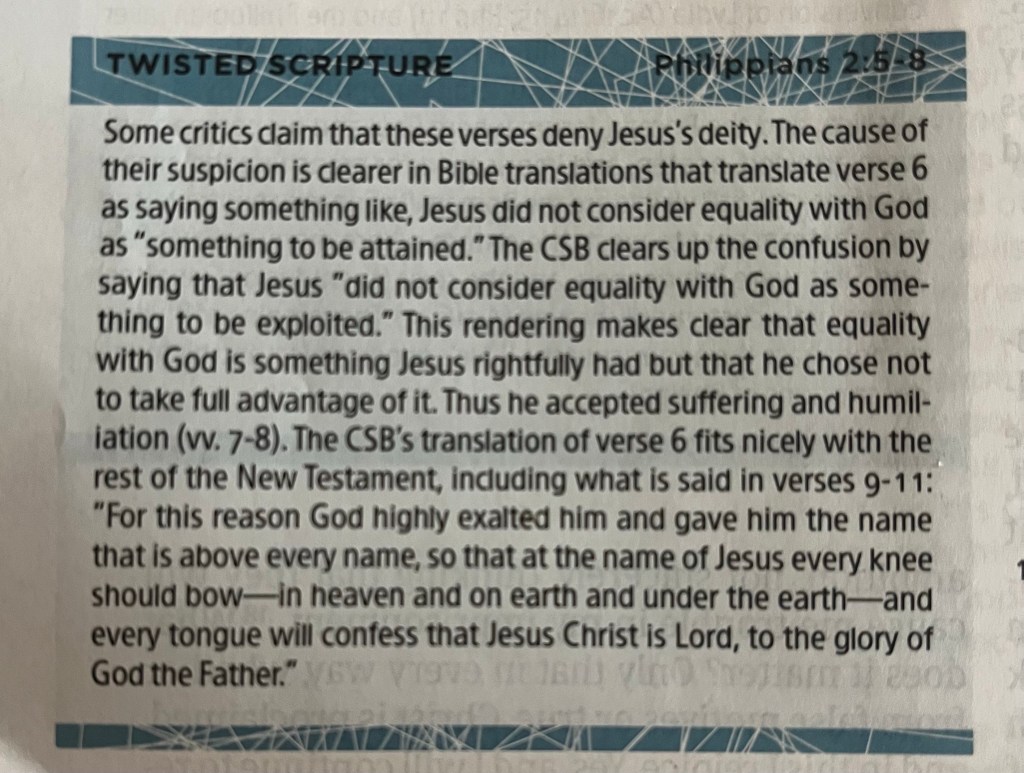
    “Twisted Scripture” section of the CSB Apologetics Study Bible by Sean McDowell

    Biblegateway (CSB):

    If, then, there is any encouragement in Christ, if any consolation of love, if any fellowship with the Spirit, if any affection and mercy, make my joy complete by thinking the same way, having the same love, united in spirit, intent on one purpose. Do nothing out of selfish ambition or conceit, but in humilityconsider others as more important than yourselves. Everyone should look not to his own interests, but rather to the interests of others.

    Adopt the same attitude as that of Christ Jesus,

    who, existing in the form of God,
    did not consider equality with God
    as something to be exploited.[a]
    Instead he emptied himself
    by assuming the form of a servant,
    taking on the likeness of humanity.
    And when he had come as a man,
    he humbled himself by becoming obedient
    to the point of death—
    even to death on a cross.
    For this reason God highly exalted him
    and gave him the name
    that is above every name,
    10 so that at the name of Jesus
    every knee will bow—
    in heaven and on earth
    and under the earth—
    11 and every tongue will confess
    that Jesus Christ is Lord,
    to the glory of God the Father.

    12 Therefore, my dear friends, just as you have always obeyed, so now, not only in my presence but even more in my absence, work out your own salvation with fear and trembling. 13 For it is God who is working in you both to will and to work according to his good purpose. 14 Do everything without grumbling and arguing, 15 so that you may be blameless and pure, children of God who are faultless in a crooked and pervertedgeneration, among whom you shine like stars in the world, 16 by holding firm to the word of life. Then I can boast in the day of Christ that I didn’t run or labor for nothing. 17 But even if I am poured out as a drink offering on the sacrificial service of your faith, I am glad and rejoice with all of you. 18 In the same way you should also be glad and rejoice with me.

    19 Now I hope in the Lord Jesus to send Timothy to you soon so that I too may be encouraged by news about you. 20 For I have no one else like-minded who will genuinely care about your interests; 21 all seek their own interests, not those of Jesus Christ. 22 But you know his proven character, because he has served with me in the gospel ministry like a son with a father. 23 Therefore, I hope to send him as soon as I see how things go with me. 24 I am confident in the Lord that I myself will also come soon.25 But I considered it necessary to send you Epaphroditus—my brother, coworker, and fellow soldier, as well as your messenger and minister to my need— 26 since he has been longing for all of you and was distressed because you heard that he was sick. 27 Indeed, he was so sick that he nearly died. However, God had mercy on him, and not only on him but also on me, so that I would not have sorrow upon sorrow. 28 For this reason, I am very eager to send him so that you may rejoice again when you see him and I may be less anxious. 29 Therefore, welcome him in the Lord with great joy and hold people like him in honor, 30 because he came close to death for the work of Christ, risking his life to make up what was lacking in your ministry to me.Footnotes2:6 Or to be grasped, or to be held on

  • To preface, friends, please always check what I say and write by Scripture…It’s so important that we test what is taught by anyone alongside the straightedge of God’s Word.

    Prior to “being made alive together with Christ” (Eph 2:5), we were spiritually dead (separated from God)…disobedient to God, carrying out the desires of our fallenness. We were consumed with self-interest, self-love, and anything that will accomplish either of those. Tragically, the sin within us viewed others as either stepping stones to a pleasurable life, or hindrances. This heart-level perspective and sin-stained attitude affects our spouses and children as well.

    But when the grace of God saved us from our sins through the work of His Son on the cross, we were given new life. This new life is Jesus’s life. This life enables us to know love for the very first time! The faithful, selfless, and committed love shared by God the Father, God the Son, and God the Holy Spirit is now shared with us. This gift of new life and new love also gives us new eyes to see others as made in the image of God. We love others not because they are likable or lovely, nor for the possibility that they can help us fulfill our longings, but because we have been shown both in Scripture and through prayer that God’s great mercy and loving Justice puts the interests of others at the forefront.

    Putting others ahead is what Jesus modeled when He came down. Jesus remained fully God when He became fully human, but He didn’t go rogue from the Father and place His own interests ahead of His Father. Love looks to God’s will as paramount. And obedience to God’s plans makes God’s priorities our priority. Trusting Jesus walks-out love step by step.

    When we love others, we voluntarily place their interests ahead of our own. This doesn’t necessarily mean that we ignore our own needs, nor does it imply that our needs don’t matter. But putting the interests of others ahead of our own demonstrates a practical trust in the everyday events of life…knowing that God knows our desires, concerns, and hopes, and that He will do what’s best. We can trust God with everything we are and have…because we are His, and everything we have is His. Our homes, our spouses, and our children, too.

    “Difficult doesn’t mean wrong. Difficult reminds us that we need a Savior.”

    As we look to the interests of one another today, let’s remember that the “one another” isn’t speaking solely to those outside of our homes. We must fight to choose the Words of God ahead of those in society by remembering that family is our primary mission field. It’s not individual expressionism that rules our lives, nor is it comfort and entertainment. God alone rules. Choosing to serve God instead of self isn’t easy, but difficult doesn’t mean wrong. Difficult reminds us that we need a Savior. And that Savior came and lived a life we aren’t able to live.He died a death we deserved to die. And rose to life bodily as to give us that opportunity.

    “Family is our primary mission field.”

    Philippians 2

    Per the ESV Study Bible, Paul wrote the letter to the Philippian Church around A.D. 62, with the hope and prayer to “encourage the Philippians to live out their lives as citizens of a heavenly colony, as evidenced by a growing commitment to service to God and one another.”

    BibleGateway (NET)

    Therefore, if there is any encouragement in Christ, any comfort provided by love, any fellowship in the Spirit,[a] any affection or mercy,[b] 2 complete my joy and be of the same mind,[c] by having the same love, being united in spirit,[d] and having one purpose. 3 Instead of being motivated by selfish ambition[e] or vanity, each of you should, in humility, be moved to treat one another as more important than yourself. 4 Each of you should be concerned[f] not only[g] about your own interests, but about the interests of others as well.[h] 5 You should have the same attitude toward one another that Christ Jesus had,[i]

    [j] who though he existed in the form of God[k]
    did not regard equality with God
    as something to be grasped,
    but emptied himself
    by taking on the form of a slave,[l]
    by looking like other men,[m]
    and by sharing in human nature.[n]
    He humbled himself,
    by becoming obedient to the point of death
    —even death on a cross!
    As a result God highly exalted him
    and gave him the name
    that is above every name,
    10 so that at the name of Jesus
    every knee will bow
    —in heaven and on earth and under the earth—
    11 and every tongue confess
    that Jesus Christ is Lord
    to the glory of God the Father.

    12 So then, my dear friends, just as you have always obeyed, not only in my presence but even more in my absence, continue working out your salvation with awe and reverence,[o]13 for the one bringing forth in you both the desire and the effort—for the sake of his good pleasure—is God. 14 Do everything without grumbling or arguing, 15 so that you may be blameless and pure, children of God without blemish though you live in a crooked and perverse society, in which you shine as lights in the world[p] 16 by holding on to[q] the word of life so that on the day of Christ I will have a reason to boast that I did not run in vain nor labor in vain. 17 But even if I am being poured out like a drink offering on the sacrifice and service of your faith, I am glad and rejoice together with all of you. 18 And in the same way you also should be glad and rejoice together with me.

    19 Now I hope in the Lord Jesus to send Timothy to you soon, so that I too may be encouraged by hearing news about you. 20 For there is no one here like him who will readily demonstrate his deep concern for you.[r]21 Others are busy with their own concerns, not those of Jesus Christ. 22 But you know his qualifications, that like a son working with his father, he served with me in advancing the gospel. 23 So I hope to send him as soon as I know more about my situation, 24 though I am confident in the Lord that I too will be coming to see you[s] soon.

    25 But for now[t] I have considered it necessary to send Epaphroditus to you. For he is my brother,[u] coworker and fellow soldier, and your messenger[v] and minister[w] to me in my need.[x] 26 Indeed, he greatly missed all of you and was distressed because you heard that he had been ill. 27 In fact he became so ill that he nearly died.[y] But God showed mercy to him—and not to him only, but also to me—so that I would not have grief on top of grief. 28 Therefore I am all the more eager to send him,[z] so that when you see him again you can rejoice[aa] and I can be free from anxiety. 29 So welcome him in the Lord with great joy, and honor people like him, 30 since it was because of the work of Christ that he almost died. He risked his life so that he could make up for your inability to serve me.[ab]

    Footnotes

    1. Philippians 2:1 tn Or “spiritual fellowship” if πνεύματος (pneumatos) is an attributive genitive; or “fellowship brought about by the Spirit” if πνεύματος is a genitive of source or production.
    2. Philippians 2:1 tn Grk “affection and mercy.” The Greek idea, however, is best expressed by “or” in English.
    3. Philippians 2:2 tn Or “and feel the same way,” “and think the same thoughts.” The ἵνα (hina) clause has been translated “and be of the same mind” to reflect its epexegetical force to the imperative “complete my joy.”
    4. Philippians 2:2 tn The Greek word here is σύμψυχοι (sumpsuchoi, literally “fellow souled”).
    5. Philippians 2:3 tn Grk “not according to selfish ambition.” There is no main verb in this verse; the subjunctive φρονῆτε(phronēte, “be of the same mind”) is implied here as well. Thus, although most translations supply the verb “do” at the beginning of v. 3 (e.g., “do nothing from selfish ambition”), the idea is even stronger than that: “Don’t even think any thoughts motivated by selfish ambition.”
    6. Philippians 2:4 tn On the meaning “be concerned about” for σκοπέω (skopeō), see L&N 27.36.
    7. Philippians 2:4 tn The word “only” is not in the Greek text, but is implied by the ἀλλὰ καί (alla kai) in the second clause (“but…as well”).
    8. Philippians 2:4 tc The bulk of the Western witnesses (D*,c F G K it) dropped καί (kai) here, most likely due to ascetic concerns (the absence of the καί makes the statement express absolute self-denial). Strong external attestation for its inclusion from excellent witnesses as well as the majority (P46 א A B C D1 Ψ 075 0278 33 11751241 1505 1739 1881 2464 M sy) also marks it as autographic.tn Verses 1-4constitute one long conditional sentence in Greek. The protasis is in verse 1, while vv. 2-4 constitute the apodosis. There is but one verb not in a subordinate clause in vv. 2-4, the imperative “complete” in v. 2. This is followed by a subjunctive after ἵνα (hina, translated as an epexegetical clause, “and be of the same mind”) and three instrumental participles. Thus the focus of these four verses is to “be of the same mind” and all that follows this instruction is the means for accomplishing that.
    9. Philippians 2:5 tn Grk “Have this attitude in/among yourselves which also [was] in Christ Jesus,” or “Have this attitude in/among yourselves which [you] also [have] in Christ Jesus.”
    10. Philippians 2:6 sn This passage has been typeset as poetry because many scholars regard this passage as poetic or hymnic. These terms are used broadly to refer to the genre of writing, not to the content. There are two broad criteria for determining if a passage is poetic or hymnic: “(a) stylistic: a certain rhythmical lilt when the passages are read aloud, the presence of parallelismus membrorum (i.e., an arrangement into couplets), the semblance of some metre, and the presence of rhetorical devices such as alliteration, chiasmus, and antithesis; and (b) linguistic:an unusual vocabulary, particularly the presence of theological terms, which is different from the surrounding context” (P. T. O’Brien, Philippians [NIGTC], 188-89). Classifying a passage as hymnic or poetic is important because understanding this genre can provide keys to interpretation. However, not all scholars agree that the above criteria are present in this passage, so the decision to typeset it as poetry should be viewed as a tentative decision about its genre.
    11. Philippians 2:6 sn The Greek term translated form indicates a correspondence with reality. Thus the meaning of this phrase is that Christ was truly God.
    12. Philippians 2:7 tn See the note on the word “slaves” in 1:1.
    13. Philippians 2:7 tn Grk “by coming in the likeness of people.”sn The Greek expression underlying by looking like other men is similar to Paul’s wording in Rom 8:3(“in the likeness of sinful flesh”). The same word “likeness” is used in both passages. It implies that there is a form that does not necessarily correspond to reality. In Rom 8:3, the meaning is that Christ looked likesinful humanity. Here the meaning is similar: Jesus looked like other men (note anthrōpoi), but was in fact different from them in that he did not have a sin nature.
    14. Philippians 2:7 tn Grk “and by being found in form as a man.” The versification of vv. 7and 8 (so also NRSV) is according to the versification in the NA28 and UBS5 editions of the Greek text. Some translations, however, break the verses in front of this phrase (NKJV, NASB, NIV, NLT). The same material has been translated in each case; the only difference is the versification of that material.sn By sharing in human nature. This last line of v. 7 (line d) stands in tension with the previous line, line c (“by looking like other men”). Both lines have a word indicating form or likeness. Line c, as noted above, implies that Christ only appeared to be like other people. Line d, however, uses a different term that implies a correspondence between form and reality. Further, line c uses the plural “men” while line d uses the singular “man.” The theological point being made is that Christ looked just like other men, but he was not like other men (in that he was not sinful), though he was fully human.
    15. Philippians 2:12 tn Grk “with fear and trembling.” The Greek words φόβος and τρόμος both imply fear in a negative sense (L&N 25.251 and 16.6 respectively) while the former can also refer to respect and awe for deity (L&N 53.59). Paul’s use of the terms in other contexts refers to “awe and reverence in the presence of God” (P. T. O’Brien, Philippians [NIGTC], 284; see discussion on 282-84). The translation “awe and reverence” was chosen to portray the attitude the believer should have toward God as they consider their behavior in light of God working through Jesus Christ (2:6-11) and in the believer’s life (2:13) to accomplish their salvation.
    16. Philippians 2:15 tn Or “as stars in the universe.”
    17. Philippians 2:16 tn Or “holding out, holding forth.”
    18. Philippians 2:20 tn Grk “For I have no one who is like-minded who will genuinely be concerned for your welfare.”
    19. Philippians 2:24 tn The words “to see you” are not in the Greek text, but are implied, and are supplied in the translation for clarity.
    20. Philippians 2:25 tn Grk “But.” The temporal notion (“for now”) is implied in the epistolary aorist (“I have considered”), for Epaphroditus was dispatched with this letter to the Philippians.
    21. Philippians 2:25 tn Grk “my brother” instead of “For he is my brother.” Verse 25constitutes one sentence in Greek, with “my brother…” functioning appositionally to “Epaphroditus.” sn The reason why Paul refers to Epaphroditus as his brothercoworkerfellow soldier, etc., is because he wants to build up Epaphroditus in the eyes of the Philippians, since Paul is sending him back instead of Timothy. This accent on Epaphroditus’ character and service is implied in the translation “For he is…
    22. Philippians 2:25 tn Grk “apostle.”
    23. Philippians 2:25 tn The Greek word translated “minister” here is λειτουργός(leitourgos).
    24. Philippians 2:25 tn Grk “servant of my need.”
    25. Philippians 2:27 tn Grk “For he became ill to the point of death.”
    26. Philippians 2:28 tn Grk “I have sent him to you with earnestness.” But the epistolary aorist needs to be translated as a present tense with this adverb due to English stylistic considerations.
    27. Philippians 2:28 tn Or “when you see him you can rejoice again.”
    28. Philippians 2:30 tn Grk “make up for your lack of service to 
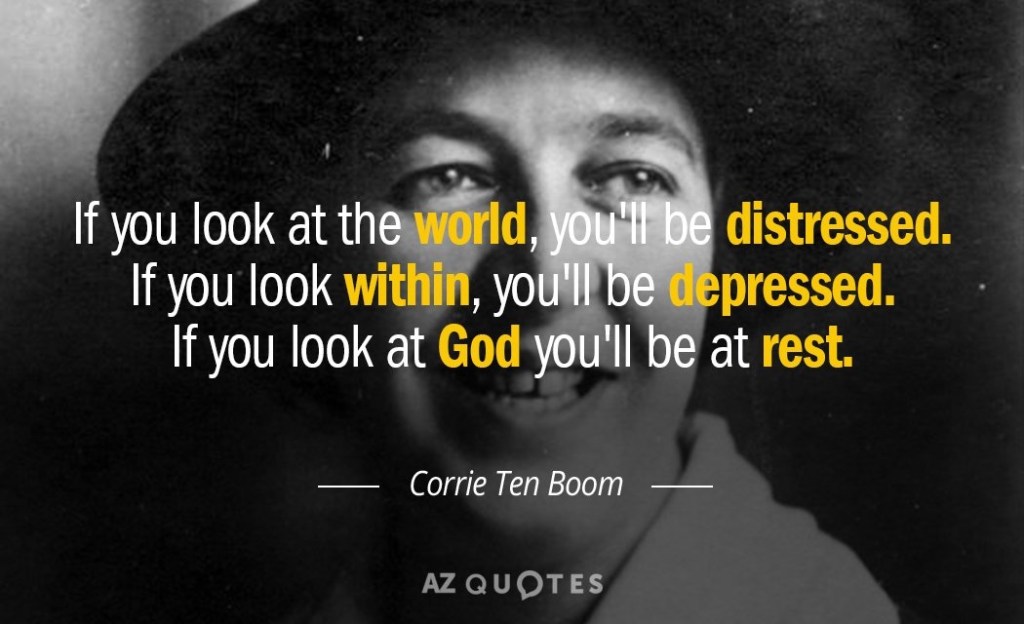
  • “If you look at the world, you’ll be distressed. If you look within, you’ll be depressed. If you look at God you’ll be at rest.” – Corrie Ten Boom

    While the world beckons us to look within, saying “You’ve got this!” Corrie knew that by looking within for strength and guidance was a bewildering journey. Brokenness attempting to fix brokenness.

    And if I’m incredibly vulnerable, at the core of my own humanity, I am straight-up all about me…self-centered and care about whatever makes me comfortable and happy. But God. He genuinely saved me from that hopeless (and futile) pit, showing me a love that isn’t found within but from Him alone (Ps 40).

    Friends, it’s not by looking within, or to the culture, that we find the love and worth for which so desperately long. We were created as personal and rational beings to have a relationship with our Creator. We were made human, not as God,…but we long to know the One who Created us.

    As Easter approaches, my prayer is that we all slow down and think upon these deeply important matters.

    🎞️ Corrie Ten Boom’s, The Hiding Place (click here)

    Psalm 42

    As a deer pants for flowing streams,
        so pants my soul for you, O God.
    My soul thirsts for God,
        for the living God.
    When shall I come and appear before God?
    My tears have been my food
        day and night,
    while they say to me all the day long,
        “Where is your God?”
    These things I remember,
        as I pour out my soul:
    how I would go with the throng
        and lead them in procession to the house of God
    with glad shouts and songs of praise,
        a multitude keeping festival.

    Why are you cast down, O my soul,
        and why are you in turmoil within me?
    Hope in God; for I shall again praise him,
        my salvation and my God.

    My soul is cast down within me;
        therefore I remember you
    from the land of Jordan and of Hermon,
        from Mount Mizar.
    Deep calls to deep
        at the roar of your waterfalls;
    all your breakers and your waves
        have gone over me.
    By day the Lord commands his steadfast love,
        and at night his song is with me,
        a prayer to the God of my life.
    I say to God, my rock:
        “Why have you forgotten me?
    Why do I go mourning
        because of the oppression of the enemy?”
    10 As with a deadly wound in my bones,
        my adversaries taunt me,
    while they say to me all the day long,
        “Where is your God?”

    11 Why are you cast down, O my soul,
    and why are you in turmoil within me?
    Hope in God; for I shall again praise him,
    my salvation and my God.

  • Written by Women in Apologetics and can be found on Facebook and Instagram.

    Author: Meridith Black

    March 7, 2023

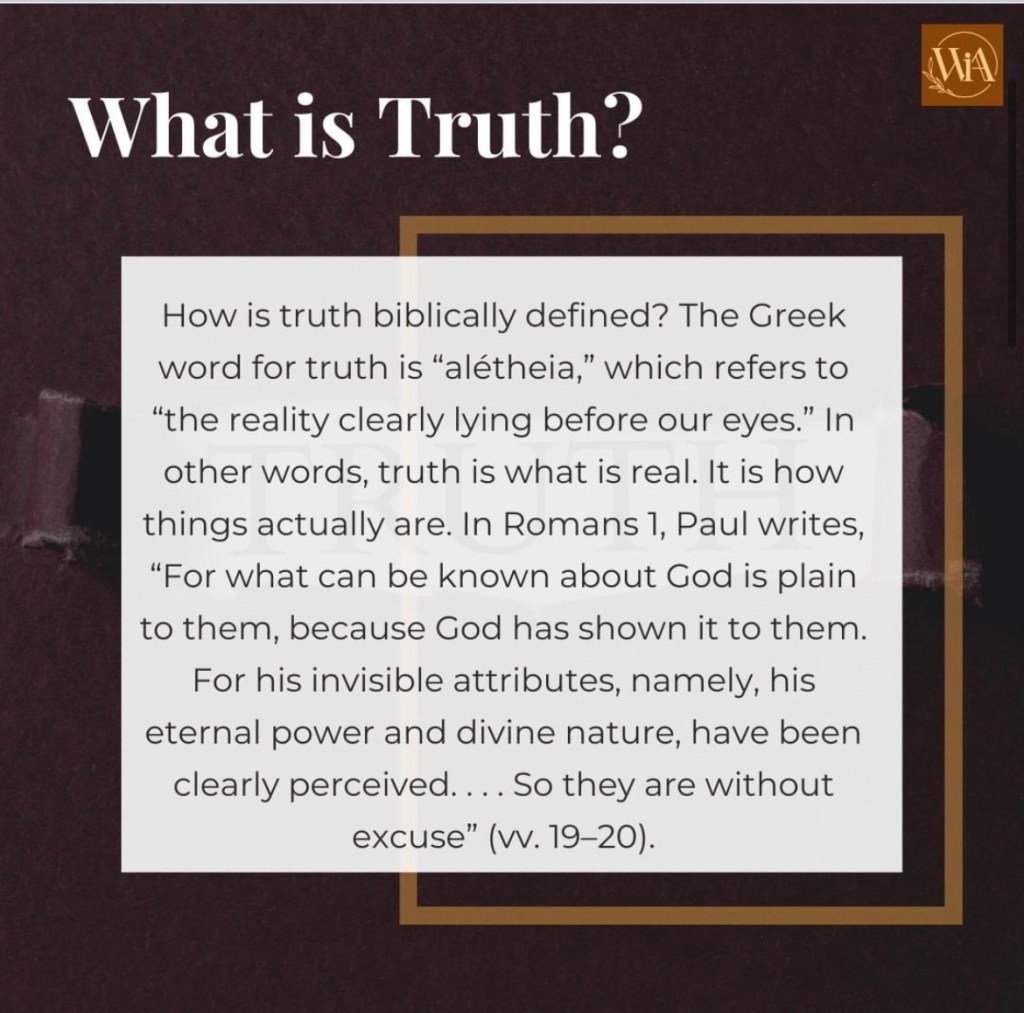
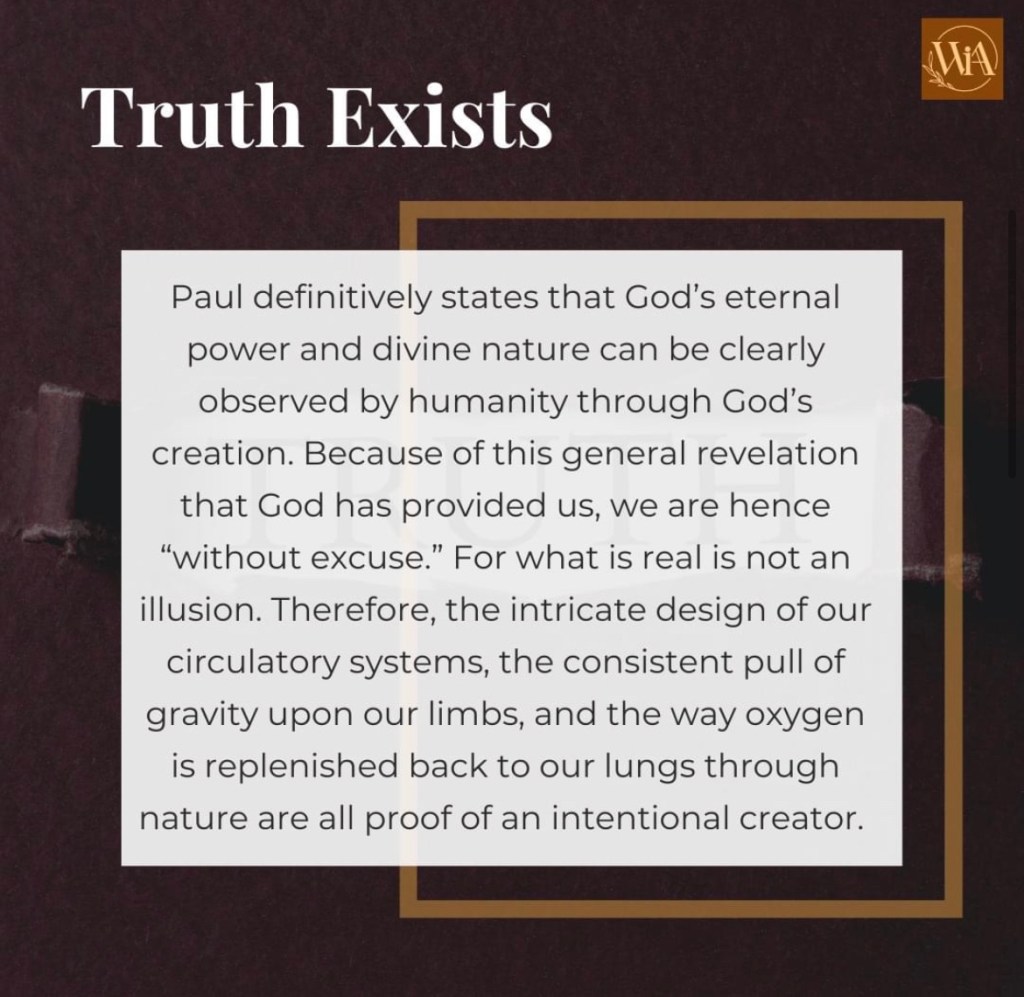
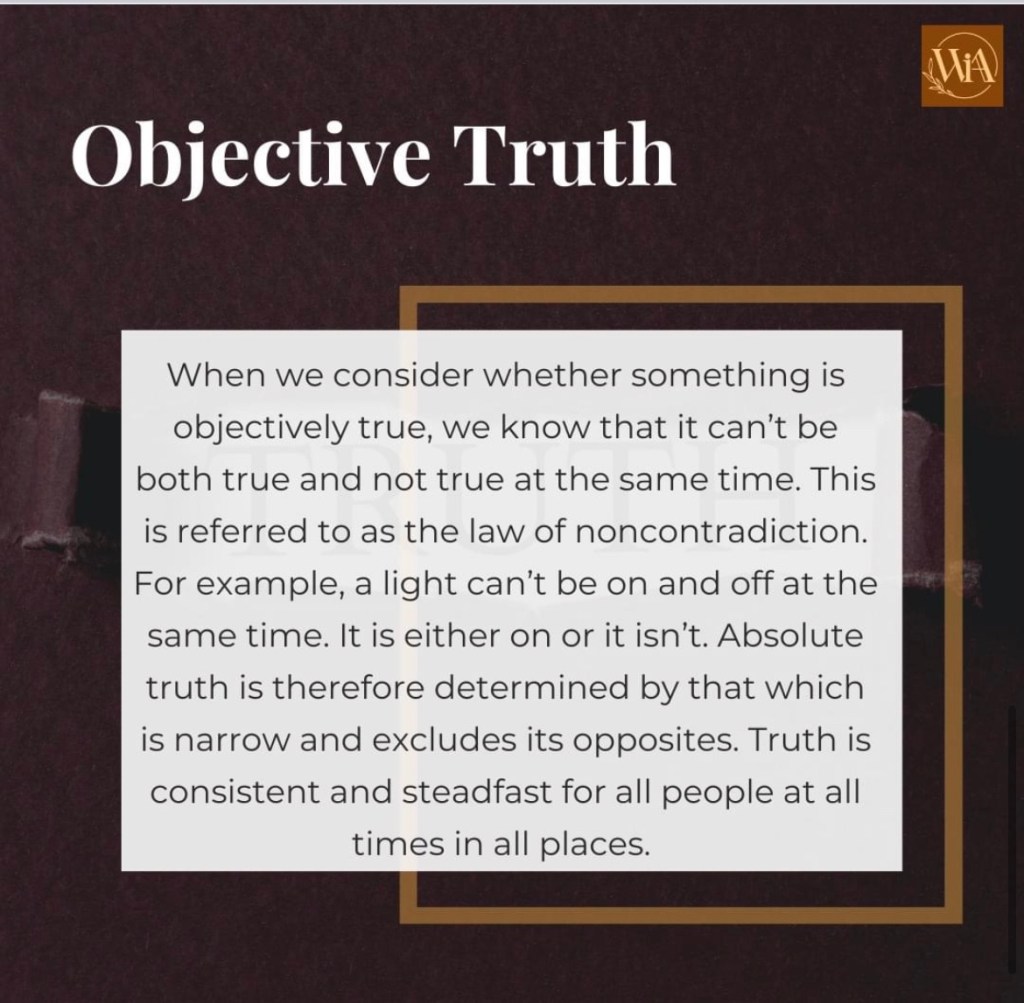
    “The Christian worldview isn’t limited only to Sunday morning, but instead encompasses all of life. As Francis Schaeffer said, ‘Christianity is not a series of truths in the plural, but rather truth spelled with a capital “T.” Truth about total reality.’ The world believes in a relativistic view of truth, where ‘you do you’ supersedes objective truth for all. Let’s tackle the common claim that Christianity is a worldview/religion that works for some people, but isn’t the truth/reality for all.”

    📍References:

    1. Steven Lawson. “What Is Truth?” Ligonier Ministries, September 1, 2010.
      https://lnkd.in/g2B5j2NA.
    2. J. Warner Wallace. “Celebrate Christmas with Your Kids, Because They Already Believe in God.” Cold Case Christianity, December 9, 2022. https://lnkd.in/gbSz8Xyx.

    📍Additional Resources:
    📕Relativism: Feet Firmly Planted in Mid-Air by Francis J. Beckwith and Gregory Koukl

    📕Live Your Truth and Other Lies: Exposing Popular Deceptions That Make Us Anxious, Exhausted, and Self-Obsessed by Alisa Childers

    📕Total Truth by Nancy Pearcey
    📕Finding Truth by Nancy Pearcey

  • “Jesus himself did not make a distinction between his authority and the authority of the written Scriptures. He acted upon the unity of his authority in the content of the Scriptures.”

    Francis Schaeffer’s Escape from Reason 📕

    *Jesus quoted the Old Testament often, proclaiming it to be the Word of God.

    *Jesus both taught the Scriptures and lived according to the Scriptures.

    *Jesus also pointed to himself within the Scriptures (Luke 24:44-48).

    Luke 24

    But on the first day of the week, at early dawn, they went to the tomb, taking the spices they had prepared. And they found the stone rolled away from the tomb, but when they went in they did not find the body of the Lord Jesus. While they were perplexed about this, behold, two men stood by them in dazzling apparel. And as they were frightened and bowed their faces to the ground, the men said to them, “Why do you seek the living among the dead? He is not here, but has risen. Remember how he told you, while he was still in Galilee, that the Son of Man must be delivered into the hands of sinful men and be crucified and on the third day rise.” And they remembered his words,and returning from the tomb they told all these things to the eleven and to all the rest.10 Now it was Mary Magdalene and Joanna and Mary the mother of James and the other women with them who told these things to the apostles, 11 but these words seemed to them an idle tale, and they did not believe them.12 But Peter rose and ran to the tomb; stooping and looking in, he saw the linen cloths by themselves; and he went home marveling at what had happened.

    13 That very day two of them were going to a village named Emmaus, about seven milesfrom Jerusalem, 14 and they were talking with each other about all these things that had happened. 15 While they were talking and discussing together, Jesus himself drew near and went with them. 16 But their eyes were kept from recognizing him. 17 And he said to them, “What is this conversation that you are holding with each other as you walk?” And they stood still, looking sad. 18 Then one of them, named Cleopas, answered him, “Are you the only visitor to Jerusalem who does not know the things that have happened there in these days?” 19 And he said to them, “What things?” And they said to him, “Concerning Jesus of Nazareth, a man who was a prophet mighty in deed and word before God and all the people, 20 and how our chief priests and rulers delivered him up to be condemned to death, and crucified him. 21 But we had hoped that he was the one to redeem Israel. Yes, and besides all this, it is now the third day since these things happened. 22 Moreover, some women of our company amazed us. They were at the tomb early in the morning, 23 and when they did not find his body, they came back saying that they had even seen a vision of angels, who said that he was alive. 24 Some of those who were with us went to the tomb and found it just as the women had said, but him they did not see.” 25 And he said to them, “O foolish ones, and slow of heart to believe all that the prophets have spoken! 26 Was it not necessary that the Christ should suffer these things and enter into his glory?” 27 And beginning with Moses and all the Prophets, he interpreted to them in all the Scriptures the things concerning himself.

    28 So they drew near to the village to which they were going. He acted as if he were going farther, 29 but they urged him strongly, saying, “Stay with us, for it is toward evening and the day is now far spent.” So he went in to stay with them. 30 When he was at table with them, he took the bread and blessed and broke it and gave it to them. 31 And their eyes were opened, and they recognized him. And he vanished from their sight. 32 They said to each other, “Did not our hearts burn within us while he talked to us on the road, while he opened to us the Scriptures?” 33 And they rose that same hour and returned to Jerusalem. And they found the eleven and those who were with them gathered together, 34 saying, “The Lord has risen indeed, and has appeared to Simon!” 35 Then they told what had happened on the road, and how he was known to them in the breaking of the bread.

    36 As they were talking about these things, Jesus himself stood among them, and said to them, “Peace to you!” 37 But they were startled and frightened and thought they saw a spirit. 38 And he said to them, “Why are you troubled, and why do doubts arise in your hearts? 39 See my hands and my feet, that it is I myself. Touch me, and see. For a spirit does not have flesh and bones as you see that I have.” 40 And when he had said this, he showed them his hands and his feet. 41 And while they still disbelieved for joy and were marveling, he said to them, “Have you anything here to eat?” 42 They gave him a piece of broiled fish, 43 and he took it and ate before them.

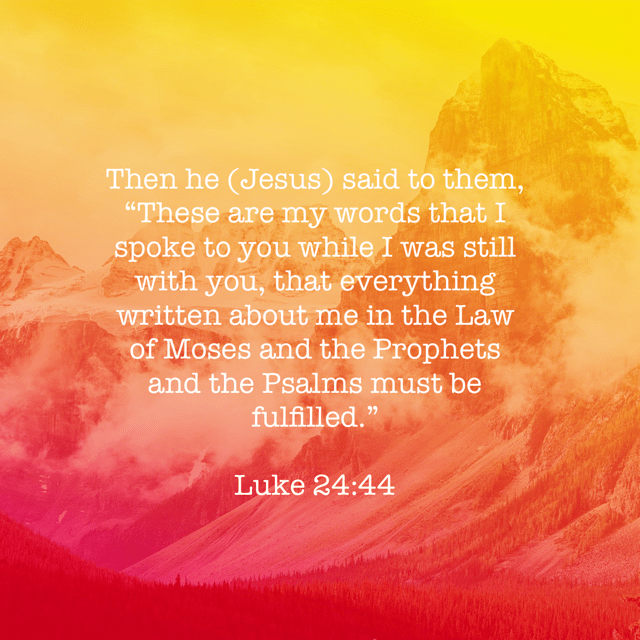
    44 Then he said to them, “These are my words that I spoke to you while I was still with you, that everything written about me in the Law of Moses and the Prophets and the Psalms must be fulfilled.” 45 Then he opened their minds to understand the Scriptures, 46 and said to them, “Thus it is written, that the Christ should suffer and on the third day rise from the dead, 47 and that repentance for the forgiveness of sins should be proclaimed in his name to all nations, beginning from Jerusalem. 48 You are witnesses of these things. 49 And behold, I am sending the promise of my Father upon you. But stay in the city until you are clothed with power from on high.”

    50 And he led them out as far as Bethany, and lifting up his hands he blessed them. 51 While he blessed them, he parted from them and was carried up into heaven. 52 And they worshiped him and returned to Jerusalem with great joy, 53 and were continually in the temple blessing God.

  • Friends, a great deal of what Paul had written to churches (New Testament letters) was pertaining to false teachers. He was alerting these believers because he loved God, and wanted these fledgling churches to know the truth. And while this topic is certainly not uplifting, it is both kind and necessary to discuss.

    💡Hypothetical: If you knew there was ginormous pothole near your home, and that it was nearly impossible to see at night, wouldn’t you warn your loved ones before they visit? Definitely! Remember, your warning them isn’t unloving. It’s HOW you warn them that can be either hurtful or helpful. We need to be gentle and respectful with these alerts.

    Here are two scriptural examples:

    🔍”…stay there in Ephesus so that you may command certain men not to teach false doctrines any longer nor devote themselves to myths and endless genealogies. These promote controversies rather than God’s work–which is by faith. The goal of this command is love, which comes from a pure heart and a good conscience and a sincere faith. Some have wandered away from these and turned to meaningless talk. They want to be teachers of the law, but they do not know what they are talking about our what they so confidently affirm.” 1 Timothy 1:3-7

    🔍”I appeal to you, brothers, to watch out for those who cause divisions and create obstacles contrary to the doctrine that you have been taught; avoid them. For such persons do not serve our Lord Christ, but their own appetites,[f] and by smooth talk and flattery they deceive the hearts of the naive.” Romans 16:17-18

    ⬇️Below is a 15-minute podcast by authors and Christian apologists, Natasha Crain and Alisa Childers, called “Unshaken Faith Podcast.” This particular episode discusses why “Calling Out False Teachers” is a necessity. Also included with the podcast is a link to Frank Turek’s article addresses the same topic: article. These are wonderful resources addressing the real issue of false teaching.

    #57 John Mark Comer's Practicing the Way: Serious Theological Concerns Unshaken Faith

    In this episode of Unshaken Faith, we take a careful, biblical look at Practicing the Way by John Mark Comer, a book that has quickly gained popularity in Christian discipleship and spiritual formation circles. Many listeners have asked whether we recommend it and after a thorough review, the answer is no. We walk through the book’s core framework, its view of spiritual formation, and how it defines discipleship and transformation. While some of the practices it encourages may sound helpful on the surface, we found deeper theological concerns underneath including influences that overlap with contemplative spirituality, charismatic/NAR-style formation models, progressive-leaning theology, and sacramental or mystical streams more commonly associated with Eastern Orthodox and Roman Catholic spirituality.Most importantly, we evaluate the book’s message against the biblical gospel. Does it clearly present salvation by grace through faith? Does it ground transformation in the finished work of Christ or shift the center toward practices and processes? We explain where we believe the message drifts and why that matters for everyday Christians.Our goal is not to attack people, but to equip believers with discernment. We encourage you to think biblically, test everything against Scripture, and stay rooted in the true gospel.If this book has been recommended to you, or if you’re already reading it, this episode will help you evaluate it through a clear theological lens.Consider the Lillies, by Johnny ArdavanisHappy Lies, by Melissa DoughertyAlisa's video on generational curses
    1. #57 John Mark Comer's Practicing the Way: Serious Theological Concerns
    2. #56 Christmas Livestream + How Progressive Christians Read the Bible Through the Wrong Lens
    3. #55 Awake… or Deceived? Inside Jen Hatmaker’s New Gospel
    4. #54 6 Ways Charlie Kirk Should Inspire Unshaken Faith
    5. #53 Post-Election Thoughts

    Frank Turek’s article, “He Gets Us, but Do We Get Him? The Case for Criticizing False Teachers”


  • John 14 shared by Biblegateway

    I Am the Way, and the Truth, and the Life

    14 “Let not your hearts be troubled. Believe in God;[a] believe also in me. In my Father’s house are many rooms. If it were not so, would I have told you that I go to prepare a place for you?[b] And if I go and prepare a place for you, I will come again and will take you to myself, that where I am you may be also. And you know the way to where I am going.”[c]Thomas said to him, “Lord, we do not know where you are going. How can we know the way?” Jesus said to him, “I am the way, and the truth, and the life. No one comes to the Father except through me. If you had known me, you would have known my Father also.[d]From now on you do know him and have seen him.”

    Philip said to him, “Lord, show us the Father, and it is enough for us.” Jesus said to him, “Have I been with you so long, and you still do not know me, Philip? Whoever has seen me has seen the Father. How can you say, ‘Show us the Father’? 10 Do you not believe that I am in the Father and the Father is in me? The words that I say to you I do not speak on my own authority, but the Father who dwells in me does his works. 11 Believe me that I am in the Father and the Father is in me, or else believe on account of the works themselves.

    12 “Truly, truly, I say to you, whoever believes in me will also do the works that I do; and greater works than these will he do, because I am going to the Father. 13 Whatever you ask in my name, this I will do, that the Father may be glorified in the Son. 14 If you ask me[e] anything in my name, I will do it.

    Jesus Promises the Holy Spirit

    15 “If you love me, you will keep my commandments. 16 And I will ask the Father, and he will give you another Helper,[f] to be with you forever, 17 even the Spirit of truth, whom the world cannot receive, because it neither sees him nor knows him. You know him, for he dwells with you and will be[g] in you.

    18 “I will not leave you as orphans; I will come to you. 19 Yet a little while and the world will see me no more, but you will see me. Because I live, you also will live. 20 In that day you will know that I am in my Father, and you in me, and I in you. 21 Whoever has my commandments and keeps them, he it is who loves me. And he who loves me will be loved by my Father, and I will love him and manifest myself to him.” 22 Judas (not Iscariot) said to him, “Lord, how is it that you will manifest yourself to us, and not to the world?” 23 Jesus answered him, “If anyone loves me, he will keep my word, and my Father will love him, and we will come to him and make our home with him. 24 Whoever does not love me does not keep my words. And the word that you hear is not mine but the Father’s who sent me.

    25 “These things I have spoken to you while I am still with you. 26 But the Helper, the Holy Spirit, whom the Father will send in my name, he will teach you all things and bring to your remembrance all that I have said to you.27 Peace I leave with you; my peace I give to you. Not as the world gives do I give to you. Let not your hearts be troubled, neither let them be afraid. 28 You heard me say to you, ‘I am going away, and I will come to you.’ If you loved me, you would have rejoiced, because I am going to the Father, for the Father is greater than I. 29 And now I have told you before it takes place, so that when it does take place you may believe. 30 I will no longer talk much with you, for the ruler of this world is coming. He has no claim on me, 31 but I do as the Father has commanded me, so that the world may know that I love the Father. Rise, let us go from here.

    Footnotes

    1. John 14:1 Or You believe in God
    2. John 14:2 Or In my Father’s house are many rooms; if it were not so, I would have told you; for I go to prepare a place for you
    3. John 14:4 Some manuscripts Where I am going you know, and the way you know
    4. John 14:7 Or If you know me, you will know my Father also, or If you have known me, you will know my Father also
    5. John 14:14 Some manuscripts omit me
    6. John 14:16 Or Advocate, or Counselor; also 14:2615:2616:7
    7. John 14:17 Some manuscripts and is
  • God’s eternal plan to save a condemned world is sovereignly detailed throughout every book and letter of the Bible…all 66.

    This phenomenal 10-minute message by pastor Tim Keller shares how the historical events documented in Exodus show us the gospel of God (good news).

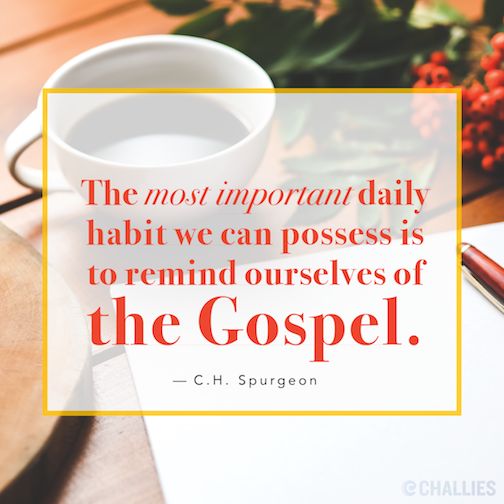
    As Charles Spurgeon once said, “Visit many good books but live in the Bible.” Friends, need God’s Word more than any other words.

    Click here to read Exodus.

    Exodus 1

    Israel Increases Greatly in Egypt

    These are the names of the sons of Israel who came to Egypt with Jacob, each with his household: Reuben, Simeon, Levi, and Judah, Issachar, Zebulun, and Benjamin, Dan and Naphtali, Gad and Asher. All the descendants of Jacob were seventy persons; Joseph was already in Egypt. Then Joseph died, and all his brothers and all that generation. But the people of Israel were fruitful and increased greatly; they multiplied and grew exceedingly strong, so that the land was filled with them.

    Pharaoh Oppresses Israel

    Now there arose a new king over Egypt, who did not know Joseph. And he said to his people, “Behold, the people of Israel are too many and too mighty for us. 10 Come, let us deal shrewdly with them, lest they multiply, and, if war breaks out, they join our enemies and fight against us and escape from the land.” 11 Therefore they set taskmasters over them to afflict them with heavy burdens. They built for Pharaoh store cities, Pithom and Raamses. 12 But the more they were oppressed, the more they multiplied and the more they spread abroad. And the Egyptians were in dread of the people of Israel. 13 So they ruthlessly made the people of Israel work as slaves 14 and made their lives bitter with hard service, in mortar and brick, and in all kinds of work in the field. In all their work they ruthlessly made them work as slaves.

    15 Then the king of Egypt said to the Hebrew midwives, one of whom was named Shiphrah and the other Puah, 16 “When you serve as midwife to the Hebrew women and see them on the birthstool, if it is a son, you shall kill him, but if it is a daughter, she shall live.” 17 But the midwives feared God and did not do as the king of Egypt commanded them, but let the male children live. 18 So the king of Egypt called the midwives and said to them, “Why have you done this, and let the male children live?” 19 The midwives said to Pharaoh, “Because the Hebrew women are not like the Egyptian women, for they are vigorous and give birth before the midwife comes to them.” 20 So God dealt well with the midwives. And the people multiplied and grew very strong. 21 And because the midwives feared God, he gave them families. 22 Then Pharaoh commanded all his people, “Every son that is born to the Hebrews[a] you shall cast into the Nile, but you shall let every daughter live.”


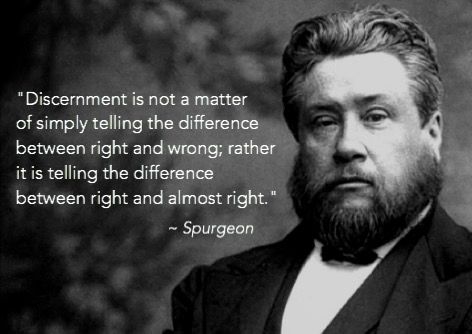
  • A quote which has impacted me immensely is this one by late preacher, Charles Spurgeon:

    “Discernment is not knowing the difference between right and wrong. It is knowing the difference between right and almost right.”

    So very often we make the mistake of interpreting rightness and wrongness solely through the lens of emotion. If something feels right than it must be good…Or if it hurts and causes hardship, it is interpreted as wrong. However, trusting God in and through every circumstance does not depend upon your feelings.

    For example, we might need to confess a wrongdoing to our souse, a coworker, or a friend…and that doesn’t necessarily feel good. But does that mean we are wrong to confess? What if you were in the emergency room receiving care for a critical injury? This situation certainly doesn’t feel ideal, but we would avoid receiving the care we need, correct? We all are so prone to follow what seems right in our own eyes (Pr 14:12) that we often forget that only God is God, and that we desperately need His help…in all areas of life. That is why God encourages us to study the scriptures diligently (He 1:1-3; 2 Ti 3:16-17).

    Friends, God’s plans are right and good. His right is the only right. It’s when we follow the “almost rights” that we witness, all-the-more, how much we need to depend on Jesus…not our opinions. But God’s redemptive work on the cross even covers the “almost rights” we commit (Prov 3 and 14).

    Today let’s rest in the reality that God came down to both save us and reconcile us. No matter how often we fail and miss the mark, God’s finished work on the cross was final…and His leading is faithful (Philippians 1:6; Romans 8).

  • 1 Corinthians 15

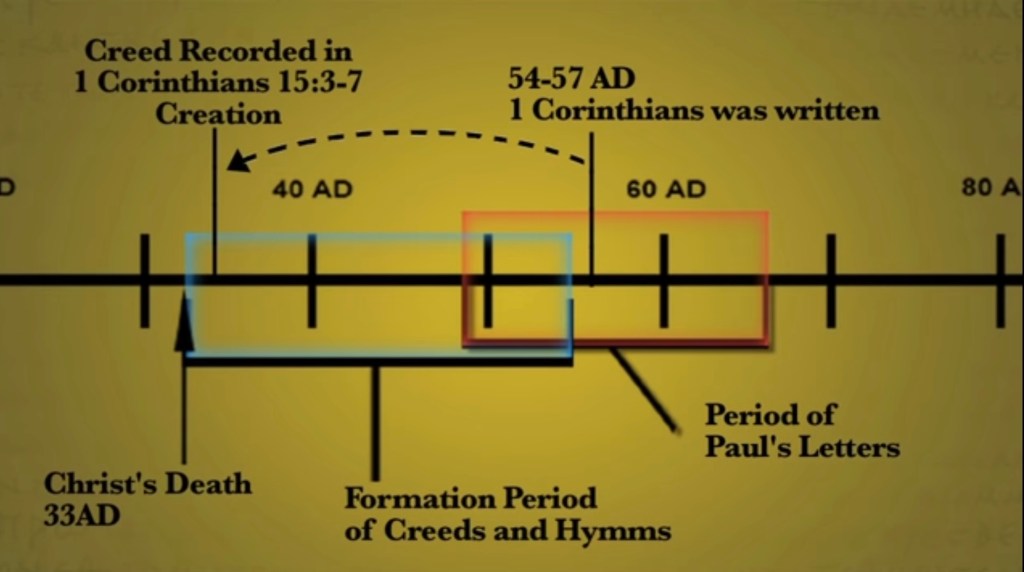
    Inspired by God, Paul penned this first letter to church sometime between AD 35-45. Within Paul’s letter are creeds (teachings made to memorize) which were spoken regularly by Christians within only months of the Resurrection.

    Graphic made by Inspiring Philosophy (IP)
    45 minutes with Gary Habermas
    60 minutes with Alisa and Krista regarding essential Christian Doctrine.

    1 Corinthians 15

    The Resurrection of Christ

    15 Now I would remind you, brothers,[a] of the gospel I preached to you, which you received, in which you stand,and by which you are being saved, if you hold fast to the word I preached to you—unless you believed in vain.

    For I delivered to you as of first importance what I also received: that Christ died for our sins in accordance with the Scripturesthat he was buried, that he was raised on the third day in accordance with the Scripturesand that he appeared to Cephas, then to the twelve. Then he appeared to more than five hundred brothers at one time, most of whom are still alive, though some have fallen asleep. Then he appeared to James, then to all the apostles. Last of all, as to one untimely born, he appeared also to me. For I am the least of the apostles, unworthy to be called an apostle, because I persecuted the church of God. 10 But by the grace of God I am what I am, and his grace toward me was not in vain. On the contrary, I worked harder than any of them, though it was not I, but the grace of God that is with me. 11 Whether then it was I or they, so we preach and so you believed.

    The Resurrection of the Dead

    12 Now if Christ is proclaimed as raised from the dead, how can some of you say that there is no resurrection of the dead? 13 But if there is no resurrection of the dead, then not even Christ has been raised. 14 And if Christ has not been raised, then our preaching is in vain and your faith is in vain. 15 We are even found to be misrepresenting God, because we testified about God that he raised Christ, whom he did not raise if it is true that the dead are not raised.16 For if the dead are not raised, not even Christ has been raised. 17 And if Christ has not been raised, your faith is futile and you are still in your sins. 18 Then those also who have fallen asleep in Christ have perished. 19 If in Christ we have hope[b] in this life only, we are of all people most to be pitied.

    20 But in fact Christ has been raised from the dead, the firstfruits of those who have fallen asleep. 21 For as by a man came death, by a man has come also the resurrection of the dead. 22 For as in Adam all die, so also in Christ shall all be made alive. 23 But each in his own order: Christ the firstfruits, then at his coming those who belong to Christ.24 Then comes the end, when he delivers the kingdom to God the Father after destroying every rule and every authority and power. 25 For he must reign until he has put all his enemies under his feet. 26 The last enemy to be destroyed is death. 27 For “God[c] has put all things in subjection under his feet.” But when it says, “all things are put in subjection,” it is plain that he is excepted who put all things in subjection under him. 28 When all things are subjected to him, then the Son himself will also be subjected to him who put all things in subjection under him, that God may be all in all.

    29 Otherwise, what do people mean by being baptized on behalf of the dead? If the dead are not raised at all, why are people baptized on their behalf? 30 Why are we in danger every hour? 31 I protest, brothers, by my pride in you, which I have in Christ Jesus our Lord, I die every day! 32 What do I gain if, humanly speaking, I fought with beasts at Ephesus? If the dead are not raised, “Let us eat and drink, for tomorrow we die.” 33 Do not be deceived: “Bad company ruins good morals.”[d] 34 Wake up from your drunken stupor, as is right, and do not go on sinning. For some have no knowledge of God. I say this to your shame.

    The Resurrection Body

    35 But someone will ask, “How are the dead raised? With what kind of body do they come?” 36 You foolish person! What you sow does not come to life unless it dies. 37 And what you sow is not the body that is to be, but a bare kernel, perhaps of wheat or of some other grain. 38 But God gives it a body as he has chosen, and to each kind of seed its own body. 39 For not all flesh is the same, but there is one kind for humans, another for animals, another for birds, and another for fish. 40 There are heavenly bodies and earthly bodies, but the glory of the heavenly is of one kind, and the glory of the earthly is of another. 41 There is one glory of the sun, and another glory of the moon, and another glory of the stars; for star differs from star in glory.

    42 So is it with the resurrection of the dead. What is sown is perishable; what is raised is imperishable. 43 It is sown in dishonor; it is raised in glory. It is sown in weakness; it is raised in power. 44 It is sown a natural body; it is raised a spiritual body. If there is a natural body, there is also a spiritual body. 45 Thus it is written, “The first man Adam became a living being”;[e] the last Adam became a life-giving spirit. 46 But it is not the spiritual that is first but the natural, and then the spiritual. 47 The first man was from the earth, a man of dust; the second man is from heaven.48 As was the man of dust, so also are those who are of the dust, and as is the man of heaven, so also are those who are of heaven. 49 Just as we have borne the image of the man of dust, we shall[f] also bear the image of the man of heaven.

    Mystery and Victory

    50 I tell you this, brothers: flesh and blood cannot inherit the kingdom of God, nor does the perishable inherit the imperishable. 51 Behold! I tell you a mystery. We shall not all sleep, but we shall all be changed, 52 in a moment, in the twinkling of an eye, at the last trumpet. For the trumpet will sound, and the dead will be raised imperishable, and we shall be changed. 53 For this perishable body must put on the imperishable, and this mortal body must put on immortality. 54 When the perishable puts on the imperishable, and the mortal puts on immortality, then shall come to pass the saying that is written:

    “Death is swallowed up in victory.”
    55 “O death, where is your victory?
        O death, where is your sting?”

    56 The sting of death is sin, and the power of sin is the law. 57 But thanks be to God, who gives us the victory through our Lord Jesus Christ.

    58 Therefore, my beloved brothers, be steadfast, immovable, always abounding in the work of the Lord, knowing that in the Lord your labor is not in vain.

    Who is Jesus?

    12 minutes with Nabeel Qureshi, Jesus and the Trinity
    6 minutes
    45 minutes with Mikel Del Rosario

    What is the Gospel?

    8 minutes with Jeff Durbin
    20 minutes with David Wood

    The Resurrection

    <4 minutes with Lee Strobel
    70 minutes w/ Dr Gary Habermas
    20 minutes with David Wood
  • “Then Laban and Bethuel replied, ‘This is the Lord’s doing. Our wishes are of no concern.’” Genesis 24:50

    When Abraham was advanced in years, after Sarah had died and was buried in Hebron, he sent a trusted worker to Abraham’s homeland to find a wife for Isaac. Genesis 24 documents how the faithfulness of God greatly encouraged Abraham’s servant (head of the Abraham’s household), as well as explains why Rebecca left her homeland with a stranger…to marry a man she had never met!

    When God leads, we should respond as Rebecca’s family had, “This is the Lord’s doing, our wishes are of no concern” (Ge 24:50). The will of God is always best, no matter if we understand the reasons in that moment. However, to follow God willingly and to trust His authority readily is not what the human heart desires, due to sin. This has been the case since Adam and Eve were deceived in the Garden. And yet today we find the culture magnifying the self-centered leanings of the heart more than ever, it seems.

    Everything we see on billboards, painted shop windows, or listed on Netflix conditions us to suppose that our desires matter more than God’s. Everything is customized to fit what we think we need, pointing us inward instead of to God. These days if someone doesn’t have the correct personality trait for a role at church or as a spouse, than look elsewhere for fulfillment! After all, the world says, “You do you,” and “Follow your heart!” Subjective compatibility and worldly comfort has usurped the importance of trusting God’s Word and sharing the Gospel.

    The most impactful moment of 2022 for me was looking up at a maple tree in our yard in the early fall and finally understanding, “This life is not about me at all.” It literally stopped me in my tracks. It most certainly felt counter-cultural, not to mention was contrary to what I was shown by the world for 49 years of life. To think that I don’t need to know my personality traits, nor to define who I am on social media was mind-blowing! Not to mention incredibly liberating!! All I cared about what was being His. Trusting God moment-by-moment was what I needed to do. Snd that was, and still is, more than enough.

    Our sin nature does not seek God leading, but nor does it make following God easy. We learn from Rebecca’s family that our feelings shouldn’t override God’s purposes ever. They can catch-up later. Friends, “The earth is the Lord’s, and everything in it, the world and everyone in it” (Ps 24:1). Who are we to think that we own the world and could lead better? So grateful for the mercy and faithfulness of God, who sent Himself as to take the punishment that we deserve. Only God could make a way back to Him. Let’s trust Him with everything!