
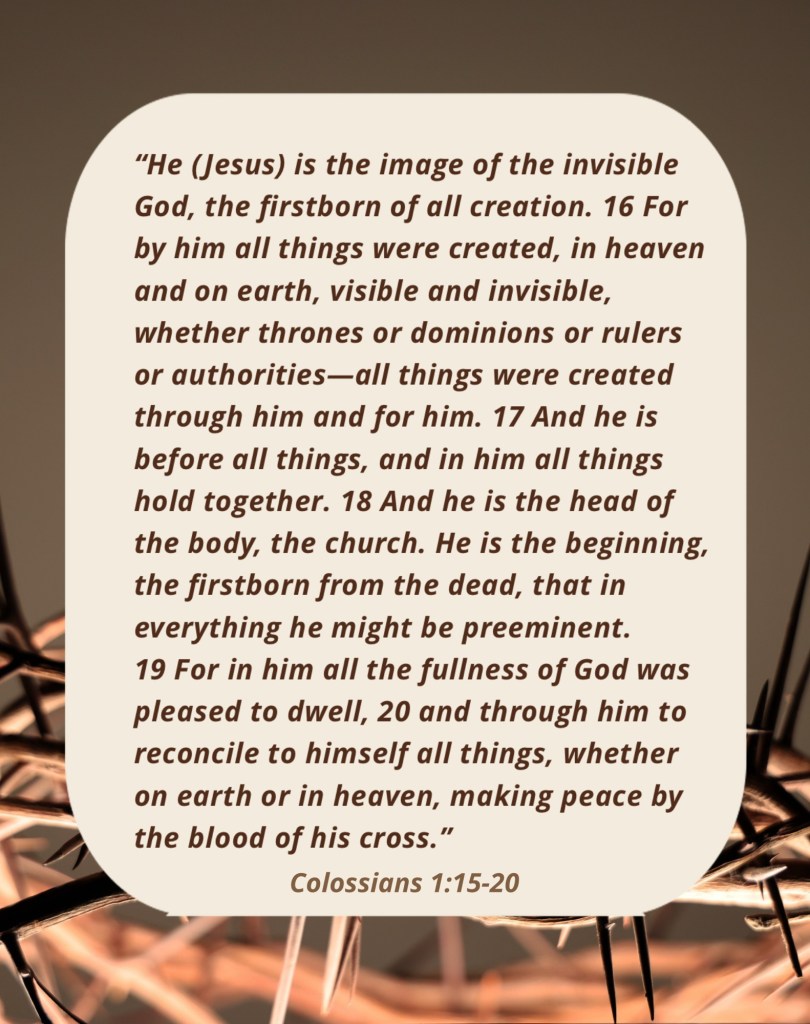
If we pick sentences and/or verses out of their context, ignoring the other verses surrounding them, we might read a meaning into those sentences which isn’t accurate (eisegesis) — instead of what the text is actually saying (exegesis). A prominent example of eisegesis is isolating “firstborn” in Colossians 1 from the rest of Paul’s letter.
D.A. Carson explained Paul’s usage of “firstborn” (within Colossians 1) in this way:
“The vast majority of commentators, whether conservative or liberal, recognize that in the Old Testament the firstborn, because of the laws of succession, normally received the lion’s share of the estate, or the firstborn would become king in the case of a royal family. The firstborn therefore was the one ultimately with all the rights of the father.
By the second century before Christ, there are places where the word no longer has any notion of actual begetting or of being born first but carries the idea of the authority that comes with the position of being the rightful heir. That’s the way it applies to Jesus, as virtually all scholars admit. In light of that, the very expression ‘firstborn’ is slightly misleading. I think supreme heir would be more appropriate.”
Carson continues…
“If you’re going to quote Colossians 1:15, you have to keep it in context by going on to Colossians 2:9, where the very same author stresses, ‘For in Christ all the fullness of the Deity lives in bodily form’? The author wouldn’t contradict himself. So the term firstborn cannot exclude Jesus’ eternality. since that is part of what it means to possess the fullness of the divine.” [1]
Dr. Robert Bowman, in his incredible tome The Incarnate Christ and His Critics: A Biblical Defense, advocates the following:
“According to the New Testament, then, Jesus Christ existed not only before his human life but also before creation, because all things were made through and for him. This means that the preincarnate Christ — whether we call him the Logos or the Son — was on the Creator side of the line between Creator and creation.” [2]
To summarize:
Jesus, having prexisted as God (same substance as the Father), put on a fully human nature. Therefore, He was the first, in His humanity, to fulfill God’s Law perfectly. He was the only sinless person able to pay humanity’s debt (upon the cross in AD 30 or 33). He is also the only one able, as God, to make a way back to God through His bodily resurrection (1 Cor 15).
The Creator of our skin, was willing to put on our skin. The Judge of our souls, was willing to be judged on our behalf. All for the sake of reconciling us back to Himself. Think upon these things.
- D.A. Carson, Lee Strobel’s The Case for Christmas; pp. 68-69.
- Robert M. Bowman and Ed Komoszewski, The Incarnate Christ and His Critics: A Biblical Defense; p. 267.
 Hold Fast Apologetics