

The question of whether the Enneagram is permissible due to its perception of helpfulness is a very common one! Its incredibly important that we acknowledge the emotional significance of this question for we all have grown-up with the postmodern mindset that “what seems helpful must be good and right (pragmatism).” And sadly, so many of us, Christians, are possibly confusing the idea of helpfulness with holiness.
We, as a society, have forgotten to slow down and think carefully about our decisions. And therefore, we follow at whim, the emotionally helpfulness of something. Let’s look at some examples which being to light the need to slowdown and reason better:
Firstly, we hopefully can all conclude that even though adulterous relationships in the context of marriage might seem helpful to those involved in the act, they are not lawful nor permissible. Nor are they considering others (their families). It’s not helpful for them.
The same goes with drinking too much alcohol to numb the pain of a physical injury or an emotional wound. You see, what seems to be helpful in the moment does not always equate to good and right. But can actually create more harm.
Let’s get back to the question at hand:
“But the Enneagram helps me grow in holiness. Plus, isn’t it permissible to utilize this tool?”
This is an earnest question. And one I certainly want to afresh gently and respectfully.
To preface, Friends, when you are able, refresh yourselves with the Galatians 2 account of when Paul lovingly corrected his brother in Christ, Peter. If Peter, a man who walked and talked with God in the flesh (Jesus), then we all will make mistakes and he corrected at various times in our lives.
So, how do we answer this?
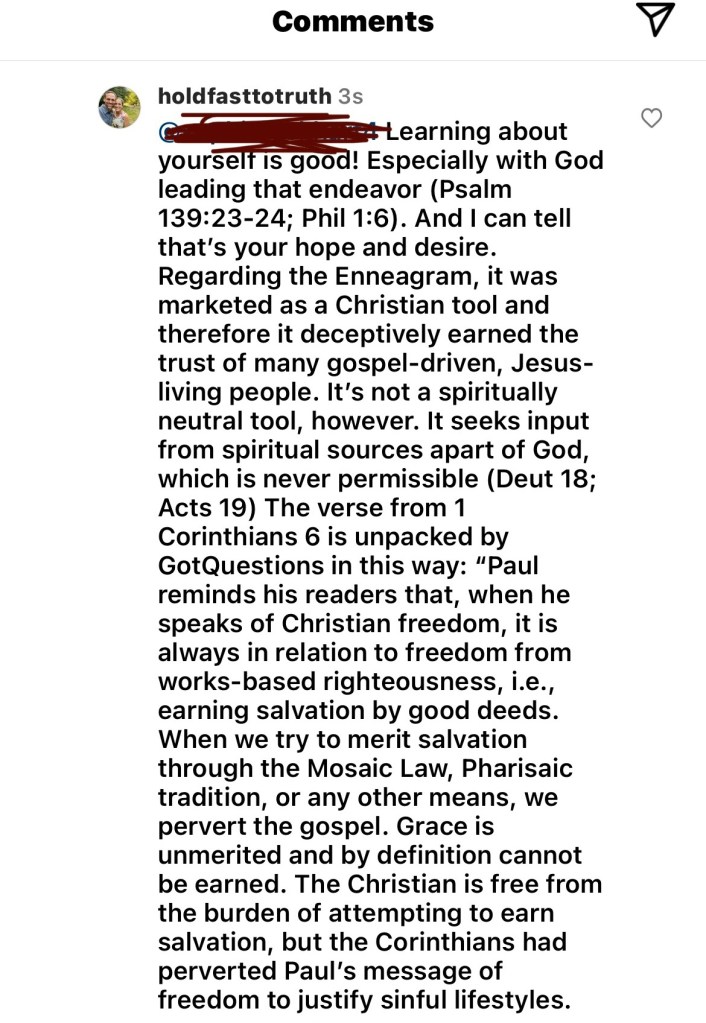
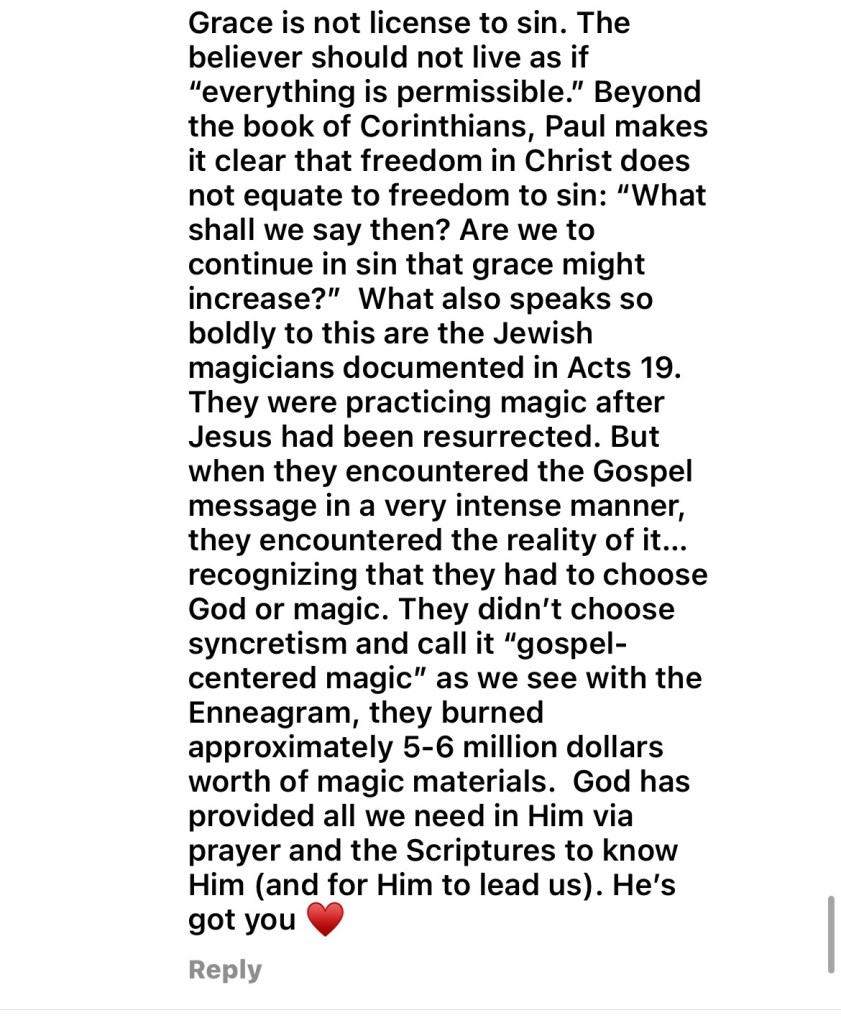
Below is was my response combined with the article I quoted from GotQuestions:
GotQuestions:
Question: “What does it mean that everything is permissible in 1 Corinthians 6:12 and 1 Corinthians 10:23?”
Answer: In 1 Corinthians 6:12, we read, “Everything is permissible for me” (CSB), a statement that, pulled from its context, would seem to cast off all restraint. Is everything permissible for the believer? Can we do anything we want? Here is the whole verse: “All things are lawful for me, but not all things are profitable. All things are lawful for me, but I will not be mastered by anything” (NASB). Paul repeats the idea in chapter 10, verse 23: “All things are lawful, but not all things are profitable. All things are lawful, but not all things edify” (NASB).
Freedom in Christ is a truth Paul constantly emphasizes. For example, Paul says, “Christ has truly set us free. Now make sure that you stay free, and don’t get tied up again in slavery to the law. . . . For you have been called to live in freedom, my brothers and sisters” (Galatians 5:1, 13, NLT). Paul states that believers “are not under the law, but under grace” (Romans 6:14) and “by grace you have been saved, through faith . . . not by works” (Ephesians 2:8–9; cf. Romans 3:20). Paul never tires of telling Christians that “we have been released from the law so that we serve in the new way of the Spirit, and not in the old way of the written code” (Romans 7:6).
Evidently, some in Corinth had distorted Paul’s message of liberty and moved toward an antinomian approach of living, which sees moral law being of no use and not binding because faith alone is necessary for salvation. Because of the textual construction in the Greek, many commentators believe the statement All things are lawful for mewas used by the Corinthians, and Paul is simply repeating back to them their own words. It was the Corinthians who were saying, “Everything is permissible for me,” repeating it as a mantra to cover their sinful behavior. In their minds, they probably even thought they were quoting Paul, who had taught them about Christian liberty. In his corrective letter to them, Paul’s intent was to counter that attitude. Some translations use punctuation to bring out that meaning, putting everything is permissible or its equivalent in quotation marks: “‘I have the right to do anything,’ you say—but not everything is beneficial. ‘I have the right to do anything’—but not everything is constructive” (1 Corinthians 10:23, NIV).
In both places where everything is permissible is found, Paul reminds his readers that, when he speaks of Christian freedom, it is always in relation to freedom from works-based righteousness, i.e., earning salvation by good deeds. When we try to merit salvation through the Mosaic Law, Pharisaic tradition, or any other means, we pervert the gospel. Grace is unmerited and by definition cannot be earned. The Christian is free from the burden of attempting to earn salvation, but the Corinthians had perverted Paul’s message of freedom to justify sinful lifestyles.
Grace is not license to sin. The believer should not live as if “everything is permissible.” Beyond the book of Corinthians, Paul makes it clear that freedom in Christ does not equate to freedom to sin: “What shall we say then? Are we to continue in sin that grace might increase? May it never be! How shall we who died to sin still live in it? . . . What then? Shall we sin because we are not under law but under grace? May it never be!” (Romans 6:1–2, 15, NASB); “For you were called to freedom, brethren; only do not turn your freedom into an opportunity for the flesh, but through love serve one another” (Galatians 5:13, NASB).
Chapters 6 and 10 in 1 Corinthians also emphasize a restraint of Christian freedom when it comes to other believers. Paul’s primary message on this subject for the Corinthians and all believers in all ages is summarized in 1 Corinthians 10:31: “Whatever you do, do all to the glory of God” (NASB).
Deuteronomy 18
18 “The Levitical priests, all the tribe of Levi, shall have no portion or inheritance with Israel. They shall eat the Lord’s food offerings as their inheritance. 2 They shall have no inheritance among their brothers; the Lord is their inheritance, as he promised them. 3 And this shall be the priests’ due from the people, from those offering a sacrifice, whether an ox or a sheep: they shall give to the priest the shoulder and the two cheeks and the stomach. 4 The firstfruits of your grain, of your wine and of your oil, and the first fleece of your sheep, you shall give him. 5 For the Lordyour God has chosen him out of all your tribes to stand and minister in the name of the Lord, him and his sons for all time.
6 “And if a Levite comes from any of your towns out of all Israel, where he lives—and he may come when he desires—to the place that the Lord will choose, 7 and ministers in the name of the Lord his God, like all his fellow Levites who stand to minister there before the Lord, 8 then he may have equal portions to eat, besides what he receives from the sale of his patrimony.Abominable Practices9 “When you come into the land that the Lordyour God is giving you, you shall not learn to follow the abominable practices of those nations. 10 There shall not be found among you anyone who burns his son or his daughter as an offering, anyone who practices divination or tells fortunes or interprets omens, or a sorcerer 11 or a charmer or a medium or a necromancer or one who inquires of the dead, 12 for whoever does these things is an abomination to the Lord. And because of these abominations the Lord your God is driving them out before you. 13 You shall be blameless before the Lord your God, 14 for these nations, which you are about to dispossess, listen to fortune-tellers and to diviners. But as for you, the Lord your God has not allowed you to do this.A New Prophet like Moses15 “The Lord your God will raise up for you a prophet like me from among you, from your brothers—it is to him you shall listen— 16 just as you desired of the Lord your God at Horeb on the day of the assembly, when you said, ‘Let me not hear again the voice of the Lordmy God or see this great fire any more, lest I die.’ 17 And the Lord said to me, ‘They are right in what they have spoken. 18 I will raise up for them a prophet like you from among their brothers. And I will put my words in his mouth, and he shall speak to them all that I command him. 19 And whoever will not listen to my words that he shall speak in my name, I myself will require it of him. 20 But the prophet who presumes to speak a word in my name that I have not commanded him to speak, orwho speaks in the name of other gods, that same prophet shall die.’ 21 And if you say in your heart, ‘How may we know the word that the Lord has not spoken?’— 22 when a prophet speaks in the name of the Lord, if the word does not come to pass or come true, that is a word that the Lord has not spoken; the prophet has spoken it presumptuously. You need not be afraid of him.
 Hold Fast Apologetics